PUBLISHER: Mordor Intelligence | PRODUCT CODE: 2122680

PUBLISHER: Mordor Intelligence | PRODUCT CODE: 2122680
Dry Shampoo - Market Share Analysis, Industry Trends & Statistics, Growth Forecasts (2026 - 2031)
According to Mordor Intelligence, the dry shampoo market size is expected to grow from USD 2.95 billion in 2025 to USD 3.17 billion in 2026 and is forecast to reach USD 4.44 billion by 2031 at a 6.96% CAGR over 2026-2031.
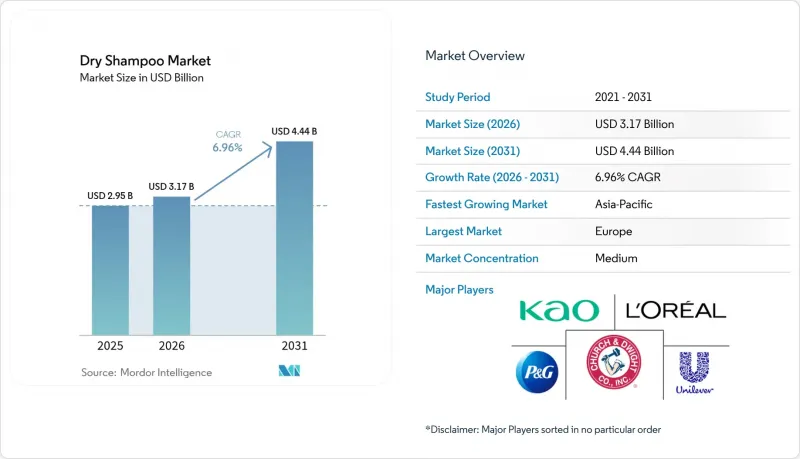
This report is Segmented by Product Type (Spray, Powder, and More), Nature (Conventional and Organic), Price Range (Mass and Premium), Distribution Channel (Supermarkets/Hypermarkets, Health and Beauty Stores, Online Retail Stores, and More), and Geography (North America, Europe, Asia-Pacific, South America, Middle East and Africa). Market Forecasts are Provided in Terms of Value (USD) and Volume (Tons).
Global Dry Shampoo Market Trends and Insights
Rising demand for convenient hair-care routines
Time-pressed professionals are turning to dry shampoos, achieving oil absorption in under 2 minutes, as a replacement for traditional wash cycles. This shift is especially evident among Gen Z consumers, the fastest-growing demographic in the U.S. haircare market, where products from the shampoo family dominate. The move is not just about convenience: dry shampoos facilitate multi-day styling, minimizing heat-tool use and water waste. This trend aligns with the "skinification" of haircare, emphasizing scalp health and hair vitality with a dermatological approach. Brands are innovating, introducing features like sweat-activated fragrances. For instance, Batiste's March 2024 Touch-Activated Dry Shampoo releases its scent during physical activity, elevating dry shampoo from a mere stopgap to an essential accessory for an active lifestyle. The U.S. Bureau of Labor Statistics forecasts a 33% growth in personal care services employment from 2020 to 2030, outpacing total employment growth by five times. This underscores a robust demand for products that can replicate salon results at home. Given the interplay of time constraints, a focus on scalp health, and the desire for at-home styling, dry shampoo emerges not just as a fleeting trend but as a significant growth category in the market.
Increasing adoption among female workforce
In OECD economies, female labor force participation rates have stabilized above 67.1% in 2024. This trend has led to a rise in dual-income households, where the efficiency of grooming routines plays a crucial role in managing discretionary time. As urban working women shift towards 3-to-4-day hair wash cycles, they increasingly rely on dry shampoos for non-wash days. This practice is not just a personal choice; it's backed by professional hairstylists who advocate for less frequent washing to maintain natural scalp oils and the integrity of color-treated hair. Interestingly, men are now entering the grooming services market at an accelerating pace. The Bureau of Labor Statistics (BLS) highlights a notable trend: men are adopting personal care routines that were once predominantly female. This shift suggests that the market for dry shampoos could broaden, reaching beyond its traditional female audience. Brands are taking note. They're rolling out fragrance-free and residue-free formulations to cater to this evolving demographic. For instance, Redken's Invisible Dry Shampoo, enriched with Vitamin E and tailored for dark hair, is positioned for 1-to-2-day refresh cycles. Such products are particularly appealing in professional settings, where a subtle touch is essential.
Aerosol propellant and talc-related health concerns
Formulators are abandoning legacy ingredients and delivery systems due to inhalation risks from aerosol delivery and talc contamination. This shift is compressing margins and extending the time-to-market for reformulated SKUs. In its 2024 opinion, the European Commission's Scientific Committee on Consumer Safety (SCCS) deemed titanium dioxide (TiO2) unsafe in hair aerosol sprays at the commonly used 25% concentration. They set maximum safe levels at 1.4% for consumers and 1.11% for professional hairdressers, citing inhalation risks of carcinogenicity. Concurrently, the U.S. FDA, responding to asbestos contamination findings, has ramped up talc testing. With MoCRA mandating standardized testing methods for cosmetic-grade talc, the FDA's 2024 withdrawal of a proposed rule for further reconsideration has left manufacturers in a regulatory quandary. Addressing these dual health concerns, brands like Briogeo introduced the Style + Treat Dry Shampoo Puff in December 2024. This product is both talc-free and aerosol-free, utilizing a powder-puff applicator while ensuring oil-absorption efficacy. The International Agency for Research on Cancer (IARC) has identified talc, TiO2, and carbon black as inhalation carcinogens. This classification poses a regulatory challenge, especially for aerosol-format dry shampoos, pushing the market towards powder, paste, and lotion-to-powder alternatives.
Other drivers and restraints analyzed in the detailed report include:
- E-commerce channel expansion across emerging markets
- Sustainability push for waterless beauty product lines
- Counterfeit/low-quality products eroding brand trust
For complete list of drivers and restraints, kindly check the Table Of Contents.
Segment Analysis
In 2025, spray aerosols held 65.62% of the market, reflecting consumer preference for even product distribution. However, powder formats are projected to grow at a 7.80% CAGR through 2031, driven by health and environmental concerns. Searches for non-aerosol dry shampoos rose 37.3% year-over-year, with tools like powder puffs and brushes gaining traction for portability and reduced inhalation risks. In January 2025, Kitsch launched a Pump-Powder Dry Shampoo free of talc and aerosols, while Ceremonia introduced a Dry Shampoo with Arrowroot and natural starch alternatives. R+Co Bleu's Vapor Lotion to Powder Dry Shampoo combines cream precision with powder efficacy, addressing challenges of loose-powder formats. The "Other Product Type" segment, including foams and pastes, is niche but growing in salon channels where stylists prefer tactile control.
Regulatory changes are accelerating this shift. The SCCS capped titanium dioxide in aerosols at 1.4% for consumers and 1.11% for hairdressers due to carcinogenicity concerns. California and Northeast U.S. states enforce VOC limits below 10%, constraining propellant formulations. Procter & Gamble has patented low-VOC propellant blends to maintain spray performance while complying with regulations. Powder formats benefit from Green Seal GS-50 certification, which prohibits aerosols, caps VOCs at 2-5%, and bans PFAS and parabens, appealing to eco-conscious consumers. The format shift reflects segmentation: aerosols dominate mass retail and travel for convenience, while powders capture premium and clean-beauty niches where ingredient transparency commands higher prices.
In 2025, conventional dry shampoos held 76.74% market share, driven by brands like Batiste, TRESemme, and Pantene leveraging synthetic fragrances, silicone-based agents, and petroleum-derived propellants. However, organic dry shampoos are projected to grow at 8.13% CAGR through 2031, fueled by clean-beauty certifications and ingredient transparency. ECOCERT's COSMOS Organic standard mandates 99% natural-origin ingredients, 95% organic plant ingredients, and 20% organic product weight for leave-on cosmetics (10% for rinse-off), banning synthetic fragrances, parabens, and most silicones. EWG Verified certification prohibits aerosols, requires full fragrance disclosure, and mandates allergenicity testing, creating high compliance barriers for clean-beauty brands.
Consumer skepticism about premium efficacy drives organic growth, as many doubt premium products outperform mass alternatives. To justify price premiums, organic brands emphasize benefits like scalp health, reduced buildup, and allergen avoidance. Ceremonia's arrowroot-based dry shampoo targets Latinx consumers with plant-derived formulations, while K18, acquired by Unilever in Q1 2024, offers a biotech peptide platform that neutralizes odors. Thailand's "T-Beauty" movement, focusing on botanical ingredients and clean-label claims, positions the country as a manufacturing hub for organic dry shampoos targeting ASEAN and Middle Eastern markets, where halal certification aligns with cultural preferences. Conventional formulations will dominate the mass market due to affordability, but organic variants are carving a premium niche with 30-50% price premiums justified by ingredient provenance and certification rigor.
Complete Report Scope:
- Product Type
- Spray
- Powder
- Other Product Type
- Nature
- Conventional
- Organic
- Price Range
- Mass
- Premium
- Distribution Channel
- Supermarkets/Hypermarkets
- Convenience Stores
- Health and Beauty Stores
- Online Retail Stores
- Other Distribution Channels
- Geography
- North America
- United States
- Canada
- Mexico
- Rest of North America
- Europe
- United Kingdom
- Germany
- France
- Italy
- Spain
- Sweden
- Belgium
- Poland
- Netherlands
- Rest of Europe
- Asia-Pacific
- China
- Japan
- India
- Thailand
- Singapore
- South Korea
- Australia
- New Zealand
- Rest of Asia Pacific
- South America
- Brazil
- Argentina
- Rest of South America
- Middle East and Africa
- United Arab Emirates
- Saudi Arabia
- Qatar
- Turkey
- South Africa
- Nigeria
- Egypt
- Turkey
- Rest of Middle East and Africa
- North America
Geography Analysis
Europe accounted for 35.43% of the dry shampoo market share in 2025, driven by well-established grooming habits and strict recycling regulations that encourage the use of eco-friendly packaging. The European Union has implemented rules that promote the adoption of low-Volatile Organic Compounds (VOC) sprays and recyclable materials like aluminum cans, making these products more attractive to environmentally conscious consumers. Premium organic dry shampoos are becoming increasingly popular, as consumers in the region are willing to spend more on products that are both effective and sustainable. Retailers are dedicating more shelf space to these high-end options, reflecting the growing demand for eco-friendly and health-focused products in Europe.
The Asia-Pacific region is expected to grow at a CAGR of 7.88% through 2031, driven by rising disposable incomes, urbanization, and water scarcity issues in countries like India, China, and Southeast Asia. These challenges are encouraging the adoption of water-saving personal care products, including dry shampoos. In India, local brands are leveraging Ayurvedic formulations to attract consumers, while Korean companies are introducing innovative scalp-soothing powders designed for humid climates. The growing awareness of hygiene and convenience among urban populations is further boosting the demand for dry shampoos in this region, making it a key area for market growth. The increasing influence of social media and online platforms is helping to raise awareness about these products.
North America is experiencing steady growth in the dry shampoo market, supported by busy lifestyles and a strong salon culture that promotes the use of dry shampoos as part of hairstyling routines. Retailers are focusing on expanding their offerings of talc-free and clean-label products to cater to the growing demand for healthier and safer options. Meanwhile, South America and the Middle East and Africa are emerging as potential markets, with demand increasing due to the expansion of e-commerce platforms. These digital channels are improving product accessibility, while localized manufacturing efforts are helping to reduce costs, making dry shampoos more affordable for consumers in these regions.
- Church & Dwight Co., Inc.
- Unilever PLC
- L'Oreal S.A.
- Procter & Gamble Company
- Henkel AG & Co. KGaA
- Kao Corporation
- Shiseido Company, Limited
- Coty Inc.
- Revlon, Inc.
- Johnson & Johnson Services Inc.
- Estee Lauder Companies Inc.
- LVMH Moet Hennessy Louis Vuitton SE
- Colgate-Palmolive Company
- The Honest Company, Inc.
- Oriflame Holding AG
- NatureLab Co., Ltd.
- Moroccanoil Israel Ltd.
- Lush Limited
- Sephora USA, Inc.
- Mandom Corporation
Additional Benefits:
- The market estimate (ME) sheet in Excel format
- 3 months of analyst support
TABLE OF CONTENTS
1 INTRODUCTION
- 1.1 Study Assumptions and Market Definition
- 1.2 Scope of the Study
2 RESEARCH METHODOLOGY
3 EXECUTIVE SUMMARY
4 MARKET LANDSCAPE
- 4.1 Market Overview
- 4.2 Market Drivers
- 4.2.1 Rising demand for convenient hair-care routines
- 4.2.2 Increasing adoption among female workforce
- 4.2.3 E-commerce channel expansion across emerging markets
- 4.2.4 Travel-size SKUs boosting impulse buys in airports and inflight retail
- 4.2.5 Salon-led colour-preservation regimens between visits
- 4.2.6 Sustainability push for "waterless beauty" product lines
- 4.3 Market Restraints
- 4.3.1 Aerosol propellant and talc-related health concerns
- 4.3.2 Counterfeit/low-quality products eroding brand trust
- 4.3.3 Starch-based feedstock price volatility in supply chain
- 4.3.4 VOC-emission caps limiting aerosol formulation in select US states
- 4.4 Consumer Behaviour Analysis
- 4.5 Regulatory Landscape
- 4.6 Technological Outlook
- 4.7 Porter's Five Forces
- 4.7.1 Threat of New Entrants
- 4.7.2 Bargaining Power of Buyers
- 4.7.3 Bargaining Power of Suppliers
- 4.7.4 Threat of Substitutes
- 4.7.5 Intensity of Competitive Rivalry
5 MARKET SIZE AND GROWTH FORECASTS (VALUE AND VOLUME)
- 5.1 Product Type
- 5.1.1 Spray
- 5.1.2 Powder
- 5.1.3 Other Product Type
- 5.2 Nature
- 5.2.1 Conventional
- 5.2.2 Organic
- 5.3 Price Range
- 5.3.1 Mass
- 5.3.2 Premium
- 5.4 Distribution Channel
- 5.4.1 Supermarkets/Hypermarkets
- 5.4.2 Convenience Stores
- 5.4.3 Health and Beauty Stores
- 5.4.4 Online Retail Stores
- 5.4.5 Other Distribution Channels
- 5.5 Geography
- 5.5.1 North America
- 5.5.1.1 United States
- 5.5.1.2 Canada
- 5.5.1.3 Mexico
- 5.5.1.4 Rest of North America
- 5.5.2 Europe
- 5.5.2.1 United Kingdom
- 5.5.2.2 Germany
- 5.5.2.3 France
- 5.5.2.4 Italy
- 5.5.2.5 Spain
- 5.5.2.6 Sweden
- 5.5.2.7 Belgium
- 5.5.2.8 Poland
- 5.5.2.9 Netherlands
- 5.5.2.10 Rest of Europe
- 5.5.3 Asia-Pacific
- 5.5.3.1 China
- 5.5.3.2 Japan
- 5.5.3.3 India
- 5.5.3.4 Thailand
- 5.5.3.5 Singapore
- 5.5.3.6 South Korea
- 5.5.3.7 Australia
- 5.5.3.8 New Zealand
- 5.5.3.9 Rest of Asia Pacific
- 5.5.4 South America
- 5.5.4.1 Brazil
- 5.5.4.2 Argentina
- 5.5.4.3 Rest of South America
- 5.5.5 Middle East and Africa
- 5.5.5.1 United Arab Emirates
- 5.5.5.2 Saudi Arabia
- 5.5.5.3 Qatar
- 5.5.5.4 Turkey
- 5.5.5.5 South Africa
- 5.5.5.6 Nigeria
- 5.5.5.7 Egypt
- 5.5.5.8 Turkey
- 5.5.5.9 Rest of Middle East and Africa
- 5.5.1 North America
6 COMPETITIVE LANDSCAPE
- 6.1 Market Concentration
- 6.2 Strategic Moves
- 6.3 Market Ranking Analysis
- 6.4 Company Profiles
- 6.4.1 Church & Dwight Co., Inc.
- 6.4.2 Unilever PLC
- 6.4.3 L'Oreal S.A.
- 6.4.4 Procter & Gamble Company
- 6.4.5 Henkel AG & Co. KGaA
- 6.4.6 Kao Corporation
- 6.4.7 Shiseido Company, Limited
- 6.4.8 Coty Inc.
- 6.4.9 Revlon, Inc.
- 6.4.10 Johnson & Johnson Services Inc.
- 6.4.11 Estee Lauder Companies Inc.
- 6.4.12 LVMH Moet Hennessy Louis Vuitton SE
- 6.4.13 Colgate-Palmolive Company
- 6.4.14 The Honest Company, Inc.
- 6.4.15 Oriflame Holding AG
- 6.4.16 NatureLab Co., Ltd.
- 6.4.17 Moroccanoil Israel Ltd.
- 6.4.18 Lush Limited
- 6.4.19 Sephora USA, Inc.
- 6.4.20 Mandom Corporation
7 MARKET OPPORTUNITIES AND FUTURE OUTLOOK

