PUBLISHER: Mordor Intelligence | PRODUCT CODE: 1939140

PUBLISHER: Mordor Intelligence | PRODUCT CODE: 1939140
Styrene Ethylene Butylene Styrene (SEBS) - Market Share Analysis, Industry Trends & Statistics, Growth Forecasts (2026 - 2031)
The Styrene Ethylene Butylene Styrene (SEBS) Market was valued at 328.19 kilotons in 2025 and estimated to grow from 344.69 kilotons in 2026 to reach 440.37 kilotons by 2031, at a CAGR of 5.03% during the forecast period (2026-2031).
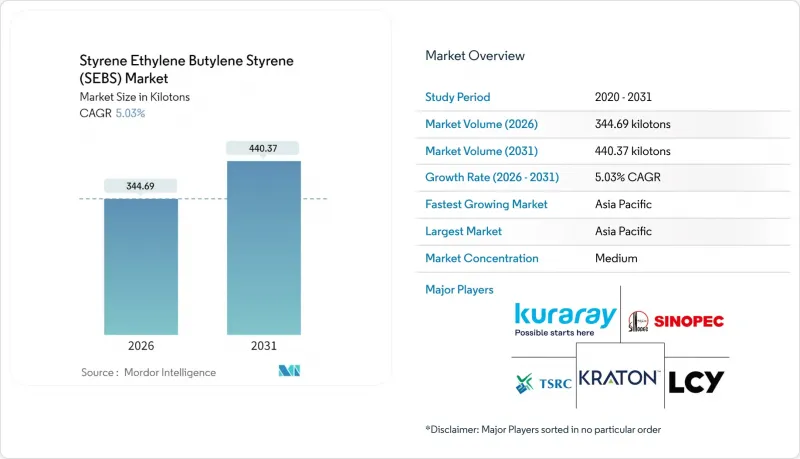
Robust demand in hot-melt adhesives, automotive sealing systems, and asphalt modification is expected to drive near-term volume gains. The Asia-Pacific region holds a decisive cost and demand advantage, aided by China's rapidly growing vehicle output and surging package-adhesive needs. Powder-form SEBS dominates asphalt and adhesive compounding because it meters cleanly in high-throughput mixers, while pellet grades defend quality-critical injection-molding niches. Regulatory drivers-most notably phthalate bans in medical devices and low-VOC rules in construction adhesives-reinforce substitution tailwinds. Competitive focus has shifted from capacity additions to functionalized and bio-attributed grades that meet automaker recyclability and brand-owner Scope 3 emission targets.
Global Styrene Ethylene Butylene Styrene (SEBS) Market Trends and Insights
Rapid Shift From Polyvinyl Chloride To Phthalate-Free SEBS Grades
California's AB 2300 prohibits di(2-ethylhexyl) phthalate in most medical devices from 2030, forcing tubing and bag makers toward plasticizer-free SEBS that matches PVC flexibility without migration risk. The European Chemicals Agency has synchronized phase-out dates, intensifying reformulation programs among global device OEMs. Validation protocols under ISO 10993 and U.S. FDA 510(k) requirements outline a multi-year qualification cycle; however, suppliers with medical-grade portfolios have already secured early-stage conversions. Price gaps versus PVC persist in single-use products, but total-cost parity is expected once commercial volumes reach scale by 2028. Accordingly, the driver adds a measurable uplift to mid-term growth as regulatory deadlines converge across major healthcare markets.
Surging Demand For Low-VOC Hot-Melt Adhesives In Asia-Pacific
China's adhesive output is expected to increase, driving SEBS consumption in carton sealing, footwear assembly, and prefabricated construction. Provincial air-quality mandates in the Yangtze and Pearl River Deltas restrict volatile organic compound emissions, incentivizing solvent-free SEBS blends. Brand owners now request bio-attributed content, prompting adhesive formulators to use mass-balance-certified liquid polybutadienes that pair efficiently with SEBS backbones. Superior heat resistance above 150°C enables SEBS hot melts to outperform polyolefin competitors on fast-moving production lines. These factors generate the largest positive impact on short-term demand.
Intensifying Price Volatility Of Isobutylene And Styrene Monomers
Feedstock-driven price swings compress producer margins. Spot styrene fluctuated between USD 800 and USD 1,400 per ton in 2024 as surplus Asian cracker capacity met slowing regional demand. Leading SEBS suppliers announced several price hikes totaling more than USD 300 per ton between 2022 and 2025 to offset higher raw-material costs. Producers without long-term monomer contracts experienced a quarter-on-quarter margin erosion of 200-300 basis points, which stressed short-term earnings and planning cycles.
Other drivers and restraints analyzed in the detailed report include:
- Lightweighting Imperatives In E-Mobility Components
- Post-Petrochemical Feedstock Integration Into Steam-Cracker Complexes
- Emergence Of Cost-Competitive TPU And Thermoplastic-Vulcanizate Blends
For complete list of drivers and restraints, kindly check the Table Of Contents.
Segment Analysis
Powder grades captured an 86.62% share of the styrene-ethylene-butylene-styrene market demand in 2025, expanding at a 5.29% CAGR, as asphalt and adhesive formulators favor free-flowing particles that meter accurately and reduce blend times. Pellet grades are also enhancing the value of injection molders, offering dust-free handling and homogeneous melt flow for interior trim parts. Suppliers have developed ultrafine powder variants with a D50 of less than 200 µm to improve dispersion, while pellets command a 5-8% price premium that buyers accept for tight-tolerance components. Consequently, powder continues to dominate high-volume, cost-sensitive segments, whereas pellets thrive in quality-critical niches.
The demand for powder in polymer-modified asphalt remains buoyant because a 3% SEBS dosage raises the softening point from 65°C to 85°C and boosts elastic recovery above 50%, thereby extending pavement life in hot climates. Pelletized specialty grades target automotive seals, smartphone over-molds, and soft-touch appliances, where dust contamination is unacceptable. Equipment investments by leading processors indicate that both forms retain strategic relevance, although powder drives the bulk of the styrene ethylene butylene styrene market volume through 2030.
The Styrene Ethylene Butylene Styrene (SEBS) Market Report is Segmented by Form (Pellets and Powder), End-User Industry (Footwear, Adhesives and Sealants, Plastics, Roads and Railways, Automotive, Sporting and Toys, Electrical and Electronics, and Other End-User Industries), and Geography (Asia-Pacific, North America, Europe, South America, and Middle-East and Africa). The Market Forecasts are Provided in Terms of Volume (Tons).
Geography Analysis
The Asia-Pacific region held a 56.61% market share in the styrene ethylene butylene styrene (SEBS) market in 2025 and is expected to advance at a 5.93% CAGR. China anchors regional leadership with 30.16 million vehicles produced in 2023, and adhesive output projected to reach 8.55 million tons by 2025. Domestic SEBS capacity additions, including 100 kt/y of new lines at Baling Petrochemical, safeguard supply, while India's large-scale infrastructure program and 1.74 million electric vehicle sales in 2024 catalyze additional demand. Southeast Asian trade pacts further streamline intra-regional flows.
North America accounts for roughly 20% of global volume. Reshoring initiatives and mass-balance certifications support moderate growth despite mature end-markets. Trinseo's exit from styrene monomer integration spotlights a broader industry pivot toward specialty compounding and recycled feedstocks. Europe accounts for approximately 17% of demand; REACH compliance and DEHP sunset extensions are accelerating SEBS substitution in the medical and consumer goods sectors. Large-scale investment plans by Versalis to shift away from commodity polyethylene signal a renewed commitment to higher-value SEBS compounds and circular economy solutions. South America and the Middle East & Africa contribute a combined 9% of demand. Infrastructure projects in Brazil and Saudi Arabia use SEBS in asphalt and adhesives, but currency volatility and import reliance temper growth. Collectively, Asia-Pacific remains the primary engine, while regulatory accelerators in North America and Europe ensure diversified regional progress.
- Asahi Kasei Corporation
- Celanese Corporation
- China Petrochemical Corporation
- Dynasol Group
- ENEOS Corporation
- Kraton Corporation
- KURARAY CO., LTD.
- LCY Group
- Ningbo Changhong Polymer Scientific and Technical Inc.
- Ravago
- RTP Company
- Sibur LLC
- Trinseo PLC
- TSRC
- Versalis SpA
Additional Benefits:
- The market estimate (ME) sheet in Excel format
- 3 months of analyst support
TABLE OF CONTENTS
1 Introduction
- 1.1 Study Assumptions & Market Definition
- 1.2 Scope of the Study
2 Research Methodology
3 Executive Summary
4 Market Landscape
- 4.1 Market Overview
- 4.2 Market Drivers
- 4.2.1 Rapid shift from Polyvinyl Chloride to phthalate-free SEBS grades
- 4.2.2 Surging demand for low-VOC hot-melt adhesives in Asia-Pacific
- 4.2.3 Lightweighting imperatives in e-Mobility components
- 4.2.4 Post-petrochemical feedstock integration into steam-cracker complexes
- 4.2.5 Commercialisation of bio-based SEBS via mass-balance routes
- 4.3 Market Restraints
- 4.3.1 Intensifying price volatility of isobutylene and styrene monomers
- 4.3.2 Emergence of cost-competitive Thermoplastic Polyurethane (TPU) and Thermoplastic Vulcanizate (TPV) blends in footwear
- 4.3.3 Carbon-border-tax risk for Asia-made SEBS into EU/US markets
- 4.4 Value Chain Analysis
- 4.5 Porter's Five Forces
- 4.5.1 Bargaining Power of Suppliers
- 4.5.2 Bargaining Power of Buyers
- 4.5.3 Threat of New Entrants
- 4.5.4 Threat of Substitutes
- 4.5.5 Degree of Competition
5 Market Size & Growth Forecasts (Volume)
- 5.1 By Form
- 5.1.1 Pellets
- 5.1.2 Powder
- 5.2 By End-User Industry
- 5.2.1 Footwear
- 5.2.2 Adhesives and Sealants
- 5.2.3 Plastics
- 5.2.4 Roads and Railways
- 5.2.5 Automotive
- 5.2.6 Sporting and Toys
- 5.2.7 Electrical and Electronics
- 5.2.8 Other End-User Industries
- 5.3 By Geography
- 5.3.1 Asia-Pacific
- 5.3.1.1 China
- 5.3.1.2 India
- 5.3.1.3 Japan
- 5.3.1.4 South Korea
- 5.3.1.5 ASEAN Countries
- 5.3.1.6 Rest of Asia-Pacific
- 5.3.2 North America
- 5.3.2.1 United States
- 5.3.2.2 Canada
- 5.3.2.3 Mexico
- 5.3.3 Europe
- 5.3.3.1 Germany
- 5.3.3.2 United Kingdom
- 5.3.3.3 France
- 5.3.3.4 Italy
- 5.3.3.5 Spain
- 5.3.3.6 Rest of Europe
- 5.3.4 South America
- 5.3.4.1 Brazil
- 5.3.4.2 Argentina
- 5.3.4.3 Rest of South America
- 5.3.5 Middle-East and Africa
- 5.3.5.1 Saudi Arabia
- 5.3.5.2 South Africa
- 5.3.5.3 Rest of Middle-East and Africa
- 5.3.1 Asia-Pacific
6 Competitive Landscape
- 6.1 Market Concentration
- 6.2 Strategic Moves
- 6.3 Market Share (%)/Ranking Analysis
- 6.4 Company Profiles (includes Global Overview, Market Overview, Core Segments, Financials, Strategic Information, Products & Services, Recent Developments)
- 6.4.1 Asahi Kasei Corporation
- 6.4.2 Celanese Corporation
- 6.4.3 China Petrochemical Corporation
- 6.4.4 Dynasol Group
- 6.4.5 ENEOS Corporation
- 6.4.6 Kraton Corporation
- 6.4.7 KURARAY CO., LTD.
- 6.4.8 LCY Group
- 6.4.9 Ningbo Changhong Polymer Scientific and Technical Inc.
- 6.4.10 Ravago
- 6.4.11 RTP Company
- 6.4.12 Sibur LLC
- 6.4.13 Trinseo PLC
- 6.4.14 TSRC
- 6.4.15 Versalis SpA
7 Market Opportunities and Future Outlook
- 7.1 White-space and Unmet-Need Assessment

