PUBLISHER: Mordor Intelligence | PRODUCT CODE: 1939152

PUBLISHER: Mordor Intelligence | PRODUCT CODE: 1939152
Thermal Spray - Market Share Analysis, Industry Trends & Statistics, Growth Forecasts (2026 - 2031)
The Thermal Spray market is expected to grow from USD 11.87 billion in 2025 to USD 12.36 billion in 2026 and is forecast to reach USD 15.15 billion by 2031 at 4.15% CAGR over 2026-2031.
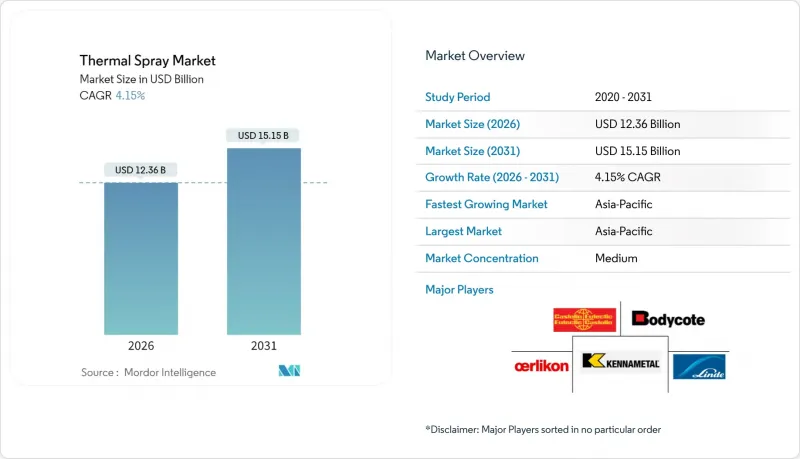
Demand is rising as aerospace, medical-device, and next-generation automotive manufacturers replace legacy surface treatments with high-performance coatings that extend part life and improve thermal management. Investments in automated equipment and real-time process monitoring continue to ease skilled-labor constraints, while the shift to electric energy spray techniques aligns with tightening environmental regulations. The Asia-Pacific manufacturing base is expanding rapidly, driving regional consumption of both coating materials and turnkey spray cells aimed at electronics and e-powertrain components.
Global Thermal Spray Market Trends and Insights
Increasing Use of Thermally-Sprayed Hydroxyapatite Coatings in Orthopedic and Dental Implants
Thermally-sprayed hydroxyapatite coatings significantly improve bone ingrowth and reduce rejection rates, making them the preferred surface finish for load-bearing orthopedic screws, hip stems, and dental fixtures. Process control enables tailored porosity that matches cancellous bone morphology, accelerating osseointegration and shortening rehabilitation periods. Regulatory acceptance under U.S. FDA class II devices and CE marking frameworks supports rapid adoption among global implant makers. Growing geriatric populations in the United States, Germany, and Japan keep procedural volumes expanding, sustaining raw-material demand for calcium-phosphate powders. Equipment suppliers now bundle closed-loop robots and inline thickness gauges that assure repeatability, addressing surgeon concerns regarding coating delamination. As hospitals track infection metrics more closely, the bioactive nature of hydroxyapatite surfaces provides an additional clinical advantage that keeps the thermal spray market on a steady upswing.
Replacement of Hard-Chrome Plating in Rotating Equipment and Hydraulic Rods
Tightening REACH and OSHA rules on hexavalent chromium have forced OEMs to seek alternatives, positioning high-velocity oxygen fuel (HVOF) coatings as the sustainable successor. HVOF layers routinely exceed 60 HRC hardness while slashing porosity below 1%, more than doubling component lifetimes for hydraulic shafts and compressor impellers. Reduced maintenance translates into lower down-time costs for process industries, bolstering the total cost-of-ownership argument in favor of thermal spray market adoption. Automated boom manipulators now apply HVOF inside hard-to-reach bores, extending the addressable part universe. Early conversion programs in North American oil-and-gas drill fleets demonstrated payback periods under 18 months, spurring wider replication in Asian foundries. As ESG auditors tighten supply-chain scorecards, the switch from chrome baths to solvent-free spray booths provides an immediate emissions win.
Emergence of Hard Trivalent Chrome Coatings with Lower CAPEX
Next-generation trivalent chrome baths provide 50 HRC hardness at investment levels one-third those of an entry-level HVOF cell, a value proposition that appeals to small hydraulic-rod refurbishers in cost-sensitive markets. Suppliers emphasize drop-in compatibility with existing fixtures, eliminating the need for new ventilation or dust-collection systems. Early field results confirm acceptable corrosion resistance for gear shafts operating below 200 °C, blunting near-term replacements by the thermal spray market in those niches. However, trivalent chrome struggles at higher thicknesses and cannot serve components exposed to combustion gases, which preserves the advantage for thermal barrier and wear-resistant overlays in aerospace as well as oil-and-gas pumps. The technology therefore acts as a selective restraint rather than a universal threat.
Other drivers and restraints analyzed in the detailed report include:
- Demand for High-Temperature Lightweight Alloys in Next-Gen Narrow-Body Aircraft Engines
- Automotive Shift Toward Hydrogen ICE and E-Powertrains Requiring Wear-Resistant Cylinder Coatings
- Process Repeatability and Skilled-Operator Shortage in Asia and Latin America Job-Shops
For complete list of drivers and restraints, kindly check the Table Of Contents.
Segment Analysis
The equipment category is projected to expand at a 6.06% CAGR through 2031, surpassing consumables in growth momentum even though coatings retained a 76.82% share of the overall thermal spray market in 2025. Automated cells equipped with six-axis robots and closed-loop mass-flow control reduce coat-to-coat variance below 2 µm, a requirement set by turbine OEMs aiming for zero unplanned downtime.
Recurring revenues from powders and wires remain pivotal, as every kilogram deposited creates a pull-through effect for replacement nozzles and plasma electrodes. Tungsten carbide-cobalt powders continue to dominate wear-protection formulas, but scarcity and price volatility have sparked process recipes that extend tip life or recycle overspray. Suppliers now promote modular feeder units that switch between fine and coarse fractions in under 10 minutes, enhancing shop flexibility. Noise-attenuating booths and cyclone-based dust collectors clock double-digit growth rates, an ancillary but lucrative niche aligned with factory-safety mandates in Germany and South Korea.
The Thermal Spray Report is Segmented by Product Type (Coatings, Materials, and Thermal-Spray Equipment), Thermal Spray Coatings and Finishes (Combustion and Electric Energy), End-User Industry (Aerospace, Industrial Gas Turbines, Automotive, Electronics, Oil and Gas, and More), and Geography (Asia-Pacific, North America, Europe, South America, and Middle-East and Africa). The Market Forecasts are Provided in Terms of Value (USD).
Geography Analysis
Asia-Pacific contributed 34.20% of the thermal spray market in 2025 and is forecast to climb at a 4.98% CAGR, reflecting aggressive onshoring of semiconductor fabs in China and advanced battery plants in Japan. Regional governments channel subsidies into smart-machinery imports, lowering payback barriers for automated spray booths. Still, the skilled-labor gap persists, pushing OEMs to partner with vocational institutes in India and Malaysia that offer operator certification under ISO 14924 standards.
North America and Europe are underpinned by legacy aerospace fleets and strict occupational safety guidelines favoring chrome-free overlays. The United States remains the largest single-country buyer of tungsten carbide powders, while Germany leads in plasma-torch exports. Both regions invest in research and development focused on hydrogen-compatible coatings.
South America and the Middle East and Africa trail in absolute revenues but post steady double-digit equipment orders linked to petrochemical plant upgrades and mining conveyor refurbishments. Each geography therefore plays to distinct end-market triggers, yet converges on a common trajectory of digitalized and environmentally compliant surface-engineering solutions within the global thermal spray market.
- Thermal Spray Coatings Companies
- Thermal Spray Equipment Companies
- Thermal Spray Materials Companies
Additional Benefits:
- The market estimate (ME) sheet in Excel format
- 3 months of analyst support
TABLE OF CONTENTS
1 Introduction
- 1.1 Study Assumptions and Market Definition
- 1.2 Scope of the Study
2 Research Methodology
3 Executive Summary
4 Market Landscape
- 4.1 Market Overview
- 4.2 Market Drivers
- 4.2.1 Increasing use of thermally-sprayed hydroxyapatite coatings in orthopedic and dental implants
- 4.2.2 Replacement of hard-chrome plating in rotating equipment and hydraulic rods
- 4.2.3 Demand for high-temperature lightweight alloys in next-gen narrow-body aircraft engines
- 4.2.4 Automotive shift toward hydrogen ICE and e-powertrains requiring wear-resistant cylinder coatings
- 4.2.5 Adoption of high-entropy alloy (HEA) coatings for extreme geothermal and space applications
- 4.3 Market Restraints
- 4.3.1 Emergence of hard trivalent chrome coatings with lower CAPEX
- 4.3.2 Process repeatability and skilled-operator shortage in Asia and LATAM job-shops
- 4.3.3 Volatile pricing and supply risk for critical feedstocks (WC-Co, rare-earth oxides)
- 4.4 Value Chain Analysis
- 4.5 Porter's Five Forces
- 4.5.1 Bargaining Power of Suppliers
- 4.5.2 Bargaining Power of Buyers
- 4.5.3 Threat of New Entrants
- 4.5.4 Threat of Substitute Products
- 4.5.5 Degree of Competition
5 Market Size and Growth Forecasts (Value)
- 5.1 By Product Type
- 5.1.1 Coatings
- 5.1.2 Materials
- 5.1.2.1 Coating Materials
- 5.1.2.1.1 Powders
- 5.1.2.1.1.1 Ceramics
- 5.1.2.1.1.2 Metals
- 5.1.2.1.1.3 Polymers and Other Powders
- 5.1.2.1.2 Wires/Rods
- 5.1.2.1.3 Other Coating Materials
- 5.1.2.1.1 Powders
- 5.1.2.2 Supplementary Materials (Auxiliary Material)
- 5.1.2.1 Coating Materials
- 5.1.3 Thermal-Spray Equipment
- 5.1.3.1 Thermal Spray Coating Systems
- 5.1.3.2 Dust Collection Equipment
- 5.1.3.3 Spray Guns and Nozzles
- 5.1.3.4 Feeder Equipment
- 5.1.3.5 Spare Parts
- 5.1.3.6 Noise-reducing Enclosures
- 5.1.3.7 Other Thermal Spray Equipment
- 5.2 By Thermal Spray Coatings and Finishes
- 5.2.1 Combustion
- 5.2.2 Electric Energy
- 5.3 By End-user Industry
- 5.3.1 Aerospace
- 5.3.2 Industrial Gas Turbines
- 5.3.3 Automotive
- 5.3.4 Electronics
- 5.3.5 Oil and Gas
- 5.3.6 Medical Devices
- 5.3.7 Energy and Power
- 5.3.8 Other End-user Industries
- 5.4 By Geography
- 5.4.1 Asia-Pacific
- 5.4.1.1 China
- 5.4.1.2 India
- 5.4.1.3 Japan
- 5.4.1.4 South Korea
- 5.4.1.5 Malaysia
- 5.4.1.6 Thailand
- 5.4.1.7 Indonesia
- 5.4.1.8 Vietnam
- 5.4.1.9 Rest of Asia-Pacific
- 5.4.2 North America
- 5.4.2.1 United States
- 5.4.2.2 Canada
- 5.4.2.3 Mexico
- 5.4.3 Europe
- 5.4.3.1 Germany
- 5.4.3.2 United Kingdom
- 5.4.3.3 France
- 5.4.3.4 Italy
- 5.4.3.5 Spain
- 5.4.3.6 NORDIC Countries
- 5.4.3.7 Turkey
- 5.4.3.8 Russia
- 5.4.3.9 Rest of Europe
- 5.4.4 South America
- 5.4.4.1 Brazil
- 5.4.4.2 Argentina
- 5.4.4.3 Colombia
- 5.4.4.4 Rest of South America
- 5.4.5 Middle-East and Africa
- 5.4.5.1 Saudi Arabia
- 5.4.5.2 Qatar
- 5.4.5.3 United Arab Emirates
- 5.4.5.4 Nigeria
- 5.4.5.5 Egypt
- 5.4.5.6 South Africa
- 5.4.5.7 Rest of Middle-East and Africa
- 5.4.1 Asia-Pacific
6 Competitive Landscape
- 6.1 Market Concentration
- 6.2 Strategic Moves
- 6.3 Market Share (%)/Ranking Analysis
- 6.4 Company Profiles (includes Global level Overview, Market level overview, Core Segments, Financials as available, Strategic Information, Market Rank/Share, Products and Services, Recent Developments)
- 6.4.1 Thermal Spray Coatings Companies
- 6.4.1.1 APS Materials, Inc.
- 6.4.1.2 ASB Industries Inc
- 6.4.1.3 BODYCOTE
- 6.4.1.4 CHROMALLOY GAS TURBINE LLC
- 6.4.1.5 Curtiss-Wright Corporation
- 6.4.1.6 Fisher Barton
- 6.4.1.7 FM Industries
- 6.4.1.8 Lincotek Trento S.p.A.
- 6.4.1.9 Linde PLC
- 6.4.1.10 OC Oerlikon Management AG
- 6.4.1.11 Thermion
- 6.4.1.12 TOCALO Co., Ltd.
- 6.4.2 Thermal Spray Equipment Companies
- 6.4.2.1 Aimtek, Inc.
- 6.4.2.2 Air Products and Chemicals, Inc.
- 6.4.2.3 Arzell, Inc.
- 6.4.2.4 Camfil
- 6.4.2.5 Castolin Eutectic
- 6.4.2.6 CenterLine (Windsor) Limited
- 6.4.2.7 Donaldson Company, Inc.
- 6.4.2.8 Flame Spray Technologies B.V.
- 6.4.2.9 GTV VerschleiBschutz GmbH
- 6.4.2.10 HAI Inc
- 6.4.2.11 Hannecard Roller Coatings, Inc. - ASB Industries
- 6.4.2.12 Imperial Systems, Inc.
- 6.4.2.13 Kennametal Inc
- 6.4.2.14 Lincoteck Equipment SPA
- 6.4.2.15 Linde PLC
- 6.4.2.16 Metalizing Equipment Co Pvt Ltd
- 6.4.2.17 Metallisation Limited
- 6.4.2.18 OC Oerlikon Management AG
- 6.4.2.19 Powder Feed Dynamics, Inc
- 6.4.2.20 Progressive Surface
- 6.4.2.21 Saint-Gobain
- 6.4.2.22 Surface Technology Services BV
- 6.4.2.23 Thermion
- 6.4.3 Thermal Spray Materials Companies
- 6.4.3.1 AIM MRO Holdings, LLC.
- 6.4.3.2 Aimtek, Inc.
- 6.4.3.3 AlSher APM, LLC
- 6.4.3.4 AMETEK, Inc.
- 6.4.3.5 C&M Technologies GmbH
- 6.4.3.6 Castolin Eutectic
- 6.4.3.7 CenterLine (Windsor) Limited
- 6.4.3.8 Elmet Technologies
- 6.4.3.9 Fisher Barton
- 6.4.3.10 Global Tungsten & Powders
- 6.4.3.11 HAI Inc
- 6.4.3.12 Hoganas AB
- 6.4.3.13 Hunter Chemical, LLC
- 6.4.3.14 Kennametal Inc
- 6.4.3.15 Linde PLC
- 6.4.3.16 LSN Diffusion Limited
- 6.4.3.17 Metallisation Limited
- 6.4.3.18 Metallizing Equipment Co. Pvt. Ltd
- 6.4.3.19 OC Oerlikon Management AG
- 6.4.3.20 Polymet
- 6.4.3.21 Powder Alloy Corporation
- 6.4.3.22 Saint -Gobain
- 6.4.3.23 Sandvik AB
- 6.4.3.24 Thermion
- 6.4.1 Thermal Spray Coatings Companies
7 Market Opportunities and Future Outlook
- 7.1 White-space and Unmet-Need Assessment

