PUBLISHER: Mordor Intelligence | PRODUCT CODE: 1939729

PUBLISHER: Mordor Intelligence | PRODUCT CODE: 1939729
Spa And Salon Software - Market Share Analysis, Industry Trends & Statistics, Growth Forecasts (2026 - 2031)
The spa and salon software market is expected to grow from USD 1.01 billion in 2025 to USD 1.12 billion in 2026 and is forecast to reach USD 1.86 billion by 2031 at 10.72% CAGR over 2026-2031.
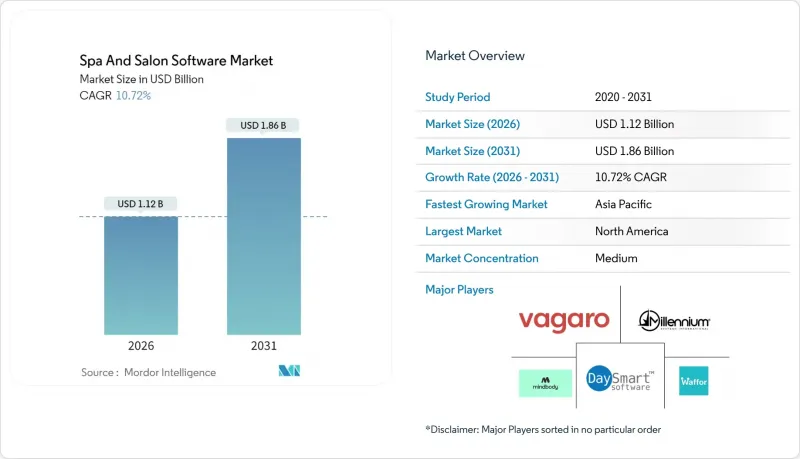
Momentum stems from post-pandemic wellness spending, the growing influence of Gen-Z and male clientele, and the shift from manual appointment books to cloud-based ecosystems that bundle scheduling, payments, inventory, and analytics. Widespread smartphone use is normalizing mobile bookings, while embedded finance tools are smoothing cash-flow for operators that were once heavily reliant on end-of-day card batches. Competitive intensity remains moderate; no single vendor holds a dominant position, yet scale advantages accrue to platforms that marry AI-driven personalization with low-friction onboarding. Regulatory fragmentation and IT-talent shortages temper adoption in pockets, but vendors that simplify compliance and provide turnkey support continue to outpace the broader spa and salon software market.
Global Spa And Salon Software Market Trends and Insights
AI-powered hyper-personalization of client journeys
Machine-learning engines now anticipate appointment timing, recommend add-on services, and populate stylist notes automatically, lifting average ticket sizes by up to 20% while halving no-shows for early adopters. Zenoti's Zeenie assistant delivers caller identification, bespoke service prompts, and real-time cross-sell offers that surface before staff pick up the phone, reshaping reception workflows. Fresha and other platforms are embedding computer-vision-based color-matching so stylists can store formula histories and mix ratios in a single tap, reducing waste and repeat-visit corrections. Chat-based virtual concierges, available around the clock, capture late-night impulse bookings that once went to competitors. As clients grow accustomed to Netflix-style relevance, AI personalization is moving from novelty to baseline expectation across the spa and salon software market.
Rising adoption of cloud-native SaaS by multi-location chains
Franchise operators increasingly view on-premise systems as technical debt. Cloud platforms push feature releases weekly, encrypt data at rest, and deliver unified dashboards that compare service mix, retail attachment, and labor margin across locations in real time. Chains that once maintained separate servers now log in from any device, shaving IT overhead and accelerating new-store rollouts. Rosy's merger with Aura centered on this premise, bundling zero-downtime updates with redundant backups housed in certified data centers. The sprint toward SaaS is especially intense in Asia Pacific, where operators can leapfrog legacy infrastructure and start with mobile-first workflows. Implementation still demands change-management rigor, yet pay-as-you-go pricing lowers capital barriers and supports experimentation.
High switching and implementation costs for legacy users
Historic databases contain thousands of client cards, color formulas, and prepaid balances that must map seamlessly into new schemas. Data migration fees, downtime risks, and staff retraining outlays can push total transition costs above initial software license expenses. Larger chains absorb the hit by amortizing over multiple sites, yet sole proprietors often postpone upgrades, creating a two-speed adoption curve. Vendors counter by offering white-glove migration and zero-interest financing, but inertia still slows the spa and salon software market in the near term.
Other drivers and restraints analyzed in the detailed report include:
- Marketplace integrations driving client acquisition and upsell
- Embedded finance and instant payouts improving cash-flow
- Fragmented regulatory data-privacy landscape
For complete list of drivers and restraints, kindly check the Table Of Contents.
Segment Analysis
Small and individual professionals controlled 51.42% of the spa and salon software market in 2025, reflecting the sector's historically fragmented owner-operator base. Medium enterprises, however, are scaling fastest with a 11.86% CAGR, and their demand for in-depth analytics and multi-site dashboards is redefining vendor roadmaps. In 2025, the spa and salon software market size for medium enterprises sits at USD 0.33 billion and is forecast to triple on the back of chain rollups and franchising momentum. Vendors cater to this cohort by automating staff utilization, centralized inventory, and role-based permissions, giving mid-tier groups an operational lift once reserved for enterprise brands.
Growth among large enterprises remains steady but muted, as the top tier already runs purpose-built suites and focuses on incremental optimization rather than net-new seat additions. Still, their feature requests-advanced AI, predictive staffing, patient-grade compliance-cascade downstream as vendors productize once-custom modules for broader sale. This trickle-down effect raises baseline expectations and nudges smaller operators toward subscription upgrades, sustaining underlying demand across the spa and salon software market.
Cloud captured 70.48% of spa and salon software market share in 2025 and is compounding at 12.34% annually to reach USD 1.43 billion by 2031, as bandwidth costs fall and browser-based interfaces outperform desktop predecessors. SaaS tools auto-scale during promotional spikes, push real-time security patches, and support mobile check-in-even if a front desk terminal fails-enhancing business resilience. For owners, pay-as-you-grow economics free capital once tied to servers and local maintenance contracts, accelerating store openings and franchise conversion timelines.
On-premise still holds niche appeal where spotty connectivity or sovereign data rules dictate local hosting, but its spa and salon software market size is expected to contract at 3.15% annually as cloud parity improves on customization and API extensibility. Hybrid deployments serve as interim states for enterprise chains migrating legacy data, but most roadmaps commit to full cloud within three years, reinforcing SaaS dominance.
The Spa and Salon Software Market Report is Segmented by Enterprise Size (Small and Individual Professionals, Medium Enterprises, and Large Enterprises), Deployment Model (Cloud, On-Premises, and Hybrid), End User (Beauty Salons, Day and Resort Spas, and Others), Functional Module (Appointment and CRM, POS and Payments, and Others), and Geography. The Market Forecasts are Provided in Terms of Value (USD).
Geography Analysis
North America contributed 38.86% of spa and salon software market revenue in 2025, buoyed by high credit-card penetration, robust cloud infrastructure, and consumers who book and pay by mobile without hesitation. United States operators pioneer AI features-voice bots, dynamic pricing-and push vendors to roll out compliance updates covering state-by-state privacy statutes. Canada functions as a live laboratory for cross-border taxation, bilingual UI, and chip-and-PIN workflows, offering early lessons for global rollouts.
Asia Pacific is the growth engine, advancing at an 11.73% CAGR through 2031 as smartphone ubiquity, e-wallet adoption, and government-backed SME digitization grants converge. India and China represent vast greenfield territory where first-time buyers often skip desktop software entirely, jumping straight to SaaS billing charged in local currency yet reconciled to USD via integrated gateways. In Australia and Japan, mature salon chains seek enterprise-grade APIs for custom mobile apps, driving higher average deal sizes. Despite linguistic fragmentation, regional operators view centralized dashboards as critical when assessing location profitability across metropolitan clusters.
Europe commands significant share and regulatory influence; GDPR shapes global engineering backlogs, and vendors unable to meet data-handling rules find scale doors closed. Southern Europe's tourism-fueled spa clusters push for multi-language, multi-currency tools, while Nordic salons pioneer gender-neutral service pricing that rewires catalog setups. South America and the Middle East and Africa trail in absolute spending yet post above-average growth. Currency volatility in Brazil favors SaaS pricing indexed to USD, while Gulf-state wellness resorts demand high-end integrations linking room-management systems to spa modules. Collectively, these regional nuances compel vendors to balance codebase standardization with local adaptation, sustaining competitive diversity in the global spa and salon software market.
- Mindbody, Inc.
- Soham Inc. (Zenoti)
- Vagaro, Inc.
- Fresha.com SV Ltd (Fresha / Shedul)
- DaySmart Software, LLC
- Ndevor Systems Ltd (Phorest)
- Millennium Systems International, LLC
- Boulevard Labs Inc.
- Mangomint, Inc.
- GlossGenius, Inc.
- Booksy, Inc.
- Block, Inc. (Square Appointments)
- Lasyk Networks, Inc. (SimpleSpa)
- Salonist Private Limited
- Waffor Retail Solutions Private Limited (BeuApp)
- SalonRunner Software LLC (Rosy Salon Software)
- Millennium Systems International, LLC (Meevo)
- Symplr Software LLC
Additional Benefits:
- The market estimate (ME) sheet in Excel format
- 3 months of analyst support
TABLE OF CONTENTS
1 INTRODUCTION
- 1.1 Study Assumptions and Market Definition
- 1.2 Scope of the Study
2 RESEARCH METHODOLOGY
3 EXECUTIVE SUMMARY
4 MARKET LANDSCAPE
- 4.1 Market Overview
- 4.2 Market Drivers
- 4.2.1 AI-powered hyper-personalisation of client journeys
- 4.2.2 Rising adoption of cloud-native SaaS by multi-location chains
- 4.2.3 Marketplace integrations driving client acquisition and upsell
- 4.2.4 Embedded finance and instant payouts improving cash-flow
- 4.2.5 Expansion of membership-based revenue models
- 4.2.6 Post-COVID wellness surge among Gen-Z and men
- 4.3 Market Restraints
- 4.3.1 High switching and implementation costs for legacy users
- 4.3.2 Fragmented regulatory data-privacy landscape
- 4.3.3 Talent shortage in IT support for SMBs
- 4.3.4 Growing threat of horizontal POS/booking platforms
- 4.4 Technological Outlook
- 4.5 Regulatory Landscape
- 4.6 Porter's Five Forces Analysis
- 4.6.1 Bargaining Power of Suppliers
- 4.6.2 Bargaining Power of Buyers
- 4.6.3 Threat of New Entrants
- 4.6.4 Threat of Substitutes
- 4.6.5 Intensity of Competitive Rivalry
5 MARKET SIZE AND GROWTH FORECASTS (VALUE)
- 5.1 By Enterprise Size
- 5.1.1 Small and Individual Professionals
- 5.1.2 Medium Enterprises
- 5.1.3 Large Enterprises
- 5.2 By Deployment Model
- 5.2.1 Cloud
- 5.2.2 On-Premises
- 5.2.3 Hybrid
- 5.3 By End User
- 5.3.1 Beauty Salons
- 5.3.2 Day and Resort Spas
- 5.3.3 Medical Spas
- 5.3.4 Barbershops and Grooming Studios
- 5.3.5 Nail and Lash Studios
- 5.3.6 Other End Users
- 5.4 By Functional Module
- 5.4.1 Appointment and CRM
- 5.4.2 POS and Payments
- 5.4.3 Inventory and Supply-Chain
- 5.4.4 Staff and Resource Management
- 5.4.5 Business Intelligence and Reporting
- 5.5 By Geography
- 5.5.1 North America
- 5.5.1.1 United States
- 5.5.1.2 Canada
- 5.5.2 South America
- 5.5.2.1 Brazil
- 5.5.2.2 Argentina
- 5.5.2.3 Rest of South America
- 5.5.3 Europe
- 5.5.3.1 Germany
- 5.5.3.2 France
- 5.5.3.3 United Kingdom
- 5.5.3.4 Rest of Europe
- 5.5.4 Asia Pacific
- 5.5.4.1 China
- 5.5.4.2 India
- 5.5.4.3 Japan
- 5.5.4.4 Australia
- 5.5.4.5 Rest of Asia Pacific
- 5.5.5 Middle East and Africa
- 5.5.5.1 Middle East
- 5.5.5.1.1 Saudi Arabia
- 5.5.5.1.2 United Arab Emirates
- 5.5.5.1.3 Turkey
- 5.5.5.1.4 Rest of Middle East
- 5.5.5.2 Africa
- 5.5.5.2.1 South Africa
- 5.5.5.2.2 Egypt
- 5.5.5.2.3 Nigeria
- 5.5.5.2.4 Rest of Africa
- 5.5.5.1 Middle East
- 5.5.1 North America
6 COMPETITIVE LANDSCAPE
- 6.1 Market Concentration
- 6.2 Strategic Moves
- 6.3 Market Share Analysis
- 6.4 Company Profiles (includes Global level Overview, Market level overview, Core Segments, Financials as available, Strategic Information, Market Rank/Share for key companies, Products and Services, and Recent Developments)
- 6.4.1 Mindbody, Inc.
- 6.4.2 Soham Inc. (Zenoti)
- 6.4.3 Vagaro, Inc.
- 6.4.4 Fresha.com SV Ltd (Fresha / Shedul)
- 6.4.5 DaySmart Software, LLC
- 6.4.6 Ndevor Systems Ltd (Phorest)
- 6.4.7 Millennium Systems International, LLC
- 6.4.8 Boulevard Labs Inc.
- 6.4.9 Mangomint, Inc.
- 6.4.10 GlossGenius, Inc.
- 6.4.11 Booksy, Inc.
- 6.4.12 Block, Inc. (Square Appointments)
- 6.4.13 Lasyk Networks, Inc. (SimpleSpa)
- 6.4.14 Salonist Private Limited
- 6.4.15 Waffor Retail Solutions Private Limited (BeuApp)
- 6.4.16 SalonRunner Software LLC (Rosy Salon Software)
- 6.4.17 Millennium Systems International, LLC (Meevo)
- 6.4.18 Symplr Software LLC
7 MARKET OPPORTUNITIES AND FUTURE OUTLOOK
- 7.1 White-space and Unmet-need Assessment

