PUBLISHER: Mordor Intelligence | PRODUCT CODE: 1940559

PUBLISHER: Mordor Intelligence | PRODUCT CODE: 1940559
Serious Games - Market Share Analysis, Industry Trends & Statistics, Growth Forecasts (2026 - 2031)
The serious games market was valued at USD 17.64 billion in 2025 and estimated to grow from USD 20.59 billion in 2026 to reach USD 44.57 billion by 2031, at a CAGR of 16.71% during the forecast period (2026-2031).
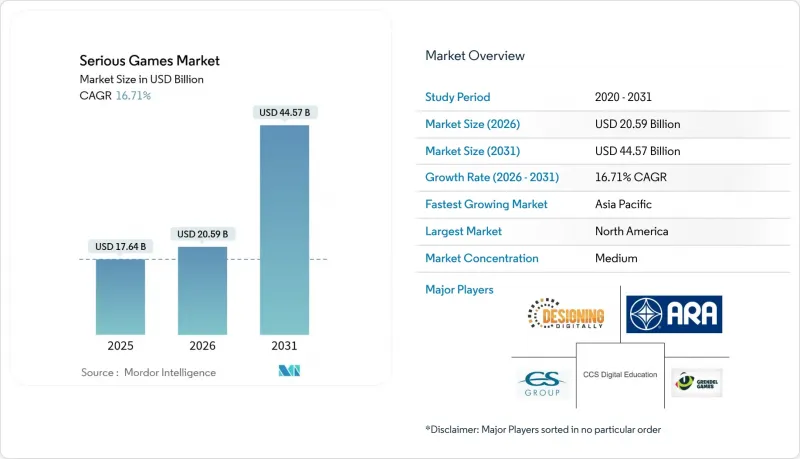
This steep trajectory reflects enterprise realization that gamified learning drives measurable performance gains while trimming operational expenses. Military demand underpins baseline revenues, exemplified by the United States Army's USD 921.1 million Synthetic Training Environment award and the Navy's USD 563 million simulation contract in 2024. Corporate buyers are following suit as aviation, nuclear, and pipeline regulators tighten training mandates, pushing organizations toward immersive compliance solutions. Hardware affordability is accelerating adoption; enterprise-grade VR headsets now cost less than USD 1,500, expanding access for small and medium enterprises. Investment momentum is equally strong, with Goldman Sachs funding Interplay Learning's September 2024 acquisition of Industrial Training International to scale VR trades curricula.
Global Serious Games Market Trends and Insights
Growing Adoption of Mobile Based Learning Platforms
Smartphone-first programs raise completion rates by 73% compared with desktop equivalents as employees favor on-demand microlearning.Enterprises are reallocating learning budgets toward mobile apps that reach frontline staff in retail, healthcare, and manufacturing. Fifth-generation networks now allow low-latency multiplayer simulations, supporting collaborative scenarios that formerly required on-premise labs. Cost dynamics are favorable because mobile initiatives avoid specialized hardware purchases and facility overhead. The trend positions the serious games market to penetrate emerging economies where mobile penetration outpaces PC ownership.
Increased Efficacy of Gamified Training in Corporate Learning and Development Programs
Independent ROI analyses show 244% returns from gamified courses that blend narrative progression with real-time feedback.Organizations shift classroom compliance programs into immersive modules that cut training time by 40% while boosting assessment scores. Firms operating under recertification cycles-aviation, pharmaceuticals, and finance-benefit most because periodic testing aligns with game-based refreshers. Analytics dashboards embedded in serious games supply granular skill data, enabling targeted coaching and credential tracking that spreadsheets cannot match. As executive teams link training metrics to productivity, spending on game-based content accelerates.
High Upfront Development Cost of Custom Serious Games
Tailored simulations cost USD 100,000 to USD 500,000 and require six-to-18-month build cycles, stretching learning budgets.Specialized teams spanning game design, instructional design, and 3D modeling drive expenses higher than off-the-shelf e-learning. Delayed payback discourages smaller firms that cannot absorb dual training costs while projects are underway. Low-code authoring tools are emerging, yet they still demand internal subject-matter expertise and content testing. Until modular templates reach greater sophistication, bespoke projects will restrain serious games market penetration among resource-constrained buyers.
Other drivers and restraints analyzed in the detailed report include:
- Rapid Expansion of VR and AR Hardware Accessibility
- AI Driven Adaptive Storylines Boosting Employee Engagement Metrics
- Limited Awareness Among SMEs
For complete list of drivers and restraints, kindly check the Table Of Contents.
Segment Analysis
Learning and Education applications accounted for 34.12% of serious games market share in 2025, setting the tone for enterprise purchasing. AI-driven Adaptive Learning Games are forecast to expand at 17.12% CAGR, reflecting appetite for personalized curricula that flex to employee proficiency. Simulation Training remains indispensable for high-risk domains such as aviation and surgery, reinforcing base revenues even as consumer-facing Advertising and Marketing campaigns generate episodic spikes.
Corporate universities increasingly embed serious games into certification pathways that mirror real-world tasks, supporting continuous professional development. The serious games market size for learning modules is expected to deepen as workforce reskilling demands mount in the face of automation. Meanwhile, therapeutic and rehabilitation sub-segments continue to secure clinical validation studies, positioning them for future regulatory approvals that could enlarge addressable revenues.
PC and Laptop platforms delivered 41.15% revenue in 2025, buoyed by entrenched IT ecosystems and compatibility with legacy learning management systems. Nevertheless, VR Head-Mounted Displays are projected for an 17.65% CAGR through 2031, shifting momentum toward immersive standalone devices. Mobile and Tablet platforms offer anytime access for geographically dispersed teams, enhancing adoption among service industries with minimal office footprints.
Cloud gaming infrastructures further democratize deployment by streaming high-fidelity content to low-spec devices, reducing compatibility headaches. Although console-based serious games remain small in enterprise settings, increased cross-platform engines may unlock incremental demand. Specialized form factors, including motion simulator rigs for aviation and heavy equipment, occupy niche but defensible positions where tactile realism is paramount.
The Serious Games Market Report is Segmented by Application (Advertising and Marketing, Simulation Training, and More), Platform (PC and Laptop, Mobile and Tablet, Game Consoles, and More), Technology (Virtual Reality, Augmented Reality, Mixed Reality, AI Driven Games, and More), End User Industry (Healthcare, Education, Media and Entertainment, and More), and Geography. The Market Forecasts are Provided in Terms of Value (USD).
Geography Analysis
North America accounted for 37.22% of global revenue in 2025 as defense budgets anchor baseline orders and federal regulators mandate simulation-based certification across aviation, medical devices, and pipelines. A dense concentration of corporate headquarters further amplifies enterprise spending, and venture capital flows fuel a robust startup pipeline.
Asia Pacific is projected to log a 16.99% CAGR through 2031, propelled by national digitization programs and expansive manufacturing footprints that require rapid worker upskilling. China's Industry 4.0 policies and Japan's knowledge-transfer imperatives intensify demand for immersive solutions that preserve tacit expertise. India's fast-growing IT and healthcare sectors favor subscription models that fit distributed footprints.
Europe presents mixed signals. Germany's games revenue fell 6% to EUR 9.4 billion (USD 10.1 billion) in 2024 amid economic headwinds.Yet national grant schemes worth EUR 50 million annually sustain developer pipelines for serious games. GDPR pushes vendors toward privacy-preserving analytics, driving differentiation but inflating compliance costs. The Middle East and Africa represent nascent opportunities, especially in oil, gas, and public-safety training, where simulation mitigates high-risk field scenarios without disrupting production.
- Designing Digitally Inc.
- CS Group - Diginext
- CCS Digital Education Ltd
- Applied Research Associates Inc.
- Grendel Games BV
- Unity Technologies
- MPS Interactive Systems Limited
- Can Studios Ltd
- L.I.B. Businessgames BV
- Tygron BV
- Triseum LLC
- Gamelearn S.L.
- BreakAway Games Corporation
- Kognito Solutions LLC
- Virtual Heroes Inc.
- Simul8 Corporation
- PlayGen Ltd
- Serious Games Solutions GmbH
- Criteria Corp (Revelian)
- Immersive VR Education
Additional Benefits:
- The market estimate (ME) sheet in Excel format
- 3 months of analyst support
TABLE OF CONTENTS
1 INTRODUCTION
- 1.1 Study Assumptions and Market Definition
- 1.2 Scope of the Study
2 RESEARCH METHODOLOGY
3 EXECUTIVE SUMMARY
4 MARKET LANDSCAPE
- 4.1 Market Overview
- 4.2 Market Drivers
- 4.2.1 Growing Adoption of Mobile Based Learning Platforms
- 4.2.2 Increased Efficacy of Gamified Training in Corporate L&D Programs
- 4.2.3 Demand for Simulation Based Compliance Training in High Risk Industries
- 4.2.4 Rapid Expansion of VR and AR Hardware Accessibility
- 4.2.5 Inclusion of Serious Games in National Defense Readiness Exercises
- 4.2.6 AI Driven Adaptive Storylines Boosting Employee Engagement Metrics
- 4.3 Market Restraints
- 4.3.1 Limited Awareness Among SMEs
- 4.3.2 High Upfront Development Cost of Custom Serious Games
- 4.3.3 Limited Standardization in Learning Outcome Measurement
- 4.3.4 Data Privacy Concerns in Biometric Enabled Immersive Simulations
- 4.4 Industry Value Chain Analysis
- 4.5 Regulatory Landscape
- 4.6 Technological Outlook
- 4.7 Impact of Macroeconomic Factors
- 4.8 Porter's Five Forces Analysis
- 4.8.1 Bargaining Power of Suppliers
- 4.8.2 Bargaining Power of Consumers
- 4.8.3 Threat of New Entrants
- 4.8.4 Intensity of Competitive Rivalry
- 4.8.5 Threat of Substitute Products
- 4.9 Investment Analysis
5 MARKET SIZE AND GROWTH FORECASTS (VALUE)
- 5.1 By Application
- 5.1.1 Advertising and Marketing
- 5.1.2 Simulation Training
- 5.1.3 Learning and Education
- 5.1.4 Other Applications
- 5.2 By Platform
- 5.2.1 PC and Laptop
- 5.2.2 Mobile and Tablet
- 5.2.3 Game Consoles
- 5.2.4 VR Head-Mounted Display
- 5.2.5 Cloud Gaming Platforms
- 5.2.6 Other Platforms
- 5.3 By Technology
- 5.3.1 Virtual Reality (VR)
- 5.3.2 Augmented Reality (AR)
- 5.3.3 Mixed Reality (MR)
- 5.3.4 Artificial Intelligence (AI) Driven Games
- 5.3.5 3D Graphics Engine Based Games
- 5.3.6 Other Technologies
- 5.4 By End User Industry
- 5.4.1 Healthcare
- 5.4.2 Education
- 5.4.3 Retail
- 5.4.4 Media and Entertainment
- 5.4.5 Automotive
- 5.4.6 Government
- 5.4.7 Other End User Industries
- 5.5 By Geography
- 5.5.1 North America
- 5.5.1.1 United States
- 5.5.1.2 Canada
- 5.5.1.3 Mexico
- 5.5.2 South America
- 5.5.2.1 Brazil
- 5.5.2.2 Argentina
- 5.5.2.3 Rest of South America
- 5.5.3 Europe
- 5.5.3.1 Germany
- 5.5.3.2 United Kingdom
- 5.5.3.3 France
- 5.5.3.4 Italy
- 5.5.3.5 Spain
- 5.5.3.6 Russia
- 5.5.3.7 Rest of Europe
- 5.5.4 Asia Pacific
- 5.5.4.1 China
- 5.5.4.2 Japan
- 5.5.4.3 India
- 5.5.4.4 South Korea
- 5.5.4.5 Australia and New Zealand
- 5.5.4.6 Rest of Asia Pacific
- 5.5.5 Middle East
- 5.5.5.1 Saudi Arabia
- 5.5.5.2 United Arab Emirates
- 5.5.5.3 Turkey
- 5.5.5.4 Rest of Middle East
- 5.5.6 Africa
- 5.5.6.1 South Africa
- 5.5.6.2 Nigeria
- 5.5.6.3 Kenya
- 5.5.6.4 Rest of Africa
- 5.5.1 North America
6 COMPETITIVE LANDSCAPE
- 6.1 Market Concentration
- 6.2 Strategic Moves
- 6.3 Market Share Analysis
- 6.4 Company Profiles (includes Global level Overview, Market level overview, Core Segments, Financials as available, Strategic Information, Market Rank/Share for key companies, Products and Services, and Recent Developments)
- 6.4.1 Designing Digitally Inc.
- 6.4.2 CS Group - Diginext
- 6.4.3 CCS Digital Education Ltd
- 6.4.4 Applied Research Associates Inc.
- 6.4.5 Grendel Games BV
- 6.4.6 Unity Technologies
- 6.4.7 MPS Interactive Systems Limited
- 6.4.8 Can Studios Ltd
- 6.4.9 L.I.B. Businessgames BV
- 6.4.10 Tygron BV
- 6.4.11 Triseum LLC
- 6.4.12 Gamelearn S.L.
- 6.4.13 BreakAway Games Corporation
- 6.4.14 Kognito Solutions LLC
- 6.4.15 Virtual Heroes Inc.
- 6.4.16 Simul8 Corporation
- 6.4.17 PlayGen Ltd
- 6.4.18 Serious Games Solutions GmbH
- 6.4.19 Criteria Corp (Revelian)
- 6.4.20 Immersive VR Education
7 MARKET OPPORTUNITIES AND FUTURE OUTLOOK
- 7.1 White space and Unmet need Assessment

