PUBLISHER: Mordor Intelligence | PRODUCT CODE: 1940629

PUBLISHER: Mordor Intelligence | PRODUCT CODE: 1940629
United States (US) Plastic Caps And Closures - Market Share Analysis, Industry Trends & Statistics, Growth Forecasts (2026 - 2031)
The United States plastic caps and closures market was valued at USD 12.12 billion in 2025 and estimated to grow from USD 12.42 billion in 2026 to reach USD 14.05 billion by 2031, at a CAGR of 2.48% during the forecast period (2026-2031).
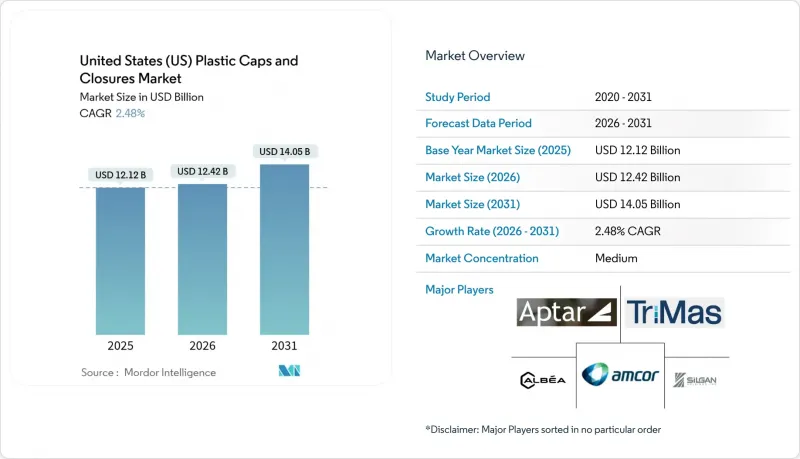
This measured pace reflects a mix of regulatory compliance costs, resin price swings, and surging demand from beverages, pharmaceuticals, and e-commerce packaging. Legislation on tethered caps, stricter child-resistant rules, and brand interest in NFC-enabled authentication are reshaping material choices and production methods. Polypropylene (PP) retains a dominant footprint due to its low cost and strong barrier performance, while polyethylene terephthalate (PET) is gaining share as brands pursue lightweighting and circularity objectives. Manufacturers that combine cost-efficient injection molding with premium smart-closure features are best positioned to capture emerging opportunities in the United States plastic caps and closures market.
United States (US) Plastic Caps And Closures Market Trends and Insights
Surge in Demand for Convenient Packaged Beverages
On-the-go consumption habits and functional hydration launches continue to pull volume through single-serve PET bottles fitted with easy-open, resealable tops. Beverage fillers increasingly specify closures compatible with sports caps and flip-top formats that support one-handed operation while complying with 21 CFR S211.132 tamper-evident rules. Brand owners are pairing NFC tags and QR codes on caps to drive post-purchase engagement and loyalty programs, turning closures into a digital media surface. As premium water, energy drinks, and ready-to-drink coffee command shelf space, closure makers gain opportunities to upsell oxygen-scavenging liners, integrated spouts, and color-matched finishes that reinforce brand identity. The United States plastic caps and closures market benefits from these requirements because value-added designs offset modest volume growth in carbonated soft drinks.
Expanding Pharmaceutical Packaging Requirements
An aging population and wider access to prescription therapies elevate demand for child-resistant, senior-friendly caps that pass Consumer Product Safety Commission torque and push-turn protocols. Hospitals and pharmacies rolling out automated dispensing cabinets also require highly consistent torque ranges and liner integrity to prevent dosage errors. Legal cannabis products-now regulated as controlled substances in 24 states-must meet poison-prevention packaging standards, spawning a premium niche for certified reclosable systems. Smart closures embedding micro-sensors or time-stamp features help track therapy adherence and flag potential misuse, giving specialty converters an entry point into health-tech partnerships.
Volatility in Resin Prices
Polyolefin feedstocks clustered along the Gulf Coast remain vulnerable to hurricanes and unplanned cracker outages that can lift spot PP and PE prices by 30-50% within weeks. Closure makers pass through surcharges with a lag, compressing margins and curbing investment in new tooling during spikes. Some converters hedge resin purchases via futures contracts, yet volatility still complicates long-term beverage supply agreements that favor fixed-price indexation. While new shale-gas crackers slated for 2026-2027 promise incremental capacity, the near-term risk profile encourages leaner inventories and multiple-sourcing strategies.
Other drivers and restraints analyzed in the detailed report include:
- Shift Toward Lightweight Plastic Over Metal Closures
- Growth of E-commerce Requiring Tamper-Evident Designs
- Competition from Sustainable Alternative Materials
For complete list of drivers and restraints, kindly check the Table Of Contents.
Segment Analysis
Polypropylene commands 41.12% share of the United States plastic caps and closures market, anchored by its chemical stability and suitability for high-speed injection molding lines. The segment is expected to post low-single-digit growth as beverage fillers standardize lightweight screw tops and household chemicals continue to favor PP flip caps for solvent resistance. PET, while only a mid-single-digit share contributor, is forecast as the fastest-growing at a 3.45% CAGR through 2031 thanks to its low density and compatibility with bottle-to-cap recycling streams, an advantage amplified by Origin Materials' novel thermoforming route that lowers cycle time and waste.
Moving beyond the top two, high-density polyethylene remains the material of choice for pharmaceutical vials that demand puncture resistance and child-safe torque ranges, whereas low-density polyethylene is preferred in dispensing nozzles for condiments and personal-care creams. Specialty bio-polymers, though under 2% share, gain traction where brand sustainability mandates override cost. Collectively, these dynamics widen the material toolbox available to converters and force resin suppliers to differentiate on circularity credentials, not just price.
Beverages accounted for 30.05% of the United States plastic caps and closures market size in 2025 due to vast bottled-water volumes and carbonated soft drink refills. Growth, however, moderates as carbonated segments mature, while functional beverages and sports drinks shift toward higher-margin sports caps. Pharmaceutical closures, in contrast, will grow 4.79% annually as prescription drug volumes climb and state cannabis markets add SKUs that mandate certified child-resistant or senior-friendly designs. Hospitals converting to unit-dose blister packs still rely on closure-sealed infusion bottles and oral suspensions, sustaining baseline demand even as some therapies migrate to pouches or pens.
Food products maintain a stable trajectory, helped by e-commerce adoption, which places a premium on tamper-evident and leak-proof attributes. Cosmetics and toiletries reach for premium overcaps, metallized finishes, and color harmony with brand palettes, making them a lucrative niche despite modest volumes. Household chemicals emphasize safety seals and dosing accuracy, reinforcing the importance of robust liner systems and torque control. Together, the mix underscores why successful suppliers tailor closure portfolios to multiple growth vectors instead of over-relying on beverage volumes.
The United States Plastic Caps and Closures Market Report is Segmented by Material (PET, PP, LDPE, and More), End-User Industry (Beverage, Food, Pharmaceutical and Healthcare, and More), Cap Type (Screw Closures, Tethered Caps, and More), and Manufacturing Technology (Injection Molding, Compression Molding, and More). The Market Forecasts are Provided in Terms of Value (USD).
List of Companies Covered in this Report:
- Silgan Holdings Inc.
- AptarGroup, Inc.
- Amcor plc
- Albea S.A.
- TriMas Corporation
- Tetra Pak International S.A.
- Guala Closures S.p.A.
- MJS Packaging, Inc.
- O. Berk Company, LLC
- Closure Systems International, Inc.
- BERICAP GmbH & Co. KG
- Crown Holdings, Inc.
- Evergreen Packaging LLC
- Phoenix Closures, Inc.
- Portola Packaging, Inc.
- Plastipak Packaging, Inc.
- Mold-Rite Plastics, LLC
- Smurfit WestRock
- SIG Combibloc Group AG
Additional Benefits:
- The market estimate (ME) sheet in Excel format
- 3 months of analyst support
TABLE OF CONTENTS
1 INTRODUCTION
- 1.1 Study Assumptions and Market Definition
- 1.2 Scope of the Study
2 RESEARCH METHODOLOGY
3 EXECUTIVE SUMMARY
4 MARKET LANDSCAPE
- 4.1 Market Overview
- 4.2 Market Drivers
- 4.2.1 Surge in demand for convenient packaged beverages
- 4.2.2 Expanding pharmaceutical packaging requirements
- 4.2.3 Shift toward lightweight plastic over metal closures
- 4.2.4 Growth of e-commerce requiring tamper-evident designs
- 4.2.5 Adoption of tethered cap legislation
- 4.2.6 Reshoring via high-speed compression-molding capacity
- 4.3 Market Restraints
- 4.3.1 Volatility in resin prices
- 4.3.2 Competition from sustainable alternative materials
- 4.3.3 Prospective federal single-use-plastic restrictions
- 4.3.4 Micro-plastic scrutiny driving liner-less closures
- 4.4 Industry Value Chain Analysis
- 4.5 Regulatory Landscape
- 4.6 Technological Outlook
- 4.7 Porter's Five Forces Analysis
- 4.7.1 Bargaining Power of Suppliers
- 4.7.2 Bargaining Power of Buyers
- 4.7.3 Threat of New Entrants
- 4.7.4 Threat of Substitute Products
- 4.7.5 Degree of Competition
- 4.8 Impact of Macroeconomic Factors on the Market
5 MARKET SIZE AND GROWTH FORECASTS (VALUE)
- 5.1 By Material
- 5.1.1 Polyethylene Terephthalate (PET)
- 5.1.2 Polypropylene (PP)
- 5.1.3 Low Density Polyethylene (LDPE)
- 5.1.4 High-Density Polyethylene (HDPE)
- 5.1.5 Other Materials
- 5.2 By End-user Industry
- 5.2.1 Beverage
- 5.2.2 Food
- 5.2.3 Pharmaceutical and Healthcare
- 5.2.4 Cosmetics and Toiletries
- 5.2.5 Household Chemicals
- 5.2.6 Other End-user industries
- 5.3 By Cap Type
- 5.3.1 Screw Closures
- 5.3.2 Tethered Caps
- 5.3.3 Flip-top and Snap-on Caps
- 5.3.4 Child-resistant Closures
- 5.3.5 Luxury/Premium Decorative Closures
- 5.3.6 Dispensing Caps
- 5.4 By Manufacturing Technology
- 5.4.1 Injection Molding
- 5.4.2 Compression Molding
- 5.4.3 3-Piece and In-line Assembly
- 5.4.4 Digitally Printed Smart Closures
6 COMPETITIVE LANDSCAPE
- 6.1 Market Concentration
- 6.2 Strategic Moves
- 6.3 Market Share Analysis
- 6.4 Company Profiles (includes Global level Overview, Market level overview, Core Segments, Financials as available, Strategic Information, Market Rank/Share for key companies, Products and Services, and Recent Developments)
- 6.4.1 Silgan Holdings Inc.
- 6.4.2 AptarGroup, Inc.
- 6.4.3 Amcor plc
- 6.4.4 Albea S.A.
- 6.4.5 TriMas Corporation
- 6.4.6 Tetra Pak International S.A.
- 6.4.7 Guala Closures S.p.A.
- 6.4.8 MJS Packaging, Inc.
- 6.4.9 O. Berk Company, LLC
- 6.4.10 Closure Systems International, Inc.
- 6.4.11 BERICAP GmbH & Co. KG
- 6.4.12 Crown Holdings, Inc.
- 6.4.13 Evergreen Packaging LLC
- 6.4.14 Phoenix Closures, Inc.
- 6.4.15 Portola Packaging, Inc.
- 6.4.16 Plastipak Packaging, Inc.
- 6.4.17 Mold-Rite Plastics, LLC
- 6.4.18 Smurfit WestRock
- 6.4.19 SIG Combibloc Group AG
7 MARKET OPPORTUNITIES AND FUTURE OUTLOOK
- 7.1 White-Space and Unmet-Need Assessment

