
PUBLISHER: Mordor Intelligence | PRODUCT CODE: 1940631

PUBLISHER: Mordor Intelligence | PRODUCT CODE: 1940631
Boron - Market Share Analysis, Industry Trends & Statistics, Growth Forecasts (2026 - 2031)
The Boron market is expected to grow from 5.09 Million tons in 2025 to 5.29 Million tons in 2026 and is forecast to reach 6.44 Million tons by 2031 at 4.01% CAGR over 2026-2031.
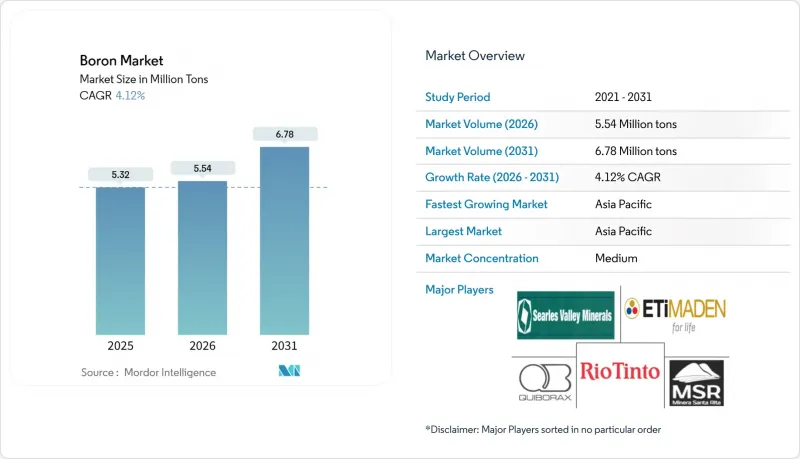
Market expansion is anchored in steady glass demand and widening uptake of high-purity boron compounds in semiconductors, green-hydrogen storage, and advanced ceramics. Supply concentration around Turkey's Eti Maden continues to shape pricing, yet new lithium-boron co-production projects are introducing alternative volumes. Energy-efficient building norms, the shift to electric vehicles, and rising agricultural micronutrient awareness collectively sustain end-use diversification. Technology-driven vertical integration by leading miners and chemical producers underpins competitive resilience as environmental rules tighten.
Global Boron Market Trends and Insights
Growing Adoption of Fiberglass in Multiple End-Use Sectors
Automotive light-weighting, wind-blade fabrication, and high-performance insulation collectively pull additional volumes of boron-reinforced glass fibers. Electric-vehicle battery housings now specify boron-enhanced composites for thermal stability, supporting persistent demand growth. Wind-energy majors adopt borosilicate variants that withstand cyclic stress, extending service life of blades deployed in offshore farms. Building codes that prioritize energy savings are accelerating the shift to boron-enriched glass wool for insulation. SCHOTT's Miradur scratch-resistant glass-ceramic, posting 10 GPa Martens hardness, highlights the premium segment's focus on performance. Overall, fiberglass uptake strengthens the boron market by binding long-cycle infrastructure and mobility megatrends.
Surging Boron-Based Micronutrient Use in Agriculture
Precision-farming platforms quantify soil boron more accurately, prompting targeted application and steady demand for refined borates. Sodium tetraborate pentahydrate delivers near-complete boron release across a 40-week window, outperforming ulexite alternatives in controlled trials. Foliar sprays timed to flowering mitigate the narrow gap between deficiency and toxicity in broadleaf crops. In the Brazilian Cerrado, soybean growers integrate boron into balanced micronutrient packages to secure yield gains. Specialty fertilizer suppliers have introduced transport-stimulated formulations that lower total application rates without sacrificing efficacy. Such refinements keep agriculture an enduring offtake channel for the boron market.
Stringent Environmental Rules on Open-Pit Boron Mining
Water-use restrictions, habitat-protection zoning, and greenhouse-gas reporting standards elevate compliance costs for new mines. Life-cycle assessments place refined boron's carbon footprint at up to 1,702 kg CO2-equivalent per ton, drawing regulator scrutiny. Waste-treatment expenses can add USD 50 per ton, narrowing margins and slowing project approvals. Turkish operations in desert ecosystems face particular pressure to curtail groundwater extraction. Conditional permits often mandate costly remediation bonds, lengthening construction timelines and limiting near-term supply growth relative to demand.
Other drivers and restraints analyzed in the detailed report include:
- Rising Semiconductor and Advanced-Electronics Demand
- Construction Boom in Borosilicate and Glass-Ceramics
- Price Volatility from Energy-Intensive Refining
For complete list of drivers and restraints, kindly check the Table Of Contents.
Segment Analysis
Technical-grade volumes dominated the boron market in 2025 at 52.18% as fabs, ceramic microstructures, and specialty chemicals demanded >=99.9% purity. This slice is projected to log a 4.12% CAGR through 2031. Semiconductor dopant consumption alone underpins over one-third of technical sales as foundries ramp silicon-carbide and gallium-nitride lines. Boron nitride nanotube research is spawning pilot contracts for aerospace heat shields. By contrast, industrial-grade material-geared toward standard glass and fertilizer-faces slower 3.02% growth with tighter margins. Close supplier-customer collaboration around contamination control secures pricing power in the technical tranche of the boron market.
Technical-grade producers leverage closed-loop recycling to reclaim boron from effluents, trimming effective cash costs and aligning with ESG audits. Industrial-grade suppliers retain scale advantages in bulk logistics, particularly into construction glass plants across Asia-Pacific. Gradual process upgrades are narrowing impurity tolerances, but a clear pricing gulf between the two grades persists. As next-generation chips move to sub-3 nm nodes, demand for hyper-clean boron will intensify, reinforcing grade bifurcation within the boron market.
The Boron Market Report is Segmented by Grade (Technical and Industrial), Application (Glass, Ceramics, Agriculture, Detergent and Cleaning, and Other Applications), and Geography (Asia-Pacific, North America, Europe, South America, and Middle East and Africa). The Market Forecasts are Provided in Terms of Volume (Tons).
Geography Analysis
Asia-Pacific commanded 52.21% of 2025 shipments, with China absorbing the lion's share for electronics, solar glass, and construction insulation. Regional CAGR is forecast at 4.18%, sustained by continuous fab expansions and infrastructure investment. India's push for higher cotton and oilseed yields supports a double-digit rise in micronutrient imports. Japan and South Korea, while mature, maintain stable offtake for precision electronics and advanced ceramics.
North America ranked second in volume, supported by integrated mining and refining in California and Nevada. The Rhyolite Ridge project enters construction in 2025, promising fresh technical-grade output and bolstering supply security. Renewable-energy subsidies spur demand for borosilicate solar covers and wind-blade glass fibers, feeding a forecast 4.02% CAGR through 2031. Mexico's automotive and appliance clusters further widen industrial-grade pull within the boron market.
Europe exhibits balanced demand across automotive lightweighting, wind-energy components, and specialty chemicals. Strict carbon-border measures encourage local sourcing from Spanish and Turkish trans-Mediterranean suppliers. While growth is slower at 3.12%, value addition in high-purity segments remains notable. South America, led by Brazil's agriculture, and the Middle East and Africa, buoyed by construction megaprojects, together represent 7.88% of the boron market and are expected to grow above the global pace through new industrial and infrastructure investments.
- 3M
- Air Liquide
- American Elements
- Boron Molecular
- Boron One Holdings
- Eti Maden
- Gujarat Boron Derivatives Pvt., Ltd.
- Ioneer
- Minera Santa Rita (MSR)
- Momentive Technologies
- Quiborax
- Resonac Holdings Corporation
- Rio Tinto
- Saint-Gobain
- SB Boron Corporation
- Searles Valley Minerals
- Stella Chemifa Corporation
Additional Benefits:
- The market estimate (ME) sheet in Excel format
- 3 months of analyst support
TABLE OF CONTENTS
1 Introduction
- 1.1 Study Assumptions and Market Definition
- 1.2 Scope of the Study
2 Research Methodology
3 Executive Summary
4 Market Landscape
- 4.1 Market Overview
- 4.2 Market Drivers
- 4.2.1 Growing Adoption of Fiberglass in Multiple End-Use Sectors
- 4.2.2 Surging Boron-Based Micronutrient Use in Agriculture
- 4.2.3 Rising Semiconductor and Advanced-Electronics Demand (Doping, BN, BF3, Bcl3)
- 4.2.4 Construction Boom in Borosilicate and Glass-Ceramics
- 4.2.5 Green-Hydrogen Storage Development via Borohydrides
- 4.3 Market Restraints
- 4.3.1 Stringent Environmental Rules on Open-Pit Boron Mining
- 4.3.2 Price Volatility from Energy-Intensive Refining
- 4.3.3 Potential Substitution by Silicon-Based Additives in Glass and Ceramics
- 4.4 Value Chain Analysis
- 4.5 Porter's Five Forces
- 4.5.1 Bargaining Power of Suppliers
- 4.5.2 Bargaining Power of Consumers
- 4.5.3 Threat of New Entrants
- 4.5.4 Threat of Substitutes
- 4.5.5 Degree of Competition
5 Market Size and Growth Forecasts (Volume)
- 5.1 By Grade
- 5.1.1 Technical
- 5.1.2 Industrial
- 5.2 By Application
- 5.2.1 Glass
- 5.2.2 Ceramics
- 5.2.3 Agriculture
- 5.2.4 Detergent and Cleaning
- 5.2.5 Other Applications
- 5.3 By Geography
- 5.3.1 Asia-Pacific
- 5.3.1.1 China
- 5.3.1.2 India
- 5.3.1.3 Japan
- 5.3.1.4 South Korea
- 5.3.1.5 ASEAN Countries
- 5.3.1.6 Rest of Asia-Pacific
- 5.3.2 North America
- 5.3.2.1 United States
- 5.3.2.2 Canada
- 5.3.2.3 Mexico
- 5.3.3 Europe
- 5.3.3.1 Germany
- 5.3.3.2 United Kingdom
- 5.3.3.3 France
- 5.3.3.4 Italy
- 5.3.3.5 Russia
- 5.3.3.6 NORDIC Countries
- 5.3.3.7 Rest of Europe
- 5.3.4 South America
- 5.3.4.1 Brazil
- 5.3.4.2 Argentina
- 5.3.4.3 Rest of South America
- 5.3.5 Middle East and Africa
- 5.3.5.1 Saudi Arabia
- 5.3.5.2 South Africa
- 5.3.5.3 Rest of Middle East and Africa
- 5.3.1 Asia-Pacific
6 Competitive Landscape
- 6.1 Market Concentration
- 6.2 Strategic Moves
- 6.3 Market Share (%)/Ranking Analysis
- 6.4 Company Profiles (includes Global level Overview, Market level overview, Core Segments, Financials as available, Strategic Information, Market Rank/Share, Products and Services, Recent Developments)
- 6.4.1 3M
- 6.4.2 Air Liquide
- 6.4.3 American Elements
- 6.4.4 Boron Molecular
- 6.4.5 Boron One Holdings
- 6.4.6 Eti Maden
- 6.4.7 Gujarat Boron Derivatives Pvt., Ltd.
- 6.4.8 Ioneer
- 6.4.9 Minera Santa Rita (MSR)
- 6.4.10 Momentive Technologies
- 6.4.11 Quiborax
- 6.4.12 Resonac Holdings Corporation
- 6.4.13 Rio Tinto
- 6.4.14 Saint-Gobain
- 6.4.15 SB Boron Corporation
- 6.4.16 Searles Valley Minerals
- 6.4.17 Stella Chemifa Corporation
7 Market Opportunities and Future Outlook
- 7.1 White-space and Unmet-need Assessment

