
PUBLISHER: Mordor Intelligence | PRODUCT CODE: 1940773

PUBLISHER: Mordor Intelligence | PRODUCT CODE: 1940773
Remote Tank Monitoring System - Market Share Analysis, Industry Trends & Statistics, Growth Forecasts (2026 - 2031)
The Remote Tank Monitoring System market is expected to grow from USD 2.49 billion in 2025 to USD 3.21 billion in 2026 and is forecast to reach USD 11.41 billion by 2031 at 28.9% CAGR over 2026-2031.
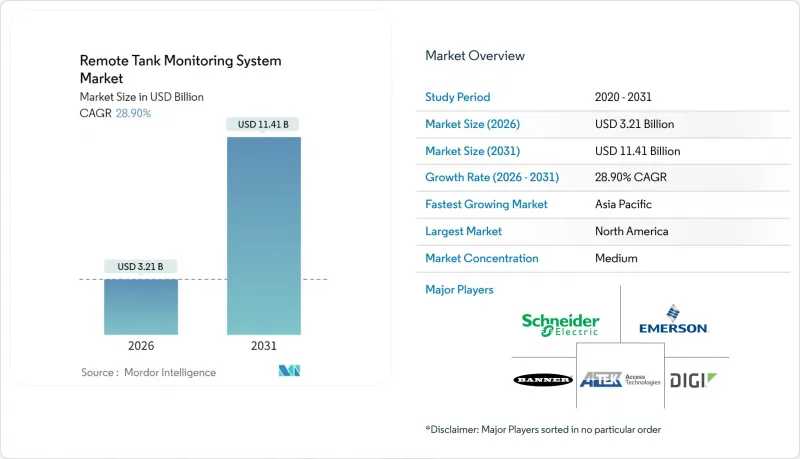
Solid growth reflects the widening adoption of industrial IoT, the maturation of satellite and LPWAN connectivity, and tighter environmental regulations that require continuous visibility into liquid storage. Sector participants are shifting from reactive maintenance to predictive asset management, and the resulting efficiency gains, lower truck rolls, tighter inventory control, and faster spill detection continue to draw both asset owners and insurers toward automated telemetry. Competitive differentiation now centers on software analytics that convert sensor data into actionable insights, while subscription-based Hardware-as-a-Service (HaaS) models reduce upfront cost barriers and accelerate the adoption of remote tank monitoring system solutions.
Global Remote Tank Monitoring System Market Trends and Insights
Expansion of Oil and Gas and Chemical Storage Infrastructure
IEA data showed global oil and gas storage capacity increasing by 12% in 2024 as firms built strategic reserves while pursuing energy transition goals . Chemical producers mirrored this pattern to buffer feedstock volatility, and both trends amplified demand for remote tank monitoring system market deployments. Operators favor scalable, multi-site platforms that integrate with existing SCADA systems and feed cloud analytics for portfolio-wide optimization. Vendors able to integrate satellite links and cellular backhaul now win multi-year frame agreements on heavy-capital projects.
Proliferation of Cloud-Based IoT Platforms
Microsoft Azure IoT and AWS IoT Core logged a 40% annual growth in industrial use cases by 2024, with tank telemetry among the fastest-growing add-on workloads. Cloud ingestion unlocks machine-learning leak detection, automated replenishment triggers, and predictive maintenance capabilities that were previously seldom possible in legacy SCADA systems. Mid-market operators tap subscription pricing to sidestep large CAPEX, further accelerating the uptake of remote tank monitoring system market solutions.
High Upfront Hardware and Integration Costs
A full sensor-to-cloud deployment can run USD 15,000-45,000 per tank, with integration often exceeding the hardware bill. SMEs managing a handful of tanks struggle to justify such spend. This restraint steers the remote tank monitoring system market toward modular kits and HaaS subscriptions, which shift costs from CAPEX to OPEX, allowing users to scale as ROI becomes evident.
Other drivers and restraints analyzed in the detailed report include:
- Stricter Global Spill-Prevention and Inventory Regulations
- Satellite-IoT Coverage for Ultra-Remote Tanks
- Cyber-Security and Data-Ownership Concerns
For complete list of drivers and restraints, kindly check the Table Of Contents.
Segment Analysis
Point-level devices led the 2025 field with a 57.92% share, aided by low cost and simple binary alarms. Continuous-level platforms captured higher-value projects, and their 29.6% CAGR signals a shift toward always-on visibility, as demanded by regulatory audits and just-in-time logistics. Revenue linked to continuous installations is set to add USD 4 billion to the remote tank monitoring system market size between 2025 and 2030.
Spending is tilting toward high-resolution radar and guided-wave radar probes in pharmaceuticals and fine chemicals, where +-1 mm accuracy yields quality dividends. Point-level remains entrenched in propane and small industrial tanks, yet aging float switches increasingly give way to digital stick probes as OEMs bundle cloud dashboards by default.
Contact technologies delivered 61.55% of 2025 sales, but non-contact sensing is expected to outpace all other categories, driven by ultrasonic and FMCW radar that avoid fluid contact. The non-contact boom lifts' average selling prices and advanced signal processing software make it a new margin lever for vendors. Remote tank monitoring system adopters also cite lower maintenance costs, no wetted parts means fewer field visits, which compounds the IoT value in rural assets.
Optical and laser devices occupy premium niches such as sterile pharmaceutical batching. Meanwhile, mechanical tape gauges persist where visual redundancy is mandatory for insurance compliance, although digital retrofit kits now stream tape-float readings into SCADA to reduce manual dip checks.
The Remote Tank Monitoring System Market Report is Segmented by Monitoring Type (Point-Level, Continuous-Level), Technology (Contact Sensors, Non-Contact Sensors), Connectivity (Cellular, LPWAN, and More), Tank Type (Above-Ground Fixed-Roof, and More), Capacity (<10, 000 L, 10, 000 - 50, 000 L, and More), End-User Industry (Oil and Gas, Chemicals, and More), and Geography. The Market Forecasts are Provided in Terms of Value (USD).
Geography Analysis
North America maintained a 34.05% lead in 2025, driven by SPCC enforcement, extensive oil and gas infrastructure, and early industrial IoT adoption. Federal grants for rural broadband enhance LPWAN coverage, further propelling the deployment of remote tank monitoring systems in agricultural states. Canada's renewed strategic petroleum reserve buildout adds cross-border momentum as operators harmonize asset management platforms.
The Asia-Pacific region is expected to deliver the most rapid growth, with a 33.1% CAGR through 2031. Massive refinery and petrochemical expansions in China and India, alongside Southeast Asian mining projects, require real-time tank telemetry for both safety and ESG reporting purposes. Regional governments also roll out soil-and-water-protection rules mirroring OECD standards, compelling underground tank owners to adopt continuous monitoring.
Stringent environmental directives and industrial decarbonization programs underpin Europe's steady growth. Cloud dashboards that calculate Scope 3 emissions from bulk-liquid logistics are finding eager users among European majors seeking to meet their 2030 carbon-neutral targets. In parallel, the Middle East, Africa, and South America show rising potential for the remote tank monitoring system market as infrastructure investments in LNG, desalination, and mining unlock greenfield projects, although economic headwinds temper near-term volumes.
- Schneider Electric SE
- Emerson Electric Co.
- Banner Engineering Corp.
- ATEK Access Technologies, LLC (TankScan)
- Anova (DataOnline Corp.)
- Digi International Inc.
- Otodata Wireless Network Inc.
- SkyBitz Inc.
- Powelectrics Ltd.
- Dunraven Systems Limited
- Endress+Hauser Group
- Honeywell International Inc.
- Vega Grieshaber KG
- RemoteTank (Alpha Wireless Automation, Inc.)
- Rugged Telemetry
- Tekelek Group
- Tank Utility, Inc. (Generac Power Systems, Inc.)
- Cavagna Group
- Angus Energy LLC
- Mistras Group, Inc.
Additional Benefits:
- The market estimate (ME) sheet in Excel format
- 3 months of analyst support
TABLE OF CONTENTS
1 INTRODUCTION
- 1.1 Study Assumptions and Market Definition
- 1.2 Scope of the Study
2 RESEARCH METHODOLOGY
3 EXECUTIVE SUMMARY
4 MARKET LANDSCAPE
- 4.1 Market Overview
- 4.2 Market Drivers
- 4.2.1 Expansion of oil and gas and chemical storage infrastructure
- 4.2.2 Proliferation of cloud-based IoT platforms
- 4.2.3 Stricter global spill-prevention and inventory regulations
- 4.2.4 Satellite-IoT coverage for ultra-remote tanks
- 4.2.5 HaaS subscription models lowering capex barriers
- 4.2.6 Scope-3 ESG reporting pressure on bulk-liquid supply chains
- 4.3 Market Restraints
- 4.3.1 High upfront hardware and integration costs
- 4.3.2 Cyber-security and data-ownership concerns
- 4.3.3 Steel/aluminum tariffs inflating device BOM
- 4.3.4 Battery-waste sustainability liabilities
- 4.4 Value Chain Analysis
- 4.5 Regulatory Landscape
- 4.6 Porter's Five Forces Analysis
- 4.6.1 Bargaining Power of Suppliers
- 4.6.2 Bargaining Power of Buyers
- 4.6.3 Threat of New Entrants
- 4.6.4 Threat of Substitutes
- 4.6.5 Intensity of Competitive Rivalry
- 4.7 Impact of Macroeconomic Factors on the Market
5 MARKET SIZE AND GROWTH FORECASTS (VALUE)
- 5.1 By Monitoring Type
- 5.1.1 Point-Level Monitoring
- 5.1.2 Continuous-Level Monitoring
- 5.2 By Technology
- 5.2.1 Contact Sensors
- 5.2.1.1 Float and Tape Gauge
- 5.2.1.2 Magnetostrictive
- 5.2.1.3 Hydrostatic Pressure
- 5.2.2 Non-Contact Sensors
- 5.2.2.1 Ultrasonic
- 5.2.2.2 Radar/FMCW
- 5.2.2.3 Optical/Laser
- 5.2.1 Contact Sensors
- 5.3 By Connectivity
- 5.3.1 Cellular (4G LTE, 5G, NB-IoT, Cat-M)
- 5.3.2 LPWAN (LoRaWAN, Sigfox)
- 5.3.3 Satellite (LEO/GEO)
- 5.3.4 Short-Range RF/Wi-Fi/BLE
- 5.4 By Tank Type
- 5.4.1 Above-Ground Fixed-Roof
- 5.4.2 Above-Ground Floating-Roof
- 5.4.3 Underground/UST
- 5.5 By Capacity
- 5.5.1 <10,000 L
- 5.5.2 10,000 - 50,000 L
- 5.5.3 50,001 - 200,000 L
- 5.5.4 >200,000 L
- 5.6 By End-User Industry
- 5.6.1 Oil and Gas
- 5.6.2 Chemicals and Petrochemicals
- 5.6.3 Water and Wastewater
- 5.6.4 Food and Beverage
- 5.6.5 Agriculture and Irrigation
- 5.6.6 Power Generation
- 5.6.7 Mining and Metals
- 5.6.8 Pharmaceuticals and Healthcare
- 5.7 By Geography
- 5.7.1 North America
- 5.7.1.1 United States
- 5.7.1.2 Canada
- 5.7.1.3 Mexico
- 5.7.2 South America
- 5.7.2.1 Brazil
- 5.7.2.2 Argentina
- 5.7.2.3 Rest of South America
- 5.7.3 Europe
- 5.7.3.1 United Kingdom
- 5.7.3.2 Germany
- 5.7.3.3 France
- 5.7.3.4 Italy
- 5.7.3.5 Spain
- 5.7.3.6 Russia
- 5.7.3.7 Rest of Europe
- 5.7.4 Asia Pacific
- 5.7.4.1 China
- 5.7.4.2 Japan
- 5.7.4.3 India
- 5.7.4.4 South Korea
- 5.7.4.5 Australia and New Zealand
- 5.7.4.6 Southeast Asia
- 5.7.4.7 Rest of Asia Pacific
- 5.7.5 Middle East
- 5.7.5.1 Saudi Arabia
- 5.7.5.2 United Arab Emirates
- 5.7.5.3 Turkey
- 5.7.5.4 Rest of Middle East
- 5.7.6 Africa
- 5.7.6.1 South Africa
- 5.7.6.2 Nigeria
- 5.7.6.3 Kenya
- 5.7.6.4 Rest of Africa
- 5.7.1 North America
6 COMPETITIVE LANDSCAPE
- 6.1 Market Concentration
- 6.2 Strategic Moves
- 6.3 Market Share Analysis
- 6.4 Company Profiles (includes Global level Overview, Market level overview, Core Segments, Financials as available, Strategic Information, Market Rank/Share, Products and Services, Recent Developments)
- 6.4.1 Schneider Electric SE
- 6.4.2 Emerson Electric Co.
- 6.4.3 Banner Engineering Corp.
- 6.4.4 ATEK Access Technologies, LLC (TankScan)
- 6.4.5 Anova (DataOnline Corp.)
- 6.4.6 Digi International Inc.
- 6.4.7 Otodata Wireless Network Inc.
- 6.4.8 SkyBitz Inc.
- 6.4.9 Powelectrics Ltd.
- 6.4.10 Dunraven Systems Limited
- 6.4.11 Endress+Hauser Group
- 6.4.12 Honeywell International Inc.
- 6.4.13 Vega Grieshaber KG
- 6.4.14 RemoteTank (Alpha Wireless Automation, Inc.)
- 6.4.15 Rugged Telemetry
- 6.4.16 Tekelek Group
- 6.4.17 Tank Utility, Inc. (Generac Power Systems, Inc.)
- 6.4.18 Cavagna Group
- 6.4.19 Angus Energy LLC
- 6.4.20 Mistras Group, Inc.
7 MARKET OPPORTUNITIES AND FUTURE OUTLOOK
- 7.1 White-space and Unmet-Need Assessment

