PUBLISHER: Mordor Intelligence | PRODUCT CODE: 1940830

PUBLISHER: Mordor Intelligence | PRODUCT CODE: 1940830
Tomato Seed - Market Share Analysis, Industry Trends & Statistics, Growth Forecasts (2026 - 2031)
The tomato seed market was valued at USD 1.13 billion in 2025 and estimated to grow from USD 1.19 billion in 2026 to reach USD 1.56 billion by 2031, at a CAGR of 5.47% during the forecast period (2026-2031).
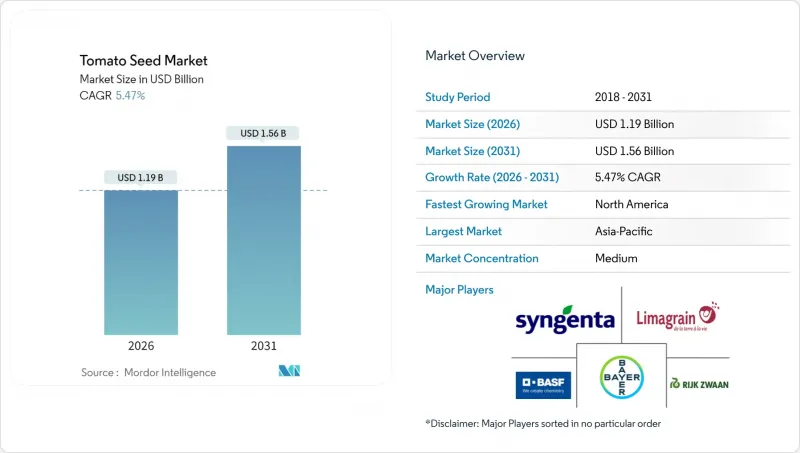
Demand for high-yield hybrid cultivars, rapid uptake of protected cultivation, and steady progress in gene-edited trait stacking are shaping the growth profile. Widespread adoption of hybrid seeds that resist multiple pathogens secures higher pack-out rates for both fresh and processed supply chains, while greenhouse expansion lets growers harvest year-round and target premium pricing. Asia-Pacific retains production leadership, North America posts the fastest growth, and market fragmentation allows niche breeders to commercialize climate-resilient lines. At the same time, informal seed reuse among smallholders and lengthy biotech approval cycles temper growth across certain developing regions.
Global Tomato Seed Market Trends and Insights
Rising Demand for High-Yield Hybrid Cultivars
Processing hubs in California's Central Valley and Italy's Po Valley predominantly rely on hybrids because mechanical harvesters require uniform size and synchronized ripening windows. Hybrids provide substantial yield improvements over open-pollinated lines, supporting processor margins that face pressure from higher labor and energy costs. Contract farming models in emerging markets help manage the upfront seed expense, enabling smallholders to access the yield benefits. With additional heterosis gains achievable through CRISPR-guided selection, seed developers can reduce breeding cycles and accelerate hybrid releases.
Expansion of Protected Cultivation Acreage
Year-round greenhouse production yields multiple harvests compared to a single outdoor cycle and supports substantial capital investments. Dutch operations achieve significantly higher yields compared to open-field productivity while maintaining uniform quality for premium retail programs. Land-scarce economies, including Singapore, push vertical farms to maximize output in limited spaces. Climate volatility drives farmers in Spain, Mexico, and Japan to controlled environments to mitigate extreme heat or rainfall swings, expanding demand for greenhouse-specific seed genetics.
Growing Prevalence of Saved-Seed Practices Among Smallholders
Many tomato farmers in East Africa save second-generation seed, despite experiencing reduced yields in subsequent cycles. Financial constraints during the planting season and limited access to credit drive this practice. While lower-cost hybrid options and flexible payment plans provide alternatives, they struggle to compete with free on-farm seed. Consequently, hybrid adoption and potential yield improvements remain underutilized in several developing regions.
Other drivers and restraints analyzed in the detailed report include:
- Increasing Adoption of Disease-Resistant Traits
- Surge in Seed-Bank Led Climate-Resilient Genotype Collaborations
- Stringent Biotech Variety Approval Timelines
For complete list of drivers and restraints, kindly check the Table Of Contents.
Segment Analysis
Hybrid varieties accounted for 72.25% of the tomato seed market share in 2025 and are on track for a 5.55% CAGR through 2031, underscoring the value growers place on disease resistance and uniformity. Commercial processors prefer hybrids because synchronized maturation reduces field passes and sorting costs. The tomato seed market for hybrid lines continues to expand significantly during the forecast period as protected cultivation systems specify bespoke greenhouse genetics. Open-pollinated cultivars remain popular in subsistence farming and in heirloom retail niches where seed saving and flavor authenticity drive purchasing decisions. The tomato seed market benefits from CRISPR selection, which substantially compresses breeding cycles and helps firms introduce stacked traits that would otherwise require multiple back-crossing generations.
Open-pollinated varieties hold critical roles in biodiversity conservation and organic farming. Seed libraries and farmer cooperatives distribute these lines across Sub-Saharan Africa and South America, generating informal trade channels that bypass formal retail yet support local adaptation. Some hybrid derivatives bridge the gap by offering partial heterosis at a lower seed cost, aiding adoption in medium-input systems. Though their aggregate volume is smaller, open-pollinated sales add resilience to the tomato seed market because they diversify revenue across consumer segments. Over the outlook period, hybrid price premiums will persist given ongoing R&D spend, but open-pollinated demand will survive in geographies where cash constraints and traditional preferences prevail.
The Tomato Seed Market Report is Segmented by Breeding Technology (Hybrids, and Open Pollinated Varieties and Hybrid Derivatives), Cultivation Mechanism (Open Field and Protected Cultivation), and Geography (Africa, Asia-Pacific, Europe, Middle East, North America, and South America). The Market Forecasts are Provided in Terms of Value (USD) and Volume (Metric Tons).
Geography Analysis
Asia-Pacific maintained 36.20% of global revenue in 2025, anchored by China's 59.6 million metric tons output that spans both fresh and processing channels. Provincial governments subsidize seed purchases for heat-tolerant hybrids, and protected-cultivation projects in India add double-digit hectares each year. Greenhouse adoption in states such as Karnataka and Maharashtra climbed 15% in 2024 alone, boosting demand for climate-adaptive genetics. Meanwhile, Indonesia and Vietnam are scaling vertical systems for urban retail supply, which depend on continuous-fruiting hybrids.
North America grew at a 7.21% CAGR and is forecast to remain the fastest region through 2031. California's Central Valley continues to lead processing volumes, and growers there moved quickly into hybrids with elevated soluble solids to streamline factory throughput. Canada and Mexico expand high-tech greenhouses that supply winter markets across the United States, sustaining demand for indeterminate greenhouse lines tolerant of artificial light. Research institutions and venture-funded start-ups in North America also accelerate CRISPR trait deployment, reinforcing regional innovation leadership.
Europe delivers steady growth despite strict biotech regulations. The Netherlands and Spain roll out energy-efficient glasshouses, combining cogeneration systems with deep water culture to maintain a year-round supply. Italy's Po Valley remains central to processing output and favors hybrids with uniform maturation. Southern Europe confronts hotter summers and erratic rainfall, so drought-tolerant varieties gain traction. Parallel consumer preference for pesticide reduction under the Farm to Fork strategy drives uptake of disease-resistant seeds bred through marker-assisted back-crossing methods approved by European regulators.
- Bayer AG
- Syngenta Group
- BASF SE
- Groupe Limagrain
- Rijk Zwaan BV
- Advanta Seeds (UPL Ltd.)
- Sakata Seed Corporation
- East-West Seed
- Enza Zaden Beheer B.V.
- Takii and Company Ltd.
- Yuan Longping High-Tech Agriculture
- Bejo Zaden BV
- VNR Seeds Pvt. Ltd.
- NongWoo Bio Co. Ltd.
- Mahyco
Additional Benefits:
- The market estimate (ME) sheet in Excel format
- 3 months of analyst support
TABLE OF CONTENTS
1 INTRODUCTION
- 1.1 Study Assumptions and Market Definition
- 1.2 Scope of the Study
- 1.3 Research Methodology
2 REPORT OFFERS
3 EXECUTIVE SUMMARY AND KEY FINDINGS
4 KEY INDUSTRY TRENDS
- 4.1 Area Under Cultivation
- 4.2 Most Popular Traits
- 4.3 Breeding Techniques
- 4.4 Regulatory Framework
- 4.5 Value Chain and Distribution Channel Analysis
- 4.6 Market Drivers
- 4.6.1 Rising demand for high-yield hybrid cultivars
- 4.6.2 Expansion of protected cultivation acreage
- 4.6.3 Increasing adoption of disease-resistant traits
- 4.6.4 Rapid growth of processed tomato industries
- 4.6.5 CRISPR-enabled trait stacking for taste and shelf-life
- 4.6.6 Surge in seed-bank led climate-resilient genotype collaborations
- 4.7 Market Restraints
- 4.7.1 Growing prevalence of saved-seed practices among smallholders
- 4.7.2 Stringent biotech variety approval timelines
- 4.7.3 Consolidation-driven royalty inflation in seed pricing
- 4.7.4 Rising consumer pushback against patent-protected traits in heirloom markets
5 MARKET SIZE AND GROWTH FORECASTS (VALUE AND VOLUME)
- 5.1 Breeding Technology
- 5.1.1 Hybrids
- 5.1.2 Open Pollinated Varieties and Hybrid Derivatives
- 5.2 Cultivation Mechanism
- 5.2.1 Open Field
- 5.2.2 Protected Cultivation
- 5.3 Geography
- 5.3.1 Africa
- 5.3.1.1 By Breeding Technology
- 5.3.1.2 By Cultivation Mechanism
- 5.3.1.3 By Country
- 5.3.1.3.1 Egypt
- 5.3.1.3.2 Ethiopia
- 5.3.1.3.3 Ghana
- 5.3.1.3.4 Kenya
- 5.3.1.3.5 Nigeria
- 5.3.1.3.6 South Africa
- 5.3.1.3.7 Tanzania
- 5.3.1.3.8 Rest of Africa
- 5.3.2 Asia-Pacific
- 5.3.2.1 By Breeding Technology
- 5.3.2.2 By Cultivation Mechanism
- 5.3.2.3 By Country
- 5.3.2.3.1 Australia
- 5.3.2.3.2 Bangladesh
- 5.3.2.3.3 China
- 5.3.2.3.4 India
- 5.3.2.3.5 Indonesia
- 5.3.2.3.6 Japan
- 5.3.2.3.7 Myanmar
- 5.3.2.3.8 Pakistan
- 5.3.2.3.9 Philippines
- 5.3.2.3.10 Thailand
- 5.3.2.3.11 Vietnam
- 5.3.2.3.12 Rest of Asia-Pacific
- 5.3.3 Europe
- 5.3.3.1 By Breeding Technology
- 5.3.3.2 By Cultivation Mechanism
- 5.3.3.3 By Country
- 5.3.3.3.1 France
- 5.3.3.3.2 Germany
- 5.3.3.3.3 Italy
- 5.3.3.3.4 Netherlands
- 5.3.3.3.5 Poland
- 5.3.3.3.6 Romania
- 5.3.3.3.7 Russia
- 5.3.3.3.8 Spain
- 5.3.3.3.9 Turkey
- 5.3.3.3.10 Ukraine
- 5.3.3.3.11 United Kingdom
- 5.3.3.3.12 Rest of Europe
- 5.3.4 Middle East
- 5.3.4.1 By Breeding Technology
- 5.3.4.2 By Cultivation Mechanism
- 5.3.4.3 By Country
- 5.3.4.3.1 Iran
- 5.3.4.3.2 Saudi Arabia
- 5.3.4.3.3 Rest of Middle East
- 5.3.5 North America
- 5.3.5.1 By Breeding Technology
- 5.3.5.2 By Cultivation Mechanism
- 5.3.5.3 By Country
- 5.3.5.3.1 Canada
- 5.3.5.3.2 Mexico
- 5.3.5.3.3 United States
- 5.3.5.3.4 Rest of North America
- 5.3.6 South America
- 5.3.6.1 By Breeding Technology
- 5.3.6.2 By Cultivation Mechanism
- 5.3.6.3 By Country
- 5.3.6.3.1 Argentina
- 5.3.6.3.2 Brazil
- 5.3.6.3.3 Rest of South America
- 5.3.1 Africa
6 COMPETITIVE LANDSCAPE
- 6.1 Key Strategic Moves
- 6.2 Market Share Analysis
- 6.3 Company Landscape
- 6.4 Company Profiles (Includes Global Level Overview, Market Level Overview, Core Segments, Financials as Available, Strategic Information, Market Rank/Share for Key Companies, Products and Services, and Recent Developments)
- 6.4.1 Bayer AG
- 6.4.2 Syngenta Group
- 6.4.3 BASF SE
- 6.4.4 Groupe Limagrain
- 6.4.5 Rijk Zwaan BV
- 6.4.6 Advanta Seeds (UPL Ltd.)
- 6.4.7 Sakata Seed Corporation
- 6.4.8 East-West Seed
- 6.4.9 Enza Zaden Beheer B.V.
- 6.4.10 Takii and Company Ltd.
- 6.4.11 Yuan Longping High-Tech Agriculture
- 6.4.12 Bejo Zaden BV
- 6.4.13 VNR Seeds Pvt. Ltd.
- 6.4.14 NongWoo Bio Co. Ltd.
- 6.4.15 Mahyco
7 KEY STRATEGIC QUESTIONS FOR SEEDS CEOS

