PUBLISHER: Mordor Intelligence | PRODUCT CODE: 1940838

PUBLISHER: Mordor Intelligence | PRODUCT CODE: 1940838
Vietnam MICE - Market Share Analysis, Industry Trends & Statistics, Growth Forecasts (2026 - 2031)
The Vietnam MICE Market size in 2026 is estimated at USD 7.71 billion, growing from 2025 value of USD 7.28 billion with 2031 projections showing USD 10.31 billion, growing at 5.97% CAGR over 2026-2031.
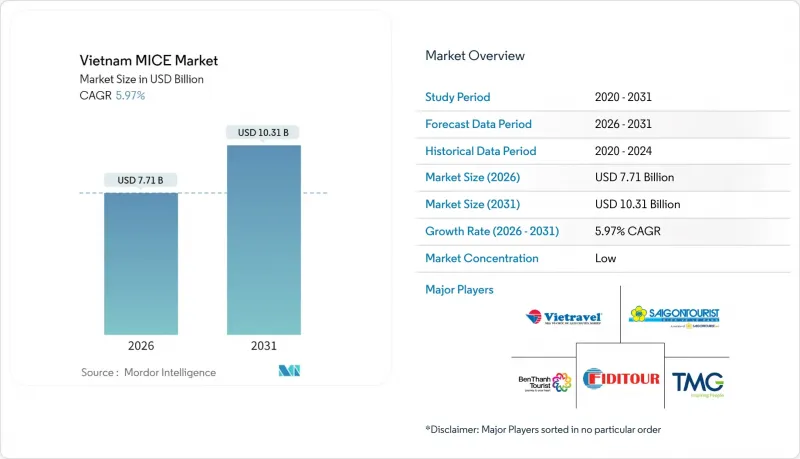
The tourism sector has recovered to 98% of its pre-pandemic levels. Record-breaking public infrastructure investments and the extension of the e-visa window to additional nationalities have significantly driven the rebound in inbound business travel. The expansion of Phu Quoc airport by Sun Group, along with metro extensions in Ho Chi Minh City and a proposed USD 67 billion high-speed rail project, enhances operational efficiency by reducing delegate transfer times. These developments improve venue utilization and strengthen Vietnam's competitive position in the MICE market compared to regional counterparts. Visa liberalization has encouraged 17.6 million foreign arrivals in 2024, with business travellers making up the fastest-growing component.
Vietnam MICE Market Trends and Insights
Government Promotion & Infrastructure Spending
Vietnam's USD 36 billion 2025 capex plan, the largest single-year allocation in its history, prioritizes airports, expressways, and metro lines, collectively solving delegate-mobility bottlenecks that once dampened the Vietnam MICE market. Sun Group's Phu Quoc upgrade triples terminal throughput to 20 million passengers and signals a private-sector vote of confidence. The expansion of Ho Chi Minh City's metro system is projected to significantly reduce cross-district travel times, enabling efficient multi-location scheduling within a single day. The establishment of a "one-stop" desk by the Ministry of Planning and Investment has streamlined permitting processes, resulting in faster venue delivery timelines. These advances neutralize Singapore's historic logistics edge while drawing in further private capital for hotel-linked convention complexes.
Relaxed E-Visa Regime & Air-Lift Expansion
The extension of e-visa validity and the implementation of exemptions resulted in a 39.5% increase in arrivals, totalling 17.6 million in 2024, with business travel serving as the key contributor to this growth. Indian delegate numbers climbed 363% year on year, helped by new nonstop Delhi-Da Nang and Mumbai-Ho Chi Minh City services. Vinpearl's partnerships create 25 additional Russian routes, widening secondary-city access for European and CIS incentive planners. A proposed ASEAN "Schengen-style" visa could drop remaining bureaucratic hurdles, reducing average lead times by six days and saving USD 120 per delegate in agency fees. For corporations under tight launch schedules, the Vietnam MICE market now represents the lowest-friction entry in Southeast Asia.
Regional Hub Competition (Singapore, Bangkok)
Singapore is strategically targeting MICE receipts of USD 50 billion by 2040, leveraging the development of a new downtown precinct designed to significantly enhance exhibition space capacity. The successful bid for hosting the Herbalife Extravaganza 2026 demonstrates Singapore's competitive edge and influence in attracting large-scale international events. In contrast, Bangkok is strengthening its position by offering venue-rental rebates and capitalizing on its robust airline connectivity, which includes direct long-haul routes, to attract global MICE participants. Vietnam, on the other hand, is adopting a cost-competitive approach by pricing full-service delegate packages to rival Singapore. However, the country's MICE market faces challenges, particularly in tier-2 cities where limited 4G infrastructure restricts the feasibility of high-tech demonstrations. The growth trajectory of Vietnam's MICE sector will depend on its ability to rapidly address service-quality deficiencies while competitors work to reduce their price premiums.
Other drivers and restraints analyzed in the detailed report include:
- Hybrid & Sustainable Event Demand
- Rise of Secondary MICE Hubs
- Limited Tier-2 Venue Capacity
For complete list of drivers and restraints, kindly check the Table Of Contents.
Segment Analysis
In 2025, meetings represented 44.78% of the Vietnam MICE market, driven by substantial foreign direct investment (FDI) inflows that facilitated corporate and policy-related gatherings. Ho Chi Minh City and Hanoi solidified their positions as key market hubs, leveraging their roles as centres of government operations and corporate headquarters. Exhibitions are forecasted to grow at a CAGR of 8.05%, underscoring Vietnam's strategic transition toward a knowledge-based economy. This growth is further supported by investments in advanced infrastructure, such as the 22,000 m2 column-free exhibition hall at WTC Binh Duong. Vietnam Expo 2025 is expected to attract participation from 400 companies across 18 countries, with a thematic focus on digital transformation and renewable energy, aligning with global supply chain realignments and sustainability trends.
The growth of the exhibition segment is driving significant economic contributions to ancillary sectors, including accommodation, advertising, and food and beverage services, thereby reinforcing the Vietnam MICE market's interconnected ecosystem. Meetings remain a critical driver of weekday demand, generating stable room bookings that support the expansion strategies of major hospitality brands such as Marriott and IHG. Additionally, Vietnam's competitive advantages, including its rich cultural offerings and cost-efficient pricing, are being strategically leveraged to enhance incentive travel programs. These programs play a pivotal role in optimizing off-peak occupancy rates, diversifying revenue streams, and strengthening the overall market positioning of Vietnam as a leading MICE destination.
The Vietnam MICE Market Report is Segmented by Event Type (Meetings, Incentives, and More), Source of Revenue (Tickets & Registration Fees, Accommodation, and More), Industry Participant (Corporate, Government & Public Sector, and More), and Region (Northern Vietnam, Central Vietnam, and More). The Market Forecasts are Provided in Terms of Value (USD).
List of Companies Covered in this Report:
- Vietravel
- Saigontourist
- Ben Thanh Tourist
- Fiditour Travel
- Thien Minh Group (TMG)
- Vietnam Alive Travel
- ACT Vietnam Travel
- Vietnam Convention & Event Service (VNCES)
- Saigon Exhibition & Convention Center (SECC)
- National Convention Center Hanoi (NCC)
- Vinpearl
- Sun Group
- InterContinental Danang Sun Peninsula Resort
- JW Marriott Phu Quoc Emerald Bay
- Furama Resort Danang
- Sheraton Saigon Hotel & Towers
- Muong Thanh Hospitality
- Lotte Hotel Hanoi
- Novotel Nha Trang
- Centara Sandy Beach Resort Danang
Additional Benefits:
- The market estimate (ME) sheet in Excel format
- 3 months of analyst support
TABLE OF CONTENTS
1 Introduction
- 1.1 Study Assumptions & Market Definition
- 1.2 Scope of the Study
2 Research Methodology
3 Executive Summary
4 Market Landscape
- 4.1 Market Overview
- 4.2 Market Drivers
- 4.2.1 Government promotion & infrastructure spending
- 4.2.2 Relaxed e-visa regime & air-lift expansion
- 4.2.3 Hybrid & sustainable event demand
- 4.2.4 Rise of secondary MICE hubs (Phu Quoc, Quy Nhon)
- 4.2.5 Bleisure packages for Asian millennials
- 4.2.6 ESG-linked venue procurement by MNCs
- 4.3 Market Restraints
- 4.3.1 Regional hub competition (Singapore, Bangkok)
- 4.3.2 Limited tier-2 venue capacity
- 4.3.3 Shortage of bilingual & sustainability-certified staff
- 4.3.4 Fragmented digital ticketing ecosystems
- 4.4 Value / Supply-Chain Analysis
- 4.5 Regulatory Landscape
- 4.6 Technological Outlook
- 4.7 Porter's Five Forces
- 4.7.1 Threat of New Entrants
- 4.7.2 Bargaining Power of Suppliers
- 4.7.3 Bargaining Power of Buyers
- 4.7.4 Threat of Substitutes
- 4.7.5 Competitive Rivalry
5 Market Size & Growth Forecasts
- 5.1 By Event Type
- 5.1.1 Meetings
- 5.1.2 Incentives
- 5.1.3 Conferences
- 5.1.4 Exhibitions
- 5.2 By Source of Revenue
- 5.2.1 Tickets & Registration Fees
- 5.2.2 Accommodation
- 5.2.3 Food & Beverage
- 5.2.4 Advertising
- 5.3 By Industry Participant
- 5.3.1 Corporate
- 5.3.2 Government & Public Sector
- 5.3.3 Associations & NGOs
- 5.4 By Region
- 5.4.1 Northern Vietnam
- 5.4.1.1 Hanoi
- 5.4.1.2 Haiphong
- 5.4.2 Central Vietnam
- 5.4.2.1 Da Nang
- 5.4.2.2 Hue
- 5.4.3 Southern Vietnam
- 5.4.3.1 Ho Chi Minh City
- 5.4.3.2 Can Tho
- 5.4.1 Northern Vietnam
6 Competitive Landscape
- 6.1 Market Concentration
- 6.2 Strategic Moves
- 6.3 Market Share Analysis
- 6.4 Company Profiles (includes Global level Overview, Market level overview, Core Segments, Financials as available, Strategic Information, Market Rank/Share for key companies, Products & Services, and Recent Developments)
- 6.4.1 Vietravel
- 6.4.2 Saigontourist
- 6.4.3 Ben Thanh Tourist
- 6.4.4 Fiditour Travel
- 6.4.5 Thien Minh Group (TMG)
- 6.4.6 Vietnam Alive Travel
- 6.4.7 ACT Vietnam Travel
- 6.4.8 Vietnam Convention & Event Service (VNCES)
- 6.4.9 Saigon Exhibition & Convention Center (SECC)
- 6.4.10 National Convention Center Hanoi (NCC)
- 6.4.11 Vinpearl
- 6.4.12 Sun Group
- 6.4.13 InterContinental Danang Sun Peninsula Resort
- 6.4.14 JW Marriott Phu Quoc Emerald Bay
- 6.4.15 Furama Resort Danang
- 6.4.16 Sheraton Saigon Hotel & Towers
- 6.4.17 Muong Thanh Hospitality
- 6.4.18 Lotte Hotel Hanoi
- 6.4.19 Novotel Nha Trang
- 6.4.20 Centara Sandy Beach Resort Danang
7 Market Opportunities & Future Outlook
- 7.1 Net-zero certified venues & carbon-offset event packages
- 7.2 Smart-city-integrated delegate experience apps (transport, AR tours, e-payments)

