PUBLISHER: Mordor Intelligence | PRODUCT CODE: 1940882

PUBLISHER: Mordor Intelligence | PRODUCT CODE: 1940882
South America Polycarbonate (PC) - Market Share Analysis, Industry Trends & Statistics, Growth Forecasts (2026 - 2031)
The South America Polycarbonate Market was valued at 170.64 kilotons in 2025 and estimated to grow from 180.78 kilotons in 2026 to reach 241.2 kilotons by 2031, at a CAGR of 5.94% during the forecast period (2026-2031).
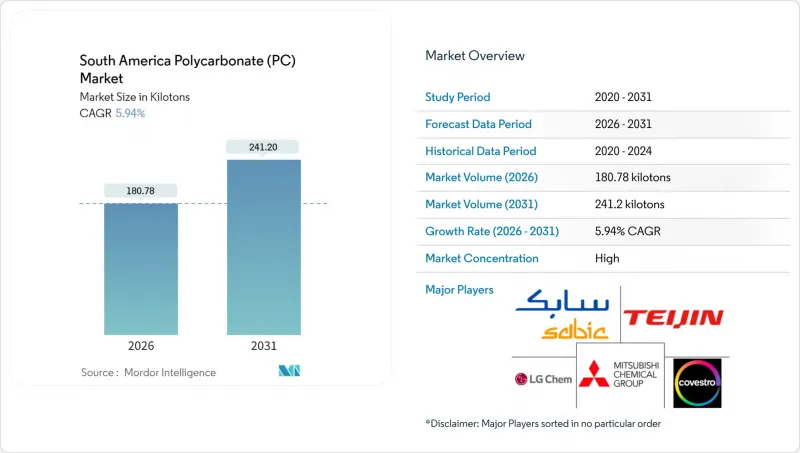
The outlook hinges on Brazil's construction resurgence, Argentina's automotive rebound, and the broader electrification of consumer devices, collectively widening end-use adoption. Manufacturers are shifting toward sustainable grades that incorporate recycled or bio-attributed content, responding to government carbon targets and procurement policies that reward low-carbon materials. Brazil continues to anchor supply with its large processing base and extensive distribution networks. At the same time, rising import tariffs on polymers, feedstock cost pressures linked to high natural gas prices, and evolving green building codes are reshaping competitive tactics. Regional players that align their portfolios with circular economy mandates and energy-efficient construction standards are poised to capture new specification wins across the forecast period.
South America Polycarbonate (PC) Market Trends and Insights
Rising EV-Related Lightweighting Demand
Electric-vehicle production growth is driving increased demand for polycarbonate volumes in battery modules, lighting, and interior trim. Argentina aims to increase its production of assembled vehicles in 2025, which is expected to drive demand for lightweight components that enhance driving range. Brazilian assemblers specify impact-resistant grades for dashboards and charging stations that outperform traditional steel or aluminum in weight and processability. Government incentives that link tax relief to carbon-emission reductions reinforce polymer substitution in body parts and structural housings.
Electrification of Consumer-Electronics Production
Regional device manufacturers are turning to flame-retardant polycarbonate to meet UL 94 V-0 safety standards while retaining the freedom of thin-wall design. SABIC introduced LNP ELCRES CXL copolymers in December 2024 and January 2025, which enhance chemical resistance in smartphones, wearables, and chargers, highlighting how innovation addresses new form-factor needs.
Bisphenol-A Feedstock Price Volatility
Lower operating rates in Asia swing global BPA prices and erode South American converter margins. The pinch is amplified by Brazilian natural-gas costs, which are above levelized U.S. or Asian rates near USD 2, making local polymerization less competitive.
Other drivers and restraints analyzed in the detailed report include:
- Construction Boom in Brazil and Green-Building Codes
- Shift Toward Recycled/Bio-Based PC to Meet ESG Mandates
- Import Dependence for Specialty Grades
For complete list of drivers and restraints, kindly check the Table Of Contents.
Segment Analysis
Polycarbonate sheets held 54.52% of South America's polycarbonate market share in 2025 on the back of roofing, glazing, and signage applications in rapidly urbanizing corridors. The South America polycarbonate market size for sheets benefits from municipal tax incentives that rate daylight-harvesting facades as energy-saving investments. Films, posting a 6.41% CAGR, gain momentum in protective electronics packaging and optical media. Corrugated, solid, and multi-wall sheet designs enable architects to reduce HVAC loads while meeting increasingly stringent thermal insulation targets. Argentina's auto assemblers have begun sourcing thin-gauge sheets for interior consoles, a shift that foreshadows incremental tonnage gains once full EV production scales.
Long-run competitiveness in sheets hinges on extrusion efficiency and resin sourcing strategies. Producers that combine in-house recycling streams with bio-attributed feedstock can capture price premiums from developers pursuing green-building certification points. Film fabricators require tighter process control and often cluster near Brazil's electronics hubs, where localized supply slashes transit times and scrap rates. Specialty fibers remain niche in aerospace and safety glazing but deliver high margins through customized modulus and flame-retardant packages.
The South America Polycarbonate (PC) Market Report is Segmented by Product Form (Sheets, Films, and Others), End User Industry (Aerospace, Automotive, Building and Construction, Electrical and Electronics, Industrial and Machinery, Packaging, and Other End-User Industries), and Geography (Brazil, Argentina, and Rest of South America). The Market Forecasts are Provided in Terms of Volume (Tons) and Value (USD).
List of Companies Covered in this Report:
- CHIMEI
- Covestro AG
- Formosa Plastics Group
- Idemitsu Kosan Co.,Ltd.
- LG Chem
- Lotte Chemical
- Mitsubishi Chemical Group Corporation
- SABIC
- Samyang Corporation
- Teijin Limited
- Trinseo
- Wanhua
Additional Benefits:
- The market estimate (ME) sheet in Excel format
- 3 months of analyst support
TABLE OF CONTENTS
1 Introduction
- 1.1 Study Assumptions and Market Definition
- 1.2 Scope of the Study
2 Research Methodology
3 Executive Summary
4 Market Landscape
- 4.1 Market Overview
- 4.2 Market Drivers
- 4.2.1 Rising EV-driven lightweighting demand
- 4.2.2 Electrification of consumer electronics manufacturing
- 4.2.3 Construction boom in Brazil and regional green-building codes
- 4.2.4 OEM adoption of paint-free, high-gloss exterior PC grades
- 4.2.5 Shift toward recycled/bio-based PC to meet ESG mandates
- 4.3 Market Restraints
- 4.3.1 Bisphenol-A feedstock price volatility
- 4.3.2 Import-dependence for specialty PC grades
- 4.3.3 Slow development of regional recycling infrastructure
- 4.4 Value Chain Analysis
- 4.5 Porter's Five Forces
- 4.5.1 Threat of New Entrants
- 4.5.2 Bargaining Power of Suppliers
- 4.5.3 Bargaining Power of Buyers
- 4.5.4 Threat of Substitutes
- 4.5.5 Competitive Rivalry
- 4.6 Import and Export Trends
- 4.7 Price Trends
- 4.8 Form Trends
- 4.9 Recycling Overview
- 4.10 Regulatory Framework
- 4.10.1 Brazil
- 4.10.2 Argentina
- 4.11 End-use Sector Trends
- 4.11.1 Aerospace (Aerospace Component Production Revenue)
- 4.11.2 Automotive (Automobile Production)
- 4.11.3 Building and Construction (New Construction Floor Area)
- 4.11.4 Electrical and Electronics (Electrical and Electronics Production Revenue)
- 4.11.5 Packaging (Plastic Packaging Volume)
5 Market Size and Growth Forecasts (Value and Volume)
- 5.1 By Product Form
- 5.1.1 Sheets
- 5.1.2 Films
- 5.1.3 Others (Fibers, etc.)
- 5.2 By End User Industry
- 5.2.1 Aerospace
- 5.2.2 Automotive
- 5.2.3 Building and Construction
- 5.2.4 Electrical and Electronics
- 5.2.5 Industrial and Machinery
- 5.2.6 Packaging
- 5.2.7 Other End-user Industries
- 5.3 By Geography
- 5.3.1 Brazil
- 5.3.2 Argentina
- 5.3.3 Rest of South America
6 Competitive Landscape
- 6.1 Market Concentration
- 6.2 Strategic Moves
- 6.3 Market Share (%)/Ranking Analysis
- 6.4 Company Profiles (includes Global level Overview, Market level Overview, Core Segments, Financials as available, Strategic Information, Market Rank/Share for key companies, Products and Services, and Recent Developments)
- 6.4.1 CHIMEI
- 6.4.2 Covestro AG
- 6.4.3 Formosa Plastics Group
- 6.4.4 Idemitsu Kosan Co.,Ltd.
- 6.4.5 LG Chem
- 6.4.6 Lotte Chemical
- 6.4.7 Mitsubishi Chemical Group Corporation
- 6.4.8 SABIC
- 6.4.9 Samyang Corporation
- 6.4.10 Teijin Limited
- 6.4.11 Trinseo
- 6.4.12 Wanhua
7 Market Opportunities and Future Outlook
- 7.1 White-Space and Unmet-Need Assessment
8 Key Strategic Questions for CEOs

