PUBLISHER: Mordor Intelligence | PRODUCT CODE: 2073663

PUBLISHER: Mordor Intelligence | PRODUCT CODE: 2073663
Marketing Agencies Market - Market Share Analysis, Industry Trends & Statistics, Growth Forecasts (2026 - 2031)
According to Mordor Intelligence, the marketing agencies market size in 2026 is estimated at USD 473.57 billion, growing from 2025 value of USD 452.96 billion with 2031 projections showing USD 591.63 billion, growing at 4.55% CAGR over 2026-2031.
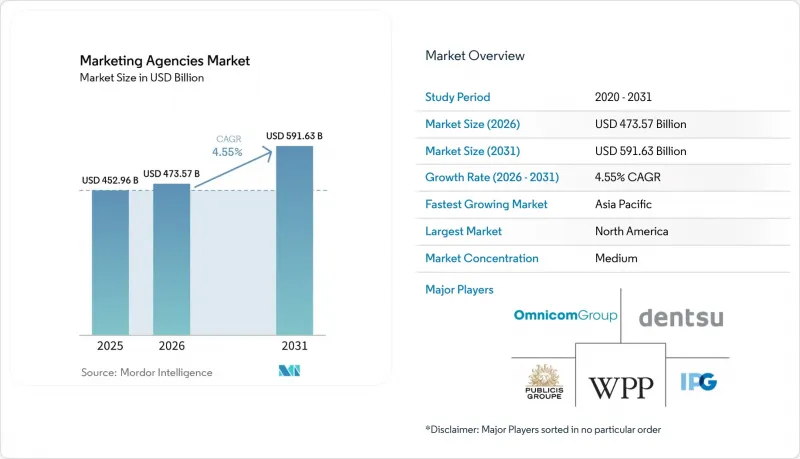
This report is Segmented by Service Type (Digital Marketing Services, Traditional Marketing Services, Full-Service Agencies), Application (Large Enterprises, Small and Mid-Sized Enterprises), End User (BFSI, IT and Telecom, Retail and Consumer Goods, Public Services, Manufacturing and Logistics), and Geography (North America, and Other). The Market Forecasts are Provided in Terms of Value (USD).
Global Marketing Agencies Market Trends and Insights
AI-driven campaign optimization
Artificial intelligence is redefining media planning as real-time algorithms dynamically vary creative, placement, and bidding across channels to maximize return on ad spend. Google's collaboration with Smartly illustrates this pivot: weekly generation of billions of creative signals enables the platform to automate asset selection for display, social, and video formats. Agencies deploying similar systems report double-digit efficiency gains, freeing strategists to focus on storytelling and measurement innovation. Rapid advances in large language models now allow copy, audio, and motion graphics to be versioned in minutes rather than days. Competitive stakes escalate as holding groups develop in-house AI studios to avoid reliance on external vendors. Over the medium term, performance differentials between AI-enabled and manual workflows are expected to widen, pressuring laggards to invest or risk commoditization.
Performance-based pricing adoption
Outcome-linked fee structures align agency revenue with client business results, replacing labor-hour billing with models tied to lead volume, incremental sales, or brand-lift metrics. Brands value the transparency and accountability of these contracts, leading to higher renewal rates for agencies able to prove impact. However, agencies assume greater financial risk because under-performance directly erodes margins, necessitating sophisticated forecasting and attribution frameworks. Data-rich verticals such as e-commerce, SaaS, and app marketing are quickest to adopt because conversion events are easily attributable. Market observers note that performance fees are already standard in influencer, affiliate, and direct-response television, and they are now moving into mainstream brand campaigns. Short-term growth stems from North American advertisers, yet European procurement teams increasingly pilot hybrid retainers that blend base fees with shared upside.
In-house agency expansion among Fortune 500 companies
Eighty-two percent of large advertisers now operate some form of internal agency, nearly doubling since 2015. Cost savings, faster turnaround, and closer proximity to first-party data motivate this shift. External partners increasingly win project-based or specialist assignments rather than full-funnel retainers, eroding revenue visibility for traditional shops. To defend relevance, holding groups embed cross-functional pods inside client offices, pairing strategic oversight with on-site production. Hybrid models flourish in highly regulated sectors where external expertise complements strict compliance mandates. Over the medium term, the boundary between in-house and external teams blurs, rewarding agencies that can flex resources while maintaining brand governance.
Other drivers and restraints analyzed in the detailed report include:
- Cookieless personalization technologies
- Retail media network proliferation
- Talent attrition to big-tech product teams
For complete list of drivers and restraints, kindly check the Table Of Contents.
Segment Analysis
Digital marketing services retained 61.58% of 2025 revenue, underscoring brands' preference for measurable, omnichannel engagement models that link spend to conversion events. This dominance anchors the marketing agencies' market size baseline, yet full-service agencies exhibit the fastest growth at 11.32% CAGR because clients seek unified governance across media, content, and commerce workflows. Integration advantages manifest in consolidated data lakes that reveal cross-channel attribution, allowing holistic optimization. Meanwhile, traditional marketing services persist in experiential activations, sponsorship consulting, and print-heavy luxury verticals where physical touchpoints carry premium brand equity. The marketing agencies' market share of digital specialists is likely to plateau once AI-augmented full-service models reach scale.
Demand for predictive analytics accelerates migration toward outcome-oriented contracts, benefiting agencies that invest in proprietary dashboards covering creative viewability, path-to-purchase, and lifetime value. Conversely, firms that depend solely on third-party ad servers lose leverage as platforms offer native optimization. Leading groups respond by funneling up-skilling budgets into machine-learning labs and low-code content automation. Over the forecast horizon, the marketing agencies industry expects greater convergence between media buying and commerce enablement, compelling legacy creative boutiques to partner or merge with performance shops to safeguard relevance.
Complete Report Scope:
- By Service Type
- Digital Marketing Services
- Traditional Marketing Services
- Full-Service Agencies
- By Application
- Large Enterprises
- Small and Mid-Sized Enterprises (SMEs)
- By End User
- BFSI
- IT and Telecom
- Retail and Consumer Goods
- Public Services
- Manufacturing and Logistics
- By Geography
- North America
- Canada
- United States
- Mexico
- South America
- Brazil
- Peru
- Chile
- Argentina
- Rest of South America
- Europe
- United Kingdom
- Germany
- France
- Spain
- Italy
- BENELUX (Belgium, Netherlands, Luxembourg)
- NORDICS (Denmark, Finland, Iceland, Norway, Sweden)
- Rest of Europe
- Asia-Pacific
- India
- China
- Japan
- Australia
- South Korea
- South East Asia (Singapore, Malaysia, Thailand, Indonesia, Vietnam, Philippines)
- Rest of Asia-Pacific
- Middle East and Africa
- United Arab Emirates
- Saudi Arabia
- South Africa
- Nigeria
- Rest of Middle East and Africa
- North America
Geography Analysis
North America held 36.05% of global 2025 revenue amid robust enterprise spending and mature ad-tech infrastructure. U.S. clients prioritize AI-enabled creative optimization, while Canada's antitrust action against Google underscores regulatory momentum toward diversified ad ecosystems. Mexico's accelerating e-commerce market attracts network agencies that pair cross-border influencer programs with localized creative studios. Europe follows as the second-largest region, with GDPR-driven privacy rigor catalyzing investment in cookieless solutions and first-party data alliances. Agencies that align with regional ESG expectations win competitive bids for sustainability-focused campaigns, especially within Germany and the Nordic states. Linguistic diversity favors hybrid talent models that combine centralized analytics hubs with country-specific creative pods.
Asia-Pacific stands out with a 14.24% forecast CAGR, propelled by mobile-centric consumption, social commerce proliferation, and rising middle-class discretionary spend. China's marketers employ an average of 12.7 agencies per brand to navigate platform fragmentation across Alibaba, Tencent, and Douyin. India's SME surge under the Digital India program spurs demand for vernacular content and low-data video formats. Southeast Asian markets embrace influencer-driven live-commerce, prompting agencies to cultivate creator networks fluent in local dialects. Japan's agency landscape experiences heightened compliance scrutiny following bid-rigging investigations, forcing governance enhancements that global advertisers view favorably. Australia's retail media boom entices U.S. holding companies to acquire boutique commerce consultancies, signaling ongoing cross-border M&A.
The Middle East and Africa represent smaller but nascent opportunities as sovereign funds finance megaprojects requiring integrated marketing for tourism, smart-city recruitment, and cultural heritage promotion. Agencies with Arabic localization capabilities and Islamic finance expertise position ahead of rivals in Qatar and Saudi Arabia. Latin America's digital-payment revolution accelerates social-commerce campaigns across Brazil, Argentina, and Colombia, although macroeconomic volatility mandates flexible contract terms. Collectively, regional nuances reinforce the marketing agencies market's requirement for multilingual, culturally agile service delivery.
List of Companies Covered in this Report:
- WPP
- Omnicom Group
- Publicis Groupe
- Interpublic Group
- Dentsu Group
- Accenture Song
- Havas Group
- Deloitte Digital
- Cognizant Interactive
- IBM iX
- Cheil Worldwide
- Hakuhodo DY Holdings
- BBDO
- Ogilvy
- Grey Group
- Saatchi & Saatchi
- R/GA
- VMLY&R
- Leo Burnett
- TBWA Worldwide
Additional Benefits:
- The market estimate (ME) sheet in Excel format
- 3 months of analyst support
TABLE OF CONTENTS
1 Introduction
- 1.1 Study Assumptions & Market Definition
- 1.2 Scope of the Study
2 Research Methodology
3 Executive Summary
4 Market Landscape
- 4.1 Market Overview
- 4.2 Market Drivers
- 4.2.1 AI-driven campaign optimization
- 4.2.2 Performance-based pricing adoption
- 4.2.3 Cookieless personalization technologies
- 4.2.4 Accelerated shift of B2B budgets to ABM platforms
- 4.2.5 SME-friendly self-serve ad portals
- 4.2.6 Retail media network proliferation
- 4.3 Market Restraints
- 4.3.1 In-house agency expansion among Fortune 500
- 4.3.2 Talent attrition to big-tech product teams
- 4.3.3 Data-privacy-driven campaign compliance costs
- 4.3.4 Fragmented measurement standards
- 4.4 Value / Supply-Chain Analysis
- 4.5 Regulatory Landscape
- 4.6 Technological Outlook
- 4.7 Porter's Five Forces
- 4.7.1 Threat of New Entrants
- 4.7.2 Bargaining Power of Buyers
- 4.7.3 Bargaining Power of Suppliers
- 4.7.4 Threat of Substitutes
- 4.7.5 Industry Rivalry
5 Market Size & Growth Forecasts
- 5.1 By Service Type
- 5.1.1 Digital Marketing Services
- 5.1.2 Traditional Marketing Services
- 5.1.3 Full-Service Agencies
- 5.2 By Application
- 5.2.1 Large Enterprises
- 5.2.2 Small and Mid-Sized Enterprises (SMEs)
- 5.3 By End User
- 5.3.1 BFSI
- 5.3.2 IT and Telecom
- 5.3.3 Retail and Consumer Goods
- 5.3.4 Public Services
- 5.3.5 Manufacturing and Logistics
- 5.4 By Geography
- 5.4.1 North America
- 5.4.1.1 Canada
- 5.4.1.2 United States
- 5.4.1.3 Mexico
- 5.4.2 South America
- 5.4.2.1 Brazil
- 5.4.2.2 Peru
- 5.4.2.3 Chile
- 5.4.2.4 Argentina
- 5.4.2.5 Rest of South America
- 5.4.3 Europe
- 5.4.3.1 United Kingdom
- 5.4.3.2 Germany
- 5.4.3.3 France
- 5.4.3.4 Spain
- 5.4.3.5 Italy
- 5.4.3.6 BENELUX (Belgium, Netherlands, Luxembourg)
- 5.4.3.7 NORDICS (Denmark, Finland, Iceland, Norway, Sweden)
- 5.4.3.8 Rest of Europe
- 5.4.4 Asia-Pacific
- 5.4.4.1 India
- 5.4.4.2 China
- 5.4.4.3 Japan
- 5.4.4.4 Australia
- 5.4.4.5 South Korea
- 5.4.4.6 South East Asia (Singapore, Malaysia, Thailand, Indonesia, Vietnam, Philippines)
- 5.4.4.7 Rest of Asia-Pacific
- 5.4.5 Middle East and Africa
- 5.4.5.1 United Arab Emirates
- 5.4.5.2 Saudi Arabia
- 5.4.5.3 South Africa
- 5.4.5.4 Nigeria
- 5.4.5.5 Rest of Middle East and Africa
- 5.4.1 North America
6 Competitive Landscape
- 6.1 Market Concentration
- 6.2 Strategic Moves
- 6.3 Market Share Analysis
- 6.4 Company Profiles (includes Global-level Overview, Market-level Overview, Core Segments, Financials as available, Strategic Information, Market Rank/Share for key companies, Products & Services, and Recent Developments)
- 6.4.1 WPP
- 6.4.2 Omnicom Group
- 6.4.3 Publicis Groupe
- 6.4.4 Interpublic Group
- 6.4.5 Dentsu Group
- 6.4.6 Accenture Song
- 6.4.7 Havas Group
- 6.4.8 Deloitte Digital
- 6.4.9 Cognizant Interactive
- 6.4.10 IBM iX
- 6.4.11 Cheil Worldwide
- 6.4.12 Hakuhodo DY Holdings
- 6.4.13 BBDO
- 6.4.14 Ogilvy
- 6.4.15 Grey Group
- 6.4.16 Saatchi & Saatchi
- 6.4.17 R/GA
- 6.4.18 VMLY&R
- 6.4.19 Leo Burnett
- 6.4.20 TBWA Worldwide
7 Market Opportunities & Future Outlook
- 7.1 Generative-AI-enabled hyper-personalized creative studios
- 7.2 Brand commerce integration with live-stream shopping platforms

