
PUBLISHER: Mordor Intelligence | PRODUCT CODE: 2035029

PUBLISHER: Mordor Intelligence | PRODUCT CODE: 2035029
Bonsai - Market Share Analysis, Industry Trends & Statistics, Growth Forecasts (2026 - 2031)
The bonsai market size is expected to grow from USD 8.3 billion in 2025 to USD 9.11 billion in 2026 and is forecast to reach USD 14.52 billion by 2031 at 9.76% CAGR over 2026-2031.
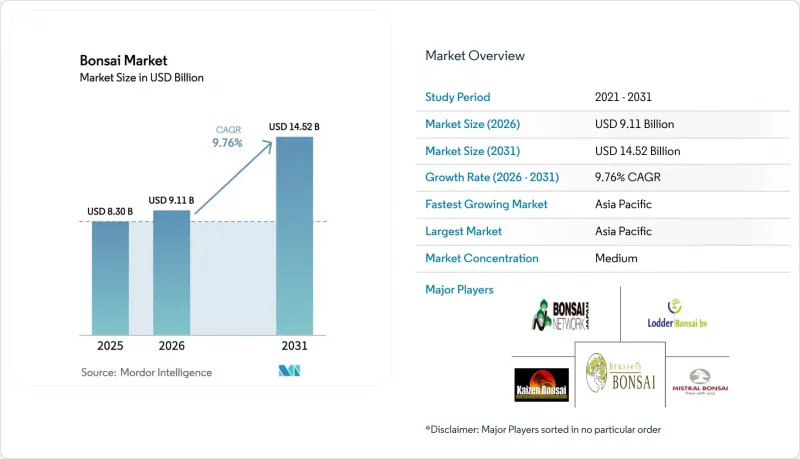
Consumer migration to cities, the popularity of compact decor plants, and the rise of digital specialty-plant platforms are expanding both addressable demand and geographic reach of the bonsai commodity market. Broader disposable income, especially among young urban hobbyists, is prompting a shift from niche collecting toward mainstream living-art purchases that blur the line between investment and lifestyle. At the same time, regulatory complexity in cross-border plant movement, climate-related pest pressures, and labor-intensive care requirements temper the short-term scalability of the bonsai commodity market.
Global Bonsai Market Trends and Insights
Cultural significance and tradition
Cross-generational appreciation of miniature trees is turning heritage practices into commercial momentum. The 400-year anniversary celebration of the Yamaki Pine at the U.S. National Arboretum in May 2025 drew record footfall, live auctions, and new vendor partnerships, underscoring how cultural events catalyze sales of both young and mature specimens. Blending Japanese styling with Western interiors is widening the taste spectrum, and curator testimonials indicate steady year-round visitor spending that supports premium retail price points.
Urban densification driving demand for compact ornamentals
Soaring apartment living is reshaping ornamental plant choice, and bonsai offers high visual impact per square foot. The 2025 Garden Trends Report notes that city dwellers are converting balconies into gardens, boosting demand for container plants with architectural form. Commercial venues illustrate the same shift, a decades-old bonsai installation in Atlanta's airport lounge draws traveler engagement and showcases durability in high-traffic spaces.
High labor-intensive maintenance costs
Fine pruning, wiring and repotting require skilled labor, and wage inflation raises operating expenses outside low-cost Asian clusters. Recent consumer polling finds that 70% of shoppers value eco-friendly products yet remain highly price-sensitive, forcing growers to balance craftsmanship with affordability. Commercial buyers weigh bonsai against lower-maintenance living-wall alternatives, curbing uptake in cost-focused projects.
Other drivers and restraints analyzed in the detailed report include:
- Sustainability and low-carbon landscaping goals
- Rising disposable income for premium hobby crops
- Limited grower expertise outside East Asia
For complete list of drivers and restraints, kindly check the Table Of Contents.
Segment Analysis
Indoor cultivars are the fastest-expanding slice of the bonsai commodity market, advancing at a 10.28% CAGR through 2031 on the back of apartment living and the houseplant boom. Needle conifers and deciduous maples still command the heritage aura that bolsters outdoor demand, but space-saving ficus, jade, and money-tree selections dominate new purchases. The indoor cohort benefits from micro-propagation advances, which achieve close to 100% rooting success and temper price inflation.
At 34.35% of the overall bonsai commodity market share in 2025, outdoor species remain revenue leaders, yet their growth lags as smaller urban plots limit landscape installations. The bonsai commodity market size for indoor varieties is set to swell by 2031, reflecting both volume gains and premiumization at specialty retailers.
The Bonsai Market Report is Segmented by Species (Indoor Species, Outdoor Species, and More), by Distribution Channel (Online and Offline), by Application (Residential, Commercial, and Others), and by Geography (North America, Europe, Asia-Pacific, South America, Middle East, and Africa). The Market Forecasts are Provided in Terms of Value (USD).
Geography Analysis
Asia-Pacific controlled 45.85% of the bonsai commodity market share in 2025 and is advancing at an 11.28% CAGR through 2031 on the strength of cultural heritage, lower labor costs, and established logistics. Japan leverages artisan authority, TRADMAN'S BONSAI introduced engraved tools at USD 60, feeding a premium accessory tier that supports overall category growth. China's deep e-commerce penetration online, exceeding 40% of lifestyle sales, offers a scalable template for regional bonsai marketplace rollouts. Producers in Vietnam and Indonesia are entering export channels with climate-tolerant seedlings, diversifying supply, and reducing lead times.
North America is the second-largest revenue contributor and shows substantial acceleration owing to urban densification and affluent consumer bases. Portland's nursery ecosystem, quoting trees from USD 160 entry pieces to USD 7,000 masterworks, illustrates tiered pricing that accommodates varying budgets while elevating perceived artistry. Corporate offices, hospitality venues, and airports commission statement bonsai to enhance indoor air quality and visual appeal, propelling commercial demand beyond hobbyist circles. Regulatory harmonization efforts between the United States and key Asian suppliers could trim phytosanitary delays, further unlocking growth.
Europe is pivoting toward water-efficient landscaping that aligns with strict environmental rules, positioning bonsai as a viable ornamental alternative. Compliance costs under EU phytosanitary regimes form both entry barriers and protective moats: established importers enjoy reduced competitive pressure, while emerging local greenhouses adopt controlled-environment agriculture to localize supply. Corporate net-zero pledges increasingly allocate budget for low-carbon indoor greenery, and bonsai's small soil footprint suits retrofit projects in historic urban cores where space and water access are constrained. Subsidies in select EU states for drought-resistant plantings may further stimulate category adoption.
- Brussels Bonsai
- Mistral Bonsai
- Kaizen Bonsai
- Abana Homes
- Lodder Bonsai BV
- Bonsai Network Japan
- Bonsaischule Wenddorf (Detlef Goroll)
- Bonsai Outlet
- Bonsai Empire
- Herons Bonsai Limited
- Maillot Bonsai
- Kimura Bonsai Garden
- Wigerts Bonsai
- Shanghai Penjing Garden
- Chrysal International (bonsai nutrients)
Additional Benefits:
- The market estimate (ME) sheet in Excel format
- 3 months of analyst support
TABLE OF CONTENTS
1 Introduction
- 1.1 Study Assumptions and Market Definition
- 1.2 Scope of the Study
2 Research Methodology
3 Executive Summary
4 Market Landscape
- 4.1 Market Overview
- 4.2 Market Drivers
- 4.2.1 Cultural significance and tradition
- 4.2.2 Urban densification driving demand for compact ornamentals
- 4.2.3 Sustainability and low-carbon landscaping goals
- 4.2.4 Rising disposable income for premium hobby crops
- 4.2.5 AI-driven e-commerce platforms matching growers and collectors
- 4.2.6 Micro-grafting rootstock R&D boosting farm productivity
- 4.3 Market Restraints
- 4.3.1 High labor-intensive maintenance costs
- 4.3.2 Limited grower expertise outside East Asia
- 4.3.3 Stricter phytosanitary export rules
- 4.3.4 Climate-change-induced pest outbreaks
- 4.4 Regulatory Landscape
- 4.5 Technological Outlook
- 4.6 Porter's Five Forces
- 4.6.1 Threat of New Entrants
- 4.6.2 Bargaining Power of Buyers
- 4.6.3 Bargaining Power of Suppliers
- 4.6.4 Threat of Substitute
- 4.6.5 Intensity of Competitive Rivalry
5 Market Size and Growth Forecasts (Value)
- 5.1 By Species
- 5.1.1 Indoor Species
- 5.1.2 Outdoor Species
- 5.1.3 Needle Tree Species
- 5.1.4 Deciduous Tree Species
- 5.2 By Distribution Channel
- 5.2.1 Online
- 5.2.2 Offline
- 5.3 By Application
- 5.3.1 Residential
- 5.3.2 Commercial
- 5.3.3 Others (institutional gifts, art fairs)
- 5.4 By Geography
- 5.4.1 North America
- 5.4.1.1 United States
- 5.4.1.2 Canada
- 5.4.1.3 Mexico
- 5.4.1.4 Rest of North America
- 5.4.2 Europe
- 5.4.2.1 Germany
- 5.4.2.2 United Kingdom
- 5.4.2.3 France
- 5.4.2.4 Russia
- 5.4.2.5 Spain
- 5.4.2.6 Rest of Europe
- 5.4.3 Asia-Pacific
- 5.4.3.1 China
- 5.4.3.2 Japan
- 5.4.3.3 India
- 5.4.3.4 Thailand
- 5.4.3.5 Australia
- 5.4.3.6 Rest of Asia-Pacific
- 5.4.4 South America
- 5.4.4.1 Brazil
- 5.4.4.2 Argentina
- 5.4.4.3 Rest of South America
- 5.4.5 Middle East
- 5.4.5.1 Saudi Arabia
- 5.4.5.2 UAE
- 5.4.5.3 Rest of Middle East
- 5.4.6 Africa
- 5.4.6.1 South Africa
- 5.4.6.2 Rest of Africa
- 5.4.1 North America
6 Competitive Landscape
- 6.1 Market Concentration
- 6.2 Strategic Moves
- 6.3 Market Share Analysis
- 6.4 Company Profiles (includes Global level Overview, Market level overview, Core Segments, Financials as available, Strategic Information, Market Rank/Share for key companies, Products and Services, and Recent Developments)
- 6.4.1 Brussels Bonsai
- 6.4.2 Mistral Bonsai
- 6.4.3 Kaizen Bonsai
- 6.4.4 Abana Homes
- 6.4.5 Lodder Bonsai BV
- 6.4.6 Bonsai Network Japan
- 6.4.7 Bonsaischule Wenddorf (Detlef Goroll)
- 6.4.8 Bonsai Outlet
- 6.4.9 Bonsai Empire
- 6.4.10 Herons Bonsai Limited
- 6.4.11 Maillot Bonsai
- 6.4.12 Kimura Bonsai Garden
- 6.4.13 Wigerts Bonsai
- 6.4.14 Shanghai Penjing Garden
- 6.4.15 Chrysal International (bonsai nutrients)
7 Market Opportunities and Future Outlook

