
PUBLISHER: Mordor Intelligence | PRODUCT CODE: 2035036

PUBLISHER: Mordor Intelligence | PRODUCT CODE: 2035036
Vietnam HVAC - Market Share Analysis, Industry Trends & Statistics, Growth Forecasts (2026 - 2031)
The Vietnam HVAC market size stood at USD 3.91 billion in 2026 and is projected to reach USD 5.48 billion by 2031, advancing at a 6.96% CAGR over the forecast period.
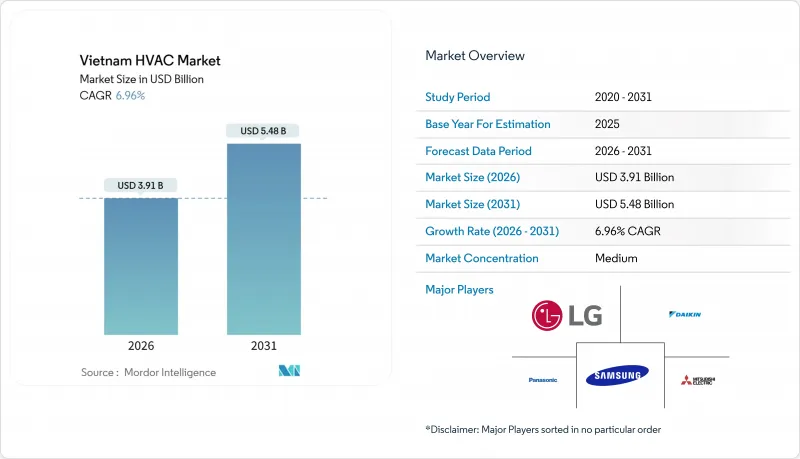
Robust GDP growth, accelerating urbanization, and a steady pipeline of mixed-use construction are enlarging the Vietnam HVAC market by broadening the customer base across residential, commercial, and industrial applications. Foreign direct investment into electronics assembly and semiconductor packaging is spurring demand for precision cleanroom air-handling, while the hospitality sector's post-pandemic rebound is boosting requirements for centralized chillers and low-noise guest-room systems. Government energy-efficiency incentives, together with mandatory performance standards for non-ducted air conditioners that took effect in 2025, are tilting preferences toward inverter-driven equipment and variable refrigerant flow platforms, reshaping competitive positioning in the Vietnam HVAC market. At the same time, tighter refrigerant regulations and district-cooling pilots are creating white-space opportunities for suppliers of low-GWP refrigerants, integrated controls, and performance-based service contracts.
Vietnam HVAC Market Trends and Insights
Growing Tourism And Hospitality Sector
Visitor arrivals are rebounding toward the 25 million target set for 2025, and the national hotel pipeline now tops 49,800 rooms concentrated in Ho Chi Minh City, Hanoi, Da Nang, and Phu Quoc. Hotels are specifying centralized chillers, VRF systems, and low-noise ductless units that meet QCVN 09:2017/BXD efficiency benchmarks, pushing contractors to incorporate inverter compressors and R-32 refrigerant. International brands require compliance with ASHRAE 55 thermal-comfort standards and ISO 7730 metrics, prompting the integration of building management systems to reduce peak electrical demand during high-occupancy periods. Wellness amenities and spa zones require precise humidity control, driving demand for high-efficiency air-handling units. The sector's focus on life-cycle cost savings is accelerating the shift toward energy-recovery ventilators and performance-based maintenance contracts.
Rising Disposable Income And Urbanization
Urbanization is near 45%, and metropolitan populations in Hanoi and Ho Chi Minh City are growing 3-4% annually, extending the Vietnam HVAC market across mid-rise condominiums and high-rise apartments. Rising household incomes enable middle-class buyers to upgrade from window units to multi-zone inverter mini-splits, while luxury projects increasingly pre-install VRF systems. TCVN 7830:2021 minimum performance thresholds, mandatory since January 2025, are phasing out fixed-speed models and reinforcing demand for variable-speed platforms. Developers align with green-building labels to attract buyers, using high CSPF scores as marketing levers. Localized production by LG, Daikin, and Mitsubishi Electric reduces lead times and supports after-sales service networks that are critical to residential purchase decisions.
High Installation And Maintenance Costs
Centralized chillers, VRF platforms, and cleanroom air-handling units require specialized engineering, ductwork fabrication, and structural adaptations that can add 20-30% to project capital outlays, restricting adoption among SMEs and budget-sensitive developers. Lifecycle service costs are elevated by periodic refrigerant handling, filter replacement, and digital controls calibration, all of which demand certified technicians. A shortage of HVAC professionals trained to QCVN 21:2015/BLDTBXH and ASHRAE standards pushes wages upward and extends downtime when failures occur. Smaller residential customers in secondary cities gravitate toward fixed-speed units that cost less despite higher energy bills. Limited access to concessional financing further slows the uptake of high-efficiency retrofits.
Other drivers and restraints analyzed in the detailed report include:
- Rapid Growth Of Commercial Real-Estate Construction
- Expansion Of Foreign-Invested Cleanroom Manufacturing Plants
- Volatile Electricity Tariffs Increasing Operating Costs
For complete list of drivers and restraints, kindly check the Table Of Contents.
Segment Analysis
Air-conditioning equipment captured 45.43% of the Vietnam HVAC market revenue share in 2025, and the segment is poised to grow at a 7.43% CAGR through 2031. In the Vietnam HVAC market, ductless mini-splits dominate residential applications because they can be wired to single-phase power and require minimal structural work. Commercial buyers favor variable refrigerant flow systems that provide zone independence and recover waste heat, improving part-load efficiency across open-plan offices and co-working spaces. Chiller demand is stable in hotels, hospitals, and high-rise offices where plant capacities exceed 500 TR, with screw and centrifugal compressors preferred for high COPs at both full and part load. The shift toward R-32 refrigerant and microchannel condensers is reducing charge volumes and improving heat-transfer coefficients. Packaged rooftop units and terminal air conditioners remain staples in small retail and stand-alone classrooms owing to their plug-and-play serviceability.
Heating equipment remains a niche because tropical temperatures seldom drop below 18 °C, but heat-pump water heaters are gaining traction in resorts and hospitals that value energy recovered from condenser waste heat. Ventilation products, including dedicated outdoor-air systems, energy-recovery ventilators, and smart CO2-based demand control, are registering steady gains as QCVN 04:2019/BXD tightens fresh-air and smoke-extraction mandates. In cleanrooms and healthcare isolation wards, fan-filter units with EC motors and ULPA filters meet stricter particulate and pathogen thresholds. Suppliers that bundle air-conditioning and ventilation equipment with unified controls can differentiate on commissioning speed and data analytics capabilities.
Retrofit and replacement accounted for 61.64% of the Vietnam HVAC market in 2025, as buildings erected before QCVN 09:2017/BXD seek energy-efficiency upgrades and digital controls. Owners of pre-2010 offices, hotels, and retail centers frequently replace fixed-speed chillers and pneumatic controls with inverter-driven systems and building management systems, cutting annual electricity bills by as much as 30%. VNEEP audit mandates for facilities surpassing 1,000 TOE per year unlock concessional loans and tax incentives that shorten payback to fewer than five years, expanding the Vietnam HVAC market size for retrofit services. Residential demand is driven by mid-income households upgrading to quieter, Wi-Fi-enabled mini-splits that integrate with smart-home ecosystems.
New-build installations are projected to grow at a 7.89% CAGR, powered by mega-projects such as Thu Thiem's Lotte Eco Smart City and Dong Anh Smart City near Hanoi. Integrated design teams employ BIM and prefabricated MEP modules to accelerate schedules and minimize material waste. District-cooling feasibility studies in Thu Thiem and Can Tho favor high-efficiency chillers, thermal storage tanks, and tertiary loops serving mixed-use clusters. Greenfield factories in northern industrial hubs install ISO-compliant cleanrooms and high-static-pressure air-handling units during the shell-and-core stage to avoid costly retrofits. As construction shifts toward green certification, first-cost premiums for high-efficiency HVAC are increasingly justified by lower operational expenditure and tenant attraction.
The Vietnam HVAC Market Report is Segmented by Equipment Type (Air-Conditioning Equipment, Heating Equipment, and Ventilation Equipment), Installation Type (New Construction, and Retrofit and Replacement), End User (Residential, Commercial, and Industrial), and Building Type (Office Buildings, Data Centers, Hospitality and Leisure, Healthcare, and More). The Market Forecasts are Provided in Terms of Value (USD).
List of Companies Covered in this Report:
- Daikin Industries Ltd.
- Mitsubishi Electric Corporation
- LG Electronics Inc.
- Panasonic Holdings Corporation
- Carrier Global Corporation
- Samsung Electronics Co., Ltd.
- Hitachi Air Conditioning Ltd.
- Johnson Controls International plc (York)
- Toshiba Carrier Corporation
- Voltas Limited
- Gree Electric Appliances Inc.
- Trane Technologies plc
- Fujitsu General Ltd.
- Midea Group Co., Ltd.
- Sharp Corporation
- Refrigeration Electrical Engineering Corporation (REE)
- Goodman Manufacturing Company, L.P.
- Lennox International Inc.
- Electrolux AB
Additional Benefits:
- The market estimate (ME) sheet in Excel format
- 3 months of analyst support
TABLE OF CONTENTS
1 INTRODUCTION
- 1.1 Study Assumptions and Market Definition
- 1.2 Scope of the Study
2 RESEARCH METHODOLOGY
3 EXECUTIVE SUMMARY
4 MARKET LANDSCAPE
- 4.1 Market Overview
- 4.2 Market Drivers
- 4.2.1 Growing Tourism and Hospitality Sector
- 4.2.2 Rising Disposable Income and Urbanization
- 4.2.3 Government Incentives for Energy-Efficient Buildings
- 4.2.4 Rapid Growth of Commercial Real-Estate Construction
- 4.2.5 Adoption of District Cooling in Smart-City Projects
- 4.2.6 Expansion of Foreign-Invested Cleanroom Manufacturing Plants
- 4.3 Market Restraints
- 4.3.1 High Installation and Maintenance Costs
- 4.3.2 Volatile Electricity Tariffs Increasing Operating Costs
- 4.3.3 Skilled Labor Shortage Inflating Installation Lead Times
- 4.3.4 Limited Domestic Production of Low-GWP Refrigerants
- 4.4 Industry Value Chain Analysis
- 4.5 Impact of Macroeconomic Factors on the Market
- 4.6 Regulatory Landscape
- 4.7 Technological Outlook
- 4.8 Porter's Five Forces Analysis
- 4.8.1 Bargaining Power of Suppliers
- 4.8.2 Bargaining Power of Buyers
- 4.8.3 Threat of New Entrants
- 4.8.4 Threat of Substitutes
- 4.8.5 Intensity of Competitive Rivalry
- 4.9 Key Performance Indicators
5 MARKET SIZE AND GROWTH FORECASTS (VALUE)
- 5.1 By Equipment Type
- 5.1.1 Heating Equipment
- 5.1.1.1 Boilers and Furnaces
- 5.1.1.2 Heat Pumps
- 5.1.1.3 Unitary Heaters
- 5.1.2 Ventilation Equipment
- 5.1.2.1 Air Handling Units (AHUs)
- 5.1.2.2 Air Filters
- 5.1.2.3 Fan Coil Units
- 5.1.2.4 Humidifiers and Dehumidifiers
- 5.1.3 Air-Conditioning Equipment
- 5.1.3.1 Unitary Air Conditioners
- 5.1.3.1.1 Ducted Splits
- 5.1.3.1.2 Ductless Mini-Splits
- 5.1.3.1.3 Packaged Rooftops
- 5.1.3.1.4 Variable Refrigerant Flow (VRF) Systems
- 5.1.3.2 Room Air Conditioners
- 5.1.3.3 Packaged Terminal Air Conditioners
- 5.1.3.4 Chillers
- 5.1.3.1 Unitary Air Conditioners
- 5.1.1 Heating Equipment
- 5.2 By Installation Type
- 5.2.1 New Construction
- 5.2.2 Retrofit / Replacement
- 5.3 By End User
- 5.3.1 Residential
- 5.3.2 Commercial
- 5.3.3 Industrial
- 5.4 By Building Type (Commercial)
- 5.4.1 Office Buildings
- 5.4.2 Healthcare Facilities
- 5.4.3 Hospitality and Leisure
- 5.4.4 Retail Stores and Malls
- 5.4.5 Educational Institutions
- 5.4.6 Data Centers
6 COMPETITIVE LANDSCAPE
- 6.1 Market Concentration
- 6.2 Strategic Moves
- 6.3 Market Share Analysis
- 6.4 Company Profiles (includes Global Level Overview, Market Level Overview, Core Segments, Financials as available, Strategic Information, Market Rank/Share, Products and Services, Recent Developments)
- 6.4.1 Daikin Industries Ltd.
- 6.4.2 Mitsubishi Electric Corporation
- 6.4.3 LG Electronics Inc.
- 6.4.4 Panasonic Holdings Corporation
- 6.4.5 Carrier Global Corporation
- 6.4.6 Samsung Electronics Co., Ltd.
- 6.4.7 Hitachi Air Conditioning Ltd.
- 6.4.8 Johnson Controls International plc (York)
- 6.4.9 Toshiba Carrier Corporation
- 6.4.10 Voltas Limited
- 6.4.11 Gree Electric Appliances Inc.
- 6.4.12 Trane Technologies plc
- 6.4.13 Fujitsu General Ltd.
- 6.4.14 Midea Group Co., Ltd.
- 6.4.15 Sharp Corporation
- 6.4.16 Refrigeration Electrical Engineering Corporation (REE)
- 6.4.17 Goodman Manufacturing Company, L.P.
- 6.4.18 Lennox International Inc.
- 6.4.19 Electrolux AB
7 MARKET OPPORTUNITIES AND FUTURE OUTLOOK
- 7.1 White-Space and Unmet-Need Assessment

