
PUBLISHER: Mordor Intelligence | PRODUCT CODE: 2043843

PUBLISHER: Mordor Intelligence | PRODUCT CODE: 2043843
Europe Molecular Sieves - Market Share Analysis, Industry Trends & Statistics, Growth Forecasts (2026 - 2031)
The Europe Molecular Sieves Market size is expected to grow from USD 0.95 billion in 2025 to USD 0.98 billion in 2026 and is forecast to reach USD 1.16 billion by 2031 at a 3.42% CAGR over 2026-2031.
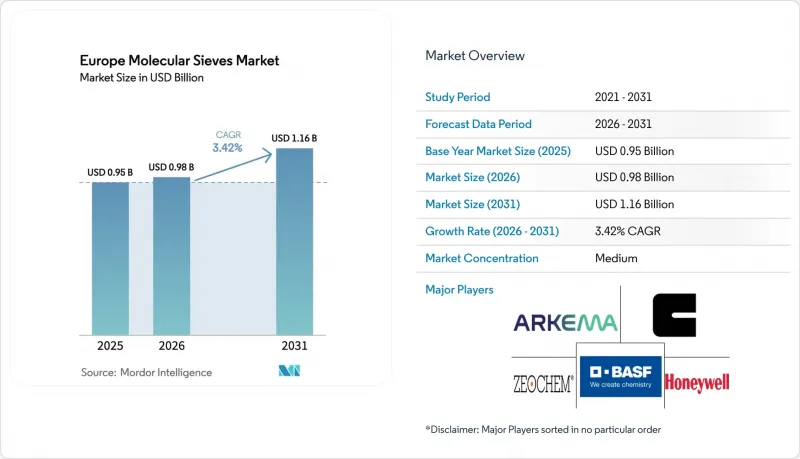
Surging demand for ultra-dry hydrogen in expanding electrolyzer parks, accelerated post-COVID investments in hospital oxygen plants, and Carbon Border Adjustment Mechanism (CBAM)-driven upgrades across industrial gas networks are widening the application base for adsorbents. Carbon molecular sieves are edging ahead of traditional zeolites as biogas upgrading and direct air-capture projects prefer their lower-temperature regeneration profiles. Format preferences are also shifting: powdered grades are gaining ground in phosphate-free detergents while pellets retain primacy in large air-separation units. Competitive strategy now pivots on binder-free zeolite technologies, energy-efficient regeneration, and hybrid membrane-adsorber offerings that blunt operating-cost headwinds.
Europe Molecular Sieves Market Trends and Insights
Regulatory Tail-Winds From REACH and CBAM Tightening Moisture/VOC Specs
REACH (Registration, Evaluation, Authorisation and Restriction of Chemicals) updates and the phased CBAM roll-out from 2026 are lowering allowable moisture and VOC (Volatile Organic Compound) thresholds across industrial gas, petrochemical, and pharmaceutical plants, pushing operators toward high-performance zeolite beds with documented kinetics. The European Industrial Gases Association put 2025 industry revenue at EUR 21.2 billion and flagged energy-cost exposure under CBAM, heightening the value of efficient adsorption trains. Air Liquide earmarked over EUR 250 million for new air-separation capacity in Dresden, Germany, and partnered with Aurubis on a EUR 100 million Bulgarian unit, both specifying CBAM-compliant molecular sieve packages. Suppliers able to certify ISO 9001 processes and deliver moisture breakthroughs below 2 ppm (parts per million) are winning early replacement contracts.
Explosive PSA Oxygen Demand From Ageing EU Hospitals and Mini-Plants
Post-pandemic hospital retrofits and an aging population have lifted PSA oxygen installations, sending regional zeolite demand higher at 5.8-7.8% CAGR in Germany, France, and the United Kingdom. Honeywell UOP's OXYSIV range supplied emergency volumes to Italian hospitals during the 2021 surges, underscoring strategic proximity benefits. Rural clinics and nursing homes favor compact beaded beds that stretch service intervals beyond 18 months, further widening the Europe Molecular Sieves market.
Energy-Intensive Regeneration Costs Amid EU Carbon Price Escalation
Vacuum-temperature swing or thermal swing cycles consume up to 90 kWh of electricity and 2.9 GJ of heat per tonne of CO2 desorbed, inflating operating costs as EU-ETS (European Union Emissions Trading System) allowances rise. Smaller biogas and PSA oxygen operators with limited capital find the economics challenging and may defer bed replacements, dampening short-term volumes.
Other drivers and restraints analyzed in the detailed report include:
- Surge in Green-Hydrogen Electrolyzer Build-Outs Requiring Ultra-Dry H2 Streams
- Petro-Refinery Revamps to Meet Euro 7 Fuel Standards
- Competition From Hybrid Membrane-Adsorber Skids in Biogas Upgrading
For complete list of drivers and restraints, kindly check the Table Of Contents.
Segment Analysis
Pelleted grades represented 39.71% of the Europe Molecular Sieves market size in 2025, benefiting from mechanical strength that withstands pressure cycles in air-separation and refinery PSA (Pressure Swing Adsorption) towers. Although format changeovers are capital-heavy, the Europe Molecular Sieves market is witnessing incremental retrofits in which pellets are swapped for low-pressure-drop extrudates to trim blower energy.
Powdered molecular sieves, forecast to grow at a 3.90% CAGR during the forecast period (2026-2031), are penetrating detergent and rapid-cycle adsorption niches, where high surface area overrides handling convenience. The trend aligns with phosphate-free mandates that solidify Zeolite A dominance. Beaded variants occupy a smaller share, mainly in compact medical oxygen concentrators, where dust control extends filter life.
Microporous materials held 64.57% of the Europe Molecular Sieves market share in 2025 and will rise at a 3.99% CAGR during the forecast period (2026-2031), reflecting sustained air-separation demand. Investments such as Air Liquide's EUR 250 million Dresden ASU lean on 13X beds to meet CBAM efficiency thresholds.
Mesoporous and macroporous grades serve catalyst and specialty chromatographic uses. Zeopore's May 2025 mesoporized launch demonstrates momentum in hydrocracking and biofuel routes, but volumes remain modest against microporous workhorses that dominate drying, purification, and CO2 capture.
The Europe Molecular Sieves Market is Segmented by Shape (Pelleted, Beaded, and Powdered), Size (Microporous, Mesoporous, and Macroporous), Product Type (Carbon, Clay, Porous Glass, Silica Gel, Zeolite, and Other Product Types), End-User Industry (Agricultural Products, Air Purification, Automotive Industry, Cosmetics, and More), and Geography (Germany, United Kingdom, Italy, France, Spain, Russia, and Rest of Europe)
List of Companies Covered in this Report:
- Arkema Group
- Axens
- BASF SE
- Bear River Zeolite Co.
- Bete Ceramics Co. Ltd.
- Cabot Corporation
- CARBOTECH AC GMBH
- Clariant
- Dalian absorbent Co., Ltd
- Desicca Chemicals Pvt. Ltd.
- Graver Technologies
- Honeywell International Inc.
- KNT Group
- Merck KGaA
- Shanghai Hengye Molecular Sieve Co. Ltd
- SHOWA DENKO K.K.
- Solvay
- Tosoh Corporation
- W. R. Grace & Co.-Conn.
- Zeolyst International
- Zeochem
Additional Benefits:
- The market estimate (ME) sheet in Excel format
- 3 months of analyst support
TABLE OF CONTENTS
1 Introduction
- 1.1 Study Assumptions & Market Definition
- 1.2 Scope of the Study
2 Research Methodology
3 Executive Summary
4 Market Landscape
- 4.1 Market Overview
- 4.2 Market Drivers
- 4.2.1 Regulatory tail-winds from REACH and CBAM tightening moisture/VOC specs
- 4.2.2 Explosive PSA oxygen demand from ageing European Union hospitals and mini-plants (post-COVID)
- 4.2.3 Surge in green-hydrogen electrolyser build-outs requiring ultra-dry H2 streams
- 4.2.4 Petro-refinery revamps to meet Euro 7 fuel standards
- 4.2.5 Detergent phosphate bans boosting 4A zeolite uptake
- 4.3 Market Restraints
- 4.3.1 Energy-intensive regeneration costs amid European Union carbon price escalation
- 4.3.2 Competition from hybrid membrane-adsorber skids in biogas upgrading
- 4.3.3 Raw-material (soda-ash, sodium-silicate) price volatility
- 4.4 Value Chain Analysis
- 4.5 Porter's Five Forces
- 4.5.1 Bargaining Power of Suppliers
- 4.5.2 Bargaining Power of Consumers
- 4.5.3 Threat of New Entrants
- 4.5.4 Threat of Substitutes
- 4.5.5 Degree of Competition
5 Market Size & Growth Forecasts (Value)
- 5.1 By Shape
- 5.1.1 Pelleted
- 5.1.2 Beaded
- 5.1.3 Powdered
- 5.2 By Size
- 5.2.1 Microporous (< 2 nm)
- 5.2.2 Mesoporous (2-50 nm)
- 5.2.3 Macroporous (> 50 nm)
- 5.3 By Product Type
- 5.3.1 Carbon
- 5.3.2 Clay
- 5.3.3 Porous Glass
- 5.3.4 Silica Gel
- 5.3.5 Zeolite
- 5.3.6 Others
- 5.4 By End-user Industry
- 5.4.1 Agricultural Products
- 5.4.2 Air Purification
- 5.4.3 Automotive Industry
- 5.4.4 Detergents Industry
- 5.4.5 Cosmetics
- 5.4.6 Heating and Refrigeration Industry
- 5.4.7 Industrial Gas Production
- 5.4.8 Nuclear Industry
- 5.4.9 Petroleum Refining and Petrochemicals
- 5.4.10 Pharmaceutical Industry
- 5.4.11 Plastics and Polymers Industry
- 5.4.12 Waste and Water Treatment
- 5.4.13 Others
- 5.5 By Geography
- 5.5.1 Germany
- 5.5.2 United Kingdom
- 5.5.3 France
- 5.5.4 Italy
- 5.5.5 Spain
- 5.5.6 Russia
- 5.5.7 Rest of Europe
6 Competitive Landscape
- 6.1 Market Concentration
- 6.2 Strategic Moves
- 6.3 Market Share(%)/Ranking Analysis
- 6.4 Company Profiles (includes Global Overview, Market Overview, Core Segments, Financials, Strategic Information, Products and Services, Recent Developments)
- 6.4.1 Arkema Group
- 6.4.2 Axens
- 6.4.3 BASF SE
- 6.4.4 Bear River Zeolite Co.
- 6.4.5 Bete Ceramics Co. Ltd.
- 6.4.6 Cabot Corporation
- 6.4.7 CARBOTECH AC GMBH
- 6.4.8 Clariant
- 6.4.9 Dalian absorbent Co., Ltd
- 6.4.10 Desicca Chemicals Pvt. Ltd.
- 6.4.11 Graver Technologies
- 6.4.12 Honeywell International Inc.
- 6.4.13 KNT Group
- 6.4.14 Merck KGaA
- 6.4.15 Shanghai Hengye Molecular Sieve Co. Ltd
- 6.4.16 SHOWA DENKO K.K.
- 6.4.17 Solvay
- 6.4.18 Tosoh Corporation
- 6.4.19 W. R. Grace & Co.-Conn.
- 6.4.20 Zeolyst International
- 6.4.21 Zeochem
7 Market Opportunities and Future Outlook
- 7.1 White-space and Unmet-need Assessment

