PUBLISHER: Mordor Intelligence | PRODUCT CODE: 2043878

PUBLISHER: Mordor Intelligence | PRODUCT CODE: 2043878
Europe Home Fitness Equipment - Market Share Analysis, Industry Trends & Statistics, Growth Forecasts (2026 - 2031)
The Europe home fitness equipment market size in 2026 is estimated at USD 4.46 billion, growing from 2025 value of USD 4.28 billion with 2031 projections showing USD 4.35 billion, growing at 4.73% CAGR over 2026-2031.
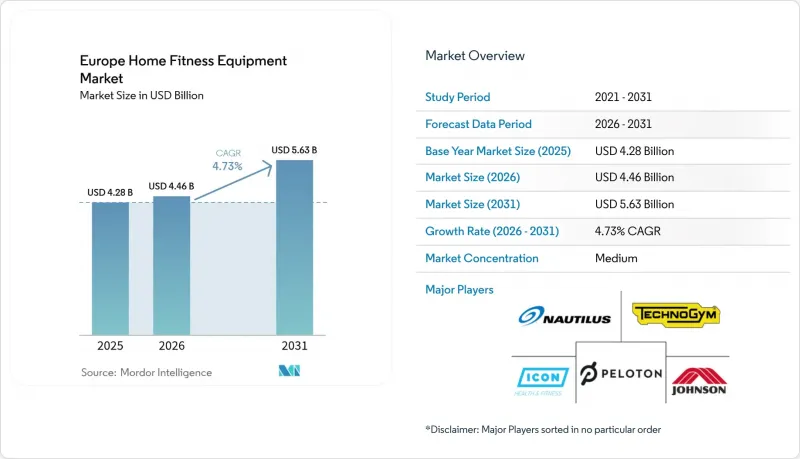
This demand surge signals a lasting lifestyle transformation, not merely a fleeting response to the pandemic. Alarmingly, the World Health Organization reports that 59% of adults in the region are overweight, and 1 in 3 children grapple with obesity. Retail giants are taking note. In January 2025, Decathlon unveiled its Compact Run 100 treadmill, Training Rower 900, and Training Bike 900. These space-efficient, mid-priced offerings cater to the 70% of urban Europeans, where floor space is at a premium. Furthermore, smart equipment with AI-driven form correction is paving the way for subscription-based revenues. Following this trend, Technogym's Checkup platform played a pivotal role in boosting their H1 2024 sales by 11.3%, reaching EUR 406.3 million (USD 440 million). The rise of e-commerce and direct-to-consumer logistics not only streamlines the purchasing process but also allows brands to gather valuable usage data, contributing to a notable 5.82% CAGR in online sales. While Germany holds a dominant 27.63% revenue share, attributed to its established wellness culture, Italy outpaces with a 5.19% growth rate, fueled by proactive government wellness initiatives and a younger, more affluent demographic.
Europe Home Fitness Equipment Market Trends and Insights
Rising obesity and health-awareness wave
In 2024, the World Health Organization's European Regional Obesity Report revealed that 59% of European adults grappled with obesity, a notable rise of 7 percentage points since 2015. Alarmingly, the report also highlighted that 1 in 3 children were affected. In response to this growing concern, national health systems are pivoting their focus towards preventive care. This includes subsidized fitness programs, which, in turn, are driving up demand for home fitness equipment. The WHO's monitoring framework for Health-Enhancing Physical Activity indicated a significant leap in policy achievement across the European Union: 81.8% in 2024, a jump from 64.7% in 2015. This underscores a steadfast governmental commitment to promoting active living. Despite these efforts, cardiovascular diseases continue to dominate, accounting for 45% of regional deaths. This grim statistic has fueled public health campaigns advocating for daily exercise. As clinical evidence mounts and fitness equipment becomes more accessible, even the most sedentary individuals find it easier to embark on strength and cardio training at home. Recognizing the importance of wellness, employers are weaving these metrics into corporate health plans, creating a scenario where owning fitness equipment becomes a tangible indicator of employee engagement.
Rapid product innovation in smart/connected gear
In the first half of 2024, Technogym's Checkup platform, leveraging AI for movement assessments and corrective exercise prescriptions, drove a 11.3% year-on-year revenue surge to EUR 406.3 million (USD 440 million). This underscores the premium pricing potential of software differentiation. Echelon Fitness, in October 2024, unveiled its Strength Home system: a foldable unit boasting a 24-inch HD touchscreen and digital resistance from 5 to 110 pounds, priced at USD 2,999.99. The launch targets urban residents without dedicated workout spaces. Despite Peloton reporting 2.9 million paid connected-fitness subscribers in its Q1 fiscal 2025 results, the company faced a 1.6% year-on-year revenue dip to USD 586 million. This trend suggests hardware saturation is nudging brands towards content monetization. In January 2025, Tonal Systems rolled out a B2B initiative, embedding its electromagnetic resistance units in hotels, physical therapy centers, and private gyms. This move diversifies its revenue channels beyond direct consumer sales. Equipment firmware now integrates biometric sensors, monitoring heart rate, cadence, and power output, for real-time coaching adjustments. However, this advancement amplifies data privacy responsibilities under the General Data Protection Regulation. As a result, manufacturers are channeling investments into fortified cloud systems and clear consent processes.
High upfront equipment cost
Mid-tier treadmills and rowing machines are moderately priced, while premium connected variants from Peloton and Technogym command high prices. This pricing dynamic poses a challenge for households in Italy, Spain, Poland, and Belgium, where median disposable incomes lag behind their Western European counterparts. Nautilus Inc. filed for Chapter 11 bankruptcy in March 2024, a move spurred by a 28.5% drop in cardio-equipment sales. This highlights the fragility of demand, especially when consumers see little distinction between premium and budget offerings. In January 2025, Decathlon rolled out the Compact Run 100 treadmill, priced for the mass market, targeting first-time buyers who value functionality over connectivity. While financing options like installment plans and lease-to-own structures are on the rise, eurozone interest rates remain high. As of December 2024, the European Central Bank's deposit facility rate stood at 3.00%, inflating the effective cost of credit. Although the price-performance gap between traditional and smart equipment is shrinking due to declining component costs, concerns about ongoing subscription fees for connected devices heighten the total cost of ownership worries. Retailers have observed a 25% to 30% drop in conversion rates when checkout pages feature subscription prompts alongside hardware prices, underscoring the friction caused by bundling transparency.
Other drivers and restraints analyzed in the detailed report include:
- Expansion of e-commerce and D2C logistics
- Persistent hybrid (home + gym) workout habits
- Limited living space in dense urban housing
For complete list of drivers and restraints, kindly check the Table Of Contents.
Segment Analysis
Stationary cycles are projected to grow at a 6.04% CAGR from 2026 to 2031, surpassing the broader market's 4.73% growth. Their compact size and affordability attract first-time buyers, particularly in space-constrained urban apartments. Treadmills, contributing 28.64% of 2025's revenue, are popular for walking, jogging, and running. However, their 1.5 to 2.0 square-meter footprint and noise issues limit adoption in multi-family housing. Decathlon's January 2025 launch of the Compact Run 100 treadmill addresses these challenges with a foldable design, though its mass-market focus suggests price competition over advanced features. Rowing machines are gaining popularity for full-body cardio with minimal joint impact, with brands like Hydrow and WaterRower emphasizing natural resistance mechanisms. Elliptical machines, while offering low-impact motion for rehabilitation and older users, face limited market penetration due to their bulkier frames and higher price points.
In Nautilus Inc.'s final pre-bankruptcy quarter, strength training equipment, dumbbells, resistance bands, cable systems, and electromagnetic units like Tonal, which saw a 7.4% sales increase, contrasting with a 28.5% decline in cardio equipment sales. This shift highlights growing consumer interest in functional fitness and muscle preservation. Echelon's October 2024 launch of the Strength Home, priced at USD 2,999.99, targets this trend with a compact design and digital resistance range of 5 to 110 pounds. Other fitness products like yoga mats, foam rollers, and suspension trainers remain fragmented across specialty retailers and lack the recurring-revenue potential of connected equipment, relegating them to a supplementary role. The European Union's Ecodesign for Sustainable Products Regulation, effective September 2026, will mandate durability and reparability disclosures, favoring mechanical products like rowing machines and free weights over electronic treadmills and cycles, which face higher compliance costs.
From 2026 to 2031, smart and connected equipment is projected to grow at a 6.51% CAGR, outpacing conventional variants by nearly 2 percentage points. Manufacturers are enhancing hardware with AI-driven coaching, biometric tracking, and gamified challenges, justifying premium pricing and recurring subscriptions. While conventional equipment captured 74.86% of 2025 revenue, appealing to cost-conscious buyers and subscription skeptics, its growth faces challenges from commoditization and thin margins. Technogym's Checkup platform, leveraging AI for movement assessments and corrective exercise prescriptions, drove an 11.3% year-on-year revenue surge to EUR 406.3 million (USD 440 million) in H1 2024, underscoring the value of software differentiation. Peloton's 2.9 million paid connected-fitness subscribers provide a recurring revenue buffer against hardware losses, yet a 1.6% year-on-year dip in Q1 fiscal 2025 revenue to USD 586 million signals a plateau in subscriber growth.
Smart equipment faces additional compliance costs due to the General Data Protection Regulation, with mid-sized firms incurring an annual burden of EUR 50,000 to EUR 200,000 (USD 54,000 to USD 216,000) for consent, encryption, and data localization mandates. This creates a competitive edge for incumbents with seasoned legal teams. Decathlon's April 2025 alliance with Freeletics, offering a 3-month complimentary subscription with equipment buys and aiming for over 100 co-branded products by end-2026, showcases mass-market retailers' strategy of tapping into the connected segment via content ecosystems. Tonal's January 2025 shift to a B2B approach, installing electromagnetic resistance units in hotels and physical-therapy centers, broadens its revenue avenues and mitigates subscription-churn hurdles. While conventional equipment's straightforwardness, free from firmware updates, cloud dependencies, and recurring fees, ensures its lasting appeal, the lack of usage analytics curtails manufacturers' potential for product design optimization and upselling services.
The Europe Home Fitness Equipment Market is Segmented by Product Type (Treadmills, Elliptical Machines, Stationary Cycles, Rowing Machines, and More), Category (Conventional and Smart/Connected Equipment), End User (Male and Female), Distribution Channel (Offline Retail Stores and Online Retail Stores), and Geography. The Market Forecasts are Provided in Terms of Value (USD).
List of Companies Covered in this Report:
- Technogym
- Peloton Interactive, Inc.
- ICON Health & Fitness (NordicTrack, ProForm)
- Johnson Health Tech (Horizon, Matrix)
- Life Fitness (Brunswick)
- Nautilus Inc. (Bowflex, Schwinn)
- Echelon Fitness
- Tonal Systems
- NOHrD/WaterRower
- BH Fitness
- Decathlon SA
- Hammer Sport AG
- Sport-Tiedje GmbH
- JTX Fitness
- Sport-Thieme GmbH
- Volava
- Hydrow
- True Fitness
- Precor
- Star Trac/Core Health & Fitness
Additional Benefits:
- The market estimate (ME) sheet in Excel format
- 3 months of analyst support
TABLE OF CONTENTS
1 INTRODUCTION
- 1.1 Study Assumptions and Market Definition
- 1.2 Scope of the Study
2 RESEARCH METHODOLOGY
3 EXECUTIVE SUMMARY
4 MARKET LANDSCAPE
- 4.1 Market Overview
- 4.2 Market Drivers
- 4.2.1 Rising obesity and health-awareness wave
- 4.2.2 Rapid product innovation in smart/connected gear
- 4.2.3 Expansion of e-commerce and D2C logistics
- 4.2.4 Persistent hybrid (home + gym) workout habits
- 4.2.5 EU "Green Deal" spurring demand for energy-efficient equipment
- 4.2.6 Employer-subsidised home-fitness programmes for remote staff
- 4.3 Market Restraints
- 4.3.1 High upfront equipment cost
- 4.3.2 Limited living space in dense urban housing
- 4.3.3 Subscription-fatigue toward digital content fees
- 4.3.4 GDPR-driven data-privacy compliance costs
- 4.4 Consumer Behaviour Analysis
- 4.5 Regulatory Landscape
- 4.6 Technological Outlook
- 4.7 Porter's Five Forces
- 4.7.1 Threat of New Entrants
- 4.7.2 Bargaining Power of Buyers
- 4.7.3 Bargaining Power of Suppliers
- 4.7.4 Threat of Substitutes
- 4.7.5 Competitive Rivalry
5 MARKET SIZE AND GROWTH FORECASTS (VALUE)
- 5.1 Product Type
- 5.1.1 Treadmills
- 5.1.2 Elliptical Machines
- 5.1.3 Stationary Cycles
- 5.1.4 Rowing Machines
- 5.1.5 Strength Training Equipment
- 5.1.6 Other Product Types
- 5.2 Category
- 5.2.1 Conventional
- 5.2.2 Smart/Connected Equipment
- 5.3 End User
- 5.3.1 Male
- 5.3.2 Female
- 5.4 Distribution Channel
- 5.4.1 Offline Retail Stores
- 5.4.2 Online Retail Stores
- 5.5 Geography
- 5.5.1 United Kingdom
- 5.5.2 Germany
- 5.5.3 France
- 5.5.4 Italy
- 5.5.5 Spain
- 5.5.6 Netherlands
- 5.5.7 Poland
- 5.5.8 Belgium
- 5.5.9 Sweden
- 5.5.10 Rest of Europe
6 COMPETITIVE LANDSCAPE
- 6.1 Market Concentration
- 6.2 Strategic Moves
- 6.3 Market Share Analysis
- 6.4 Company Profiles (includes Global level Overview, Market level overview, Core Segments, Financials as available, Strategic Information, Market Rank/Share for key companies, Products and Services, and Recent Developments)
- 6.4.1 Technogym
- 6.4.2 Peloton Interactive, Inc.
- 6.4.3 ICON Health & Fitness (NordicTrack, ProForm)
- 6.4.4 Johnson Health Tech (Horizon, Matrix)
- 6.4.5 Life Fitness (Brunswick)
- 6.4.6 Nautilus Inc. (Bowflex, Schwinn)
- 6.4.7 Echelon Fitness
- 6.4.8 Tonal Systems
- 6.4.9 NOHrD/WaterRower
- 6.4.10 BH Fitness
- 6.4.11 Decathlon SA
- 6.4.12 Hammer Sport AG
- 6.4.13 Sport-Tiedje GmbH
- 6.4.14 JTX Fitness
- 6.4.15 Sport-Thieme GmbH
- 6.4.16 Volava
- 6.4.17 Hydrow
- 6.4.18 True Fitness
- 6.4.19 Precor
- 6.4.20 Star Trac/Core Health & Fitness
7 MARKET OPPORTUNITIES AND FUTURE OUTLOOK

