PUBLISHER: Mordor Intelligence | PRODUCT CODE: 2043939

PUBLISHER: Mordor Intelligence | PRODUCT CODE: 2043939
Nail Polish - Market Share Analysis, Industry Trends & Statistics, Growth Forecasts (2026 - 2031)
The nail polish market is expected to grow significantly, increasing from USD 5.28 billion in 2025 and USD 5.59 billion in 2026 to USD 7.43 billion by 2031. This represents a compound annual growth rate (CAGR) of 5.86% during the forecast period from 2026 to 2031.
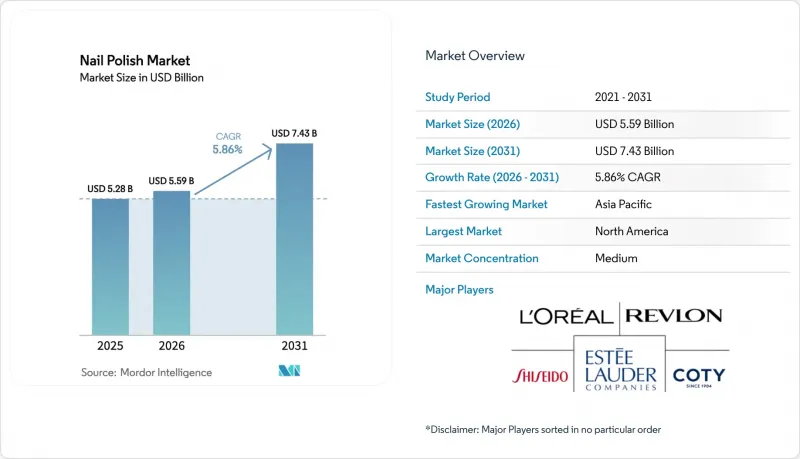
Several factors are driving this growth. Regulatory bans on harmful photoinitiators in regions such as the European Union and California have pushed companies to invest in research and development to develop safer, cleaner nail polish formulas. By product type, gel nail polishes are gaining popularity and are outpacing traditional lacquer formats due to their durability and finish. In terms of coat type, base coats currently dominate the market, while top coats are also experiencing accelerated growth. When categorized by formula, conventional nail polishes continue to lead the market, but demand for natural or organic options is rising as consumers become more environmentally conscious. The market remains moderately consolidated, with established players and emerging brands competing to meet evolving consumer preferences.
Global Nail Polish Market Trends and Insights
Growing demand for clean, non-toxic, halal and vegan formulations
The demand for clean, non-toxic, halal, and vegan nail polish is growing as consumers increasingly prioritize safety, ethical practices, and transparency in product ingredients. According to the World Animal Foundation, the global vegan population is expected to reach approximately 88 million out of over 8.3 billion people by February 2026. Similarly, data from the Islamic City indicates that Muslims, who make up about 24.1% of the global population, total nearly 2 billion people as of 2025. This significant demographic is driving the demand for halal-certified beauty products. At the same time, regulatory restrictions on certain ingredients, such as TPO and HEMA, are prompting manufacturers to develop safer alternatives, including HEMA-free, long-lasting nail polish systems. Despite their higher price points, premium clean products are gaining popularity among consumers who value quality and safety. For instance, Iba Cosmetics offers halal-certified, breathable nail polishes that allow water vapor to permeate while adhering to ethical standards.
Demand for long-lasting and chip-resistant formulations
The growing preference for nail polishes that last longer and resist chipping is fueling the expansion of gel and dip powder segments. Consumers are seeking products that deliver salon-quality results at home. Brands are introducing innovations like one-step gel polishes that work with affordable, portable lamps, making the application process easier and more accessible for beginners. Companies are improving their formulations by incorporating features such as high-pigment colors, flexible polymers, and self-leveling properties. Many of these products promise extended wear, often lasting up to ten days without chipping, which appeals to consumers even at higher price points due to the value they provide. Retailers are also focusing on stocking high-performance products, favoring brands that back their durability claims with testing and customer feedback. For example, Sally Hansen's Miracle Gel line, OPI GelColor, and Kiara Sky Dip Powder are well-known for delivering long-lasting, chip-resistant results, making them popular choices in the market.
Availability of low-cost counterfeit and unbranded products
The presence of cheap counterfeit and unbranded nail polish products is a major challenge for the global market. These low-cost alternatives raise serious health and safety risks. Counterfeit products often contain poor-quality or harmful ingredients, such as industrial dyes or heavy metals, which can harm users and damage the reputation of trusted brands. Since these products are priced much lower, they attract budget-conscious consumers, resulting in revenue losses for legitimate manufacturers. To address this issue, leading brands are taking steps to combat counterfeiting. They are implementing measures like QR-code verification to help customers identify genuine products, selling directly to consumers through official channels, and tightening control over their distribution networks. While these efforts increase operational costs, they are essential for protecting brand integrity. Companies are working to educate consumers about the risks of counterfeit products and the benefits of choosing authentic, high-quality options.
Other drivers and restraints analyzed in the detailed report include:
- Influence of celebrity endorsements and brand collaborations
- Advancements in nail polish application technologies
- Stringent regulatory requirements on cosmetic ingredients
For complete list of drivers and restraints, kindly check the Table Of Contents.
Segment Analysis
In 2025, traditional liquid nail polish held the largest share of the nail polish market, accounting for 49.34% of total sales. This dominance was due to its affordability, ease of use, and widespread availability in retail stores. It remained a popular choice, especially in markets with high price sensitivity. The segment also benefited from a wide variety of shades, frequent product updates, and strong brand visibility across both physical and online retail platforms. Additionally, advancements in quick-dry formulas and improved product quality further reinforced its appeal among consumers.
On the other hand, gel nail polish emerged as the fastest-growing segment and is expected to grow at a CAGR of 7.23% through 2031. Its rising popularity is driven by consumer demand for long-lasting, salon-like finishes that are durable and chip-resistant. The increasing availability of at-home manicure kits and UV/LED curing devices has made gel polish more accessible to a broader audience. Furthermore, ongoing innovations in gel formulations and the growing trend of DIY beauty have significantly contributed to its rapid adoption. This segment is poised for continued growth as consumers prioritize convenience and professional-quality results.
Base coats accounted for a significant 67.03% share of the global nail polish market in 2025, primarily because they are a crucial step in achieving long-lasting manicures. These products help nail polish adhere better, prevent nail discoloration, and ensure the polish stays intact for longer. Their consistent use by both professionals and individuals at home has made them a staple in the nail care routine. Additionally, the introduction of base coats with added benefits, such as nail strengthening and nourishment, has further boosted their popularity and demand among consumers.
Top coats, meanwhile, are expected to grow at a steady CAGR of 6.54% through 2031, driven by rising consumer preference for a polished, durable finish. These products are gaining popularity for their ability to deliver a gel-like shine and extend nail polish's lifespan without UV light. Quick-drying, chip-resistant formulations have made top coats more convenient for users, especially those seeking efficient at-home manicure solutions. Moreover, the rising trend of DIY nail care and the desire for salon-quality results at home are key drivers of this segment's growth.
The Nail Polish Market Report is Segmented by Product Type (Gel Nail Polish, Dip Powder Nail Polish, and More), Coat Type (Base Coat and Top Coat), Category (Natural/Organic and Conventional/Synthetic), Price Range (Mass and Premium), Distribution Channel (Supermarkets/Hypermarkets, Specialty Stores, and More), and Geography (North America, Europe, Asia-Pacific, and More). The Market Forecasts are Provided in Terms of Value (USD).
Geography Analysis
North America accounted for 33.58% of nail polish market revenue in 2025, driven by high consumer spending on beauty products and the popularity of premium nail polish formulations. The region's well-established retail networks and strong brand presence played a key role in maintaining its dominance. Europe also showed steady performance, supported by consistent demand for nail care products. Meanwhile, regions like Asia-Pacific and Latin America, though starting from a smaller base, showed promising growth as they expanded their market presence. Developed regions continued to lead due to their advanced distribution systems and high product awareness.
Asia-Pacific is expected to grow at the fastest rate, with a CAGR of 7.36% projected through 2031. This growth is fueled by increasing disposable incomes and greater access to beauty products in the region. The rapid expansion of e-commerce platforms and digital tools has made nail polish products more accessible to consumers, boosting engagement and sales. Additionally, the Middle East and Africa and South America are also anticipated to grow steadily, supported by improving retail infrastructure and changing consumer preferences. These emerging markets are becoming significant contributors to the global nail polish industry.
Globally, the nail polish market reflects a combination of mature and growing regions. Developed markets are focusing on innovation and premium products to retain their consumer base, while emerging markets are emphasizing affordability and accessibility to attract new customers. The rise of online shopping and direct-to-consumer models is transforming how brands connect with buyers worldwide. At the same time, localization strategies and evolving regulations are shaping product offerings and distribution methods. These trends are expected to influence the competitive landscape across all regions in the coming years.
- LVMH Moet Hennessy Louis Vuitton SE
- L'Oreal S.A.
- Revlon Inc.
- The Estee Lauder Companies
- Chanel Ltd.
- Shiseido Co., Ltd.
- Coty Inc.
- Orly International, Inc.
- Avon Products Inc.
- Wella Company
- Art of Beauty, Inc.
- FACES Cosmetics India Pvt. Ltd.
- Nails Inc. Ltd.
- Deborah Lippmann LLC
- Colorbar Cosmetics
- The Good Glamm Group
- Unilever plc
- Ecotrail Personal Care Pvt. Ltd. (Iba)
- LoveChild by Masaba
- Kering SA
Additional Benefits:
- The market estimate (ME) sheet in Excel format
- 3 months of analyst support
TABLE OF CONTENTS
1 INTRODUCTION
- 1.1 Study Assumptions and Market Definition
- 1.2 Scope of the Study
2 RESEARCH METHODOLOGY
3 EXECUTIVE SUMMARY
4 MARKET LANDSCAPE
- 4.1 Market Overview
- 4.2 Market Drivers
- 4.2.1 Increasing focus on personal grooming and appearance
- 4.2.2 Demand for long-lasting and chip-resistant formulations
- 4.2.3 Demand for everyday, office-friendly nail styles such as "soap nails"
- 4.2.4 Influence of celebrity endorsements and brand collaborations
- 4.2.5 Advancements in nail polish application technologies
- 4.2.6 Growing demand for clean, non-toxic, halal and vegan formulations
- 4.3 Market Restraints
- 4.3.1 Availability of low-cost counterfeit and unbranded products
- 4.3.2 Skin sensitivity and allergic reactions among users
- 4.3.3 Growing concerns over harmful chemicals in formulations
- 4.3.4 Stringent regulatory requirements on cosmetic ingredients
- 4.4 Consumer Behavior Analysis
- 4.5 Regulatory Outlook
- 4.6 Porter's Five Forces
- 4.6.1 Threat of New Entrants
- 4.6.2 Bargaining Power of Buyers
- 4.6.3 Bargaining Power of Suppliers
- 4.6.4 Threat of Substitute Products
- 4.6.5 Intensity of Competitive Rivalry
5 MARKET SIZE AND GROWTH FORECASTS (VALUE)
- 5.1 By Product Type
- 5.1.1 Traditional/Liquid Nail Polish
- 5.1.2 Gel Nail Polish
- 5.1.3 Dip Powder Nail Polish
- 5.1.4 Others
- 5.2 By Coat Type
- 5.2.1 Base Coat
- 5.2.2 Top Coat
- 5.3 By Category
- 5.3.1 Natural/Organic
- 5.3.2 Conventional/Synthetic
- 5.4 By Price Range
- 5.4.1 Mass
- 5.4.2 Premium
- 5.5 By Distribution Channel
- 5.5.1 Supermarkets/Hypermarkets
- 5.5.2 Specialty Stores
- 5.5.3 Online Retail Stores
- 5.5.4 Other Distribution Channels
- 5.6 By Geography
- 5.6.1 North America
- 5.6.1.1 United States
- 5.6.1.2 Canada
- 5.6.1.3 Mexico
- 5.6.1.4 Rest of North America
- 5.6.2 South America
- 5.6.2.1 Brazil
- 5.6.2.2 Argentina
- 5.6.2.3 Colombia
- 5.6.2.4 Chile
- 5.6.2.5 Peru
- 5.6.2.6 Rest of South America
- 5.6.3 Europe
- 5.6.3.1 Germany
- 5.6.3.2 United Kingdom
- 5.6.3.3 Italy
- 5.6.3.4 France
- 5.6.3.5 Spain
- 5.6.3.6 Poland
- 5.6.3.7 Belgium
- 5.6.3.8 Sweden
- 5.6.3.9 Rest of Europe
- 5.6.4 Asia-Pacific
- 5.6.4.1 China
- 5.6.4.2 Japan
- 5.6.4.3 India
- 5.6.4.4 Australia
- 5.6.4.5 Indonesia
- 5.6.4.6 South Korea
- 5.6.4.7 Thailand
- 5.6.4.8 Singapore
- 5.6.4.9 Rest of Asia-Pacific
- 5.6.5 Middle East and Africa
- 5.6.5.1 South Africa
- 5.6.5.2 Saudi Arabia
- 5.6.5.3 United Arab Emirates
- 5.6.5.4 Nigeria
- 5.6.5.5 Egypt
- 5.6.5.6 Morocco
- 5.6.5.7 Turkey
- 5.6.5.8 Rest of Middle East and Africa
- 5.6.1 North America
6 COMPETITIVE LANDSCAPE
- 6.1 Market Concentration
- 6.2 Strategic Moves
- 6.3 Market Share Analysis
- 6.4 Company Profiles (includes Global-level Overview, Market-level Overview, Core Segments, Financials (if available), Strategic Information, Market Rank/Share, Products and Services, Recent Developments)
- 6.4.1 LVMH Moet Hennessy Louis Vuitton SE
- 6.4.2 L'Oreal S.A.
- 6.4.3 Revlon Inc.
- 6.4.4 The Estee Lauder Companies
- 6.4.5 Chanel Ltd.
- 6.4.6 Shiseido Co., Ltd.
- 6.4.7 Coty Inc.
- 6.4.8 Orly International, Inc.
- 6.4.9 Avon Products Inc.
- 6.4.10 Wella Company
- 6.4.11 Art of Beauty, Inc.
- 6.4.12 FACES Cosmetics India Pvt. Ltd.
- 6.4.13 Nails Inc. Ltd.
- 6.4.14 Deborah Lippmann LLC
- 6.4.15 Colorbar Cosmetics
- 6.4.16 The Good Glamm Group
- 6.4.17 Unilever plc
- 6.4.18 Ecotrail Personal Care Pvt. Ltd. (Iba)
- 6.4.19 LoveChild by Masaba
- 6.4.20 Kering SA
7 MARKET OPPORTUNITIES AND FUTURE OUTLOOK

