PUBLISHER: Mordor Intelligence | PRODUCT CODE: 2043941

PUBLISHER: Mordor Intelligence | PRODUCT CODE: 2043941
Tomato Powder - Market Share Analysis, Industry Trends & Statistics, Growth Forecasts (2026 - 2031)
The tomato powder market size is expected to grow from USD 1.61 billion in 2025 to USD 1.71 billion in 2026 and is forecast to reach USD 2.29 billion by 2031 at 6.02% CAGR over 2026-2031.
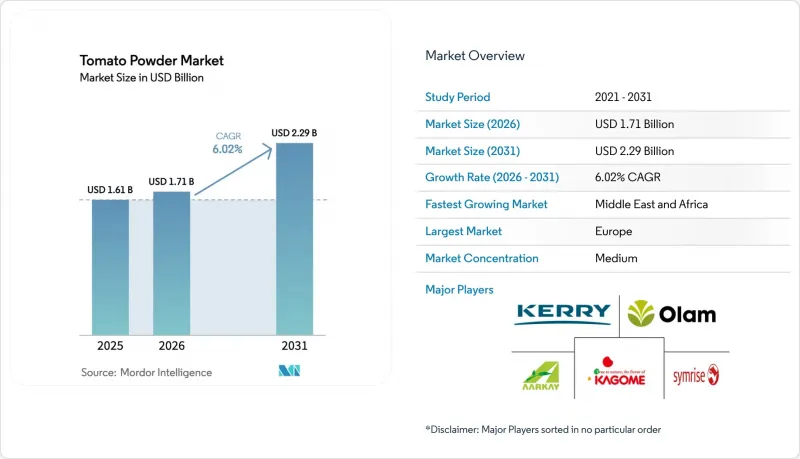
This growth is primarily driven by its extensive use in processed foods such as soups, sauces, seasonings, and ready-to-eat meals. Additionally, the longer shelf life and ease of storage compared to fresh tomatoes make it a preferred choice for both manufacturers and consumers. Food manufacturers are increasingly incorporating tomato powder as a natural flavoring and coloring agent, aligning with clean-label trends. Furthermore, the growth of the foodservice industry and expansion of packaged food sectors are contributing to higher consumption levels. Emerging markets are also playing a key role, driven by urbanization and rising disposable incomes. Overall, the market is expected to witness sustained growth, supported by product innovation and expanding application areas.
Global Tomato Powder Market Trends and Insights
Rising demand for clean-label and natural food ingredients
The rising demand for clean-label and natural food ingredients is a key factor driving the growth of the tomato powder market globally. Consumers are increasingly seeking products with simple, transparent ingredient lists, free from artificial additives, preservatives, and synthetic colors, which positions tomato powder as a favorable natural alternative. Derived from dehydrated tomatoes, it offers a clean-label solution for flavoring, coloring, and nutritional enhancement across various food applications. This shift is particularly evident in processed and convenience foods, where manufacturers are reformulating products to meet evolving consumer expectations. According to research by the CBI Ministry of Foreign Affairs, clean-label products are projected to account for over 70% of product portfolios in 2025 and 2026, up from 52% in 2021, highlighting the rapid transition toward natural ingredients. According to Kerry Nutrition Report 2025, 50% of Brazilian consumer's preferred natural ingredients. This growing preference is encouraging food producers to replace artificial tomato-based additives with powdered forms. As a result, tomato powder is gaining traction as a versatile, shelf-stable, and label-friendly ingredient across global markets.
Increasing consumption of ready-to-eat and convenience foods
The growing demand for ready-to-eat and convenience food products is significantly contributing to the expansion of the tomato powder market. As busy lifestyles and increasing urbanization drive the need for quick and easy meal solutions, consumers are relying more on packaged and instant food options. Tomato powder is widely utilized in these products due to its extended shelf life, ease of handling, and ability to quickly reconstitute while maintaining flavor and color. It is commonly incorporated into instant soups, sauces, snack seasonings, and prepared meals, enhancing both taste and visual appeal. Moreover, manufacturers favor tomato powder as it simplifies storage and transportation compared to fresh tomatoes, reducing overall operational costs. The rising popularity of convenience foods across global markets is therefore boosting its demand. Consequently, tomato powder continues to gain importance as a versatile and efficient ingredient in modern food processing.
Fluctuations in raw tomato prices and seasonal supply instability
Fluctuations in raw tomato prices and seasonal supply instability represent a significant restraint for the tomato powder market. The availability and cost of processing tomatoes are highly dependent on climatic conditions, agricultural inputs, and regional production dynamics, leading to inconsistent supply and pricing volatility. For instance, California processing-tomato acreage contracted to 9.25 million tons in 2025, reflecting an 11% decline from 10.25 million tons in 2024, indicating tightening raw material availability. Furthermore, projections for 2026 suggest that planted area may fall below 200,000 acres for the first time in five decades, driven by water allocation restrictions, labor shortages, and a shift of growers toward more profitable crops such as tree nuts. These structural challenges directly impact the cost of raw tomatoes used in powder production. As a result, manufacturers face margin pressures and potential disruptions in supply continuity. This volatility makes long-term pricing strategies and production planning increasingly complex for industry participants.
Other drivers and restraints analyzed in the detailed report include:
- Technological advancements in drying and dehydration processes
- Surging demand for shelf-stable and long-lasting food ingredients
- High production and processing costs (drying technologies, equipment)
For complete list of drivers and restraints, kindly check the Table Of Contents.
Segment Analysis
Conventional tomato powder held the dominant position in the market in 2025, accounting for 85.71% of the total market share. This strong presence is largely attributed to its cost-effectiveness and widespread availability across global markets. Food manufacturers prefer conventional variants due to their consistent quality, stable supply, and suitability for large-scale production. The segment is extensively used in processed foods such as sauces, soups, snacks, and ready-to-eat meals, where pricing and bulk usage are key considerations. Additionally, well-established supply chains and large-scale tomato cultivation support the continued dominance of conventional products. Its versatility as a flavoring and coloring agent further enhances its adoption across both food processing and foodservice industries.
The organic tomato powder segment is projected to be the fastest-growing category, expanding at a CAGR of 8.46% through 2031. This growth is driven by increasing consumer awareness regarding health, sustainability, and clean-label food products. Consumers are increasingly seeking organic alternatives that are free from synthetic pesticides, fertilizers, and additives. As a result, food manufacturers are incorporating organic tomato powder into premium product lines to cater to this growing demand. The segment is also benefiting from the expansion of organic food retail channels and certifications that build consumer trust. Additionally, rising disposable incomes and a shift toward healthier dietary habits are further supporting its growth.
The Tomato Powder Market Report is Segmented by Product Type (Conventional and Organic), Process Technology (Spray-Dried, Freeze-Dried, Vacuum-Dried, Others), End Use (Food Processing, Foodservice/HoReCa, Retail), and Geography (North America, Europe, Asia-Pacific, South America, Middle East and Africa). The Market Forecasts are Provided in Terms of Value (USD).
Geography Analysis
Europe held the largest share of the tomato powder market in 2025, accounting for 35.65% of the global market size. This dominance is supported by the region's well-established food processing industry and high consumption of tomato-based products. Countries such as Italy, Spain, and Germany are key contributors, driven by strong culinary traditions that rely heavily on tomato ingredients. The demand for convenience foods, including ready meals, sauces, and soups, further boosts the use of tomato powder across the region. Additionally, increasing preference for clean-label and natural ingredients is encouraging manufacturers to adopt tomato powder as a natural flavoring and coloring agent. Advanced supply chains, strong retail networks, and high consumer awareness also contribute to sustained market leadership.
The Middle East and Africa region is projected to be the fastest-growing market, expanding at a CAGR of 7.31% through 2031. This growth is driven by rapid urbanization, rising disposable incomes, and increasing demand for processed and convenience foods. Tomato powder is gaining popularity due to its long shelf life and suitability for regions with limited cold storage infrastructure. The expanding foodservice sector, including restaurants and catering services, is also contributing to higher consumption levels. Additionally, population growth and changing dietary patterns are supporting demand for affordable and easy-to-use food ingredients. As distribution networks and retail infrastructure continue to develop, the region is expected to offer significant growth opportunities for market players.
North America and Asia-Pacific represent significant and steadily growing markets for tomato powder, supported by strong demand from both food processing and retail sectors. In North America, the market is driven by the widespread consumption of packaged and convenience foods, along with increasing demand for natural and clean-label ingredients. Asia-Pacific is witnessing rapid growth due to urbanization, expanding food processing industries, and rising adoption of Western-style diets in countries such as China and India. Meanwhile, South America is emerging as a promising market, supported by abundant tomato production and increasing exports of processed food products. Across these regions, the growth of e-commerce, product innovation, and expanding application areas are key factors driving market expansion.
- Kerry Group PLC
- Symrise AG
- Olam International Limited
- Kagome Co., Ltd.
- Aarkay Food Products Ltd.
- SUNOPTA INC.
- Ingredion Incorporated
- Givaudan SA
- Dohler GmbH
- Archer Daniels Midland Company
- International Flavors & Fragrances Inc.
- Kalsec Inc.
- COFCO Tunhe Tomato Co., Ltd.
- Lycored Ltd.
- Silva International, Inc.
- Agraz S.A.
- Vegenat S.A.
- Cham Foods Ltd.
- Harmony House Foods, Inc.
- Garlico Industries Ltd.
Additional Benefits:
- The market estimate (ME) sheet in Excel format
- 3 months of analyst support
TABLE OF CONTENTS
1 INTRODUCTION
- 1.1 Study Assumptions and Market Definition
- 1.2 Scope of the Study
2 RESEARCH METHODOLOGY
3 EXECUTIVE SUMMARY
4 MARKET LANDSCAPE
- 4.1 Market Overview
- 4.2 Market Drivers
- 4.2.1 Rising demand for clean-label and natural food ingredients
- 4.2.2 Increasing consumption of ready-to-eat and convenience foods
- 4.2.3 Technological advancements in drying and dehydration processes
- 4.2.4 Surging demand for shelf-stable and long-lasting food ingredients
- 4.2.5 Growing focus on food waste reduction and efficient ingredient utilization
- 4.2.6 Expansion of the food processing industry
- 4.3 Market Restraints
- 4.3.1 Fluctuations in raw tomato prices and seasonal supply instability
- 4.3.2 High production and processing costs (drying technologies, equipment)
- 4.3.3 Quality consistency challenges due to variability in raw materials
- 4.3.4 Stringent food safety and regulatory compliance requirements
- 4.4 Supply-Chain Analysis
- 4.5 Regulatory Landscape
- 4.6 Technological Outlook
- 4.7 Porter's Five Forces Analysis
- 4.7.1 Threat of New Entrants
- 4.7.2 Bargaining Power of Buyers
- 4.7.3 Bargaining Power of Suppliers
- 4.7.4 Threat of Substitutes
- 4.7.5 Intensity of Competitive Rivalry
5 MARKET SIZE AND GROWTH FORECASTS (VALUE)
- 5.1 By Product Type
- 5.1.1 Conventional
- 5.1.2 Organic
- 5.2 By Process Technology
- 5.2.1 Spray-Dried
- 5.2.2 Freeze-Dried
- 5.2.3 Vacuum-Dried
- 5.2.4 Others (Sun-Dried, Drum Dried)
- 5.3 By End Use
- 5.3.1 Food Processing
- 5.3.1.1 Soups and Sauces
- 5.3.1.2 Bakery and Snacks
- 5.3.1.3 Seasonings and Flavors
- 5.3.1.4 Ready Meals and Instant Mixes
- 5.3.1.5 Others
- 5.3.2 Foodservice/HoreCa
- 5.3.3 Retail
- 5.3.3.1 Supermarkets/Hypermarkets
- 5.3.3.2 Convenience Stores
- 5.3.3.3 Online Retail Stores
- 5.3.3.4 Others
- 5.3.1 Food Processing
- 5.4 By Geography
- 5.4.1 North America
- 5.4.1.1 United States
- 5.4.1.2 Canada
- 5.4.1.3 Mexico
- 5.4.1.4 Rest of North America
- 5.4.2 Europe
- 5.4.2.1 Germany
- 5.4.2.2 United Kingdom
- 5.4.2.3 Italy
- 5.4.2.4 France
- 5.4.2.5 Spain
- 5.4.2.6 Netherlands
- 5.4.2.7 Poland
- 5.4.2.8 Belgium
- 5.4.2.9 Sweden
- 5.4.2.10 Rest of Europe
- 5.4.3 Asia-Pacific
- 5.4.3.1 China
- 5.4.3.2 India
- 5.4.3.3 Japan
- 5.4.3.4 Australia
- 5.4.3.5 Indonesia
- 5.4.3.6 South Korea
- 5.4.3.7 Thailand
- 5.4.3.8 Singapore
- 5.4.3.9 Rest of Asia-Pacific
- 5.4.4 South America
- 5.4.4.1 Brazil
- 5.4.4.2 Argentina
- 5.4.4.3 Colombia
- 5.4.4.4 Chile
- 5.4.4.5 Peru
- 5.4.4.6 Rest of South America
- 5.4.5 Middle East and Africa
- 5.4.5.1 South Africa
- 5.4.5.2 Saudi Arabia
- 5.4.5.3 United Arab Emirates
- 5.4.5.4 Nigeria
- 5.4.5.5 Egypt
- 5.4.5.6 Morocco
- 5.4.5.7 Turkey
- 5.4.5.8 Rest of Middle East and Africa
- 5.4.1 North America
6 COMPETITIVE LANDSCAPE
- 6.1 Market Concentration
- 6.2 Strategic Moves
- 6.3 Market Share Analysis
- 6.4 Company Profiles (includes Global level Overview, Market level overview, Core Segments, Financials as available, Strategic Information, Market Rank/Share for key companies, Products and Services, and Recent Developments)
- 6.4.1 Kerry Group PLC
- 6.4.2 Symrise AG
- 6.4.3 Olam International Limited
- 6.4.4 Kagome Co., Ltd.
- 6.4.5 Aarkay Food Products Ltd.
- 6.4.6 SUNOPTA INC.
- 6.4.7 Ingredion Incorporated
- 6.4.8 Givaudan SA
- 6.4.9 Dohler GmbH
- 6.4.10 Archer Daniels Midland Company
- 6.4.11 International Flavors & Fragrances Inc.
- 6.4.12 Kalsec Inc.
- 6.4.13 COFCO Tunhe Tomato Co., Ltd.
- 6.4.14 Lycored Ltd.
- 6.4.15 Silva International, Inc.
- 6.4.16 Agraz S.A.
- 6.4.17 Vegenat S.A.
- 6.4.18 Cham Foods Ltd.
- 6.4.19 Harmony House Foods, Inc.
- 6.4.20 Garlico Industries Ltd.
7 MARKET OPPORTUNITIES AND FUTURE OUTLOOK

