
PUBLISHER: Mordor Intelligence | PRODUCT CODE: 2043955

PUBLISHER: Mordor Intelligence | PRODUCT CODE: 2043955
Organic Yogurt - Market Share Analysis, Industry Trends & Statistics, Growth Forecasts (2026 - 2031)
The global organic yogurt market is witnessing steady growth, driven by increasing consumer preference for health-focused, clean-label, and functional food products. The market was valued at USD 11.90 billion in 2025, is estimated to reach USD 12.88 billion in 2026, and is projected to grow to USD 19.11 billion by 2031, registering a CAGR of 8.21% during 2026-2031.
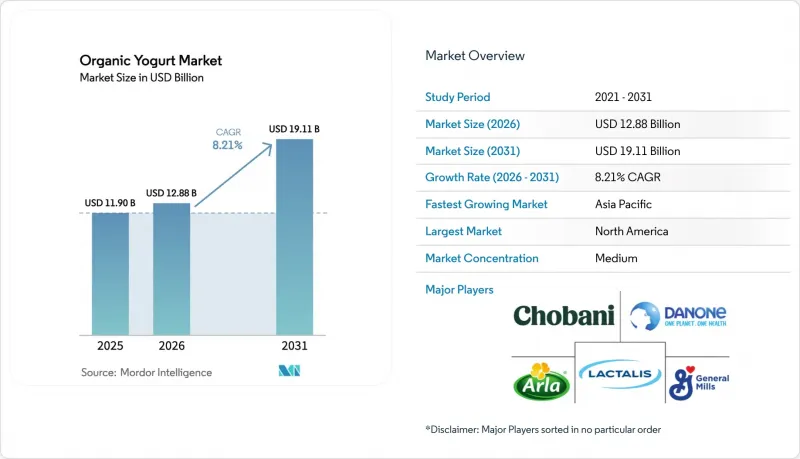
This growth is attributed to the rising incorporation of organic yogurt into daily diets as consumers prioritize nutrient-rich foods offering benefits such as digestive health support, high protein content, and natural ingredients. Growing awareness of gut health and the role of probiotics is further driving demand, establishing organic yogurt as both a staple and a functional dietary choice. Additionally, changing lifestyle patterns, including busy schedules and the need for convenient, ready-to-eat options, are boosting the popularity of organic yogurt for various consumption occasions such as breakfast, snacking, and post-workout nutrition.
Global Organic Yogurt Market Trends and Insights
Rising health and wellness awareness
Consumers increasingly view organic yogurt as a functional food that provides essential nutrients, including protein, probiotics, and calcium, without artificial additives or synthetic ingredients. This perception is strongly supported by scientific research, which highlights the benefits of probiotic yogurt in improving glycemic control, enhancing gut health, and supporting microbiome recovery, particularly after antibiotic use. Consequently, organic yogurt is becoming popular not only as a daily dietary choice but also as a targeted health-focused product. Additionally, the growing emphasis on protein consumption is significantly driving demand, particularly for high-protein options like Greek organic yogurt. According to the International Food Information Council's 2025 Food & Health Survey, nearly 70% of Americans are actively seeking to increase their protein intake, which directly supports the expansion of protein-rich organic yogurt products .
Convenience and on-the-go consumption trends
Convenience and on-the-go consumption trends are major factors driving the global organic yogurt market. As busy lifestyles become more prevalent, consumers are increasingly seeking quick, portable, and ready-to-eat nutritional options. Organic yogurt, especially in single-serve and drinkable formats, integrates well into modern routines such as commuting, office snacking, and post-workout consumption, offering strong nutritional value without requiring preparation. This emphasis on convenience is also broadening consumption occasions beyond traditional meals, positioning organic yogurt as a versatile snack or mini-meal option. For example, in January 2025, Little Spoon introduced YoGos, an on-the-go yogurt product made with organic whole milk Greek yogurt. YoGos provide 4 grams of protein, real fruit, hidden vegetables, and probiotics, addressing both convenience and nutrition needs.
Higher price premium compared to conventional yogurt
The higher price premium of organic yogurt compared to conventional yogurt serves as a significant restraint on the global organic yogurt market. The elevated cost of organic production directly leads to higher retail prices, which limits broader consumer adoption. Organic yogurt production requires certified organic milk, necessitating stricter farming practices, higher feed costs, and lower yield efficiencies compared to conventional dairy farming. Additionally, costs associated with certification, compliance, and supply chain segregation further contribute to increased production expenses. Consequently, organic yogurt is often priced significantly higher than conventional alternatives, making it less accessible to price-sensitive consumers and discouraging frequent purchases. This pricing disparity is particularly pronounced in emerging markets, where affordability often takes precedence over perceived health and environmental benefits. Even among health-conscious consumers, the premium pricing can restrict consumption to occasional purchases rather than regular use.
Other drivers and restraints analyzed in the detailed report include:
- Clean-label and natural ingredient Preference
- Preference for sustainable, eco-friendly farming practices
- Supply constraints of organic milk
For complete list of drivers and restraints, kindly check the Table Of Contents.
Segment Analysis
The flavored organic yogurt segment, which accounted for 61.09% of the market share in 2025, is a significant driver of growth in the global organic yogurt market. This segment enhances product appeal, increases consumption frequency, and broadens consumer reach beyond traditional health-focused buyers. The inclusion of natural fruit blends, botanical extracts, and dessert-inspired flavors improves palatability, making organic yogurt more appealing to a wider audience, including children and first-time organic consumers who may find plain variants less attractive. These sensory improvements contribute to higher repeat purchases and habitual consumption, thereby supporting volume growth. Additionally, the use of organic-certified flavoring ingredients aligns with clean-label expectations, fostering trust and reinforcing product authenticity without compromising taste.
The plain organic yogurt segment, projected to grow at a CAGR of 8.26% through 2031, is emerging as a key growth contributor in the global organic yogurt market. This growth is driven by the segment's alignment with clean-label, minimal ingredient, and functional nutrition trends. Plain organic yogurt is perceived as a more authentic and unprocessed option, typically containing only essential ingredients such as organic milk and live cultures. This simplicity appeals to consumers seeking transparency and purity in their food choices. Furthermore, its versatility as a base product allows customization with fruits, cereals, or natural sweeteners, enabling consumers to control sugar intake and flavor profiles. The segment also benefits from increasing adoption among health-conscious individuals who prioritize high-protein, probiotic-rich foods without added sugars or artificial flavoring, particularly in diets focused on weight management, gut health, and overall wellness.
The spoonable or cup organic yogurt segment, projected to hold a 68.73% market share in 2025, is a key driver of the global organic yogurt market. This dominance is attributed to its alignment with everyday consumption habits, convenience, and product familiarity. The format is widely favored as it integrates seamlessly into daily routines such as breakfast, mid-day snacks, and light meals, offering a ready-to-eat option that requires no preparation. Its thick, creamy texture enhances satiety and provides an indulgent eating experience, appealing to both health-conscious consumers and those seeking comfort-oriented foods. Additionally, the cup format supports portion control and portability, making it ideal for on-the-go consumption in urban lifestyles. The segment's versatility further adds to its appeal, as it can be easily paired with toppings like fruits, granola, and seeds, enabling consumers to personalize their meals while maintaining a healthy profile.
The drinkable organic yogurt segment, anticipated to grow at a CAGR of 9.87% through 2031, is emerging as the fastest-growing format in the global organic yogurt market. This growth is primarily driven by its superior convenience, portability, and compatibility with fast-paced consumer lifestyles. Unlike spoonable formats, drinkable yogurt offers a highly accessible, on-the-go solution that fits seamlessly into busy routines, including commuting, work breaks, and post-workout consumption. Its easy-to-consume format eliminates the need for utensils, making it particularly appealing to time-constrained consumers seeking quick yet nutritious options. Additionally, the segment benefits from its strong positioning as a functional beverage, often associated with hydration, digestion support, and energy replenishment, thereby broadening its appeal beyond traditional yogurt consumption occasions.
The Global Organic Yogurt Market is Segmented by Product Type (Plain Organic Yogurt and Flavored Organic Yogurt), by Form (Spoonable/Cup Yogurt and Drinkable Yogurt), by Source (Dairy-Based Organic Yogurt and Plant-Based Organic Yogurt), by Distribution Channel (On-Trade and Off-Trade), and by Geography. The Market Forecasts are Provided in Both Value (USD) and Volume (Tons).
Geography Analysis
North America is set to dominate the global organic yogurt market, holding a 38.78% market share in 2025. This leadership is attributed to strong consumer awareness of organic foods, well-established certification systems, and a mature retail ecosystem that ensures wide product availability. The region benefits from a deeply ingrained culture of health and wellness, where consumers actively seek clean-label, probiotic-rich, and minimally processed dairy products. According to the Organic Trade Association, organic food sales in the United States reached USD 71.6 billion in 2024, highlighting robust demand for organic products, including yogurt . This solid market foundation is further strengthened by continuous product innovation, high penetration of organic certifications, and the integration of organic yogurt into daily consumption habits such as breakfast and snacking, making North America a key revenue-generating region.
The Asia-Pacific region is projected to be the fastest-growing market, with a CAGR of 9.46% through 2031. This growth is driven by rapid urbanization, evolving dietary patterns, and increasing exposure to health-focused food choices. Countries such as China, India, Indonesia, and Vietnam are experiencing a shift toward convenient and functional dairy products, including organic yogurt, as consumers increasingly prioritize gut health and nutritional quality. The expansion of organized retail and e-commerce platforms is significantly enhancing product accessibility, while growing awareness of organic certifications is fostering consumer trust. Additionally, the rising popularity of Western-style diets and on-the-go consumption patterns is accelerating the adoption of yogurt-based products, positioning Asia-Pacific as a major growth driver for the market.
Europe, South America, and the Middle East & Africa are collectively experiencing steady growth in the organic yogurt market. In Europe, the market is gaining momentum due to strong sustainability initiatives, stringent organic standards, and a well-informed consumer base that values ethical sourcing and environmental impact. South America is witnessing increased interest in organic dairy products as health awareness improves and retail infrastructure develops, particularly in urban areas. Meanwhile, the Middle East and Africa region is gradually emerging, supported by growing exposure to international food trends, a rising focus on premium and health-oriented products, and the expansion of modern retail formats.
- Danone S.A.
- General Mills Inc.
- Lactalis Group
- Chobani LLC
- Arla Foods amba
- Fage International S.A.
- Organic Valley (CROPP)
- Yeo Valley Group Ltd.
- Straus Family Creamery
- Aurora Organic Dairy
- Siggi's Dairy
- Emmi AG
- Valio Ltd.
- Hain Celestial Group
- Green Valley Creamery
- Icelandic Provisions
- Maple Hill Creamery LLC
- Almarai Co.
- Yili Group
- Clover Sonoma
Additional Benefits:
- The market estimate (ME) sheet in Excel format
- 3 months of analyst support
TABLE OF CONTENTS
1 INTRODUCTION
- 1.1 Study Assumptions and Market Definition
- 1.2 Scope of the Study
2 RESEARCH METHODOLOGY
3 EXECUTIVE SUMMARY
4 MARKET LANDSCAPE
- 4.1 Market Overview
- 4.2 Market Drivers
- 4.2.1 Rising health and wellness awareness
- 4.2.2 Convenience and on-the-go consumption trends
- 4.2.3 Clean-label and natural ingredient Preference
- 4.2.4 Preference for sustainable, eco-friendly farming practices
- 4.2.5 Product innovation and flavor diversification
- 4.2.6 Increasing demand for prbiotic-rich foods
- 4.3 Market Restraints
- 4.3.1 Higher price premium compared to conventional yogurt
- 4.3.2 Supply constraints of organic milk
- 4.3.3 Stringent certification and regulatory requirements
- 4.3.4 Taste perception and preference Barriers
- 4.4 Consumer Behaviour Analysis
- 4.5 Regulatory Landscape
- 4.6 Technological Outlook
- 4.7 Porter's Five Forces Analysis
- 4.7.1 Threat of New Entrants
- 4.7.2 Bargaining Power of Buyers
- 4.7.3 Bargaining Power of Suppliers
- 4.7.4 Threat of Substitutes
- 4.7.5 Intensity of Competitive Rivalry
5 MARKET SIZE AND GROWTH FORECASTS (VALUE AND VOLUME)
- 5.1 By Product Type
- 5.1.1 Plain Organic Yogurt
- 5.1.2 Flavored Organic Yogurt
- 5.2 By Form
- 5.2.1 Spoonable / Cup Yogurt
- 5.2.2 Drinkable Yogurt
- 5.3 By Source
- 5.3.1 Dairy-based Organic Yogurt
- 5.3.2 Plant-based Organic Yogurt
- 5.4 By Distribution Channel
- 5.4.1 On-trade
- 5.4.2 Off-trade
- 5.4.2.1 Supermarkets / Hypermarkets
- 5.4.2.2 Convenience Stores
- 5.4.2.3 Specialty Stores
- 5.4.2.4 Online Retail Stores
- 5.4.2.5 Other Channels
- 5.5 By Geography
- 5.5.1 North America
- 5.5.1.1 United States
- 5.5.1.2 Canada
- 5.5.1.3 Mexico
- 5.5.1.4 Rest of North America
- 5.5.2 Europe
- 5.5.2.1 United Kingdom
- 5.5.2.2 Germany
- 5.5.2.3 France
- 5.5.2.4 Italy
- 5.5.2.5 Spain
- 5.5.2.6 Netherlands
- 5.5.2.7 Poland
- 5.5.2.8 Belgium
- 5.5.2.9 Sweden
- 5.5.2.10 Rest of Europe
- 5.5.3 Asia-Pacific
- 5.5.3.1 China
- 5.5.3.2 Japan
- 5.5.3.3 India
- 5.5.3.4 Australia
- 5.5.3.5 Indonesia
- 5.5.3.6 South Korea
- 5.5.3.7 Thailand
- 5.5.3.8 Singapore
- 5.5.3.9 Rest of Asia-Pacific
- 5.5.4 South America
- 5.5.4.1 Brazil
- 5.5.4.2 Argentina
- 5.5.4.3 Colombia
- 5.5.4.4 Chile
- 5.5.4.5 Peru
- 5.5.4.6 Rest of South America
- 5.5.5 Middle East and Africa
- 5.5.5.1 South Africa
- 5.5.5.2 Saudi Arabia
- 5.5.5.3 United Arab Emirates
- 5.5.5.4 Nigeria
- 5.5.5.5 Egypt
- 5.5.5.6 Morocco
- 5.5.5.7 Turkey
- 5.5.5.8 Rest of Middle East and Africa
- 5.5.1 North America
6 COMPETITIVE LANDSCAPE
- 6.1 Market Concentration
- 6.2 Strategic Moves
- 6.3 Market Share Analysis
- 6.4 Company Profiles (includes Global level Overview, Market level overview, Core Segments, Financials as available, Strategic Information, Market Rank/Share for key companies, Products and Services, and Recent Developments)
- 6.4.1 Danone S.A.
- 6.4.2 General Mills Inc.
- 6.4.3 Lactalis Group
- 6.4.4 Chobani LLC
- 6.4.5 Arla Foods amba
- 6.4.6 Fage International S.A.
- 6.4.7 Organic Valley (CROPP)
- 6.4.8 Yeo Valley Group Ltd.
- 6.4.9 Straus Family Creamery
- 6.4.10 Aurora Organic Dairy
- 6.4.11 Siggi's Dairy
- 6.4.12 Emmi AG
- 6.4.13 Valio Ltd.
- 6.4.14 Hain Celestial Group
- 6.4.15 Green Valley Creamery
- 6.4.16 Icelandic Provisions
- 6.4.17 Maple Hill Creamery LLC
- 6.4.18 Almarai Co.
- 6.4.19 Yili Group
- 6.4.20 Clover Sonoma
7 MARKET OPPORTUNITIES AND FUTURE OUTLOOK

