PUBLISHER: Mordor Intelligence | PRODUCT CODE: 2043975

PUBLISHER: Mordor Intelligence | PRODUCT CODE: 2043975
South America Cybersecurity - Market Share Analysis, Industry Trends & Statistics, Growth Forecasts (2026 - 2031)
The South America cybersecurity market size was valued at USD 18.37 billion in 2025 and estimated to grow from USD 20.33 billion in 2026 to reach USD 33.74 billion by 2031, at a CAGR of 10.66% during the forecast period (2026-2031).
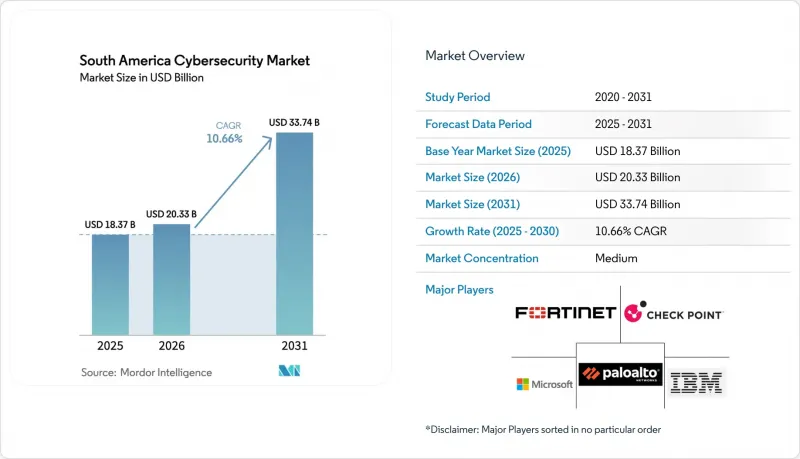
A surge in ransomware-as-a-service kits, wider zero-trust adoption across regulated industries, and cloud migration by small and medium enterprises (SMEs) are pushing spending beyond basic firewalls toward integrated detection and response platforms. Brazil's Resolution 538 has turned continuous monitoring from a best practice into a licensing condition for banks, causing a run on managed security operations center (SOC) capacity. Currency volatility, especially in Argentina, is steering buyers toward subscription pricing denominated in USD, while hyperscaler investments in Sao Paulo and Santiago reduce latency concerns for regulated workloads. As industrial firms expose operational technology (OT) networks for remote maintenance, demand is rising for protocol-aware threat analytics that traditional IT tools cannot deliver.
South America Cybersecurity Market Trends and Insights
Rising Ransomware-as-a-Service Ecosystem
Affiliate programs selling ready-made encryption payloads have cut the skill threshold for attackers, shifting South America cybersecurity market spending toward endpoint detection, immutable backup, and incident response retainers. Dragos logged 147 ransomware incidents against regional industrial control systems during the first three quarters of 2025, a 34% year-over-year increase, with Brazil accounting for 62% of cases. Healthcare institutions running Windows Server 2012 were hit hardest, forcing provincial governments to authorize cryptocurrency payments despite budget constraints. Double-extortion tactics stealing data before encryption nudged enterprises to elevate data loss prevention and forensics. Boards now request tabletop exercises that assume perimeter compromise, prompting uptake of managed detection and response services with one-hour containment service-level agreements. As payouts inflate, insurers tighten underwriting, raising premiums and amplifying return-on-investment narratives for proactive security tooling.
Proliferation of Zero-Trust Adoption by Regulated Industries
Zero-trust frameworks moved from concept to compliance obligation once Brazil's Resolution 538 mandated continuous authentication and micro-segmentation for banks in December 2025. Chile's copper producers replicated the approach after ransomware halted supervisory control and data acquisition systems, costing millions in lost output. Identity platforms that score device posture and geolocation before granting access are replacing static credential checks. Implementation starts with asset inventory and ends with east-west traffic monitoring, a path that most firms outsource to managed security providers due to scarce in-house architects. Vendors offering policy templates mapped to Brazil's LGPD and Chile's Framework Law shorten audits and encourage cross-sell into cloud workload protection.
Fragmented Data-Protection Regulations Across Countries
Brazil's LGPD obliges 72-hour breach disclosure and data-protection officers, Chile's new law mirrors European notice periods, yet Peru still allows 10 business days. Multinationals juggle divergent consent rules and cross-border transfer bans, forcing data-residency workarounds that drain budgets earmarked for threat hunting. Without a South American equivalent of the EU's adequacy regime, firms deploy country-specific encryption gateways, multiplying tooling and audit costs. The patchwork also deters regional SOC centralization because alerts containing personal data cannot always cross borders for correlation. This inefficiency disadvantages local vendors that cannot amortize compliance engineering over wider markets.
Other drivers and restraints analyzed in the detailed report include:
- Accelerating Cloud Migration Among South American SMEs
- Government Cybersecurity Capacity-Building Programs in Brazil and Chile
- Acute Cybersecurity Skills Shortage in Spanish and Portuguese Talent Pools
For complete list of drivers and restraints, kindly check the Table Of Contents.
Segment Analysis
Services expanded at an 11.18% CAGR from 2026-2031, eclipsing the broader South America cybersecurity market rate as banks, hospitals, and miners outsourced 24/7 monitoring to offset staffing gaps. Although solutions controlled a 61.76% slice of South America cybersecurity market share in 2025, buyers realized that appliances are inert without expertise to tune alerts and run threat hunts. Regulatory triggers like Resolution 538 forced mid-tier banks to prove real-time incident response, making managed detection and response contracts a faster path to compliance than building internal SOCs. Cloud security and identity suites led solution spending thanks to hybrid architectures, while commodity network firewalls ceded ground to multifunction platforms.
Professional services assessment, integration, migration remain essential when enterprises pivot to zero trust. Demand rises for consultants who map LGPD, Chile's Framework Law, and sector mandates into unified control matrices. Managed services now bundle GRC dashboards, threat intel feeds, and automated containment, delivering enterprise-grade outcomes to SMEs on a per-user basis. Integrators with Portuguese and Spanish SOC analysts, such as Tempest Security Intelligence, differentiate against global players that primarily staff English-only centers.
Cloud deployments are tracking an 11.24% CAGR through 2031, steadily shrinking the on-premises majority that stood at 53.43% in 2025. The tipping point came as hyperscalers opened Sao Paulo and Santiago zones, satisfying data residency clauses and slicing latency for real-time payments. Consumption pricing resonates in inflationary economies because monthly invoices preserve cash flow and hedge currency swings. South America cybersecurity market size for cloud tools grows as SMEs procure web-native firewalls, workload protection, and secure access edge components without capital outlays.
On-premises estates persist in core banking, health records, and defense environments where sovereignty and legacy system interdependence demand physical control. Yet even here, unified consoles like Microsoft Defender for Cloud enforce common policies across physical and virtual machines. Telcos now position SASE gateways inside their metropolitan networks, offering elastic bandwidth married with inline threat inspection. As shadow IT declines, the locus of policy enforcement moves from branch routers to identity-centric overlays.
The South America Cybersecurity Market Report is Segmented by Offering (Solutions, and Services), Deployment Mode (On-Premises, and Cloud), End-Use Industry (IT and Telecom, BFSI, Healthcare, Industrial Manufacturing, Retail and E-Commerce, Energy and Utilities, and More), End-User Enterprise Size (Large Enterprises, and Small and Medium Enterprises), and Country. The Market Forecasts are Provided in Terms of Value (USD).
List of Companies Covered in this Report:
- Cisco Systems, Inc.
- International Business Machines Corporation
- Palo Alto Networks, Inc.
- Fortinet, Inc.
- Check Point Software Technologies Ltd.
- Trend Micro Incorporated
- Microsoft Corporation
- Broadcom Inc. (Symantec Enterprise Division)
- CrowdStrike Holdings, Inc.
- Zscaler, Inc.
- Sophos Group plc
- Kaspersky Lab JSC
- McAfee Corp.
- Proofpoint, Inc.
- Dell Technologies Inc.
- Huawei Technologies Co., Ltd.
- BAE Systems plc
- Prosegur Compania de Seguridad, S.A. (Cipher)
- Tempest Security Intelligence S.A.
- VaultOne, Inc.
- Modulo Security LLC
Additional Benefits:
- The market estimate (ME) sheet in Excel format
- 3 months of analyst support
TABLE OF CONTENTS
1 INTRODUCTION
- 1.1 Study Assumptions and Market Definition
- 1.2 Scope of the Study
2 RESEARCH METHODOLOGY
3 EXECUTIVE SUMMARY
4 MARKET LANDSCAPE
- 4.1 Market Overview
- 4.2 Market Drivers
- 4.2.1 Rapid shift to cloud-native architectures
- 4.2.2 Exploding ransomware-as-a-service economy
- 4.2.3 Mandatory data-protection laws (LGPD, Chile Law 21.459)
- 4.2.4 OT/ICS security spend for critical infrastructure
- 4.2.5 AI-powered zero-trust network access roll-out
- 4.2.6 Nearshoring of global MSSP delivery centres
- 4.3 Market Restraints
- 4.3.1 Shortage of cyber-talent and high salary inflation
- 4.3.2 Fragmented, country-specific compliance regimes
- 4.3.3 FX volatility limiting cap-ex for SMEs
- 4.3.4 Grey-market hardware inflows undermining standards
- 4.4 Industry Value Chain Analysis
- 4.5 Regulatory Landscape
- 4.6 Technological Outlook
- 4.7 Impact of Macroeconomic Factors on the Market
- 4.8 Porter's Five Forces Analysis
- 4.8.1 Threat of New Entrants
- 4.8.2 Bargaining Power of Suppliers
- 4.8.3 Bargaining Power of Buyers
- 4.8.4 Threat of Substitutes
- 4.8.5 Intensity of Competitive Rivalry
5 MARKET SIZE AND GROWTH FORECASTS (VALUE)
- 5.1 By Offering
- 5.1.1 Solutions
- 5.1.1.1 Application Security
- 5.1.1.2 Cloud Security
- 5.1.1.3 Data Security
- 5.1.1.4 Identity and Access Management
- 5.1.1.5 Infrastructure Protection
- 5.1.1.6 Integrated Risk Management
- 5.1.1.7 Network Security Equipment
- 5.1.1.8 Endpoint Security
- 5.1.2 Services
- 5.1.2.1 Professional Services
- 5.1.2.2 Managed Services
- 5.1.1 Solutions
- 5.2 By Deployment Mode
- 5.2.1 On-Premise
- 5.2.2 Cloud
- 5.3 By End-User Vertical
- 5.3.1 BFSI
- 5.3.2 Healthcare
- 5.3.3 IT and Telecom
- 5.3.4 Industrial and Defense
- 5.3.5 Manufacturing
- 5.3.6 Retail and E-commerce
- 5.3.7 Energy and Utilities
- 5.3.8 Other End-User Verticals
- 5.4 By Enterprise Size
- 5.4.1 Small and Medium Enterprises (SMEs)
- 5.4.2 Large Enterprises
- 5.5 By Country
- 5.5.1 Brazil
- 5.5.2 Argentina
- 5.5.3 Peru
- 5.5.4 Chile
- 5.5.5 Colombia
- 5.5.6 Ecuador
- 5.5.7 Venezuela
- 5.5.8 Rest of South America
6 COMPETITIVE LANDSCAPE
- 6.1 Market Concentration
- 6.2 Strategic Moves
- 6.3 Market Share Analysis
- 6.4 Company Profiles {(includes Global level Overview, Market level overview, Core Segments, Financials as available, Strategic Information, Market Rank/Share for key companies, Products and Services, and Recent Developments)}
- 6.4.1 Cisco Systems, Inc.
- 6.4.2 International Business Machines Corporation
- 6.4.3 Palo Alto Networks, Inc.
- 6.4.4 Fortinet, Inc.
- 6.4.5 Check Point Software Technologies Ltd.
- 6.4.6 Trend Micro Incorporated
- 6.4.7 Microsoft Corporation
- 6.4.8 Broadcom Inc. (Symantec Enterprise Division)
- 6.4.9 CrowdStrike Holdings, Inc.
- 6.4.10 Zscaler, Inc.
- 6.4.11 Sophos Group plc
- 6.4.12 Kaspersky Lab JSC
- 6.4.13 McAfee Corp.
- 6.4.14 Proofpoint, Inc.
- 6.4.15 Dell Technologies Inc.
- 6.4.16 Huawei Technologies Co., Ltd.
- 6.4.17 BAE Systems plc
- 6.4.18 Prosegur Compania de Seguridad, S.A. (Cipher)
- 6.4.19 Tempest Security Intelligence S.A.
- 6.4.20 VaultOne, Inc.
- 6.4.21 Modulo Security LLC
7 MARKET OPPORTUNITIES AND FUTURE OUTLOOK
- 7.1 White-space and Unmet-Need Assessment

