PUBLISHER: Mordor Intelligence | PRODUCT CODE: 2043976

PUBLISHER: Mordor Intelligence | PRODUCT CODE: 2043976
South America Digital Signage - Market Share Analysis, Industry Trends & Statistics, Growth Forecasts (2026 - 2031)
The South America digital signage market size was valued at USD 1.21 billion in 2025 and estimated to grow from USD 1.29 billion in 2026 to reach USD 1.77 billion by 2031, at a CAGR of 6.53% during the forecast period (2026-2031).
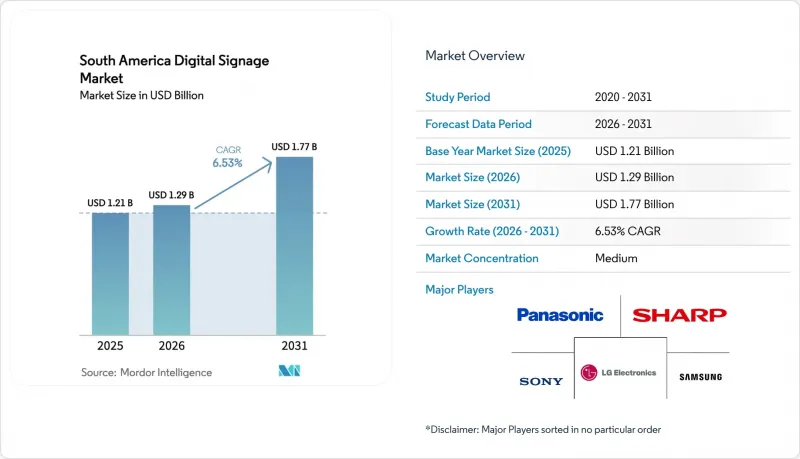
A confluence of retail-media adoption, programmatic digital-out-of-home (DOOH) trading, and smart-city investments is expanding the addressable base of networked screens across malls, transit hubs, and public plazas. Hardware remained the largest cost center in 2025, yet operators are pivoting toward managed services that monetize audiences through data-driven content rotation. Falling panel prices, especially for large-format LED, are lowering entry barriers for mid-tier municipalities, while e-paper modules open off-grid opportunities in the Amazon Basin and Andean highlands. Regulatory uncertainty persists, but rising broadband penetration and 5G rollout underpin the region's capacity for real-time bidding and cloud-based content management.
South America Digital Signage Market Trends and Insights
Retail Modernization and Omnichannel Investment Up-Trend
Retail chains are embedding connected screens into aisle ends, checkout lanes, and pharmacy counters to synchronize in-store promotions with mobile apps and e-commerce storefronts. Brazil's retail-media revenue grew 42.3% in 2024, and 81% of surveyed brands plan to boost spending in 2026 as screens shift from brand awareness assets to performance marketing endpoints that track conversions. Loyalty data allows grocers to serve real-time offers, while QR codes accelerate mobile redemption, a tactic that lifted Mercado Libre's Black Friday sales by 80% year over year. Argentina's grocery operators pursue similar models to offset store-expansion costs, and Chilean retailers now prioritize high-brightness indoor displays that circumvent a light-pollution ordinance mandating overnight shutdown of outdoor screens.
DOOH Adoption Surge among FMCG and Telecom Advertisers
Fast-moving consumer goods and telecom brands are reallocating budgets from static billboards to programmatic DOOH that supports audience measurement and flexible daypart buying. JCDecaux and VIOOH switched on programmatic access to Sao Paulo street furniture in August 2024, demonstrating uplift in both brand recall and website traffic for pilot advertiser InfinitePay. A VIOOH survey notes 87% of incremental DOOH spend in Brazil now migrates from online channels rather than legacy out-of-home formats. Telcos promoting 5G bundles leverage transit-hub screens to engage commuters at wait times, while new advertiser categories such as betting platforms add depth to demand. Coverage gaps outside tier-one cities remain a challenge, yet rising 4G and 5G penetration promises wider inventory activation.
High Upfront System and Integration Costs
End-to-end video-wall implementations can exceed USD 250,000 once displays, media players, software licenses, and installation labor are tallied, a barrier for small retailers and cost-constrained municipalities. Argentina's currency volatility inflates imported hardware prices, encouraging buyers to delay upgrades or settle for low-spec models that do not support programmatic trading. Revenue-sharing arrangements that defer payment against future ad proceeds exist but remain uncommon outside Brazil.
Other drivers and restraints analyzed in the detailed report include:
- Declining Capex of Large-Format LCD and LED Panels
- Government-Funded Smart-City Kiosk Roll-Outs
- Municipal Permitting Variability across Provinces
For complete list of drivers and restraints, kindly check the Table Of Contents.
Segment Analysis
Hardware retained 57.37% of the South America digital signage market share in 2025 as retailers and transit authorities invested in panels, mounts, and cabling. The services category is projected to deliver a 6.84% CAGR, reflecting demand for content scheduling, uptime monitoring, and programmatic ad sales that convert fixed sponsorships into impression-based revenue.
The services boom signals a shift from capital expenditure to recurring operating expenditure models. Integrators bundle creative production, data analytics, and compliance reporting so retailers spanning 200 stores across Brazil, Argentina, and Chile can outsource technical complexity. Cloud platforms that embed artificial intelligence for predictive maintenance and dynamic creative optimization carry subscription fees, moving vendors toward annuity revenue streams.
LCD and LED panels captured 61.28% of the South America digital signage market size in 2025, prized for brightness and a broad range of dimensions suited to indoor retail and outdoor transit assets. E-paper, although niche, will accelerate at 7.44% as solar-powered modules enable always-readable signage in Amazonian river ports and Andean logistics corridors.
E Ink's Spectra 6 achieves full-color refresh rates suitable for electronic shelf labels and bus-stop schedules, while Samsung's 13-inch bio-resin e-paper display aligns with municipal sustainability mandates. OLED and micro-LED remain high-cost options reserved for luxury retail and flagship corporate lobbies, whereas legacy projection systems decline as direct-view LED prices fall.
The South America Digital Signage Market Report is Segmented by Component (Hardware, Software, and Services), Display Technology (LCD/LED, OLED, Projection and Screens, E-Paper, and More), Installed Location (Indoor, and Outdoor), and End-User Industry (Retail, Transportation and Transit, Hospitality and Leisure, Corporate and Banking, Healthcare, and More) and Country. The Market Forecasts are Provided in Terms of Value (USD).
List of Companies Covered in this Report:
- LG Electronics Inc.
- Samsung Electronics Co., Ltd.
- Panasonic Holdings Corporation
- Sony Group Corporation
- Sharp Corporation
- NEC Display Solutions, Ltd.
- Mitsubishi Electric Corporation
- Barco NV
- Broadsign International, LLC
- Scala, Inc.
- STRATACACHE, Inc.
- Planar Systems, Inc.
- Daktronics, Inc.
- Omnivex Corporation
- E Ink Holdings Inc.
- AU Optronics Corp.
- Leyard Optoelectronic Co., Ltd.
- Clear Channel Outdoor Holdings, Inc.
- Christie Digital Systems USA, Inc.
Additional Benefits:
- The market estimate (ME) sheet in Excel format
- 3 months of analyst support
TABLE OF CONTENTS
1 INTRODUCTION
- 1.1 Study Assumptions and Market Definition
- 1.2 Scope of the Study
2 RESEARCH METHODOLOGY
3 EXECUTIVE SUMMARY
4 MARKET LANDSCAPE
- 4.1 Market Overview
- 4.2 Market Drivers
- 4.2.1 Retail Modernization and Omnichannel Investment Up-Trend
- 4.2.2 DOOH Adoption Surge among FMCG and Telecom Advertisers
- 4.2.3 Declining Capex of Large-Format LCD/LED Panels
- 4.2.4 Government-Funded Smart-City Kiosk Roll-Outs
- 4.2.5 Programmatic DOOH Exchanges Localized for ES-PT Markets
- 4.2.6 E-Paper Signage for Off-Grid Amazon and Andean Logistics
- 4.3 Market Restraints
- 4.3.1 High Upfront System and Integration Costs
- 4.3.2 Complex Multi-Vendor Technology Stack
- 4.3.3 Municipal Permitting Variability across Provinces
- 4.3.4 Power-Consumption Curbs, Grid Instability in Rural Zones
- 4.4 Industry Value Chain Analysis
- 4.5 Regulatory Landscape
- 4.6 Technological Outlook
- 4.7 Porter's Five Forces Analysis
- 4.7.1 Bargaining Power of Suppliers
- 4.7.2 Bargaining Power of Buyers
- 4.7.3 Threat of New Entrants
- 4.7.4 Threat of Substitutes
- 4.7.5 Intensity of Competitive Rivalry
- 4.8 Impact of Macroeconomic Factors on the Market
5 MARKET SIZE AND GROWTH FORECASTS (VALUE)
- 5.1 By Component
- 5.1.1 Hardware
- 5.1.2 Software
- 5.1.3 Services
- 5.2 By Display Technology
- 5.2.1 LCD / LED
- 5.2.2 OLED
- 5.2.3 Projection and Screens
- 5.2.4 E-Paper
- 5.2.5 Other Display Technologies
- 5.3 By Installation Location
- 5.3.1 Indoor
- 5.3.2 Outdoor
- 5.4 By End-User Industry
- 5.4.1 Retail
- 5.4.2 Transportation and Transit
- 5.4.3 Hospitality and Leisure
- 5.4.4 Corporate and Banking
- 5.4.5 Government and Public Spaces
- 5.4.6 Education and Healthcare
- 5.4.7 Other End-User Industries
- 5.5 By Country
- 5.5.1 Brazil
- 5.5.2 Argentina
- 5.5.3 Peru
- 5.5.4 Chile
- 5.5.5 Rest of South America
6 COMPETITIVE LANDSCAPE
- 6.1 Market Concentration
- 6.2 Strategic Moves
- 6.3 Market Share Analysis
- 6.4 Company Profiles (includes Global level Overview, Market level overview, Core Segments, Financials as available, Strategic Information, Market Rank/Share for key companies, Products and Services, and Recent Developments)
- 6.4.1 LG Electronics Inc.
- 6.4.2 Samsung Electronics Co., Ltd.
- 6.4.3 Panasonic Holdings Corporation
- 6.4.4 Sony Group Corporation
- 6.4.5 Sharp Corporation
- 6.4.6 NEC Display Solutions, Ltd.
- 6.4.7 Mitsubishi Electric Corporation
- 6.4.8 Barco NV
- 6.4.9 Broadsign International, LLC
- 6.4.10 Scala, Inc.
- 6.4.11 STRATACACHE, Inc.
- 6.4.12 Planar Systems, Inc.
- 6.4.13 Daktronics, Inc.
- 6.4.14 Omnivex Corporation
- 6.4.15 E Ink Holdings Inc.
- 6.4.16 AU Optronics Corp.
- 6.4.17 Leyard Optoelectronic Co., Ltd.
- 6.4.18 Clear Channel Outdoor Holdings, Inc.
- 6.4.19 Christie Digital Systems USA, Inc.
7 MARKET OPPORTUNITIES AND FUTURE OUTLOOK
- 7.1 White-Space and Unmet-Need Assessment

