PUBLISHER: Mordor Intelligence | PRODUCT CODE: 2043977

PUBLISHER: Mordor Intelligence | PRODUCT CODE: 2043977
South America Soft Drinks Packaging - Market Share Analysis, Industry Trends & Statistics, Growth Forecasts (2026 - 2031)
The South America soft drinks packaging market size was valued at USD 14.18 billion in 2025 and is estimated to grow from USD 15.08 billion in 2026 to USD 20.38 billion by 2031, at a CAGR of 6.22% over 2026-2031.
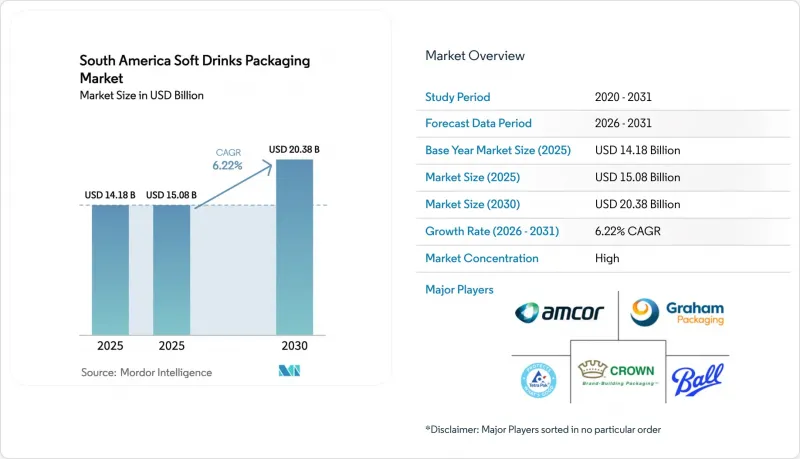
Mandatory recycled-content laws in Brazil and harmonized food-contact rules in MERCOSUR are prompting early investments in rPET, lightweighting, and reverse-logistics networks, giving first movers cost advantages and stronger retail ties. Rapid income growth in Peru and Colombia, expanding e-commerce grocery penetration in Brazil and Argentina, and persistent demand for hygienic single-serve packs continue to lift unit volumes even as consumers trade down to value beverages. At the same time, volatile resin and aluminum prices, fragmented deposit-return roll-outs, and bans on multi-material laminates are squeezing converter margins and accelerating consolidation. Competitive intensity remains moderate because the top five converters control only about 45% of regional revenue, leaving space for mid-tier specialists in pouches, aseptic cartons, and glass.
South America Soft Drinks Packaging Market Trends and Insights
Rising Disposable Income And Middle-Class Expansion
Real wage gains of 4.2% in 2025 lifted household purchasing power in Peru and Colombia, creating a two-tier demand pattern that splits premium functional drinks in large cities from value carbonated offerings in secondary towns. Brazil added 3.1 million middle-class families, yet higher food and transport inflation nudged shoppers toward larger multi-serve bottles, which lower per-liter costs. The pack-size dichotomy helps explain why 251-500 ml formats still dominate while smaller single-serve packs post faster growth. In Peru's mining hubs, such as Arequipa, 500 ml isotonic bottles gained share among shift workers seeking on-the-go hydration solutions. Colombia's new labor rules, formalizing gig-economy jobs, expanded tax-based income, boosting demand for cans and pouches popular with delivery riders.
Surge In PET Bottled-Water Consumption
Persistent gaps in municipal water supply leave 22% of Argentine and 31% of Peruvian urban households without reliable tap water, driving daily bottled-water use and consistent 500 ml single-serve purchases. Coca-Cola reported a 7% volume jump in its regional water portfolio during 2025 and invested USD 85 million in PET preform capacity at Jundiai, Brazil, to meet demand. Lightweighting cut the 500 ml bottle weight to 24 grams, saving 14% in resin but requiring stricter quality checks. Chile tightened microbiological rules, raising compliance costs for small brands yet accelerating consolidation. Out-of-home consumption in Brazil's Northeast, where temperatures exceed 30 °C year-round, underpins sustained growth in single-serve water formats.
Volatile Resin And Aluminum Prices
PET prices fluctuated between USD 1,050-1,380 per t in 2025 due to crude swings and plant outages, squeezing converter margins as beverage brands resisted mid-season price hikes. Aluminum averaged USD 2,420 per t on the LME, with South American can makers paying freight premiums of USD 180 per t and facing local currency volatility. Brazil's Novelis and Argentina's Aluar ran near full capacity, so Colombian coil importers paid a 22% cost penalty that slowed can adoption. Spot volatility forces converters to hedge or accept thinner margins, reinforcing the appeal of rPET, whose pricing increasingly decouples from virgin resin.
Other drivers and restraints analyzed in the detailed report include:
- Post-COVID Demand For Hygienic Single-Serve Packs
- Sustainability Push, rPET And Lightweighting Mandates
- Stringent Bans On Non-Recyclable Plastics
For complete list of drivers and restraints, kindly check the Table Of Contents.
Segment Analysis
Plastic held 61.48% of 2025 revenue, anchored by PET bottles that combine clarity, cost, and distribution efficiency. Within plastics, the rPET subsegment is set to expand at a 6.98% CAGR through 2031 as mandates raise demand for recycled content, supporting integrated supply contracts and chemical-recycling pilots. Metal formats, chiefly aluminum cans, captured 23% despite price volatility because of their infinite recyclability, which resonates with urban millennial shoppers. Glass maintained a 9% niche in premium juice and craft soda, reinforced by Verallia's new oxy-combustion furnace that runs on 55% cullet feed and lowers carbon intensity by 18% versus legacy melts. Paperboard-based aseptic cartons rounded out 6.7%, benefiting from ambient logistics and shelf-ready e-commerce designs promoted by Tetra Pak. Lightweighting trimmed 500 ml PET bottles from 26 g in 2023 to 23 g in 2025, and Amcor's oxygen-scavenger patents aim to drop them another 12% without compromising shelf life.
Cost pressure and sustainability branding continue to tilt converter capex toward rPET, barrier coatings, and hybrid paper-plastic structures that broaden end-of-life options. MERCOSUR's unified PET standard adds compliance hurdles for small plants lacking ISO 22000 labs but enhances cross-border trade for multinationals. As a result, the South America soft drinks packaging market size tied to plastic is forecast to widen even while metal and carton formats defend their own growth lanes through technical upgrades and marketing that highlights recyclability.
Bottles commanded 44.98% in 2025, with PET accounting for nearly three-quarters of volume owing to familiarity and high filling speeds. Yet pouches and sachets are on track for a 6.95% CAGR, propelled by online grocery fulfillment that values cube efficiency and lighter last-mile payloads. Aluminum cans held 28% and gained share in quick-service restaurants where single-serve hygiene and no-rinse benefits outweigh metal premiums. Cartons and aseptic boxes, at 18%, leverage ambient stability to compete in juice and plant-based drinks but face perception hurdles in Argentina, where consumers regard paperboard as lower tier.
Pouches excel in informal retail, especially in Peru, where 300 ml flexible packs undercut PET by 35% per serving. Brazil's restaurant chains standardized 250 ml cans to cut breakage, boosting can volume 9% despite metal costs. Meanwhile, pilot refillable-glass programs in Santiago achieved only 41% return rates, underscoring the challenge of changing consumer habits without a robust deposit infrastructure. As converters push robotic case-packers and easy-open tear notches, pouches look poised to erode share from bottles in impulse and e-commerce channels, reinforcing the South America soft drinks packaging market's shift toward lightweight flexible formats.
The South America Soft Drinks Packaging Market Report is Segmented by Material (Plastic, Metal, and More), Packaging Format (Bottles, Cartons and Aseptic Boxes, and More), Beverage Type (Carbonated Soft Drinks, Juices and Nectars, Ready-To-Drink Beverages, Sports and Isotonic Drinks, and More), Pack Size (Less Than Equal To 250 Ml, 251-500 Ml, and More), and Geography. The Market Forecasts are Provided in Terms of Value (USD).
List of Companies Covered in this Report:
- Amcor plc
- Ball Corporation
- Crown Holdings, Inc.
- Tetra Pak International S.A.
- CAN-PACK S.A.
- Ardagh Group S.A.
- Trivium Packaging B.V.
- Graham Packaging Company L.P.
- Refresco Group N.V.
- Victory Packaging L.P.
- Plastipak Holdings, Inc.
- Owens-Illinois Inc.
- SIG Combibloc Group Ltd.
- AptarGroup, Inc.
- Envases Universales de Mexico S.A. de C.V.
- Ecolean AB
- Alpek S.A.B. de C.V.
- CCL Industries Inc.
- Verallia S.A.
Additional Benefits:
- The market estimate (ME) sheet in Excel format
- 3 months of analyst support
TABLE OF CONTENTS
1 INTRODUCTION
- 1.1 Study Assumptions and Market Definition
- 1.2 Scope of the Study
2 RESEARCH METHODOLOGY
3 EXECUTIVE SUMMARY
4 MARKET LANDSCAPE
- 4.1 Market Overview
- 4.2 Market Drivers
- 4.2.1 Rising Disposable Income and Middle-Class Expansion
- 4.2.2 Surge in PET Bottled-Water Consumption
- 4.2.3 Post-COVID Demand for Hygienic Single-Serve Packs
- 4.2.4 Sustainability Push, rPET and Lightweighting Mandates
- 4.2.5 E-commerce Grocery Growth Spurring Shelf-Ready Formats
- 4.2.6 Standardized Refillable Bottle Programs
- 4.3 Market Restraints
- 4.3.1 Stringent Bans on Non-Recyclable Plastics
- 4.3.2 Volatile Resin and Aluminum Prices
- 4.3.3 Slow Deposit-Return Roll-Out Outside Brazil
- 4.3.4 Limited Recycling Infrastructure in Andean Nations
- 4.4 Industry Value Chain Analysis
- 4.5 Regulatory Landscape
- 4.6 Technological Outlook
- 4.7 Porter's Five Forces Analysis
- 4.7.1 Bargaining Power of Suppliers
- 4.7.2 Bargaining Power of Buyers
- 4.7.3 Threat of New Entrants
- 4.7.4 Threat of Substitutes
- 4.7.5 Competitive Rivalry
- 4.8 Overview of Global Soft Drinks Packaging Market
- 4.9 Impact of Macroeconomic Factors on the Market
5 MARKET SIZE AND GROWTH FORECASTS (VALUES)
- 5.1 By Material
- 5.1.1 Plastic
- 5.1.2 Metal
- 5.1.3 Glass
- 5.1.4 Paper and Paperboard
- 5.2 By Packaging Format
- 5.2.1 Bottles
- 5.2.2 Cans
- 5.2.3 Cartons and Aseptic Boxes
- 5.2.4 Pouches and Sachets
- 5.3 By Beverage Type
- 5.3.1 Carbonated Soft Drinks (CSDs)
- 5.3.2 Juices and Nectars
- 5.3.3 Ready-to-Drink (RTD) Beverages
- 5.3.4 Sports and Isotonic Drinks
- 5.3.5 Other Beverage Types
- 5.4 By Pack Size
- 5.4.1 Less Than Equal To 250 ml
- 5.4.2 251 - 500 ml
- 5.4.3 501 - 1000 ml
- 5.4.4 More Than 1 L
- 5.5 By Country
- 5.5.1 Brazil
- 5.5.2 Argentina
- 5.5.3 Chile
- 5.5.4 Colombia
- 5.5.5 Peru
- 5.5.6 Rest of South America
6 COMPETITIVE LANDSCAPE
- 6.1 Market Concentration
- 6.2 Strategic Moves
- 6.3 Market Share Analysis
- 6.4 Company Profiles (includes Global level Overview, Market level overview, Core Segments, Financials as available, Strategic Information, Market Rank/Share for key companies, Products and Services, and Recent Developments)
- 6.4.1 Amcor plc
- 6.4.2 Ball Corporation
- 6.4.3 Crown Holdings, Inc.
- 6.4.4 Tetra Pak International S.A.
- 6.4.5 CAN-PACK S.A.
- 6.4.6 Ardagh Group S.A.
- 6.4.7 Trivium Packaging B.V.
- 6.4.8 Graham Packaging Company L.P.
- 6.4.9 Refresco Group N.V.
- 6.4.10 Victory Packaging L.P.
- 6.4.11 Plastipak Holdings, Inc.
- 6.4.12 Owens-Illinois Inc.
- 6.4.13 SIG Combibloc Group Ltd.
- 6.4.14 AptarGroup, Inc.
- 6.4.15 Envases Universales de Mexico S.A. de C.V.
- 6.4.16 Ecolean AB
- 6.4.17 Alpek S.A.B. de C.V.
- 6.4.18 CCL Industries Inc.
- 6.4.19 Verallia S.A.
7 MARKET OPPORTUNITIES AND FUTURE OUTLOOK
- 7.1 White-Space and Unmet-Need Assessment

