PUBLISHER: Mordor Intelligence | PRODUCT CODE: 2044023

PUBLISHER: Mordor Intelligence | PRODUCT CODE: 2044023
Banking And Financial Services ERP - Market Share Analysis, Industry Trends & Statistics, Growth Forecasts (2026 - 2031)
The Banking and Financial Services Enterprise Resource Planning Market size was valued at USD 10.47 billion in 2025 and is estimated to grow from USD 11.36 billion in 2026 to reach USD 16.24 billion by 2031, at a CAGR of 7.41% during the forecast period (2026-2031).
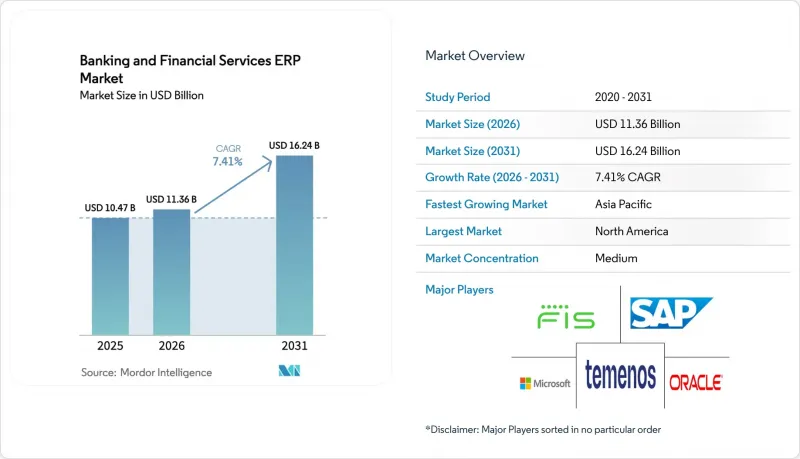
Mainstream banks are replacing monolithic, on-premise cores with cloud-native, API-first suites that embed artificial intelligence for predictive liquidity management, real-time regulatory reporting, and automated compliance controls. The confluence of Digital Operational Resilience Act timelines in the European Union, Basel Committee guidance on technology outsourcing, and the global shift to ISO 20022 payment messaging continues to steer investments toward modular platforms that can be updated without prolonged downtime. Intensifying cyber-resiliency mandates, the availability of sovereign-cloud regions, and growing demand for consumption-based pricing are reshaping buyer expectations, while the promise of lower total cost of ownership is drawing mid-tier banks and credit unions into the banking and financial services ERP market. Competitive activity centers on embedded banking APIs, fraud-detection add-ons, and climate-risk analytics, signaling that specialized functionality has become a primary differentiator rather than generic financials alone.
Global Banking And Financial Services ERP Market Trends and Insights
Demand for Real-Time Regulatory Reporting and Compliance Automation
Supervisors now expect granular, event-driven filings rather than monthly or quarterly batches, pushing institutions to embed real-time data pipelines directly into core finance processes. DORA incident-notification windows and Basel capital calculations for cryptoasset exposures require daily mark-to-market valuations that legacy batch architectures cannot support. Modern ERP suites offering ready-made XBRL taxonomy validation and central-bank connectors shorten submission cycles, reduce manual reconciliation, and lower non-compliance risk. Tier-1 banks in Germany and the United States are already running parallel production pilots that deliver live exposure data to regulators within four-hour windows, illustrating how regulatory pressure is steering budgets into the banking and financial services enterprise resource planning market. Early adopters report 30%-plus reductions in regulatory-reporting effort, freeing capacity for strategic analytics.
Integration of AI-Driven Predictive Analytics Within ERP Suites
Embedding machine-learning engines into day-to-day workflows lets treasury teams model forward liquidity buffers, fraud-ops units detect anomalous behavior, and credit officers surface early warning signs of covenant breaches. Recent product releases from the top three vendors provide natural-language interfaces that allow non-technical staff to query cash positions and scenario outcomes with conversational prompts. Pilot programs show 40%-60% declines in manual reconciliation tasks and materially sharper accuracy in cash-flow forecasts, yet the compute intensity of large-language-model inference introduces incremental subscription layers that smaller institutions must carefully budget. As predictive capabilities mature, institutions see tangible proof that AI functionality is no longer a nice-to-have but a core selection criterion, deepening penetration of the banking and financial services enterprise resource planning market.
Legacy Core System Complexity and High Integration Costs
Many universal banks still run COBOL-based cores written in the 1980s, interwoven with proprietary middleware and undocumented business logic. Large incumbents spend up to 75% of annual technology budgets on maintenance, leaving limited capital for modern ERP rollouts. Full migrations can last five years and cost USD 100 million-plus, and high-profile failures such as TSB's 2018 outage remain cautionary tales, with approximately USD 440 million in remediation costs and the approximately USD 65 million in fines imposed by the Financial Conduct Authority continuing to shape risk committees' approach to ERP transformation. Boards often favor incremental wrap-and-renew approaches, slowing wholesale adoption. This complexity keeps the brakes on the market even as modernization imperatives mount. Despite these challenges, demand for scalable, efficient ERP solutions continues to grow as institutions strive to remain competitive in a rapidly evolving market.
Other drivers and restraints analyzed in the detailed report include:
- Accelerating Cloud-Native Adoption in Regulated Financial Institutions
- Cyber-Resiliency Mandates Driving ERP Modernization
- Data-Residency and Sovereignty Barriers to Public Cloud Migration
For complete list of drivers and restraints, kindly check the Table Of Contents.
Segment Analysis
On-premises systems accounted for 58.21% of 2025 revenue, underscoring that regulatory audits and latency-sensitive ledgers still anchor workloads in bank data centers. The share of cloud implementations is rising swiftly, expanding at a 7.83% CAGR, as sovereign cloud regions assuage data localization fears. Hybrid models partition sensitive ledgers on-premises and analytics in the cloud, creating an architecture that satisfies supervisors yet delivers the agility finance teams need. Vendors now ship workload classifiers that automatically route data based on regulatory tags, trimming integration friction. Over the forecast window, hybrid footprints are expected to anchor more than half of incremental spending, embedding the market in a dual-state paradigm.
Challenger banks embrace pure SaaS because they lack legacy drag and prefer usage-based subscription economics. Conversely, Tier-1 treasuries keep settlement engines co-located with market-infrastructure gateways where microsecond latency is critical. As regulators become more comfortable with encryption at rest and multi-region replication guarantees, a gradual pivot toward cloud is inevitable, but the coexistence of all three deployment modes will define the competitive playbook through 2031 across industry. This shift will likely encourage innovation and adaptability in financial technology solutions.
Payment management retained the largest 42.57% share of 2025 spend owing to global ISO 20022 migrations, 24-hour real-time payment rails, and mounting cross-border reconciliation complexity. Yet risk and compliance modules are forecast to post the fastest CAGR of 8.23% as institutions automate sanctions screening, beneficial ownership checks, and climate risk disclosures. Generative AI is now parsing unstructured contracts, cutting manual review by half, and supervised-learning models are slashing false-positive alerts in transaction-monitoring queues, proving a strong return on incremental licenses. Those gains propel the market size allocated to compliance from a support function cost to a strategic budget line.
Customer relationship management and staff operations suites are being bundled into broader ERP stacks, offering banks a unified data model for headcount planning, conduct-risk monitoring, and personalized product offers. This integration enables banks to streamline operations and improve decision-making processes. As integration tightens, payment hubs and compliance engines will increasingly share event streams, lowering reconciliation costs while boosting real-time insight for treasury teams across the market. Additionally, this shift supports enhanced scalability and adaptability, ensuring banks can respond effectively to evolving regulatory and market demands.
The Banking and Financial Services Enterprise Resource Planning Market Report is Segmented by Deployment Mode (On-Premise, Cloud-Based, and Hybrid), Application (Payment Management, Staff Operations Management, Customer Relationship Management, and More), Organization Size (Large Enterprises, and Small and Medium Enterprises), Component (Software, and More), and Geography. The Market Forecasts are Provided in Terms of Value (USD).
Geography Analysis
North America accounted for 37.37% of the 2025 value, driven by Federal Reserve stress-test cycles and OCC oversight that require quarterly capital-ratio modeling and continuous data availability. The United States and Canada both tightened cyber guidelines in 2024, compelling platform upgrades that feed directly into the market. Mexico's open-banking rollout likewise spurred demand for API-ready systems among local incumbents, further enhancing the region's technological infrastructure.
Europe is undergoing a DORA-led modernization wave that requires immutable audit trails and four-hour incident disclosures, driving comprehensive ERP refreshes. Simultaneously, Prudential Regulation Authority rules on operational resilience have elevated board-level focus on integrated financial and risk data, thereby expanding the addressable budget. Additionally, the region's emphasis on sustainability reporting is pushing banks to adopt advanced analytics tools. Asia-Pacific, forecast at an 8.48% CAGR, benefits from digital-bank license issuances in Singapore and Hong Kong, India's small-finance bank push, and China's domestic-cloud mandates, each necessitating new ERP deployments.
South America is leveraging open-banking frameworks, most notably Brazil's PIX success, to catalyze payment-hub investments, while Middle East and Africa banks adopt Islamic-finance-compliant modules amid accelerated digital banking adoption. These advancements are fostering innovation and competition within the banking sector. Furthermore, the growing focus on financial inclusion in these regions is driving the adoption of digital solutions. Collectively, these regional dynamics maintain a structurally positive outlook for the market.
- SAP SE
- Oracle Corporation
- Microsoft Corporation
- Temenos AG
- Finastra Group Holdings Limited
- Fidelity National Information Services, Inc. (FIS)
- Fiserv, Inc.
- Jack Henry & Associates, Inc.
- Infosys Limited (Finacle)
- Tata Consultancy Services Limited (TCS BaNCS)
- IBM Corporation
- Unit4 N.V.
- Sage Group Plc
- Workday, Inc.
- Infor, Inc.
- Epicor Software Corporation
- IFS AB
- Mambu GmbH
- nCino Inc.
- Thought Machine Group Limited
- Avaloq Group AG
Additional Benefits:
- The market estimate (ME) sheet in Excel format
- 3 months of analyst support
TABLE OF CONTENTS
1 INTRODUCTION
- 1.1 Study Assumptions and Market Definition
- 1.2 Scope of the Study
2 RESEARCH METHODOLOGY
3 EXECUTIVE SUMMARY
4 MARKET LANDSCAPE
- 4.1 Market Overview
- 4.2 Market Drivers
- 4.2.1 Accelerating Cloud-Native Adoption in Regulated Financial Institutions
- 4.2.2 Demand for Real-Time Regulatory Reporting and Compliance Automation
- 4.2.3 Integration of AI-Driven Predictive Analytics within ERP Suites
- 4.2.4 Growing Preference for Modular and Composable ERP Architectures
- 4.2.5 Cyber-Resiliency Mandates Driving ERP Modernization
- 4.2.6 Rise of Embedded Banking APIs Extending ERP Value Chains
- 4.3 Market Restraints
- 4.3.1 Legacy Core System Complexity and High Integration Costs
- 4.3.2 Data-Residency and Sovereignty Barriers to Public Cloud Migration
- 4.3.3 Shortage of ERP-Savvy Treasury and Compliance Talent
- 4.3.4 Escalating Subscription OPEX Due to AI Add-On Pricing
- 4.4 Impact of Macroeconomic Factors on the Market
- 4.5 Industry Value Chain Analysis
- 4.6 Regulatory Landscape
- 4.7 Technological Outlook
- 4.8 Porter's Five Forces Analysis
- 4.8.1 Bargaining Power of Suppliers
- 4.8.2 Bargaining Power of Buyers
- 4.8.3 Threat of New Entrants
- 4.8.4 Threat of Substitutes
- 4.8.5 Intensity of Competitive Rivalry
5 MARKET SIZE AND GROWTH FORECASTS (VALUE)
- 5.1 By Deployment Mode
- 5.1.1 On-Premise
- 5.1.2 Cloud-Based
- 5.1.3 Hybrid
- 5.2 By Application
- 5.2.1 Payment Management
- 5.2.2 Staff Operations Management
- 5.2.3 Customer Relationship Management
- 5.2.4 Risk and Compliance Management
- 5.2.5 Other Applications
- 5.3 By Organization Size
- 5.3.1 Large Enterprises
- 5.3.2 Small and Medium Enterprises
- 5.4 By Component
- 5.4.1 Software
- 5.4.2 Services
- 5.5 By Geography
- 5.5.1 North America
- 5.5.1.1 United States
- 5.5.1.2 Canada
- 5.5.1.3 Mexico
- 5.5.2 South America
- 5.5.2.1 Brazil
- 5.5.2.2 Argentina
- 5.5.2.3 Rest of South America
- 5.5.3 Europe
- 5.5.3.1 United Kingdom
- 5.5.3.2 Germany
- 5.5.3.3 France
- 5.5.3.4 Italy
- 5.5.3.5 Spain
- 5.5.3.6 Rest of Europe
- 5.5.4 Asia-Pacific
- 5.5.4.1 China
- 5.5.4.2 Japan
- 5.5.4.3 India
- 5.5.4.4 South Korea
- 5.5.4.5 Rest of Asia-Pacific
- 5.5.5 Middle East and Africa
- 5.5.5.1 Middle East
- 5.5.5.1.1 United Arab Emirates
- 5.5.5.1.2 Saudi Arabia
- 5.5.5.1.3 Rest of Middle East
- 5.5.5.2 Africa
- 5.5.5.2.1 South Africa
- 5.5.5.2.2 Egypt
- 5.5.5.2.3 Rest of Africa
- 5.5.5.1 Middle East
- 5.5.1 North America
6 COMPETITIVE LANDSCAPE
- 6.1 Market Concentration
- 6.2 Strategic Moves
- 6.3 Market Share Analysis
- 6.4 Company Profiles (includes Global Level Overview, Market Level Overview, Core Segments, Financials as available, Strategic Information, Market Rank/Share, Products and Services, Recent Developments)
- 6.4.1 SAP SE
- 6.4.2 Oracle Corporation
- 6.4.3 Microsoft Corporation
- 6.4.4 Temenos AG
- 6.4.5 Finastra Group Holdings Limited
- 6.4.6 Fidelity National Information Services, Inc. (FIS)
- 6.4.7 Fiserv, Inc.
- 6.4.8 Jack Henry & Associates, Inc.
- 6.4.9 Infosys Limited (Finacle)
- 6.4.10 Tata Consultancy Services Limited (TCS BaNCS)
- 6.4.11 IBM Corporation
- 6.4.12 Unit4 N.V.
- 6.4.13 Sage Group Plc
- 6.4.14 Workday, Inc.
- 6.4.15 Infor, Inc.
- 6.4.16 Epicor Software Corporation
- 6.4.17 IFS AB
- 6.4.18 Mambu GmbH
- 6.4.19 nCino Inc.
- 6.4.20 Thought Machine Group Limited
- 6.4.21 Avaloq Group AG
7 MARKET OPPORTUNITIES AND FUTURE OUTLOOK
- 7.1 White-Space and Unmet-Need Assessment

