
PUBLISHER: Mordor Intelligence | PRODUCT CODE: 2044145

PUBLISHER: Mordor Intelligence | PRODUCT CODE: 2044145
Building Automation System - Market Share Analysis, Industry Trends & Statistics, Growth Forecasts (2026 - 2031)
The Building automation system market size is projected to expand from USD 83.39 billion in 2025 and USD 91.17 billion in 2026 to USD 143.38 billion by 2031, registering a 9.48% CAGR between 2026 and 2031.
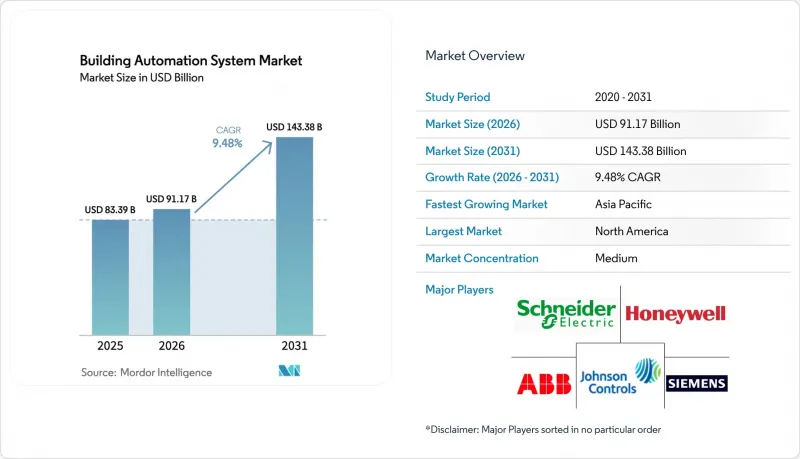
Rising regulatory pressure, falling sensor prices, and maturing cloud analytics are turning building controls from isolated HVAC timers into enterprise-wide, data-rich platforms. Facility owners are accelerating retrofits to comply with tighter energy codes, while subscription software models lower the entry barrier for small portfolios. Vendors are bundling predictive analytics that cut service calls and monetize operational data, and utilities are sweetening demand-response programs with higher rebates. The shift from proprietary hardware toward open, secure protocols is setting the stage for broader adoption across commercial, institutional, and even single-family housing stock.
Global Building Automation System Market Trends and Insights
Stringent Energy Efficiency Regulations And Green Building Codes
Fresh codes are turning energy reduction from a choice into a mandate. The 2024 International Energy Conservation Code tightened HVAC setback and ventilation rules, while Germany's 2024 Gebaudeenergiegesetz requires automation in non-residential buildings above 1,000 m2. Buildings that exceed a 70-point Smart Readiness Indicator in early Austrian pilots enjoy 4-7% rental premiums. California's Title 24 update obliges data centers and retailers to drop 15% of peak load within ten minutes of a grid signal. As certifications such as ISO 52120 gain momentum, insurers and lenders are using automation depth to price green finance, effectively putting a hard dollar value on compliance.
Growing Adoption of IoT And Smart Connected Devices
Low-cost silicon and open APIs are dissolving the premium once attached to sophisticated controls. Matter 1.4 enabled interoperability across 800-plus certified devices, letting managers mix thermostats, lighting, and access badges from multiple brands without middleware. Thread's mesh network stretches wireless range to 100 m in dense towers, shaving conduit labor by 40% in Singapore pilots. Honeywell's Azure-enabled Forge platform now predicts failures up to two weeks ahead, cutting unplanned downtime by 25%. Converged Wi-Fi 6E access points with embedded BACnet gateways simplify wiring and make real-time occupancy maps part of corporate IT dashboards.
High Upfront Capital Expenditure And Long Payback Periods
Comprehensive retrofits can cost USD 8-15 per ft2, pushing a 100,000-ft2 office into a USD 1 million outlay that many landlords struggle to finance. European studies show EUR 10 per m2 spend with four-year paybacks in subsidized-electricity zones such as Poland. Smaller owners lack access to green loans, and ROI calculations wobble with changing tariffs and weather. Pay-for-performance contracts shift capex to vendors but add legal complexity that cautious managers resist.
Other drivers and restraints analyzed in the detailed report include:
- Demand for Energy Cost Savings And Sustainability Targets
- Proliferation of Smart City Initiatives And Government Incentives
- Lack Of Interoperable Standards Across Legacy Systems
For complete list of drivers and restraints, kindly check the Table Of Contents.
Segment Analysis
Software is recording a 10.07% CAGR through 2031 as vendors transition from one-time licenses to recurring subscriptions that monetize fault detection and energy benchmarking. Supervisory suites now embed reinforcement-learning modules that optimize chiller staging and flag valve drift before comfort complaints arise. Schneider Electric's EcoStruxure, active in 480,000 sites, charges at USD 0.05-0.15 per ft2 monthly, turning the installed base into an annuity. Hardware still dominates the Building automation system market share at 48.43% in 2025 because sensors and controllers remain mandatory, yet commoditization is eroding margins. Services are steady mid-single-digit growers as remote diagnostics lessen the need for on-site truck rolls.
The Building automation system market size attached to software is projected to grow sharply because cloud hosting sidesteps server procurement costs. Vendors bundle multiyear analytics contracts with every new controller, aligning incentives to cut a facility's utility bills. Independent integrators that master both IT and OT domains are filling skill gaps, charging premium day rates to stitch third-party sensors into vendor dashboards. Over the forecast horizon, software's higher gross margin will nudge corporate valuations, spurring more tuck-in acquisitions of AI startups.
HVAC controls, at 38.51% revenue share in 2025, remain the backbone of the Building automation system market, but energy management modules are racing ahead at a 10.17% CAGR. Utilities in 18 U.S. states now dispatch five-minute price signals, and automated response can shave 15-25% of a site's bill. Lighting controls are shifting from calendar-based dimming to sensor-driven daylight harvesting, especially in glass-heavy towers. Security, access, and life-safety platforms are converging, enabling a fire alarm to cue HVAC smoke purge and unlock exits simultaneously, as stipulated by NFPA 72.
As boundaries blur, integrated dashboards give facility managers a single view of thermal loads, kWh spend, and occupant counts. That convergence is redefining building controls from "HVAC plus extras" into holistic operational technology stacks. The Building automation system market size for energy management tools will keep expanding as CFOs link emissions disclosures to executive compensation, pushing analytics from plant rooms into the boardroom. Vendors offering modular add-ons rather than forklift upgrades are winning retrofits, and SaaS pricing lets customers start with power metering and layer on lighting or security later.
The Building Automation System Market Report is Segmented by Component (Hardware, Software, and Services), System Type (HVAC Control, Lighting Control, and More), Communication Technology (Wired, and Wireless), Installation Type (New-Build, and Retrofit), End User (Residential, Commercial, Industrial, and Institutional), and Geography (North America, Europe, and More). The Market Forecasts are Provided in Terms of Value (USD).
Geography Analysis
North America captured 34.33% of 2025 revenue, buoyed by the 2024 IECC and upcoming Title 24 updates that hard-wire automation into compliance checklists. ASHRAE 90.1-2022 promises 8.9% energy savings over the 2019 baseline, pushing corporate campuses to modernize chilled-water plants. Canada's National Energy Code mandates controls for buildings above 3,000 m2, and municipal incentives in Toronto cover up to 25% of project costs. Mexico lags due to lower tariffs but is seeing automation embedded in new near-shore factories to satisfy parent-company ESG audits. Labor shortages in commissioning trades remain a bottleneck, stretching timelines and propping up service rates.
Asia Pacific is the fastest-growing territory at a 9.86% CAGR. China's five-year plan steers USD 69 billion toward smart-city layers, reserving roughly 12% for building controls in Beijing, Shanghai, and Shenzhen. India's Smart Cities Mission mandates automation for government and commercial properties over 10,000 m2, while Japan funds pilots that target 20% savings through occupancy-based HVAC. Australia's 2025 National Construction Code embeds automation in commercial buildings above 2,000 m2, and Singapore's Green Mark raises resale values for rated properties. Fragmented supply chains and divergent local standards, however, create go-to-market complexity.
Europe enjoys strong policy tailwinds. The EPBD recast forces Building Automation and Control Systems in non-residential sites over 290 kW by 2024, dropping to 70 kW by 2029. France requires installation by January 2025, and Germany can fine laggards EUR 50,000 (USD 58,145.62) per property. Horizon Europe subsidies accelerate demos in Spain, Poland, and Greece, while the Smart Readiness Indicator links automation depth to property valuation. Eastern Europe trails due to subsidy electricity and limited green financing, yet cohesion funds of EUR 10 billion (USD 11.63 billion) through 2027 are earmarked for energy retrofits.
The Middle East shows outsized momentum. Dubai's AED 7 billion (USD 1.91 billion) smart-grid blueprint mandates building-level response for structures above 10,000 m2, baking demand into the pipeline. Siemens' retrofit of 60 UAE buildings confirmed a 27% energy cut and sub-four-year payback, setting proof points for neighbors. Saudi Arabia's Diriyah Gate channels USD 63.2 billion into BACnet Secure Connect deployments, aiming for 40% grid automation by 2025. South America and Africa remain nascent; Brazil's PROCEL Edifica and South Africa's tax incentives pick up the slack in major metros but lack nationwide impetus.
- Honeywell International Inc.
- Siemens AG
- Johnson Controls International plc
- Schneider Electric SE
- ABB Ltd
- Robert Bosch GmbH
- Mitsubishi Electric Corporation
- Carrier Global Corporation
- Trane Technologies plc
- Legrand SA
- Cisco Systems Inc.
- Hubbell Incorporated
- Delta Controls Inc.
- Lutron Electronics Co., Inc.
- Crestron Electronics, Inc.
- Distech Controls Inc.
- Leviton Manufacturing Co., Inc.
- Belimo Holding AG
- Automated Logic Corporation (Carrier)
Additional Benefits:
- The market estimate (ME) sheet in Excel format
- 3 months of analyst support
TABLE OF CONTENTS
1 INTRODUCTION
- 1.1 Study Assumptions and Market Definition
- 1.2 Scope of the Study
2 RESEARCH METHODOLOGY
3 EXECUTIVE SUMMARY
4 MARKET LANDSCAPE
- 4.1 Market Overview
- 4.2 Market Drivers
- 4.2.1 Stringent Energy Efficiency Regulations and Green Building Codes
- 4.2.2 Growing Adoption of IoT and Smart Connected Devices
- 4.2.3 Demand for Energy Cost Savings and Sustainability Targets
- 4.2.4 Proliferation of Smart City Initiatives and Government Incentives
- 4.2.5 Integration of Digital Twin Technology for Predictive Building Operations
- 4.2.6 Hybrid Work Models Driving Occupancy-Based Space Optimization
- 4.3 Market Restraints
- 4.3.1 High Upfront Capital Expenditure and Long Payback Periods
- 4.3.2 Lack of Interoperable Standards Across Legacy Systems
- 4.3.3 Escalating Cybersecurity and Data Privacy Concerns Delaying Projects
- 4.3.4 Shortage of Skilled BAS Commissioning Professionals
- 4.4 Impact of Macroeconomic Factors
- 4.5 Industry Value Chain Analysis
- 4.6 Regulatory Landscape
- 4.7 Technology Analysis
- 4.8 Porter's Five Forces Analysis
- 4.8.1 Bargaining Power of Suppliers
- 4.8.2 Bargaining Power of Buyers
- 4.8.3 Threat of New Entrants
- 4.8.4 Threat of Substitutes
- 4.8.5 Intensity of Competitive Rivalry
5 MARKET SIZE AND GROWTH FORECASTS (VALUE)
- 5.1 By Component
- 5.1.1 Hardware
- 5.1.1.1 Controllers
- 5.1.1.2 Sensors and Field Devices
- 5.1.1.3 Actuators
- 5.1.1.4 Other Hardware Components
- 5.1.2 Software
- 5.1.2.1 Supervisory / Management Software
- 5.1.2.2 Analytics / Energy Management Software
- 5.1.3 Services
- 5.1.3.1 Installation
- 5.1.3.2 Maintenance and Support
- 5.1.1 Hardware
- 5.2 By System Type
- 5.2.1 HVAC Control Systems
- 5.2.2 Lighting Control Systems
- 5.2.3 Security and Access Control Systems
- 5.2.3.1 Video Surveillance System
- 5.2.3.2 Access Control Systems
- 5.2.3.2.1 Card / RFID Access
- 5.2.3.2.2 Biometric Access
- 5.2.4 Energy Management Systems
- 5.2.5 Fire and Life-Safety Systems
- 5.3 By Communication Technology
- 5.3.1 Wired
- 5.3.2 Wireless
- 5.4 By Installation Type
- 5.4.1 New-Build
- 5.4.2 Retrofit
- 5.5 By End User
- 5.5.1 Residential
- 5.5.2 Commercial
- 5.5.3 Industrial
- 5.5.4 Institutional / Government
- 5.6 By Geography
- 5.6.1 North America
- 5.6.1.1 United States
- 5.6.1.2 Canada
- 5.6.1.3 Mexico
- 5.6.2 South America
- 5.6.2.1 Brazil
- 5.6.2.2 Argentina
- 5.6.3 Europe
- 5.6.3.1 Germany
- 5.6.3.2 United Kingdom
- 5.6.3.3 France
- 5.6.3.4 Rest of Europe
- 5.6.4 Asia Pacific
- 5.6.4.1 China
- 5.6.4.2 Japan
- 5.6.4.3 India
- 5.6.4.4 Rest of Asia Pacific
- 5.6.5 Middle East
- 5.6.5.1 United Arab Emirates
- 5.6.5.2 Saudi Arabia
- 5.6.5.3 Rest of Middle East
- 5.6.6 Africa
- 5.6.6.1 South Africa
- 5.6.6.2 Rest of Africa
- 5.6.1 North America
6 COMPETITIVE LANDSCAPE
- 6.1 Market Concentration
- 6.2 Strategic Moves
- 6.3 Market Share Analysis
- 6.4 Company Profiles (includes Global Level Overview, Market Level Overview, Core Segments, Financials as available, Strategic Information, Market Rank/Share, Products and Services, Recent Developments)
- 6.4.1 Honeywell International Inc.
- 6.4.2 Siemens AG
- 6.4.3 Johnson Controls International plc
- 6.4.4 Schneider Electric SE
- 6.4.5 ABB Ltd
- 6.4.6 Robert Bosch GmbH
- 6.4.7 Mitsubishi Electric Corporation
- 6.4.8 Carrier Global Corporation
- 6.4.9 Trane Technologies plc
- 6.4.10 Legrand SA
- 6.4.11 Cisco Systems Inc.
- 6.4.12 Hubbell Incorporated
- 6.4.13 Delta Controls Inc.
- 6.4.14 Lutron Electronics Co., Inc.
- 6.4.15 Crestron Electronics, Inc.
- 6.4.16 Distech Controls Inc.
- 6.4.17 Leviton Manufacturing Co., Inc.
- 6.4.18 Belimo Holding AG
- 6.4.19 Automated Logic Corporation (Carrier)
7 MARKET OPPORTUNITIES AND FUTURE OUTLOOK
- 7.1 White-Space and Unmet-Need Assessment

