
PUBLISHER: Mordor Intelligence | PRODUCT CODE: 2044199

PUBLISHER: Mordor Intelligence | PRODUCT CODE: 2044199
Crude Steel - Market Share Analysis, Industry Trends & Statistics, Growth Forecasts (2026 - 2031)
Crude Steel market size in 2026 is estimated at 2.32 billion tons, growing from 2025 value of 2.21 billion tons with 2031 projections showing 2.93 billion tons, growing at 4.79% CAGR over 2026-2031.
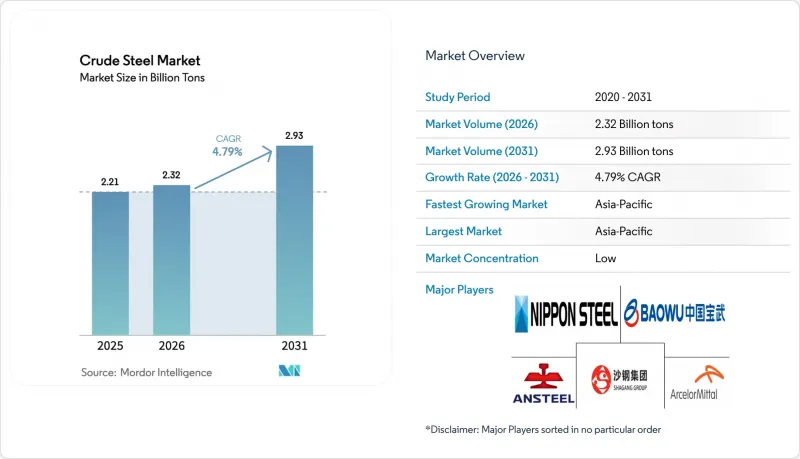
Electric-arc-furnace (EAF) technology is steadily displacing blast-furnace/basic-oxygen-furnace (BOF) routes as decarbonization targets tighten, scrap collection systems mature, and renewable electricity becomes more affordable. Asia-Pacific commands the bulk of demand through large-scale urban infrastructure programs, while India's capacity expansion and ASEAN mega-projects increasingly counterbalance China's easing property cycle. End-user trends show public infrastructure and housing absorbing more than half of annual volume, with transportation electrification, machinery upgrades, and renewable-energy build-outs adding incremental tonnage. Competitive dynamics are shaped by a wave of EAF investments, hydrogen-based direct-reduction pilots, and headline acquisitions that aim to secure low-carbon production footprints in anticipation of carbon-border levies and buyer decarbonization mandates. Integrated producers therefore channel record capital into furnace conversions, electrical-steel lines, and process-heat solutions to hedge against future asset stranding and green-premium uncertainty.
Global Crude Steel Market Trends and Insights
Decarbonization-Linked Capex Race Among Top 20 Steelmakers
More than USD 200 billion has been earmarked for low-carbon furnace conversions, hydrogen-based direct-reduction units, and electrical-steel lines scheduled for completion before 2030. ArcelorMittal's USD 1.2 billion electrical-steel plant in Alabama and thyssenkrupp's tkH2Steel program targeting a 30% CO2 cut by 2030 highlight the first-mover premium. Pilot operations scheduled for early 2026 are expected to validate cost parity with conventional routes once renewable electricity prices converge with fossil alternatives. Early adopters gain price-negotiation leverage with automotive and appliance buyers eager to shrink Scope 3 emissions, while late movers risk stranded blast-furnace assets under tightening carbon-border taxes.
Construction Super-Cycle in India and ASEAN Through 2030
India's target of boosting installed crude-steel capacity to 500 million tons by 2047 anchors a regional boom in long and structural steel, underpinned by domestic iron-ore output that rose to 318 million tons in 2025. Parallel ASEAN megaprojects-such as Indonesia's Nusantara capital and Thailand's Eastern Economic Corridor-collectively require more than 50 million tons in the current decade. Regional investors led by SteelAsia are deploying PHP 65 billion across multiple EAF lines to shorten supply chains and capture value-added fabrication. Sustained growth rests on continued fiscal spending and foreign-direct-investment inflows, although interest-rate cycles and raw-material price swings pose downside risk.
Slower-Than-Expected Chinese Real-Estate Recovery
Monthly new-home sales in China fell 37.7% year-on-year in September 2024, trimming residential-steel demand that had already halved from its 2019 peak of 296 million tons. The resulting export push by Chinese mills depresses regional prices and sparks trade friction, particularly in Southeast Asia. Long-term demand destruction is tied to demographic plateauing and higher vacancy rates, pointing to a structural rather than cyclical adjustment.
Other drivers and restraints analyzed in the detailed report include:
- Automotive Lightweighting Push Reviving Value-Added Flat Steel
- Green-Hydrogen Project Pipelines Lowering Long-Run Power Cost
- Trade-Remedy Proliferation Hampering Cross-Border Flows
For complete list of drivers and restraints, kindly check the Table Of Contents.
Segment Analysis
Killed steel captured 54.18% of the crude steel market share in 2025, reflecting its indispensability to continuous casting lines that account for nearly all modern slab production. Aluminum and silicon deoxidizers suppress gas evolution, which minimizes surface voids and improves yield. Semi-killed grades are expected to outpace overall growth at a 4.9% CAGR through 2031 as automakers seek controlled chemical segregation for lightweight chassis components. Rimmed and capped steels continue to serve niche sheet and strip use cases but remain in structural decline as integrated mills prioritize yield and cleanliness.
EAF operators increasingly specify killed grades to maximize alloy recovery and reduce rework, reinforcing the segment's predominance. Meanwhile, semi-killed steel's rising profile aligns with automakers' transition to advanced high-strength steels requiring precise micro-alloying. Regulatory factors exert minimal direct influence on composition choice, though energy-intensity considerations encourage mills to streamline deoxidation practices and recover aluminum additions for economic gain.
The Crude Steel Market Report is Segmented by Composition (Killed Steel and Semi-Killed Steel), Manufacturing Process (Basic Oxygen Furnace (BOF) and Electric Arc Furnace (EAF)), End-User Industry (Building and Construction, Transportation, and Other End-User Industries), and Geography (Asia-Pacific, North America, Europe, South America, and Middle East and Africa). The Market Forecasts are Provided in Terms of Volume (Tons).
Geography Analysis
Asia-Pacific accounted for 73.52% of 2025 shipments and is projected to grow at 4.86% CAGR to 2031, supported by India's planned scale-up to 500 million tons of annual capacity and ASEAN construction pipelines. China's housing-driven soft patch generates a surplus that increasingly targets export markets, prompting anti-dumping actions across South Asia and Latin America. Japan and South Korea shift focus to electrical-steel specialisms and hydrogen-ready furnaces backed by strong governmental subsidies.
North America's demand outlook brightens under the Bipartisan Infrastructure Law and the Inflation Reduction Act, though the region's supply side is consolidating around headline deals such as Nippon Steel's USD 14.9 billion take-over of U.S. Steel. Abundant scrap and renewable electricity create fertile ground for EAF capacity, with Canada leveraging hydro-powered grids and Mexico capturing reshoring-induced auto-steel orders.
Europe combats energy-price headwinds via efficiency upgrades, EU steel fund grants, and carbon-border tariffs aimed at leveling imports. South America and Middle East-Africa present mid-single-digit growth rooted in infrastructure and resource-processing plants, though financing constraints limit project pipelines. Regionalization of supply chains, triggered by freight-cost inflation and Scope 3 accounting, is a unifying theme influencing mill location and product-mix decisions worldwide.
- ArcelorMittal
- China Ansteel Group Corporation Limited
- China BaoWu Steel Group Corporation Limited
- Fangda Special Steel Technology
- HBIS Group
- Hunan Valin Iron and Steel Co., Ltd.
- Hyundai Steel
- JFE Steel Corporation
- Jiangsu Shagang Group
- JSW
- Nippon Steel Corporation
- NLMK Group
- Nucor Corporation
- POSCO HOLDINGS
- Rizhao Steel Holding Group CO., LTD.
- SAIL
- Tata Steel
- Techint Group
- United States Steel Corporation
Additional Benefits:
- The market estimate (ME) sheet in Excel format
- 3 months of analyst support
TABLE OF CONTENTS
1 Introduction
- 1.1 Study Assumptions and Market Definition
- 1.2 Scope of the Study
2 Research Methodology
3 Executive Summary
4 Market Landscape
- 4.1 Market Overview
- 4.2 Market Drivers
- 4.2.1 Decarbonisation-Linked Capex Race Among Top 20 Steelmakers
- 4.2.2 Construction Super-Cycle in India and ASEAN Through 2030
- 4.2.3 Automotive Lightweighting Push Reviving Value-Added Flat Steel
- 4.2.4 Green-Hydrogen Project Pipelines Lowering Long-Run Power Cost
- 4.2.5 Rapid Build-Out of Small Modular Reactors for Process Heat
- 4.3 Market Restraints
- 4.3.1 Slower-Than-Expected Chinese Real-Estate Recovery
- 4.3.2 Trade-Remedy Proliferation Hampering Cross-Border Flows
- 4.3.3 Green-Premia Uncertainty Delaying Offtake Agreements
- 4.4 Value Chain Analysis
- 4.5 Porter's Five Forces
- 4.5.1 Threat of New Entrants
- 4.5.2 Bargaining Power of Suppliers
- 4.5.3 Bargaining Power of Buyers
- 4.5.4 Threat of Substitutes
- 4.5.5 Degree of Competition
- 4.6 Supply Analysis
- 4.7 Regulatory Policy Analysis
- 4.8 Trade Analysis
- 4.9 Price Trend Analysis
- 4.10 Production Cost Analysis
5 Market Size and Growth Forecasts (Value and Volume)
- 5.1 By Composition
- 5.1.1 Killed Steel
- 5.1.2 Semi-killed Steel
- 5.2 By Manufacturing Process
- 5.2.1 Basic Oxygen Furnace (BOF)
- 5.2.2 Electric Arc Furnace (EAF)
- 5.3 By End-user Industry
- 5.3.1 Building and Construction
- 5.3.2 Transportation
- 5.3.3 Tools and Machinery
- 5.3.4 Energy
- 5.3.5 Consumer Goods
- 5.3.6 Other End-user Industries
- 5.4 By Geography
- 5.4.1 Asia-Pacific
- 5.4.1.1 China
- 5.4.1.2 India
- 5.4.1.3 Japan
- 5.4.1.4 South Korea
- 5.4.1.5 ASEAN Countries
- 5.4.1.6 Rest of Asia-Pacific
- 5.4.2 North America
- 5.4.2.1 United States
- 5.4.2.2 Canada
- 5.4.2.3 Mexico
- 5.4.3 Europe
- 5.4.3.1 Germany
- 5.4.3.2 United Kingdom
- 5.4.3.3 France
- 5.4.3.4 Italy
- 5.4.3.5 Russia
- 5.4.3.6 NORDIC Countries
- 5.4.3.7 Rest of Europe
- 5.4.4 South America
- 5.4.4.1 Brazil
- 5.4.4.2 Argentina
- 5.4.4.3 Rest of South America
- 5.4.5 Middle East and Africa
- 5.4.5.1 Saudi Arabia
- 5.4.5.2 South Africa
- 5.4.5.3 Rest of Middle East and Africa
- 5.4.1 Asia-Pacific
6 Competitive Landscape
- 6.1 Market Concentration
- 6.2 Strategic Moves
- 6.3 Market Share (%)/Ranking Analysis
- 6.4 Company Profiles (includes Global level Overview, Market level overview, Core Segments, Financials, Strategic Information, Market Rank/Share, Products and Services, Recent Developments)
- 6.4.1 ArcelorMittal
- 6.4.2 China Ansteel Group Corporation Limited
- 6.4.3 China BaoWu Steel Group Corporation Limited
- 6.4.4 Fangda Special Steel Technology
- 6.4.5 HBIS Group
- 6.4.6 Hunan Valin Iron and Steel Co., Ltd.
- 6.4.7 Hyundai Steel
- 6.4.8 JFE Steel Corporation
- 6.4.9 Jiangsu Shagang Group
- 6.4.10 JSW
- 6.4.11 Nippon Steel Corporation
- 6.4.12 NLMK Group
- 6.4.13 Nucor Corporation
- 6.4.14 POSCO HOLDINGS
- 6.4.15 Rizhao Steel Holding Group CO., LTD.
- 6.4.16 SAIL
- 6.4.17 Tata Steel
- 6.4.18 Techint Group
- 6.4.19 United States Steel Corporation
7 Market Opportunities and Future Outlook
- 7.1 White-space and Unmet-Need Assessment

