PUBLISHER: Mordor Intelligence | PRODUCT CODE: 2073056

PUBLISHER: Mordor Intelligence | PRODUCT CODE: 2073056
Abrasion Wear Resistant Steel Plates - Market Share Analysis, Industry Trends & Statistics, Growth Forecasts (2026 - 2031)
According to Mordor Intelligence, the abrasion wear resistant steel plates market size is projected to be USD 4.59 billion in 2025, USD 5 billion in 2026, and reach USD 7.62 billion by 2031, growing at a CAGR of 8.82% from 2026 to 2031.
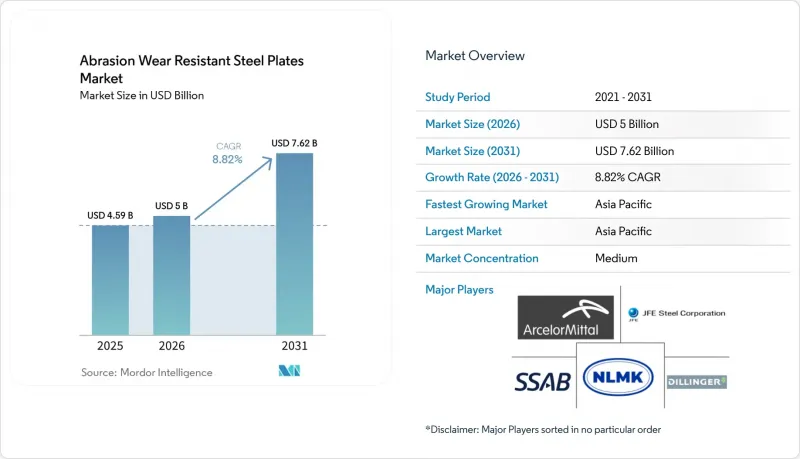
This report is Segmented by Product Type (HB 400, 450, and More), Customer Type (OEMs, Distributors, Maintenance Contractors, and Others), End-User Industry (Mining, Quarrying, Cement, Construction, Recycling, and Others), Plate Thickness (Thin <=10 Mm, Medium 10-40 Mm, and Thick (more Than 40 Mm)), and Geography (Asia-Pacific, and More). The Market Forecasts are Provided in Value (USD).
Global Abrasion Wear Resistant Steel Plates Market Trends and Insights
Rising Demand from Mining and Construction Sectors
New projects in the copper, lithium, and rare-earth sectors are driving up orders for dump-truck bodies, liners, and conveyor components. In the Asia-Pacific region, the production of excavators and loaders has surged to support transport and infrastructure initiatives. North-American OEMs are adopting higher-hardness plates to navigate regulatory weight constraints effectively. In a strategic move, ArcelorMittal Nippon Steel India has allocated funds to triple its capacity, aiming for faster domestic deliveries and reduced reliance on imports. Mining operators are increasingly favoring HB 500 and grades above 500. This preference enables them to extend operational intervals in remote sites, where downtime costs significantly exceed material premiums. As a result, this trend not only tightens the supply of ultra-hard grades but also reinforces price stability.
Regulation-Driven Safety and Wear Standards Expansion
IS 18809:2024 and GB/T 24186-2022 set new benchmarks by mandating hardness and impact-toughness criteria, tightening OEM bid specifications, and phasing out older mild-steel components. New regulations on traceability introduced heat-number stamping and certified test reports, which reduced counterfeiting risks and directed orders to rigorously audited high-capex plate mills. Safety agencies in the United States and the European Union updated equipment guidelines, designating HB 400 as the standard. As a result, heavy-duty applications increasingly favor HB 450 and harder variants.
High Production Costs of Ultra-Hardness Grades
The meticulous quench-and-temper protocols, the incorporation of chromium and molybdenum during alloying, and rigorous post-treatment inspections have driven up unit costs for certain products. In 2025, SSAB earmarked a substantial budget to upgrade its Oxelosund EAF with the aim of maintaining its premium capacity. At the same time, rising energy prices in the European Union have tightened mill margins, limiting the discounting flexibility for HB 550 and HB 600 plates.
Other drivers and restraints analyzed in the detailed report include:
- Supply-Chain Localization Incentives in Heavy-Equipment Hubs
- Circular-Economy Demand for Recycled Wear-Plate Feedstock
- Limited Fabrication and Welding Flexibility at HB grades greater than 500
For complete list of drivers and restraints, kindly check the Table Of Contents.
Segment Analysis
HB 450, which is projected to account for 34.39% of 2025's revenue, establishes its position as a key player in the mining and dump-body applications. The market for abrasion wear-resistant steel plates, particularly those with HB grades exceeding 500, is poised for robust growth at a 10.47% CAGR during the forecast period of 2026-2031. This growth is attributed to mines adopting harder, thinner liners that optimize truck payloads without compromising durability. In March 2026, SSAB unveiled Hardox HiAce, an innovation that combines the hardness of HB 450 with corrosion resistance up to 400 degrees Celsius. This advancement opens doors to wider applications, such as cement coolers and waste-handling bins.
Ultra-hard grades are benefiting from digital-twin analytics, which confirm that longer service intervals can offset the premium costs of these plates. However, challenges persist: complexities in welding and increased alloy surcharges lead to a notable price gap when compared to HB 400. Mills operating under IS 18809:2024 chemistry standards grapple with balancing boron and carbon-equivalent values to ensure toughness. This challenge necessitates investments in in-line quench equipment and automated inspection tools. Still, mining contractors are reaping the rewards. By switching to Hardox 500 Tuf, truck bodies have shed over 500 kilograms, translating to significant fuel savings. This not only strengthens the cost-of-ownership argument but also boosts confidence in the segment's growth.
In 2025, distributors accounted for 48.47% of global revenue, underscoring the fragmented nature of the aftermarket, where swift decisions are crucial. Meanwhile, the market share for OEM direct purchases of abrasion wear-resistant steel plates is increasing, with OEMs growing at a CAGR of 9.66% in the forecast period of 2026-2031. This growth is attributed to equipment builders increasingly factoring plate selection into their structural simulations and life-cycle carbon assessments. A testament to this shift is the agreement that secures a mill-to-line supply chain for all trucks debuting in 2027.
OEM influence is reinforced by mill-owned service networks. SSAB's 550-member Hardox Wearparts chain delivers next-day kits, helping OEMs eliminate buffer inventory and simplifying warranty tracking. While distributors will continue to play a role in addressing repair emergencies and small-lot orders, their significance is waning. This decline is evident as mills and builders increasingly share ownership of development data, software interfaces, and performance diagnostics.
Complete Report Scope:
- By Product Type
- HB 400
- HB 450
- HB 500
- HB grades greater than 500
- By Customer Type
- OEMs
- Distributors
- Maintenance Contractors
- Other Customer Types
- By End-User Industry
- Mining
- Quarrying
- Cement Industry
- Construction
- Recycling Industry
- Other End-user Industries
- By Plate Thickness
- Thin Plates (<=10 mm)
- Medium Plates (10-40 mm)
- Thick Plates (more than 40 mm)
- By Geography
- Asia-Pacific
- China
- India
- Japan
- South Korea
- ASEAN Countries
- Rest of Asia-Pacific
- North America
- United States
- Canada
- Mexico
- Europe
- Germany
- United Kingdom
- France
- Italy
- Spain
- Russia
- Nordic Countries
- Rest of Europe
- South America
- Brazil
- Argentina
- Rest of South America
- Middle-East and Africa
- Saudi Arabia
- South Africa
- United Arab Emirates
- Rest of Middle-East and Africa
- Asia-Pacific
Geography Analysis
In 2025, the Asia-Pacific region commanded a dominant 58.53% share of global revenue and is set to outpace all other regions with a CAGR of 9.49% projected through the forecast period of 2026-2031. China's GB/T 24186-2022 standard has become the cornerstone for domestic OEM tenders, significantly reducing the nation's dependence on imports. Concurrently, India's IS 18809:2024 standard is harmonizing local production with international benchmarks, allowing "Make in India" procurement teams to shorten lead times. ArcelorMittal Nippon Steel India is on track to expand its capacity by 2030, ensuring a consistent supply of flat plates to meet the demands of both domestic and export markets, particularly for excavators and tippers.
North America, though not the dominant player, is capitalizing on mining investments, especially in battery-metal initiatives in Nevada and Ontario. Highlighting a policy-driven localization effort, the Canadian government has granted Titus Steel a subsidy, aiming to fortify supply chains against shipping disruptions. In the United States, equipment manufacturers are pivoting towards low-carbon plates, a shift influenced by state procurement rules adopting Scope 3 accounting. This transition paves the way for SSAB Zero deliveries, which are slated to be housed in a new yard in Iowa.
Europe's growth trajectory may be stabilizing at mid-single digits, yet it commands premium pricing, in part due to environmental surcharges. SSAB's forthcoming projects, such as the Oxelosund EAF start-up and the Lulea mini-mill, are poised to make significant cuts to Scope 1 emissions over the next decade. This positions European tonnage as a preferred choice for automotive and construction OEMs that prioritize verified low-carbon content. Moreover, NATO member states are ramping up their demand for specialty products, especially in defense retrofits like armored-vehicle floor plates.
While South America and the Middle-East and Africa maintain modest market shares, both regions are experiencing robust mid-single-digit growth rates. This expansion is primarily fueled by copper pit enlargements in Chile and Peru, coupled with ambitious infrastructure megaprojects along the Saudi Red Sea coast. Baosteel's state-of-the-art plate mill in Ras Al-Khair, utilizing cost-effective natural gas DRI, is set to become a key supplier of plates to MENA mines and shipyards. This localized production not only simplifies procurement for Gulf mining contractors but also alleviates freight challenges tied to transporting heavy plates.
Trade tensions remain a looming threat. In a proactive stance, POSCO is making substantial investments in downstream assets across the United States and India, strategically positioning itself to counter potential hefty import tariffs in North America. These strategic moves, combined with region-specific regulations and capacity investments, underscore the intricate dynamics shaping the abrasion wear-resistant steel plates market.
- AG der Dillinger Huttenwerke
- ArcelorMittal
- Baosteel Co., Ltd.
- Bisalloy Steel Group
- CMC (Commercial Metals Co.)
- Eckhardt Steel & Alloy
- Hbis Steel Group
- JFE Steel Corporation
- NIPPON STEEL CORPORATION
- NLMK Group
- Nucor Corporation
- POSCO India PC
- Salzgitter Mannesmann
- SIJ Slovenian Steel Group d.d.
- SSAB
- Tata Steel Nederland B.V.
- voestalpine Stahl GmbH
Additional Benefits:
- The market estimate (ME) sheet in Excel format
- 3 months of analyst support
TABLE OF CONTENTS
1 Introduction
- 1.1 Study Assumptions and Market Definition
- 1.2 Scope of the Study
2 Research Methodology
3 Executive Summary
4 Market Landscape
- 4.1 Market Overview
- 4.2 Market Drivers
- 4.2.1 Rising demand from mining and construction sectors
- 4.2.2 Regulation-driven safety and wear standards expansion
- 4.2.3 Supply-chain localisation incentives in heavy-equipment hubs
- 4.2.4 Circular-economy demand for recycled wear-plate feedstock
- 4.2.5 Digital twins enabling predictive wear optimisation
- 4.3 Market Restraints
- 4.3.1 High production costs of ultra-hardness grades
- 4.3.2 Limited fabrication and welding flexibility at HB grades greater than 500
- 4.3.3 Scarcity of skilled welders for wear-resistant alloys
- 4.4 Value Chain Analysis
- 4.5 Regulatory Landscape
- 4.6 Technological Outlook
- 4.7 Porter's Five Forces
- 4.7.1 Threat of New Entrants
- 4.7.2 Bargaining Power of Buyers
- 4.7.3 Bargaining Power of Suppliers
- 4.7.4 Threat of Substitutes
- 4.7.5 Competitive Rivalry
5 Market Size and Growth Forecasts (Value)
- 5.1 By Product Type
- 5.1.1 HB 400
- 5.1.2 HB 450
- 5.1.3 HB 500
- 5.1.4 HB grades greater than 500
- 5.2 By Customer Type
- 5.2.1 OEMs
- 5.2.2 Distributors
- 5.2.3 Maintenance Contractors
- 5.2.4 Other Customer Types
- 5.3 By End-User Industry
- 5.3.1 Mining
- 5.3.2 Quarrying
- 5.3.3 Cement Industry
- 5.3.4 Construction
- 5.3.5 Recycling Industry
- 5.3.6 Other End-user Industries
- 5.4 By Plate Thickness
- 5.4.1 Thin Plates (<=10 mm)
- 5.4.2 Medium Plates (10-40 mm)
- 5.4.3 Thick Plates (more than 40 mm)
- 5.5 By Geography
- 5.5.1 Asia-Pacific
- 5.5.1.1 China
- 5.5.1.2 India
- 5.5.1.3 Japan
- 5.5.1.4 South Korea
- 5.5.1.5 ASEAN Countries
- 5.5.1.6 Rest of Asia-Pacific
- 5.5.2 North America
- 5.5.2.1 United States
- 5.5.2.2 Canada
- 5.5.2.3 Mexico
- 5.5.3 Europe
- 5.5.3.1 Germany
- 5.5.3.2 United Kingdom
- 5.5.3.3 France
- 5.5.3.4 Italy
- 5.5.3.5 Spain
- 5.5.3.6 Russia
- 5.5.3.7 Nordic Countries
- 5.5.3.8 Rest of Europe
- 5.5.4 South America
- 5.5.4.1 Brazil
- 5.5.4.2 Argentina
- 5.5.4.3 Rest of South America
- 5.5.5 Middle-East and Africa
- 5.5.5.1 Saudi Arabia
- 5.5.5.2 South Africa
- 5.5.5.3 United Arab Emirates
- 5.5.5.4 Rest of Middle-East and Africa
- 5.5.1 Asia-Pacific
6 Competitive Landscape
- 6.1 Market Concentration
- 6.2 Strategic Moves
- 6.3 Market Share(%)/Ranking Analysis
- 6.4 Company Profiles (includes Global level Overview, Market level overview, Core Segments, Financials as available, Strategic Information, Products and Services, Recent Developments)
- 6.4.1 AG der Dillinger Huttenwerke
- 6.4.2 ArcelorMittal
- 6.4.3 Baosteel Co., Ltd.
- 6.4.4 Bisalloy Steel Group
- 6.4.5 CMC (Commercial Metals Co.)
- 6.4.6 Eckhardt Steel & Alloy
- 6.4.7 Hbis Steel Group
- 6.4.8 JFE Steel Corporation
- 6.4.9 NIPPON STEEL CORPORATION
- 6.4.10 NLMK Group
- 6.4.11 Nucor Corporation
- 6.4.12 POSCO India PC
- 6.4.13 Salzgitter Mannesmann
- 6.4.14 SIJ Slovenian Steel Group d.d.
- 6.4.15 SSAB
- 6.4.16 Tata Steel Nederland B.V.
- 6.4.17 voestalpine Stahl GmbH
7 Market Opportunities and Future Outlook
- 7.1 White-space and Unmet-Need Assessment

