PUBLISHER: Mordor Intelligence | PRODUCT CODE: 2044211

PUBLISHER: Mordor Intelligence | PRODUCT CODE: 2044211
Print And Apply Labeling And Labeling Equipment - Market Share Analysis, Industry Trends & Statistics, Growth Forecasts (2026 - 2031)
The print and apply labeling and labeling equipment market size is projected to be USD 5.33 billion in 2025, USD 5.49 billion in 2026, and reach USD 6.38 billion by 2031, growing at a CAGR of 3.05% from 2026 to 2031.
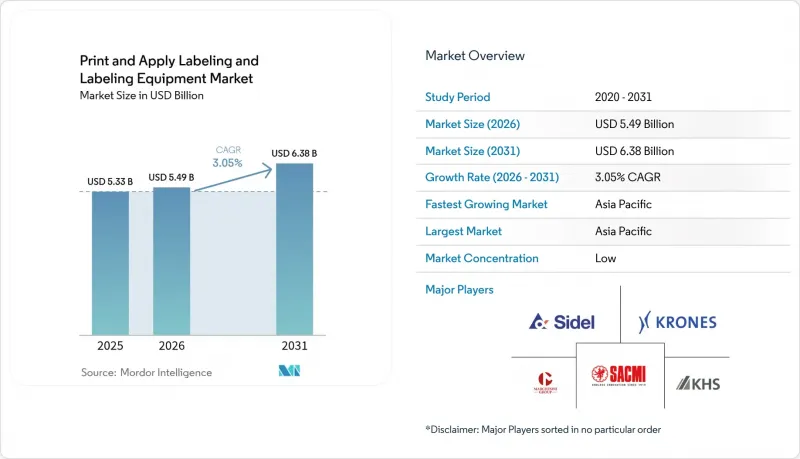
Demand is anchored in high-speed food and beverage packaging, pharmaceutical serialization programs, and e-commerce fulfillment workflows that favor on-demand variable data printing. Edge-AI defect detection is shortening changeover windows while digital inkjet modules deliver lot-size-of-one economics, encouraging brand owners to run short promotional campaigns without holding weeks of pre-printed inventory. Asia-Pacific remains the volume growth engine as China's parcel throughput and India's RFID investments translate into factory-floor automation budgets, whereas North America and Europe continue to target sustainability and traceability mandates that reward fully automatic systems with integrated vision inspection. Competitive rivalry is moderate: five global OEMs still control nearly half of installed capacity, yet price-aggressive Chinese integrators are scaling modular cells that undercut Western list prices by up to 40%, forcing incumbents to lean on IoT-enabled service contracts for margin defense.
Global Print And Apply Labeling And Labeling Equipment Market Trends and Insights
Evolution Of Digital Printing And Fully Automatic Applicators
Digital inkjet and UV-LED modules now rival flexography on speed while eliminating plates, enabling beverage co-packers to slash label inventory from twelve weeks to three days and unlock working-capital savings. Domino's Dx1060i laser coder, released in November 2025, prints 200 meters per minute on corrugated and frozen seafood cartons while cutting energy use by 40%. Konica Minolta's AccurioLabel 400 adds inline spectrophotometry, keeping color drift within 0.5 Delta-E for brands juggling hundreds of SKUs. Servo-guided applicators equipped with vision systems compensate for carton misalignment and drive defect rates below 0.05%, a metric validated by Erdinger Weissbrau's January 2026 installation of AI-enabled print engines. Together, high-resolution printheads and closed-loop robotics move the print and apply labeling and labeling equipment market toward lights-out production and lot-size-of-one personalization.
Stringent Trace And Trace And Serialization Mandates
The U.S. Drug Supply Chain Security Act requires unit-level 2D DataMatrix coding by November 2024, converting print-and-apply stations into compliance assets rather than post-printing niceties. In Europe, Falsified Medicines Directive rules plus tamper-evident seals have already shifted procurement toward combination shrink-sleeve and inkjet serialization modules. ForgeStop's January 2026 NFC-enabled label merges serialization with temperature tracking to combat USD 35 billion of annual cold-chain spoilage. Brazil and Saudi Arabia are phasing in parallel mandates that extend addressable demand across emerging regions. These requirements explain why serialization-ready platforms command premium pricing yet still outgrow legacy semi-automatic lines in the print and apply labeling and labeling equipment market.
Cap-Ex Intensity Of High-Speed Print-And-Apply Systems
Next-generation lines integrating dual-sided coding, vision inspection, and database serialization cost USD 250,000-500,000, pushing payback horizons beyond the comfort level of small and medium enterprises. North American surveys in 2025 showed 62% of contract packagers delaying automation, instead adding shifts to legacy gear. Leasing options have emerged in Europe, yet double-digit interest rates in South America and Africa keep utilization low. Rapid obsolescence compounds the risk, as printhead resolution doubled between 2023 and 2025. Unless equipment-as-a-service models proliferate globally, capital intensity will continue to shave growth points from the print and apply labeling and labeling equipment market.
Other drivers and restraints analyzed in the detailed report include:
- Automation Demand In Food And Beverage High-Speed Packaging Lines
- E-Commerce Cold-Chain Dual-Temperature Label Needs
- Shortage Of Integration And Maintenance Technicians
For complete list of drivers and restraints, kindly check the Table Of Contents.
Segment Analysis
Fully automatic platforms captured 89.51% share of the print and apply labeling and labeling equipment market in 2025 and are projected to advance at a 4.51% CAGR to 2031. These systems replace operator intervention with closed-loop robotics, trimming labor cost per unit by up to 70%. At Erdinger Weissbrau, AI-guided print engines pushed defect rates below 0.05% after a January 2026 retrofit. Semi-automatic equipment still fits co-packing sites handling frequent SKU swaps, while manual stations linger in artisanal food production and clinical trial labeling.
Interest in IoT connectivity widens the gulf. SATO's July 2025 Thailand expansion added a line dedicated to sensor-rich, cloud-monitored machines that flag printhead wear before downtime occurs. Semi-automatic units now ship with touchscreen setup wizards, making training accessible during the technician shortage. Manual tools decline steadily as modular low-cost print-and-apply cells often below USD 30,000 enter the print and apply labeling and labeling equipment market, broadening automation access for micro-breweries and niche cosmetic brands.
The Print and Apply Labeling and Labeling Equipment Market Report is Segmented by Technology (Fully Automatic, Semi-Automatic, and Manual), Label Type (Pressure-Sensitive, Shrink-Sleeve, Glue-Based, In-Mold, Linerless, and Smart-Label RFID and QR), End-User Vertical (Food and Beverage, Pharmaceutical, Personal Care and Household, and More), and Geography. The Market Forecasts are Provided in Terms of Value (USD).
Geography Analysis
Asia-Pacific held 37.89% of 2025 revenue and is expected to expand at a 4.92% CAGR, underpinned by China's 175 billion parcel throughput in 2024 and India's RFID capacity build-outs. Avery Dennison's USD 30 million Pune inlay plant, inaugurated in April 2025, can output 5 billion tags per year to satisfy surging omnichannel retail demand. OMRON's Bengaluru Automation Center further addresses technician shortages that might otherwise bottleneck adoption.
North America and Europe grow near the global average of 3.05% yet focus on higher-margin fully automatic systems that comply with serialization and sustainability statutes. The European Commission's Packaging and Packaging Waste Regulation sets a 15% packaging-reduction target by 2030, boosting linerless and digital print interest. In the United States, FDA traceability rules mean 40% of food lines require upgrades by 2027, feeding retrofit demand.
South America gains traction as Brazil phases pharmaceutical serialization in by 2027 and as foreign direct investment pours into automation. Daifuku's USD 24 million Telangana facility, announced April 2025, underscores interest in the region's logistics hubs. The Middle East and Africa remain nascent, yet Saudi Arabia's 2024 serialization rules and United Arab Emirates air-cargo RFID projects foreshadow a lift in the print and apply labeling and labeling equipment market over the next five years.
- Avery Dennison Corporation
- Axon LLC
- BW Packaging (Barry-Wehmiller Group, Inc)
- Domino Printing Sciences PLC
- Videojet Technologies
- Fuji Seal International, Inc.
- Heuft Systemtechnik GmbH
- HERMA GmbH
- ID Technology, LLC
- KHS GmbH
- Krones AG
- Shenzhen Shuangcheng Automation Co., Ltd
- Marchesini Group S.p.A.
- MARKEM-IMAJE (DOVER CORPORATION)
- Novexx Solutions GmbH
- PDC International Corp.
- Quadrel Labeling Systems
- FoxJet
- SATO Holdings Corporation
- SIDEL (Tetra Laval)
- Weber Marking Systems GmbH
- ProMach
- Wuxi Sici Auto Co, Ltd.
Additional Benefits:
- The market estimate (ME) sheet in Excel format
- 3 months of analyst support
TABLE OF CONTENTS
1 INTRODUCTION
- 1.1 Study Assumptions and Market Definition
- 1.2 Scope of the Study
2 RESEARCH METHODOLOGY
3 EXECUTIVE SUMMARY
4 MARKET LANDSCAPE
- 4.1 Market Overview
- 4.2 Market Drivers
- 4.2.1 Evolution of Digital Printing and Fully-Automatic Applicators
- 4.2.2 Stringent Trace-and-Trace and Serialization Mandates
- 4.2.3 Automation Demand in Food and Beverage High-Speed Packaging Lines
- 4.2.4 E-Commerce Cold-Chain Dual-Temperature Label Needs
- 4.2.5 Sustainability Push Toward Liner-Less Label Formats
- 4.2.6 IoT-Edge Predictive Maintenance for Labeling Lines
- 4.3 Market Restraints
- 4.3.1 Cap-Ex Intensity of High-Speed Print-and-Apply Systems
- 4.3.2 Durability Issues in Extreme Humidity / Freezer Tunnels
- 4.3.3 Shortage of Integration and Maintenance Technicians
- 4.3.4 RFID Inlay Supply Volatility Inflating Raw-Material Cost
- 4.4 Industry Value Chain Analysis
- 4.5 Regulatory Landscape
- 4.6 Technological Outlook
- 4.7 Impact of Macroeconomic Factors on the Market
- 4.8 Porter's Five Forces Analysis
- 4.8.1 Bargaining Power of Suppliers
- 4.8.2 Bargaining Power of Buyers
- 4.8.3 Threat of New Entrants
- 4.8.4 Threat of Substitutes
- 4.8.5 Intensity of Competitive Rivalry
5 MARKET SIZE AND GROWTH FORECASTS (VALUE)
- 5.1 By Technology
- 5.1.1 Fully Automatic
- 5.1.2 Semi-Automatic
- 5.1.3 Manual
- 5.2 By Label Type
- 5.2.1 Pressure-Sensitive / Self-Adhesive
- 5.2.2 Shrink-Sleeve
- 5.2.3 Glue-Based
- 5.2.4 In-Mold
- 5.2.5 Liner less Label Applicators
- 5.2.6 Smart-Label (RFID / QR) Systems
- 5.3 By End-User Vertical
- 5.3.1 Food and Beverage
- 5.3.2 Pharmaceutical
- 5.3.3 Personal Care and Household
- 5.3.4 Industrial and Logistics
- 5.3.5 Others End-User Verticals
- 5.4 By Geography
- 5.4.1 North America
- 5.4.1.1 United States
- 5.4.1.2 Canada
- 5.4.1.3 Mexico
- 5.4.2 South America
- 5.4.2.1 Brazil
- 5.4.2.2 Argentina
- 5.4.2.3 Chile
- 5.4.2.4 Rest of South America
- 5.4.3 Europe
- 5.4.3.1 Germany
- 5.4.3.2 United Kingdom
- 5.4.3.3 France
- 5.4.3.4 Rest of Europe
- 5.4.4 Asia-Pacific
- 5.4.4.1 China
- 5.4.4.2 Japan
- 5.4.4.3 India
- 5.4.4.4 South Korea
- 5.4.4.5 Australia
- 5.4.4.6 Rest of Asia-Pacific
- 5.4.5 Middle East and Africa
- 5.4.5.1 Middle East
- 5.4.5.1.1 Saudi Arabia
- 5.4.5.1.2 United Arab Emirates
- 5.4.5.1.3 Turkey
- 5.4.5.1.4 Rest of Middle East
- 5.4.5.2 Africa
- 5.4.5.2.1 South Africa
- 5.4.5.2.2 Nigeria
- 5.4.5.2.3 Rest of Africa
- 5.4.5.1 Middle East
- 5.4.1 North America
6 COMPETITIVE LANDSCAPE
- 6.1 Market Concentration
- 6.2 Strategic Moves
- 6.3 Market Share Analysis
- 6.4 Company Profiles (Includes Global Level Overview, Market Level Overview, Core Segments, Financials as Available, Strategic Information, Market Rank/Share, Products and Services, and Recent Developments)
- 6.4.1 Avery Dennison Corporation
- 6.4.2 Axon LLC
- 6.4.3 BW Packaging (Barry-Wehmiller Group, Inc)
- 6.4.4 Domino Printing Sciences PLC
- 6.4.5 Videojet Technologies
- 6.4.6 Fuji Seal International, Inc.
- 6.4.7 Heuft Systemtechnik GmbH
- 6.4.8 HERMA GmbH
- 6.4.9 ID Technology, LLC
- 6.4.10 KHS GmbH
- 6.4.11 Krones AG
- 6.4.12 Shenzhen Shuangcheng Automation Co., Ltd
- 6.4.13 Marchesini Group S.p.A.
- 6.4.14 MARKEM-IMAJE (DOVER CORPORATION)
- 6.4.15 Novexx Solutions GmbH
- 6.4.16 PDC International Corp.
- 6.4.17 Quadrel Labeling Systems
- 6.4.18 FoxJet
- 6.4.19 SATO Holdings Corporation
- 6.4.20 SIDEL (Tetra Laval)
- 6.4.21 Weber Marking Systems GmbH
- 6.4.22 ProMach
- 6.4.23 Wuxi Sici Auto Co, Ltd.
7 MARKET OPPORTUNITIES AND FUTURE OUTLOOK
- 7.1 White-Space and Unmet-Need Assessment

