PUBLISHER: Mordor Intelligence | PRODUCT CODE: 2044238

PUBLISHER: Mordor Intelligence | PRODUCT CODE: 2044238
North America Insurance Telematics - Market Share Analysis, Industry Trends & Statistics, Growth Forecasts (2026 - 2031)
The insurance telematics market size is expected to increase from USD 135.66 million in 2026 to reach USD 469.38 million by 2031, growing at a CAGR of 28.18% over 2026-2031.
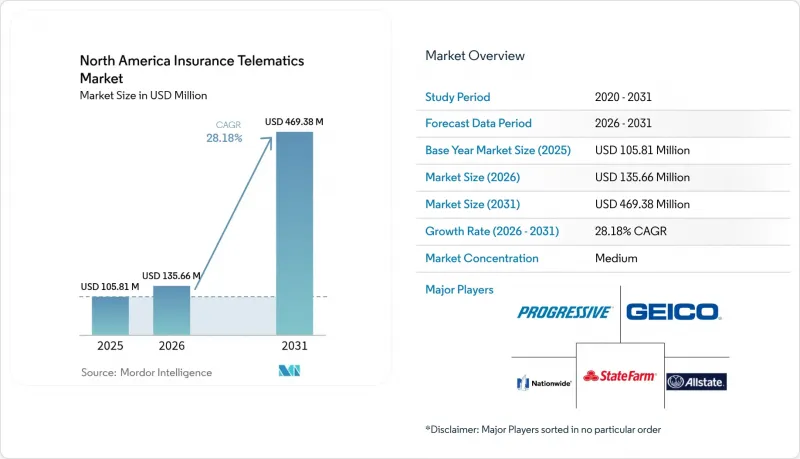
Escalating premium inflation, maturing smartphone sensors, and original equipment manufacturer data-sharing partnerships are expanding the addressable base of usage-based policies. United States auto insurers are passing higher repair costs on to customers, while Canadian carriers face a 36.4% premium jump recorded between 2014 and 2024, so telematics has become a strategic lever for underwriting profitability. Concurrently, platforms such as DriveWell now detect crashes with 99% accuracy, dissolving the reliability concerns that previously constrained adoption. Automakers are also embedding consent workflows into connected-car services, allowing drivers to enroll at the point of sale, a convenience that trims acquisition costs and fuels rapid enrollment growth. Intensifying competition from app-native insurers and technology firms is influencing incumbents to double down on vertical integration, original equipment manufacturer alliances, and claim-automation technologies.
North America Insurance Telematics Market Trends and Insights
Price-Hardening In Auto Premiums
Rapid rate increases are steering consumers toward usage-based discounts that can reach 45%. Canadian premiums climbed 36.4% over the prior decade as high repair bills for advanced driver-assistance system components kept claim costs elevated. United States carriers wrote USD 318 billion in direct premiums during 2023, with private auto lines absorbing the steepest jumps. Telematics lets insurers reward safer drivers in real time, defend margins, and lessen adverse selection. Urban corridors such as Toronto, Vancouver, New York, and Los Angeles display the strongest enrollment because collision frequency amplifies price pressure, turning driver-behavior data into a competitive necessity.
Smartphone Sensor Accuracy And API Access
Upgraded gyroscopes, accelerometers, and global positioning modules now rival dedicated dongle accuracy. The DriveWell platform demonstrated 99% crash-detection fidelity, enabling immediate emergency dispatch and claim validation. Apple and Google permit background motion sensing at low battery drain, eliminating a historic enrollment hurdle. A 2025 Smartcar survey found that 41% of North American drivers would share trip data for lower premiums, marking a sharp rise in data-sharing comfort. These technical and behavioral shifts are accelerating the pivot from hardware to software onboarding, with sign-up complete in fewer than three minutes for many carriers.
Data Privacy And Consent Regulations
A widening patchwork of rules complicates multi-state rollout. Maryland's 2024 Senate Bill 984 requires explicit opt-in and deletion rights. New York proposals press insurers to show actuarial fairness before using driving data. California classified telematics feeds as sensitive personal information under Senate Bill 354, triggering heightened disclosures. Surveys show that 60% of drivers opt out over privacy fears despite hefty discounts, forcing carriers to harmonize consent dashboards and retention policies, which erodes scale economies.
Other drivers and restraints analyzed in the detailed report include:
- OEM Embedded Telematics Penetration
- Auto-Lender Partnerships For Mileage-Linked Products
- Data Quality And Compatibility Issues In Smartphone UBI
For complete list of drivers and restraints, kindly check the Table Of Contents.
Segment Analysis
The insurance telematics market size for pay-as-you-drive eclipsed other models in 2025, yet manage-how-you-drive is expanding fastest. Coaching applications deliver steady in-app tips and gamified leaderboards that lower aggregate risk scores by double digits within six months. Insurers equate every one-point score improvement with measurable claims savings, tilting incentive budgets toward behavioral nudges over simple mileage caps. The shift also aligns with regulators, who worry that straight mileage pricing could disadvantage long-commute workers without necessarily improving road safety.
Engagement metrics validate the pivot. Across a 500,000-policy sample analyzed by Cambridge Mobile Telematics, claims declined 5.5% after drivers began receiving personalized feedback. Pay-how-you-drive retains a niche among suburban commuters whose daily patterns are stable but whose risk profiles fluctuate with driving style. Overall, carriers find that dynamic feedback lock-in boosts retention as policyholders work to preserve discounts earned through safer habits, perpetuating data flow and reducing churn.
Smartphones held the largest slice of the insurance telematics market share in 2025 because zero hardware cost and near-universal ownership make them a compelling default. However, original equipment manufacturer embedded application programming interface streams are advancing at the fastest rate, backed by manufacturer control over high-resolution sensor sets. Embedded modems deliver brake pressure, steering angle, and collision avoidance events that smartphones cannot capture, so underwriters using factory feeds achieve thinner loss-ratio variance across driver cohorts.
Portable on-board diagnostics dongles continue to phase out, primarily because shipping, installation, and customer-support overhead lift per-policy expenses. Carriers serving commercial fleets still deploy hybrid models that combine smartphone trip detection with dongle-based engine diagnostics to maximize uptime insights. Early evidence suggests that insurers accessing both data sources cut loss adjustment expenses more than those relying on a single channel, but cost must drop further for hybrid adoption to broaden beyond fleet lines.
The North America Insurance Telematics Market Report is Segmented by Revenue Model (Pay-As-You-Drive, Pay-How-You-Drive, and More), Telematics Hardware Type (Portable OBD-II Dongle, and More), Vehicle Type (Passenger Cars, and More), End-User (Personal Lines, and More), Distribution Channel (Direct To Consumer, and More), Data Source (OBD-II Data, and More), and Country. The Market Forecasts are Provided in Terms of Value (USD).
List of Companies Covered in this Report:
- Progressive Corporation
- State Farm Mutual Automobile Insurance Company
- Allstate Corporation
- Nationwide Mutual Insurance Company
- GEICO (Berkshire Hathaway Inc.)
- Octo Telematics SpA
- Cambridge Mobile Telematics
- Arity (Allstate Subsidiary)
- IMS (Insurance and Mobility Solutions)
- LexisNexis Risk Solutions (RELX Group)
- The Floow Limited
- PowerFleet Inc.
- Intact Financial Corporation
- Desjardins Group
- USAA
- Travelers Companies Inc.
- Zurich Insurance Group
- Liberty Mutual
- Metromile (Lemonade Inc.)
- Root Inc.
Additional Benefits:
- The market estimate (ME) sheet in Excel format
- 3 months of analyst support
TABLE OF CONTENTS
1 INTRODUCTION
- 1.1 Study Assumptions and Market Definition
- 1.2 Scope of the Study
2 RESEARCH METHODOLOGY
3 EXECUTIVE SUMMARY
4 MARKET LANDSCAPE
- 4.1 Market Overview
- 4.2 Market Drivers
- 4.2.1 Price-Hardening in Auto Premiums
- 4.2.2 Smartphone Sensor Accuracy and API Access
- 4.2.3 OEM Embedded Telematics Penetration
- 4.2.4 Auto-Lender Partnerships for Mileage-Linked Products
- 4.2.5 Claims-First Telematics for Accelerated Settlements
- 4.2.6 AI-Driven Driver Coaching Gamification ROI
- 4.3 Market Restraints
- 4.3.1 Data Privacy and Consent Regulations
- 4.3.2 Data Quality and Compatibility Issues in Smartphone UBI
- 4.3.3 Patchy State-Level AI Governance Uncertainty
- 4.3.4 OEM Data Monetization Squeezing Third-Party Margins
- 4.4 Industry Value Chain Analysis
- 4.5 Regulatory Landscape
- 4.6 Technological Outlook
- 4.7 Impact of Macroeconomic Factors on the Market
- 4.8 Porter's Five Forces Analysis
- 4.8.1 Bargaining Power of Suppliers
- 4.8.2 Bargaining Power of Buyers
- 4.8.3 Threat of New Entrants
- 4.8.4 Threat of Substitute Products
- 4.8.5 Degree of Competition
5 MARKET SIZE AND GROWTH FORECASTS (VALUE)
- 5.1 By Revenue Model
- 5.1.1 Pay-as-You-Drive (PAYD)
- 5.1.2 Pay-how-You-Drive (PHYD)
- 5.1.3 Manage-how-You-Drive (MHYD)
- 5.2 By Telematics Hardware Type
- 5.2.1 Portable OBD-II Dongle
- 5.2.2 Embedded TCU
- 5.2.3 Smartphone Based
- 5.2.4 OEM Embedded API Data
- 5.3 By Vehicle Type
- 5.3.1 Passenger Cars
- 5.3.2 Light Commercial Vehicles
- 5.3.3 Heavy Commercial Vehicles
- 5.4 By End-User
- 5.4.1 Personal Lines
- 5.4.2 Commercial Fleets
- 5.5 By Distribution Channel
- 5.5.1 Direct to Consumer
- 5.5.2 Agency / Broker
- 5.5.3 Affinity and OEM-Tied
- 5.6 By Data Source
- 5.6.1 OBD-II Data
- 5.6.2 Smartphone Sensor Data
- 5.6.3 OEM Embedded APIs
- 5.6.4 Hybrid Data Streams
- 5.7 By Country
- 5.7.1 United States
- 5.7.2 Canada
6 COMPETITIVE LANDSCAPE
- 6.1 Market Concentration
- 6.2 Strategic Moves
- 6.3 Market Share Analysis
- 6.4 Company Profiles (includes Global Level Overview, Market Level Overview, Core Segments, Financials as available, Strategic Information, Market Rank/Share for key companies, Products and Services, and Recent Developments)
- 6.4.1 Progressive Corporation
- 6.4.2 State Farm Mutual Automobile Insurance Company
- 6.4.3 Allstate Corporation
- 6.4.4 Nationwide Mutual Insurance Company
- 6.4.5 GEICO (Berkshire Hathaway Inc.)
- 6.4.6 Octo Telematics SpA
- 6.4.7 Cambridge Mobile Telematics
- 6.4.8 Arity (Allstate Subsidiary)
- 6.4.9 IMS (Insurance and Mobility Solutions)
- 6.4.10 LexisNexis Risk Solutions (RELX Group)
- 6.4.11 The Floow Limited
- 6.4.12 PowerFleet Inc.
- 6.4.13 Intact Financial Corporation
- 6.4.14 Desjardins Group
- 6.4.15 USAA
- 6.4.16 Travelers Companies Inc.
- 6.4.17 Zurich Insurance Group
- 6.4.18 Liberty Mutual
- 6.4.19 Metromile (Lemonade Inc.)
- 6.4.20 Root Inc.
7 MARKET OPPORTUNITIES AND FUTURE OUTLOOK
- 7.1 White-Space and Unmet-Need Assessment

