PUBLISHER: Mordor Intelligence | PRODUCT CODE: 2044250

PUBLISHER: Mordor Intelligence | PRODUCT CODE: 2044250
United Kingdom Adhesives - Market Share Analysis, Industry Trends & Statistics, Growth Forecasts (2026 - 2031)
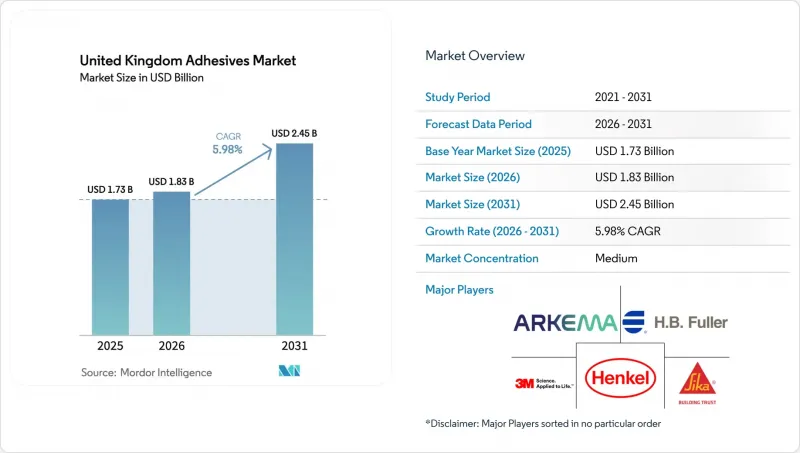
The United Kingdom Adhesives Market size is projected to be USD 1.73 billion in 2025, USD 1.83 billion in 2026, and reach USD 2.45 billion by 2031, growing at a CAGR of 5.98% from 2026 to 2031. Regulatory realignment with EU SVHC updates, rapid uptake of water-borne chemistries, and heavier use of lightweight substrates in mobility, construction, and packaging continue to redefine adhesives from commodity inputs to performance-enabling materials. Water-borne grades already dominate regulatory-sensitive applications, while hot-melt lines capture e-commerce packaging runs that demand sub-60-second set times. Suppliers are improving filler loading and shifting to reactive or bio-based systems to balance raw-material volatility and VOC compliance. Consolidation among global majors is intensifying as acquisition targets supply local production footprints, technical service teams, and regional distribution depth.
United Kingdom Adhesives Market Trends and Insights
Growing Adoption of Lightweight Composites in UK Automotive Manufacturing
Jaguar Land Rover's GBP 6.3 million (USD 8.31 million) SCALE-UP program is scaling composite doors and recycled carbon-fiber wheels, creating demand for adhesives that bond mixed substrates and survive battery-electric vehicle thermal loads. Henkel's 2026 agreement to acquire ATP Adhesive Systems adds low-VOC specialty tapes that align with Euro 7 recyclability goals. Digital modelling within SCALE-UP now predicts bond-line performance, shrinking development cycles for suppliers. Polyurethane and epoxy chemistries still dominate structural joints, but cyanoacrylate and silane-terminated polymer options are gaining share where sub-60-second takt times matter. Composite adoption is forecast to trim vehicle mass by 35 kg, reinforcing long-term pull for structural adhesives over mechanical fasteners.
Increase in Modular Off-Site Construction Techniques Boosting Adhesive Demand
Sika's UK network sells polyurethane and hybrid systems such as SikaTack Panel and Sikaflex-545 that give off-site builders airtight, vibration-tolerant joints without mechanical fixings. Factory controls cut cure-time variance and allow wider roll formats, reducing waste by roughly 30%. Dedicated MMC divisions at several suppliers now offer line-integration support and operator training. Sandwich-panel production speeds reportedly rise 30% when SikaForce systems replace rivets. Hybrid adhesives' +-25% movement capability minimizes cracking during module transport, a key benefit as housebuilders boost prefabrication to ease labor shortages.
Volatility in Raw-Material Prices Linked to Petrochemical Supply-Chain Disruptions
Henkel projects low single-digit cost inflation for isocyanates, epoxies, and acrylic monomers in 2026, yet 15-25% quarterly spot swings remain common for some feedstocks. SME formulators, which dominate local supply, lack hedging power and often absorb margin hits or delay capacity upgrades. PFAS and flame-retardant scrutiny within the UK REACH Rolling Action Plan adds further uncertainty. Larger players are countering by boosting mineral-filler loading, but viscosity and application limits cap this tactic. Cost turbulence ultimately favors integrated multinationals with forward-buying leverage and global supply webs.
Other drivers and restraints analyzed in the detailed report include:
- Rising Use of Bio-Based Adhesive Formulations Driven by UK Sustainability Mandates
- Expansion of E-Commerce Packaging Volumes Requiring High-Performance Adhesives
- Stringent VOC-Emission Limits Under UK REACH Regulations Increasing Compliance Costs
For complete list of drivers and restraints, kindly check the Table Of Contents.
Segment Analysis
Water-borne chemistries accounted for 43.44% of the United Kingdom adhesives market share in 2025, a lead reinforced by the UK's tighter VOC trajectory and by exporters' need to satisfy EU PPWR recyclability criteria. Hot-melt products, while smaller in base, are on track for a 6.26% CAGR as the UK adhesives market size tied to e-commerce grows in step with automated parcel lines and paper-based void-fill adoption.
Solvent-borne products confront rising compliance costs and shrinking target niches, though they still win select flooring and exterior joinery work that demands deep substrate wetting. Reactive polyurethane and epoxy systems remain indispensable for structural bonding in composites and modular construction; BASF and Sika's Baxxodur EC 151 hardener, with 90% lower VOC release, exemplifies the pivot toward low-emission reactive grades. UV-cure lines, though a small slice, are expanding in medical and electronics assembly for instant curing and zero-emission factory floors.
The United Kingdom Adhesives Market Report is Segmented by Technology (Water-Borne, Solvent-Borne, Reactive, Hot Melt, and UV Cured Adhesives), Resin (Polyurethane, Epoxy, Acrylic, Cyanoacrylate, VAE/EVA, Silicone, and Other Resins), and End-User Industry (Building and Construction, Packaging, Automotive, Aerospace, Woodworking and Joinery, Footwear, Healthcare, and More). The Market Forecasts are Provided in Terms of Value (USD).
List of Companies Covered in this Report:
- 3M
- Arkema
- Avery Dennison Corporation
- BASF
- Beardow Adams
- Dow
- Dymax Corporation
- Follmann Chemie GmbH
- H.B. Fuller Company
- Henkel AG & Co. KGaA
- Huntsman International LLC
- Jowat SE
- Momentive Performance Materials
- PARKER HANNIFIN CORP
- Scapa
- Sika AG
- Wacker Chemie AG
Additional Benefits:
- The market estimate (ME) sheet in Excel format
- 3 months of analyst support
TABLE OF CONTENTS
1 Introduction
- 1.1 Study Assumptions and Market Definition
- 1.2 Scope of the Study
2 Research Methodology
3 Executive Summary
4 Market Landscape
- 4.1 Market Overview
- 4.2 Market Drivers
- 4.2.1 Growing adoption of lightweight composites in UK automotive manufacturing
- 4.2.2 Increase in modular off-site construction techniques boosting adhesive demand
- 4.2.3 Rising use of bio-based adhesive formulations driven by UK sustainability mandates
- 4.2.4 Expansion of e-commerce packaging volumes requiring high-performance adhesives
- 4.2.5 Surge in niche aerospace MRO activities around UK regional airports
- 4.3 Market Restraints
- 4.3.1 Volatility in raw-material prices linked to petrochemical supply-chain disruptions
- 4.3.2 Stringent VOC-emission limits under UK REACH regulations increasing compliance costs
- 4.3.3 Skills shortage in advanced adhesive-application technicians
- 4.4 Value Chain Analysis
- 4.5 Porter's Five Forces
- 4.5.1 Threat of New Entrants
- 4.5.2 Bargaining Power of Suppliers
- 4.5.3 Bargaining Power of Buyers
- 4.5.4 Threat of Substitutes
- 4.5.5 Competitive Rivalry
5 Market Size and Growth Forecasts (Value)
- 5.1 By Technology
- 5.1.1 Water-borne
- 5.1.2 Solvent-borne
- 5.1.3 Reactive
- 5.1.4 Hot Melt
- 5.1.5 UV Cured Adhesives
- 5.2 By Resin
- 5.2.1 Polyurethane
- 5.2.2 Epoxy
- 5.2.3 Acrylic
- 5.2.4 Cyanoacrylate
- 5.2.5 VAE/EVA
- 5.2.6 Silicone
- 5.2.7 Other Resins
- 5.3 By End-user Industry
- 5.3.1 Building and Construction
- 5.3.2 Packaging
- 5.3.3 Automotive
- 5.3.4 Aerospace
- 5.3.5 Woodworking and Joinery
- 5.3.6 Footwear
- 5.3.7 Healthcare
- 5.3.8 Other End-user Industries
6 Competitive Landscape
- 6.1 Market Concentration
- 6.2 Strategic Moves
- 6.3 Market Share(%)/Ranking Analysis
- 6.4 Company Profiles (includes Global level Overview, Market level overview, Core Segments, Financials as available, Strategic Information, Products and Services, and Recent Developments)
- 6.4.1 3M
- 6.4.2 Arkema
- 6.4.3 Avery Dennison Corporation
- 6.4.4 BASF
- 6.4.5 Beardow Adams
- 6.4.6 Dow
- 6.4.7 Dymax Corporation
- 6.4.8 Follmann Chemie GmbH
- 6.4.9 H.B. Fuller Company
- 6.4.10 Henkel AG & Co. KGaA
- 6.4.11 Huntsman International LLC
- 6.4.12 Jowat SE
- 6.4.13 Momentive Performance Materials
- 6.4.14 PARKER HANNIFIN CORP
- 6.4.15 Scapa
- 6.4.16 Sika AG
- 6.4.17 Wacker Chemie AG
7 Market Opportunities and Future Outlook
- 7.1 White-space and unmet-need assessment

