
PUBLISHER: Mordor Intelligence | PRODUCT CODE: 2044266

PUBLISHER: Mordor Intelligence | PRODUCT CODE: 2044266
Nordic Countries Architectural Coatings - Market Share Analysis, Industry Trends & Statistics, Growth Forecasts (2026 - 2031)
The Nordic Countries Architectural Coatings Market size is projected to expand from USD 1.18 billion in 2025 and USD 1.23 billion in 2026 to USD 1.52 billion by 2031, registering a CAGR of 4.28% between 2026 to 2031.
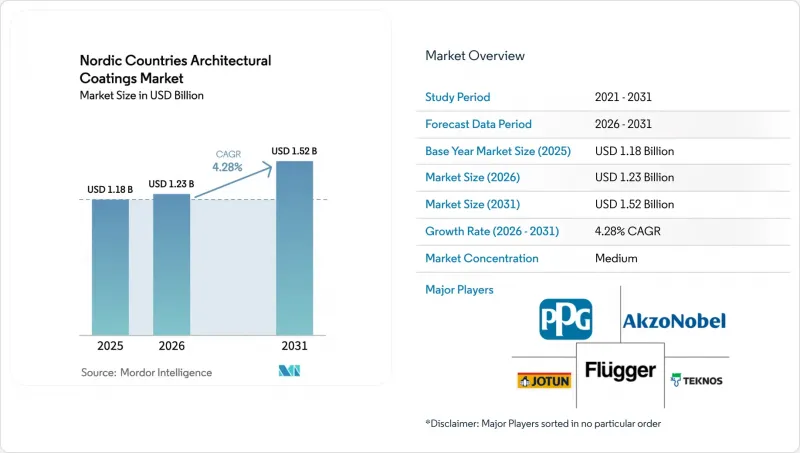
Residential renovation dominates demand, while digital retail and color-matching apps shorten decision cycles and steer shoppers toward premium, low-odor waterborne paints. Titanium dioxide and acrylic feedstock inflation squeezes margins, yet subsidy-backed bio-based chemistry offers a defensive hedge for innovators able to access EU funding. Competitive concentration sits in the middle ground; four multinationals hold roughly two-thirds of regional volume, but smaller challengers are winning share online with Nordic Swan-certified ranges and next-day delivery. Norway's 100% emission-free public-tender rule from 2025 is a pivotal catalyst because it effectively bans solventborne offerings and accelerates the shift toward hybrid acrylic-polyurethane dispersions.
Nordic Countries Architectural Coatings Market Trends and Insights
Renovation-Led DIY Boom in Detached Housing
Nordic households continue to refinance renovation rather than relocate, which lifts unit volumes for interior wall and trim paints. Online engagement is decisive; 80% of private painting customers in Flugger's network begin their journey digitally, and that online interaction correlates with same-store sales gains. Survey data show 45% of Swedes plan paint projects and 72% feel confident applying coatings themselves, prompting brands to launch smaller pack sizes and virtual color visualizers that curb mismatches. Detached homes, which dominate Nordic housing stock, absorb waterborne acrylics able to dry in cool, humid climates. Mortgage-rate headwinds dampen new-build activity, yet renovation spend remains stable, preserving throughput for retail channels. Suppliers therefore prioritize quick-drying, low-odor products that allow residents to occupy rooms immediately after application.
Green-Building Codes Accelerating Low-VOC Uptake
Regulation is compressing product life cycles and pushing solventborne lines to the margins. Norway's net-zero energy code and 100% emission-free tender rule from 2025 effectively remove hydrocarbon solvents from publicly funded projects. Sweden mandates carbon footprint declarations for construction products, while Denmark invested DKK 2.5 billion into green construction research and development in 2023. Across the region, the Nordic Swan Ecolabel caps VOCs at 30 g/L for interior matt paints and 100 g/L for exterior coatings; retailers prioritize Swan-certified SKUs on shelf, cementing low-VOC dominance. Compliance drives rapid portfolio rationalization, and suppliers with digital product passports stand to win public contracts as data auditing tightens. Consequently, waterborne acrylic-polyurethane hybrids become the default selection in both residential and commercial segments.
Volatile TiO2 and Acrylic Feedstock Prices
Tronox lifted titanium dioxide prices by 2-4% in Q1 2026 after closing its 90,000-ton Botlek plant, while Venator idled 650,000 tons of global capacity, tightening supply and amplifying sulfur-price spikes of 160%. EU anti-dumping duties block cheaper Chinese imports, locking Nordic buyers into higher-cost European supply. BASF raised acrylic monomer prices by USD 0.12 per pound in 2025 as propylene disruptions roiled the chain, with spot acrylic acid swinging between USD 1,290 and USD 1,457 per ton. Smaller local brands lack hedging leverage and may either accept margin erosion or dilute formulations with extenders that risk warranty claims.
Other drivers and restraints analyzed in the detailed report include:
- Weather-Proofing Demand from Harsh Nordic Climate
- E-Commerce Paint Retail and Color-Matching Apps
- Skilled-Labor Shortage Slowing Repaint Cycles
For complete list of drivers and restraints, kindly check the Table Of Contents.
Segment Analysis
The residential industry segment dominated sales with 69.96% of the architectural coatings market share in 2025, and it is set to log a 4.54% CAGR to 2031. The architectural coatings market size for residential repainting therefore remains the critical barometer for distributors. Sweden's private renovation outlays held firm even as new residential investment fell 55% since mid-2022. Digital color visualization converts online browsers into in-store transactions, underpinning offline sales. DIY demand favors low-odor waterborne acrylics in 1-2.5-liter packs and extends to niche sample pots for home-office accent walls.
Commercial premises represent the balance of volume, and stricter building codes make them an anchor customer for Nordic Swan-certified waterborne systems. Norway's net-zero rules eliminate solventborne lines in government projects from 2025. Prefabricated timber modules popular in Sweden's offsite sector require factory-cured polyurethane or UV-cured films that can withstand transport abrasion and on-site assembly. Growth is solid but slower than residential because public tenders often extend over multiyear funding cycles.
The Nordic Countries Architectural Coatings Market Report is Segmented by End-User Industry (Residential and Commercial), Technology (Waterborne and Solventborne), Resin (Acrylic, Alkyd, Epoxy, Polyester, Polyurethane, and Other Resin Types), and Geography (Denmark, Finland, Norway, and Sweden). The Market Forecasts are Provided in Terms of Value (USD).
List of Companies Covered in this Report:
- AkzoNobel N.V.
- Alcro Beckers
- Brillux GmbH & Co. KG
- Colorama
- DAW SE
- Flugger Group A/S
- Hempel A/S
- Jotun
- PPG Industries Inc.
- Teknos
- The Sherwin-Williams Company
Additional Benefits:
- The market estimate (ME) sheet in Excel format
- 3 months of analyst support
TABLE OF CONTENTS
1 Introduction
- 1.1 Study Assumptions and Market Definition
- 1.2 Scope of the Study
2 Research Methodology
3 Executive Summary
4 Market Landscape
- 4.1 Market Overview
- 4.2 Market Drivers
- 4.2.1 Renovation-led DIY boom in detached housing
- 4.2.2 Green-building codes accelerating low-VOC uptake
- 4.2.3 Weather-proofing demand from harsh Nordic climate
- 4.2.4 E-commerce paint retail and colour-matching apps
- 4.2.5 EU/EEA subsidies for bio-based chemistry scale-up
- 4.3 Market Restraints
- 4.3.1 Volatile TiO2 and acrylic feedstock prices
- 4.3.2 Skilled-labour shortage slowing repaint cycles
- 4.3.3 Micro-plastics regulation driving reformulation cost
- 4.4 Value Chain Analysis
- 4.5 Regulatory Analysis
- 4.6 Porter's Five Forces
- 4.6.1 Threat of New Entrants
- 4.6.2 Bargaining Power of Suppliers
- 4.6.3 Bargaining Power of Buyers
- 4.6.4 Threat of Substitutes
- 4.6.5 Competitive Rivalry
5 Market Size and Growth Forecasts (Value)
- 5.1 By End-User Industry
- 5.1.1 Residential
- 5.1.2 Commercial
- 5.2 By Technology
- 5.2.1 Waterborne
- 5.2.2 Solventborne
- 5.3 By Resin
- 5.3.1 Acrylic
- 5.3.2 Alkyd
- 5.3.3 Epoxy
- 5.3.4 Polyester
- 5.3.5 Polyurethane
- 5.3.6 Other Resin Types
- 5.4 By Geography
- 5.4.1 Denmark
- 5.4.2 Finland
- 5.4.3 Norway
- 5.4.4 Sweden
6 Competitive Landscape
- 6.1 Market Concentration
- 6.2 Strategic Moves
- 6.3 Market Share(%)/Ranking Analysis
- 6.4 Company Profiles (includes Global-level Overview, Market-level Overview, Core Segments, Financials as available, Strategic Information, Products and Services, Recent Developments)
- 6.4.1 AkzoNobel N.V.
- 6.4.2 Alcro Beckers
- 6.4.3 Brillux GmbH & Co. KG
- 6.4.4 Colorama
- 6.4.5 DAW SE
- 6.4.6 Flugger Group A/S
- 6.4.7 Hempel A/S
- 6.4.8 Jotun
- 6.4.9 PPG Industries Inc.
- 6.4.10 Teknos
- 6.4.11 The Sherwin-Williams Company
7 Market Opportunities and Future Outlook
- 7.1 White-space and Unmet-Need Assessment

