
PUBLISHER: Mordor Intelligence | PRODUCT CODE: 2061501

PUBLISHER: Mordor Intelligence | PRODUCT CODE: 2061501
Italy Rice - Market Share Analysis, Industry Trends & Statistics, Growth Forecasts (2026 - 2031)
According to Mordor Intelligence, the italy rice market size is projected to grow from USD 2.60 billion in 2025 to USD 2.72 billion in 2026, reaching USD 3.43 billion by 2031, with a CAGR of 4.7% during 2026-2031.
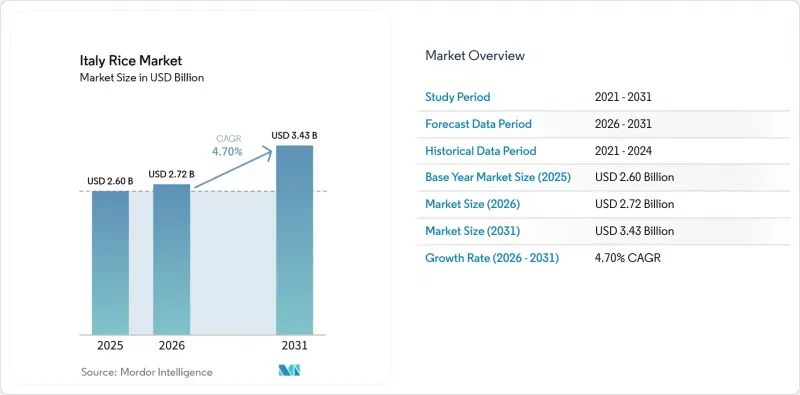
The Italy Rice Market Report Includes Production Analysis (Volume), Consumption Analysis (Value and Volume), Import Analysis (Value and Volume), Export Analysis (Value and Volume), Wholesale Price Trend Analysis and Forecast, and More. The Market Forecasts are Provided in Terms of Value (USD) and Volume (Metric Tons).
Italy Rice Market Trends and Insights
Export Premium for Arborio and Carnaroli Varieties
Italy Arborio and Carnaroli rice varieties benefit from a strong geographic indication status and culinary preference in export markets, allowing them to command consistent price premiums over standard long-grain rice. According to Trade Map (ITC), Italy exported rice worth USD 926.8 million in 2025, highlighting robust international demand and reaffirming the country's role as a significant rice exporter in European markets . Multiple quality certifications enhance product differentiation and help with fair pricing for growers and millers targeting high-value segments.
Shift to Ready-to-Cook Rice in Italy Retail Market
Convenience-driven consumption patterns are driving the growth of ready-to-cook rice formats, including microwaveable and pre-cooked meals, in Italy. Shifts in urban lifestyles, increasing demand for quick meal solutions, and a growing preference for portion-controlled packaging are shaping purchasing behavior across retail channels. Supermarkets and discount stores are allocating more shelf space to private-label and value-added rice products, prompting processors to innovate in packaging, flavors, and product formats. This trend is further supported by rising demand from foodservice and online delivery platforms, which prioritize consistent and easy-to-prepare rice options that align with modern consumption habits.
Rising Energy Costs for Parboiling and Milling
According to the Rome Business School (2025), electricity prices in Italy reached EUR 136.2 per MWh (USD 147.3 per MWh) during the first four months of 2025, the highest among major European economies . These elevated electricity costs significantly affect energy-intensive rice processing activities, including parboiling and milling. The increased power prices raise operational expenses for rice mills, particularly for small and medium-scale processors, thereby reducing cost efficiency and profitability. This ongoing pressure from high energy costs limits competitiveness and pricing flexibility, restraining the Italian rice market by increasing processing costs and hindering overall industry performance.
Other drivers and restraints analyzed in the detailed report include:
- Government Eco-Schemes for Low-Water Paddy Systems
- Adoption of AI-Based Yield Forecasting
- Soil Salinity in Po Valley from Climate-Driven Sea Intrusion
For complete list of drivers and restraints, kindly check the Table Of Contents.
Additional Benefits:
- The market estimate (ME) sheet in Excel format
- 3 months of analyst support
TABLE OF CONTENTS
1 Introduction
- 1.1 Study Assumptions and Market Definition
- 1.2 Scope of the Study
2 Research Methodology
3 Executive Summary
4 Market Landscape
- 4.1 Market Overview
- 4.2 Market Drivers
- 4.2.1 Export premium for Arborio and Carnaroli varieties
- 4.2.2 Shift to ready-to-cook rice in Italy retail market
- 4.2.3 Government eco-schemes for low-water paddy systems
- 4.2.4 Adoption of AI-based yield forecasting
- 4.2.5 Expansion of contract farming by major millers
- 4.2.6 Growing demand for gluten-free carbohydrate sources
- 4.3 Market Restraints
- 4.3.1 Rising energy costs for parboiling and milling
- 4.3.2 Soil salinity in the Po Valley from climate-driven sea intrusion
- 4.3.3 Competition from low-cost Asian imports in food service
- 4.3.4 Fragmented farms limiting economies of scale
- 4.4 Opportunities
- 4.5 Challenges
- 4.6 Value Chain Analysis
- 4.7 Technologies and usage of AI in the Industry
- 4.8 Input Market Analysis
- 4.8.1 Seeds
- 4.8.2 Fertilizers
- 4.8.3 Crop Protection Chemicals
- 4.9 Distribution Channel Analysis
- 4.10 Market Sentiment Analysis
- 4.11 PESTLE Analysis
5 Market Size and Growth Forecasts (Value)
- 5.1 Italy
- 5.1.1 Production Analysis
- 5.1.1.1 Production Volume
- 5.1.1.2 Area Harvested and Yield
- 5.1.2 Consumption Analysis (Value and Volume)
- 5.1.3 Trade Analysis (Value and Volume)
- 5.1.3.1 Import Market Analysis
- 5.1.3.1.1 Import Value and Volume
- 5.1.3.1.2 Key Supplying Markets
- 5.1.3.2 Export Market Analysis
- 5.1.3.2.1 Export Value and Volume
- 5.1.3.2.2 Key Destinations Markets
- 5.1.3.1 Import Market Analysis
- 5.1.4 Wholesale Price Trend Analysis and Forecast
- 5.1.5 Regulatory Framework
- 5.1.6 Logistics and Infrastructure
- 5.1.7 Seasonality Analysis
- 5.1.1 Production Analysis
6 End Use and Application
- 6.1 Primary Applications and Emerging Applications
- 6.2 Consumption Breakdown by Industries
7 Competitive Landscape
- 7.1 Overview of the Competition
- 7.2 Recent Developments
- 7.3 Market Concentration Analysis
- 7.4 List of Key Players
- 7.4.1 Euricom S.p.A.
- 7.4.2 Riso Gallo S.p.A.
- 7.4.3 Riso Scotti S.p.A.
- 7.4.4 Riso Vignola Giovanni S.p.A.
- 7.4.5 Curti S.r.l.
- 7.4.6 SP S.p.A.
- 7.4.7 Riseria Ferron S.r.l.
- 7.4.8 Cascina Belvedere S.r.l.
- 7.4.9 Agrover S.r.l.
- 7.4.10 Mundi Riso S.r.l.
- 7.4.11 Riseria Campanini S.r.l.
- 7.4.12 Riso Acqua e Sole S.r.l.
8 Market Opportunities and Future Outlook

