
PUBLISHER: Mordor Intelligence | PRODUCT CODE: 2061546

PUBLISHER: Mordor Intelligence | PRODUCT CODE: 2061546
United States Cardiovascular Devices - Market Share Analysis, Industry Trends & Statistics, Growth Forecasts (2026 - 2031)
According to Mordor Intelligence, the united states cardiovascular devices market size in 2026 is estimated at USD 24.97 billion, growing from 2025 value of USD 23.33 billion with 2031 projections showing USD 35.06 billion, growing at 7.02% CAGR over 2026-2031.
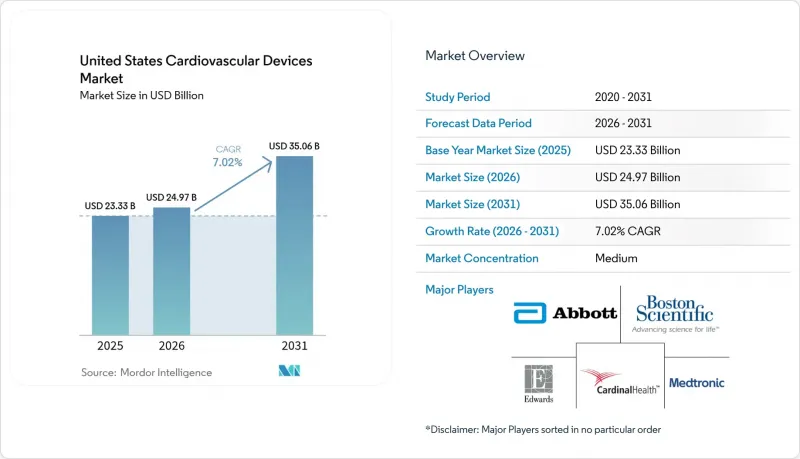
This report is Segmented by Device Type (Diagnostic & Monitoring Devices [ECG Systems, Remote Cardiac Monitor, and More], Therapeutic & Surgical Devices [Coronary Stents, and More]), Indication (Coronary Artery Disease, Arrhythmia, and More), and End User (Hospitals and More). The Market Forecasts are Provided in Terms of Value (USD).
United States Cardiovascular Devices Market Trends and Insights
Obesity-Linked Pad Surge Driving Use Of Drug-Coated Balloons
Peripheral artery disease now affects 10 million Americans, with 2 million facing critical limb-threatening ischemia. Trial evidence showing a 51.3% fall in target-lesion failure after sirolimus delivery is accelerating hospital adoption of drug-coated balloons, especially for below-the-knee work. Hospitals in high-obesity Southern states are restocking coated balloons, while large systems negotiate multiprocedure discounts that lower per-unit pricing. Device makers respond by adding smaller diameters and extended coating life to suit infrapopliteal anatomy. Payers increasingly cover these balloons once registry data confirm reduced repeat interventions, thereby reinforcing the momentum for uptake.
ACC/AHA Reimbursement Revisions Incentivizing CRT-D Upgrades
The 2025 criteria broaden access to cardiac resynchronization therapy defibrillators and reward extended battery life, yielding USD 15,120 in Medicare savings per patient over six years. Hospitals are pre-ordering premium CRT-D models to capture both clinical benefit and cost share. Early claims data reveal a 17% year-over-year increase in elective generator replacements as providers expedite swaps before older devices reach their elective-replacement indicators. Manufacturers highlight remote-monitoring firmware that dovetails with home-care expansion, strengthening the therapy's economic case.
Venture-Capital Influx Into Percutaneous Mitral Repair Start-Ups
Capstan Medical's USD 110 million Series C funding round epitomizes investor faith in the mitral and tricuspid valve market. In this field, half of patients with severe mitral regurgitation still lack access to surgery. Venture backing enables entrants to secure premium component pricing and conduct longer trials, thereby positioning them as attractive acquisition targets. Structural-heart majors now allocate dedicated scouting teams to incubators, intensifying competition for intellectual property. Hospitals anticipate broader device menus that can tailor therapy to individual anatomy and comorbidities, potentially reducing procedure counts.
Other drivers and restraints analyzed in the detailed report include:
- Growth Of Office-Based & ASC Cath-Labs Via CMS Site-Of-Service Differential
- Hospital Capital Budget Freezes After Medicare Rate Cuts
- Stringent Regulatory Requirements And Product Recalls
For complete list of drivers and restraints, kindly check the Table Of Contents.
Segment Analysis
Therapeutic & surgical products captured 76.55% of the United States cardiovascular devices market share in 2025, underpinned by stents, valve implants, and rhythm-management devices that anchor high-value procedures. Drug-eluting stents remain the mainstay; however, bioresorbable options and intravascular lithotripsy catheters, now under development by Johnson & Johnson, offer additional revenue streams. Physicians value single-vendor kits that bundle guidewires and imaging catheters, a tactic that deepens wallet share for integrated suppliers.
Diagnostic & monitoring devices are forecast to clock an 8.12% CAGR to 2031, the fastest of any category. Cloud analytics, such as EchoGo Amyloidosis, which achieves 84.5% sensitivity and 89.7% specificity, convert ultrasound systems into a source of subscription revenue. Growing reliance on remote physiologic monitoring prompts device makers to embed cellular radios, shifting BOM costs to connectivity chips while generating service-fee income.
List of Companies Covered in this Report:
- Medtronic
- Abbott Laboratories
- Boston Scientific
- Edward Lifesciences
- Johnson & Johnson
- Terumo
- Beckton Dickinson
- W. L. Gore & Associates
- Siemens Healthineers
- MicroPort CRM (MicroPort Scientific)
- BIOTRONIK
- LivaNova
- Getinge
- Teleflex
- Cordis
- Merit Medical Systems
Additional Benefits:
- The market estimate (ME) sheet in Excel format
- 3 months of analyst support
TABLE OF CONTENTS
1 Introduction
- 1.1 Study Assumptions & Market Definition
- 1.2 Scope of the Study
2 Research Methodology
3 Executive Summary
4 Market Landscape
- 4.1 Market Overview
- 4.2 Market Drivers
- 4.2.1 Obesity-Linked PAD Surge Driving Use of Drug-Coated Balloons
- 4.2.2 ACC/AHA Reimbursement Revisions Incentivizing CRT-D Upgrades
- 4.2.3 Growth of Office-Based & ASC Cath-Labs via CMS Site-of-Service Differential
- 4.2.4 Venture Capital Influx into Percutaneous Mitral Repair Start-ups
- 4.2.5 Rapid Adoption of TAVR Post-FDA Low-Risk Approval & Expanded CMS Coverage
- 4.2.6 Infection-Control Policies Boosting Demand for Single-Use Diagnostic Catheters
- 4.3 Market Restraints
- 4.3.1 Hospital Capital Budget Freezes After Medicare Rate Cuts
- 4.3.2 Stringent Regulatory Requirements and Product Recall
- 4.3.3 Semiconductor Shortages Disrupting ICD Generator Supply
- 4.3.4 Stringent 510(k) Predicate Requirements for Bioresorbable Scaffolds
- 4.4 Supply-Chain Analysis
- 4.5 Regulatory Landscape
- 4.6 Technological Outlook
- 4.7 Porter's Five Forces Analysis
- 4.7.1 Threat of New Entrants
- 4.7.2 Bargaining Power of Suppliers
- 4.7.3 Bargaining Power of Buyers
- 4.7.4 Threat of Substitutes
- 4.7.5 Competitive Rivalry
5 Market Size & Growth Forecasts (Value)
- 5.1 By Device
- 5.1.1 Diagnostic & Monitoring Devices
- 5.1.1.1 ECG Systems
- 5.1.1.2 Remote Cardiac Monitor
- 5.1.1.3 Cardiac MRI
- 5.1.1.4 Cardiac CT
- 5.1.1.5 Echocardiography / Ultrasound
- 5.1.1.6 Fractional Flow Reserve (FFR) Systems
- 5.1.2 Therapeutic & Surgical Devices
- 5.1.2.1 Coronary Stents
- 5.1.2.1.1 Drug-Eluting Stents
- 5.1.2.1.2 Bare-Metal Stents
- 5.1.2.1.3 Bioresorbable Stents
- 5.1.2.2 Catheters
- 5.1.2.2.1 PTCA Balloon Catheters
- 5.1.2.2.2 IVUS/OCT Catheters
- 5.1.2.3 Cardiac Rhythm Management
- 5.1.2.3.1 Pacemakers
- 5.1.2.3.2 Implantable Cardioverter Defibrillators
- 5.1.2.3.3 Cardiac Resynchronization Therapy Devices
- 5.1.2.4 Heart Valves
- 5.1.2.4.1 TAVR/TAVI
- 5.1.2.4.2 Mechanical Valves
- 5.1.2.4.3 Tissue/Bioprosthetic Valves
- 5.1.2.5 Ventricular Assist Devices
- 5.1.2.6 Artificial Hearts
- 5.1.2.7 Grafts & Patches
- 5.1.2.8 Other Cardiovascular Surgical Devices
- 5.1.2.1 Coronary Stents
- 5.1.1 Diagnostic & Monitoring Devices
- 5.2 By Indication
- 5.2.1 Coronary Artery Disease
- 5.2.2 Arrhythmia
- 5.2.3 Heart Failure
- 5.2.4 Valvular Heart Disease
- 5.3 By End User
- 5.3.1 Hospitals
- 5.3.2 Home Care Settings
- 5.3.3 Others
6 Competitive Landscape
- 6.1 Market Concentration
- 6.2 Market Share Analysis
- 6.3 Company Profiles {(includes Global level Overview, Market level overview, Core Segments, Financials as available, Strategic Information, Market Rank/Share for key companies, Products & Services, and Recent Developments)}
- 6.3.1 Medtronic plc
- 6.3.2 Abbott Laboratories
- 6.3.3 Boston Scientific Corporation
- 6.3.4 Edwards Lifesciences Corporation
- 6.3.5 Johnson & Johnson
- 6.3.6 Terumo Corporation
- 6.3.7 Becton, Dickinson and Company
- 6.3.8 W. L. Gore & Associates, Inc.
- 6.3.9 Siemens Healthineers AG
- 6.3.10 MicroPort CRM (MicroPort Scientific)
- 6.3.11 Biotronik
- 6.3.12 LivaNova PLC
- 6.3.13 Getinge AB
- 6.3.14 Teleflex Incorporated
- 6.3.15 Cordis Corporation
- 6.3.16 Merit Medical Systems, Inc.
7 Market Opportunities & Future Outlook
- 7.1 White-space & Unmet-Need Assessment

