
PUBLISHER: Mordor Intelligence | PRODUCT CODE: 2066383

PUBLISHER: Mordor Intelligence | PRODUCT CODE: 2066383
Germany Cardiovascular Devices - Market Share Analysis, Industry Trends & Statistics, Growth Forecasts (2026 - 2031)
According to Mordor Intelligence, the germany cardiovascular devices market size is expected to grow from USD 4.03 billion in 2025 to USD 4.31 billion in 2026 and is forecast to reach USD 6.05 billion by 2031 at 7.02% CAGR over 2026-2031.
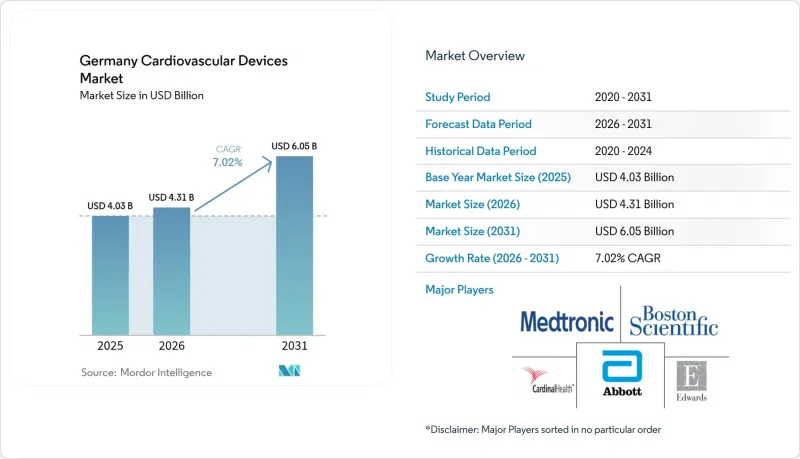
This report Segments the Industry by Device Type (Diagnostic and Monitoring Devices [Electrocardiogram (ECG) and More], Therapeutic and Surgical Devices [Cardiac Assist Devices and More]), Application (Coronary Artery Disease, and More), and End User (Hospitals and More). The Market Forecasts are Provided in Terms of Value (USD).
Germany Cardiovascular Devices Market Trends and Insights
Rapid Expansion of Reimbursed Cardiovascular Procedures
Germany's DRG system rewards hospitals for interventional care, lifting procedure counts for transcatheter aortic valve implantation beyond 100,000 cumulative cases. Catheter laboratories continue to replace surgical suites, and reimbursement parity between valve surgery and TAVI compresses payback periods for capital equipment. As 95% of octogenarian patients now receive TAVI, device makers bundle valves with embolic-protection filters to enlarge average selling prices while helping hospitals meet stroke-reduction quality metrics
Mandatory Remote Heart-Failure Telemonitoring
Since 2023, statutory insurers must cover remote telemetry for chronic heart-failure patients, motivating adoption of implantable loop recorders and non-invasive hemodynamic sensors. University centers have established command hubs that analyze continuous data feeds and trigger early outpatient interventions, cutting readmissions and freeing inpatient beds. Vendors offer subscription packages that integrate hardware, analytics dashboards, and reimbursement coding support, encouraging hospitals to migrate from episodic follow-up to always-on monitoring workflows.
EU-MDR Post-Market Costs
The 2021 MDR raised evidence thresholds and introduced intensive post-market surveillance, raising recertification costs by up to 300% for some small firms. With only 43 notified bodies to assess 500,000 devices EU-wide, certification queues stretch into 2026. Many German SMEs drop low-volume catheters rather than fund new trials, consolidating purchasing toward large multinationals and reducing product variety for niche applications.
Other drivers and restraints analyzed in the detailed report include:
- Germany's Highest PCI per-Capita Rate Sustains Drug-Eluting-Stent & Guidewire Replacement Cycles
- Krankenhaus-Zukunft Act Spurs Digital ICU/OR Hemodynamic-Monitoring Upgrades
- Pharmacotherapy Advances Moderating Device Demand
For complete list of drivers and restraints, kindly check the Table Of Contents.
Segment Analysis
Therapeutic and Surgical Devices captured 68.55% Germany cardiovascular devices market share in 2025, boosted by 164 TAVI cases per million residents. Growing reliance on drug-eluting stents, left-atrial appendage occluders, and VADs underscores hospitals' preference for minimally invasive solutions that shorten intensive-care occupancy. Despite the maturity of percutaneous coronary intervention, high-risk subsets such as calcified lesions sustain demand for lithotripsy catheters reimbursed under new OPS codes.
Diagnostic and Monitoring Devices, although smaller, will expand at 6.12% CAGR to 2031, buoyed by AI-driven ECG analytics and mandatory heart-failure telemonitoring.
List of Companies Covered in this Report:
- Abbott Laboratories
- B. Braun
- BIOTRONIK
- Boston Scientific
- CardioFocus Inc.
- Dragerwerk
- Edwards Lifesciences Corp.
- GE HealthCare Technologies Inc.
- Getinge AB (Maquet Cardiopulmonary)
- Lepu Medical
- LivaNova
- Medtronic
- MicroPort Scientific Corp.
- Koninklijke Philips
- Schiller
- Siemens Healthineers
- Straub Medical
- Terumo Corp.
- W. L. Gore & Associates
- Zoll Medical Corp.
Additional Benefits:
- The market estimate (ME) sheet in Excel format
- 3 months of analyst support
TABLE OF CONTENTS
1 Introduction
- 1.1 Study Assumptions & Market Definition
- 1.2 Scope of the Study
2 Research Methodology
3 Executive Summary
4 Market Landscape
- 4.1 Market Overview
- 4.2 Market Drivers
- 4.2.1 Rapid Expansion of Reimbursed TAVI & TMVR Procedures Boosting Transcatheter Heart Valve Demand
- 4.2.2 Mandatory Remote Heart-Failure Telemonitoring (G-BA 2022) Accelerating Implantable Loop Recorder Uptake
- 4.2.3 Germany's Highest PCI per-Capita in EU Sustaining DES & Guidewire Replacement Cycles
- 4.2.4 Super-Aged Demographics in Southern & Eastern States Driving Pacemaker & VAD Implant Volumes
- 4.2.5 R&D Tax Incentives & MDR Transition Supporting Domestic Innovators (e.g., BIOTRONIK)
- 4.2.6 Krankenhaus-Zukunft Act Funding Digital ICU / OR Hemodynamic Monitoring Systems
- 4.3 Market Restraints
- 4.3.1 EU-MDR Post-Market Costs Forcing SMEs to Withdraw Legacy Cardiovascular SKUs
- 4.3.2 DRG Budget Caps Curbing Ventricular Assist Device Implant Adoption Beyond University Centers
- 4.3.3 Value-Based Procurement Driving Price Erosion in Stents & Balloons
- 4.3.4 Pharmacotherapy Advances (e.g., SGLT2i) Moderating Device Therapy Volumes
- 4.4 Value / Supply-Chain Analysis
- 4.5 Regulatory Outlook
- 4.6 Technological Outlook
- 4.7 Porter's Five Forces
- 4.7.1 Threat of New Entrants
- 4.7.2 Bargaining Power of Suppliers
- 4.7.3 Bargaining Power of Buyers
- 4.7.4 Threat of Substitutes
- 4.7.5 Competitive Rivalry
5 Market Size & Growth Forecasts (Value)
- 5.1 By Device Type
- 5.1.1 Diagnostic & Monitoring Devices
- 5.1.1.1 ECG Systems
- 5.1.1.2 Remote Cardiac Monitor
- 5.1.1.3 Cardiac MRI
- 5.1.1.4 Cardiac CT
- 5.1.1.5 Echocardiography / Ultrasound
- 5.1.1.6 Fractional Flow Reserve (FFR) Systems
- 5.1.2 Therapeutic & Surgical Devices
- 5.1.2.1 Coronary Stents
- 5.1.2.1.1 Drug-Eluting Stents
- 5.1.2.1.2 Bare-Metal Stents
- 5.1.2.1.3 Bioresorbable Stents
- 5.1.2.2 Catheters
- 5.1.2.2.1 PTCA Balloon Catheters
- 5.1.2.2.2 IVUS/OCT Catheters
- 5.1.2.3 Cardiac Rhythm Management
- 5.1.2.3.1 Pacemakers
- 5.1.2.3.2 Implantable Cardioverter Defibrillators
- 5.1.2.3.3 Cardiac Resynchronization Therapy Devices
- 5.1.2.4 Heart Valves
- 5.1.2.4.1 TAVR/TAVI
- 5.1.2.4.2 Mechanical Valves
- 5.1.2.4.3 Tissue/Bioprosthetic Valves
- 5.1.2.5 Ventricular Assist Devices
- 5.1.2.6 Artificial Hearts
- 5.1.2.7 Grafts & Patches
- 5.1.2.8 Other Cardiovascular Surgical Devices
- 5.1.2.1 Coronary Stents
- 5.1.1 Diagnostic & Monitoring Devices
- 5.2 By Application
- 5.2.1 Coronary Artery Disease
- 5.2.2 Arrhythmia
- 5.2.3 Heart Failure
- 5.2.4 Structural Heart Disease
- 5.2.5 Hypertension
- 5.2.6 Others
- 5.3 By End User
- 5.3.1 Hospitals
- 5.3.2 Home-Care Settings
- 5.3.3 Others
6 Competitive Landscape
- 6.1 Market Concentration
- 6.2 Market Share Analysis
- 6.3 Company Profiles {(includes Global level Overview, Market level overview, Core Segments, Financials as available, Strategic Information, Market Rank/Share for key companies, Products & Services, and Recent Developments)}
- 6.3.1 Abbott Laboratories
- 6.3.2 B. Braun Melsungen AG
- 6.3.3 BIOTRONIK SE & Co. KG
- 6.3.4 Boston Scientific Corporation
- 6.3.5 CardioFocus Inc.
- 6.3.6 Dragerwerk AG & Co. KGaA
- 6.3.7 Edwards Lifesciences Corp.
- 6.3.8 GE HealthCare Technologies Inc.
- 6.3.9 Getinge AB (Maquet Cardiopulmonary)
- 6.3.10 Lepu Medical Technology
- 6.3.11 LivaNova PLC
- 6.3.12 Medtronic plc
- 6.3.13 MicroPort Scientific Corp.
- 6.3.14 Philips Healthcare
- 6.3.15 Schiller AG
- 6.3.16 Siemens Healthineers AG
- 6.3.17 Straub Medical AG
- 6.3.18 Terumo Corp.
- 6.3.19 W. L. Gore & Associates Inc.
- 6.3.20 Zoll Medical Corp.
7 Market Opportunities & Future Outlook
- 7.1 White-Space & Unmet-Need Assessment

