PUBLISHER: Mordor Intelligence | PRODUCT CODE: 2061574

PUBLISHER: Mordor Intelligence | PRODUCT CODE: 2061574
Middle-East And Africa Thermoplastic Elastomer (TPE) - Market Share Analysis, Industry Trends & Statistics, Growth Forecasts (2026 - 2031)
According to Mordor Intelligence, the middle-East and Africa Thermoplastic Elastomer Market size is expected to grow from USD 2.12 billion in 2025 to USD 2.24 billion in 2026 and is forecast to reach USD 2.94 billion by 2031 at 5.58% CAGR over 2026-2031.
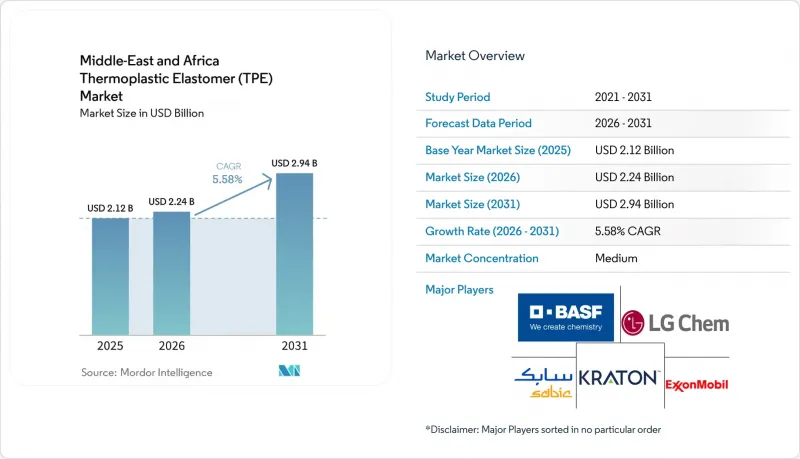
This report Segments the Industry Into Product Type (Styrenic Block Copolymer (TPE-S), Thermoplastic Olefin (TPE-O), and More), Application (Automotive and Transportation, Building and Construction, and More), and Geography (Saudi Arabia, South Africa, and the Rest of the Middle-East and Africa). The Market Size and Forecasts are Provided in Terms of Value (USD).
Middle-East And Africa Thermoplastic Elastomer (TPE) Market Trends and Insights
Automotive Light-Weighting Demand
Vehicle makers in Morocco and South Africa are replacing EPDM (ethylene propylene diene monomer) thermosets with olefinic TPEs in bumper fascia, glazing encapsulation, and air-intake ducts to curb weight and extend electric vehicle (EV) range. Stellantis's R3 billion (USD 165 million) Coega plant targets 50,000 units yearly with 35% local content, directly stimulating the Middle-East and Africa Thermoplastic Elastomer market demand for interior soft-touch skins, door seals, and NVH (noise, vibration, and harshness) components. Morocco's output surpassed 1 million vehicles in 2025, intensifying regional pull for polypropylene-based blends. Tax deductions of 150% for new-energy-vehicle facilities in South Africa from March 2026 sharpen the cost case for TPU wire-harness jackets that outperform PVC (polyvinyl chloride) in abrasion and smoke density.
Regulatory Push Replacing PVC in Medical Devices
Gulf regulators are progressively aligning with European REACH (Registration, Evaluation, Authorisation, and Restriction of Chemicals) listings that classify DEHP (Di(2-ethylhexyl) phthalate)-plasticized PVC as a Substance of Very High Concern. A December 2025 audit placed Saudi Arabia's DEHP-free penetration at roughly 30%, highlighting substantial headroom for medical-grade TPU and SEBS (styrene ethylene butylene styrene) tubing. Once the Saudi FDA (food and drug administration) ties hospital accreditation to DEHP-free sourcing, the Middle-East and Africa thermoplastic elastomer market volume for hydrolysis-resistant TPU could double within three years. Procurement reforms in the UAE and Egypt are likewise critical, as cost-driven purchasing still favors lower-priced PVC even in pediatric oncology units.
Volatile Petro-Feedstock Prices
Spot propylene in February 2026 averaged USD 1.00 per kg in the Gulf, but a USD 10 per-barrel Brent jump can lift propylene by USD 0.10 per kg, stripping 400-600 basis-points of margin from converters lacking index-linked contracts. Integrated majors such as SABIC hedge naturally by monetizing upstream cracks, while standalone compounders must rely on filler dilution or long-term offtake deals, both of which curb flexibility.
Other drivers and restraints analyzed in the detailed report include:
- Expanding Regional Footwear Manufacturing Bases
- GCC Integrated Crackers Enabling Bespoke Olefinic TPE Grades
- Competition from Thermoset Rubber at High-Temperature Service
For complete list of drivers and restraints, kindly check the Table Of Contents.
Segment Analysis
Thermoplastic Olefin captured 25.59% of the Middle-East and Africa Thermoplastic Elastomer market share in 2025, fueled by bumper fascia, door trims, and footwear soles that balance cost and light weight. The segment benefits from an in-region polypropylene supply that anchors gross margins even when ethylene contracts soften. Elastomeric Alloy is accelerating at a 5.86% CAGR during the forecast period (2026-2031), nearing thermoset EPDM compression-set performance but curing in one-shot injection cycles, which trims takt times for under-hood seals. Specialty streams such as TPU leverage BASF's 2026 flame-retardant line, while styrenic block copolymers gain scale under DL Chemical's stewardship.
Continuous innovation is evident in copolyester and polyamide blends that thrive above 120°C, commanding premium pricing but serving limited volumes. Covestro's capital injection post-acquisition by ADNOC is earmarked for Gulf-based polyether polyol lines, strengthening downstream TPU resilience. The Middle-East and Africa thermoplastic elastomer market continues to skew toward olefinic grades, yet specialty resin uptake will edge higher as medical-device and EV architectures require tighter modulus windows.
List of Companies Covered in this Report:
- Arkema
- BASF SE
- Covestro AG
- DSM
- DuPont
- Evonik Industries AG
- Exxon Mobil Corporation
- Huntsman International LLC
- LANXESS
- LCY GROUP
- LG Chem
- Mitsubishi Chemical Corporation
- SABIC
- Sumitomo Chemicals Co. Ltd
- Kraton Corporation
Additional Benefits:
- The market estimate (ME) sheet in Excel format
- 3 months of analyst support
TABLE OF CONTENTS
1 Introduction
- 1.1 Study Assumptions & Market Definition
- 1.2 Scope of the Study
2 Research Methodology
3 Executive Summary
4 Market Landscape
- 4.1 Market Drivers
- 4.1.1 Automotive light-weighting demand
- 4.1.2 Regulatory push replacing PVC in medical devices
- 4.1.3 Expanding regional footwear manufacturing bases
- 4.1.4 GCC integrated crackers enabling bespoke olefinic TPE grades
- 4.1.5 3-D-printing-grade TPU for oil and gas spare-parts logistics
- 4.2 Market Restraints
- 4.2.1 Volatile petro-feedstock prices
- 4.2.2 Competition from thermoset rubber at high-temperature service
- 4.2.3 Skilled-labor gap in local TPU compounding and processing
- 4.3 Value Chain Analysis
- 4.4 Porter's Five Forces
- 4.4.1 Bargaining Power of Suppliers
- 4.4.2 Bargaining Power of Buyers
- 4.4.3 Threat of New Entrants
- 4.4.4 Threat of Substitutes
- 4.4.5 Degree of Competition
5 Market Size and Growth Forecasts (Value)
- 5.1 By Product Type
- 5.1.1 Styrenic Block Copolymer (TPE-S)
- 5.1.2 Thermoplastic Olefin (TPE-O)
- 5.1.3 Elastomeric Alloy (TPE-V or TPV)
- 5.1.4 Thermoplastic Polyurethane (TPU)
- 5.1.5 Thermoplastic Copolyester
- 5.1.6 Thermoplastic Polyamide
- 5.2 By Application
- 5.2.1 Automotive and Transportation
- 5.2.2 Building and Construction
- 5.2.3 Footwear
- 5.2.4 Electricals and Electronics
- 5.2.5 Medical
- 5.2.6 Household Appliances
- 5.2.7 HVAC
- 5.2.8 Adhesive, Sealant and Coating
- 5.2.9 Other Applications
- 5.3 By Geography
- 5.3.1 Saudi Arabia
- 5.3.2 South Africa
- 5.3.3 Rest of Middle-East and Africa
6 Competitive Landscape
- 6.1 Market Concentration
- 6.2 Strategic Moves
- 6.3 Market Share(%)/Ranking Analysis
- 6.4 Company Profiles (includes Global Overview, Market Overview, Core Segments, Financials, Strategic Information, Products and Services, Recent Developments)
- 6.4.1 Arkema
- 6.4.2 BASF SE
- 6.4.3 Covestro AG
- 6.4.4 DSM
- 6.4.5 DuPont
- 6.4.6 Evonik Industries AG
- 6.4.7 Exxon Mobil Corporation
- 6.4.8 Huntsman International LLC
- 6.4.9 LANXESS
- 6.4.10 LCY GROUP
- 6.4.11 LG Chem
- 6.4.12 Mitsubishi Chemical Corporation
- 6.4.13 SABIC
- 6.4.14 Sumitomo Chemicals Co. Ltd
- 6.4.15 Kraton Corporation
7 Market Opportunities and Future Outlook
- 7.1 White-space and Unmet-Need Assessment

