PUBLISHER: Mordor Intelligence | PRODUCT CODE: 2061575

PUBLISHER: Mordor Intelligence | PRODUCT CODE: 2061575
Asia-Pacific Orange - Market Share Analysis, Industry Trends & Statistics, Growth Forecasts (2026 - 2031)
According to Mordor Intelligence, the asia-Pacific orange market size is valued at USD 16 billion in 2025 and is anticipated to grow from USD 16.6 billion in 2026 to USD 19.2 billion by 2031 at a 2.95% CAGR over 2026-2031.
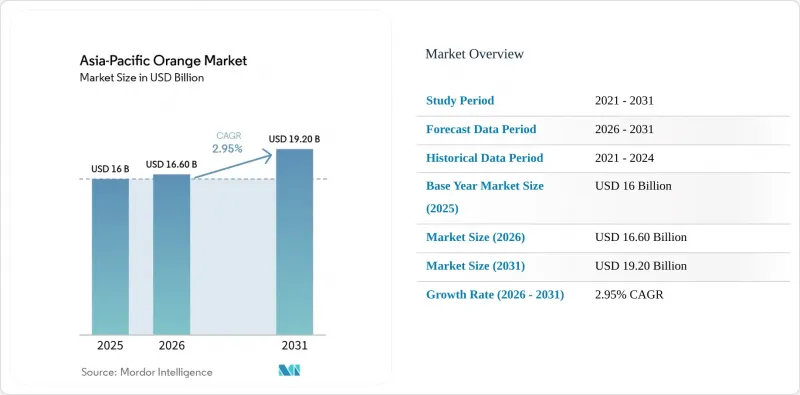
This report is Segmented by Geography (China, India, Thailand, Indonesia, and More). The Report Includes Production Analysis (Volume), Consumption Analysis (Value and Volume), Import Analysis (Value and Volume), Export Analysis (Value and Volume), Wholesale Price Trend Analysis and Forecast, List of Key Players, and More. The Market Forecasts are Provided in Terms of Value (USD) and Volume (Metric Tons).
Asia-Pacific Orange Market Trends and Insights
Rising Processed-Juice Capacity Additions Across China and India
Juice plants now secure demand for cosmetically imperfect fruit that once went to waste. Patanjali Ayurved started an 800 metric ton-per-day facility in Nagpur in 2025 after investing INR 1,500 crore (USD 180 million) and targeting zero-waste operations. Chinese orange-juice output reached 40,000 metric tons in the 2025-2026 season, from negligible volumes ten years earlier. Forward contracts now buffer growers from price swings that once erased profits. Maharashtra growers benefit most because processors locate near orchards, reducing freight costs. Improved margins spur replanting with high-yielding cultivars that align with processor specifications.
Shift to High-Density and Protected Orchards, Cutting Unit Costs
Australian orange acreage increased 31% from 2014 to 2024, reaching 20,034 hectares under high-density layouts of up to 1,500 trees per hectare that lower water use by 30-40%. Shade nets and anti-hail structures shield fruit from erratic weather, a growing concern as climate variability intensifies. China's Jiangxi and Hunan provinces subsidize similar systems to accelerate break-even to year four instead of year six. The Australia-Indonesia collaboration piloting tolerant rootstocks aims to replicate these gains across Southeast Asia. Rapid payback makes citrus competitive with alternative crops, sustaining regional output growth even in water-stressed areas.
Greening and Canker Outbreaks Spreading Beyond Traditional Hotspots
Huanglongbing, transmitted by the Asian citrus psyllid, now infects over 30% of groves in parts of Guangdong and Fujian in China. The disease kills trees within five years, undermining output stability and deterring new plantings. Australia remains free of the pathogen but spends heavily on border surveillance and joint trials with Indonesia to test tolerant rootstocks. Citrus canker adds another layer of biosecurity cost because eradication requires tree removal and long quarantines. Smallholders lack capital for integrated pest management and therefore suffer disproportionately high yield losses during outbreaks.
Other drivers and restraints analyzed in the detailed report include:
- Government Export Rebates and Cold-Chain Incentives for Premium Orange Shipments from Australia and Pakistan
- Expansion of E-Commerce Produce Platforms Boosting Farmer Margins
- High Intra-Regional Freight Rates
For complete list of drivers and restraints, kindly check the Table Of Contents.
Additional Benefits:
- The market estimate (ME) sheet in Excel format
- 3 months of analyst support
TABLE OF CONTENTS
1 Introduction
- 1.1 Study Assumptions and Market Definition
- 1.2 Scope of the Study
2 Research Methodology
3 Executive Summary
4 Market Landscape
- 4.1 Market Overview
- 4.2 Market Drivers
- 4.2.1 Rising processed-juice capacity additions across China and India
- 4.2.2 Shift to high-density and protected orchards, cutting unit costs
- 4.2.3 Government export rebates and cold-chain incentives for premium orange shipments from Australia and Pakistan
- 4.2.4 Expansion of e-commerce produce platforms boosting farmer margins
- 4.2.5 Adoption of blockchain-based traceability by Chinese packers
- 4.2.6 Climate-resilient Valencia and Cara Cara cultivars gaining acreage
- 4.3 Market Restraints
- 4.3.1 Greening and canker outbreaks spreading beyond traditional hotspots
- 4.3.2 Chronic farm-labor shortages in Japan and South Korea
- 4.3.3 High intra-regional freight rates
- 4.3.4 Volatile farm-gate prices eroding small-holder profitability
- 4.4 Opportunities
- 4.5 Challenges
- 4.6 Value Chain Analysis
- 4.7 Technologies and usage of AI in the Industry
- 4.8 Input Market Analysis
- 4.8.1 Seeds
- 4.8.2 Fertilizers
- 4.8.3 Crop Protection Chemicals
- 4.9 Distribution Channel Analysis
- 4.10 Market Sentiment Analysis
- 4.11 PESTLE Analysis
5 Market Size and Growth Forecast (Value and Volume)
- 5.1 By Geography
- 5.1.1 China
- 5.1.1.1 Production Analysis (Area Harvested, Yield, and Production Volume)
- 5.1.1.2 Consumption Analysis (Consumption Value and Volume)
- 5.1.1.3 Import Market Analysis (Import Value, Volume, and Key Supplying Markets)
- 5.1.1.4 Export Market Analysis (Export Value, Volume, and Key Destination Markets)
- 5.1.1.5 Wholesale Price Trend Analysis and Forecast
- 5.1.1.6 Regulatory Framework
- 5.1.1.7 List of Key Players
- 5.1.1.8 Logistics and Infrastructure
- 5.1.1.9 Seasonality Analysis
- 5.1.2 India
- 5.1.2.1 Production Analysis (Area Harvested, Yield, and Production Volume)
- 5.1.2.2 Consumption Analysis (Consumption Value and Volume)
- 5.1.2.3 Import Market Analysis (Import Value, Volume, and Key Supplying Markets)
- 5.1.2.4 Export Market Analysis (Export Value, Volume, and Key Destination Markets)
- 5.1.2.5 Wholesale Price Trend Analysis and Forecast
- 5.1.2.6 Regulatory Framework
- 5.1.2.7 List of Key Players
- 5.1.2.8 Logistics and Infrastructure
- 5.1.2.9 Seasonality Analysis
- 5.1.3 Thailand
- 5.1.3.1 Production Analysis (Area Harvested, Yield, and Production Volume)
- 5.1.3.2 Consumption Analysis (Consumption Value and Volume)
- 5.1.3.3 Import Market Analysis (Import Value, Volume, and Key Supplying Markets)
- 5.1.3.4 Export Market Analysis (Export Value, Volume, and Key Destination Markets)
- 5.1.3.5 Wholesale Price Trend Analysis and Forecast
- 5.1.3.6 Regulatory Framework
- 5.1.3.7 List of Key Players
- 5.1.3.8 Logistics and Infrastructure
- 5.1.3.9 Seasonality Analysis
- 5.1.4 Indonesia
- 5.1.4.1 Production Analysis (Area Harvested, Yield, and Production Volume)
- 5.1.4.2 Consumption Analysis (Consumption Value and Volume)
- 5.1.4.3 Import Market Analysis (Import Value, Volume, and Key Supplying Markets)
- 5.1.4.4 Export Market Analysis (Export Value, Volume, and Key Destination Markets)
- 5.1.4.5 Wholesale Price Trend Analysis and Forecast
- 5.1.4.6 Regulatory Framework
- 5.1.4.7 List of Key Players
- 5.1.4.8 Logistics and Infrastructure
- 5.1.4.9 Seasonality Analysis
- 5.1.5 Vietnam
- 5.1.5.1 Production Analysis (Area Harvested, Yield, and Production Volume)
- 5.1.5.2 Consumption Analysis (Consumption Value and Volume)
- 5.1.5.3 Import Market Analysis (Import Value, Volume, and Key Supplying Markets)
- 5.1.5.4 Export Market Analysis (Export Value, Volume, and Key Destination Markets)
- 5.1.5.5 Wholesale Price Trend Analysis and Forecast
- 5.1.5.6 Regulatory Framework
- 5.1.5.7 List of Key Players
- 5.1.5.8 Logistics and Infrastructure
- 5.1.5.9 Seasonality Analysis
- 5.1.6 Japan
- 5.1.6.1 Production Analysis (Area Harvested, Yield, and Production Volume)
- 5.1.6.2 Consumption Analysis (Consumption Value and Volume)
- 5.1.6.3 Import Market Analysis (Import Value, Volume, and Key Supplying Markets)
- 5.1.6.4 Export Market Analysis (Export Value, Volume, and Key Destination Markets)
- 5.1.6.5 Wholesale Price Trend Analysis and Forecast
- 5.1.6.6 Regulatory Framework
- 5.1.6.7 List of Key Players
- 5.1.6.8 Logistics and Infrastructure
- 5.1.6.9 Seasonality Analysis
- 5.1.7 Australia
- 5.1.7.1 Production Analysis (Area Harvested, Yield, and Production Volume)
- 5.1.7.2 Consumption Analysis (Consumption Value and Volume)
- 5.1.7.3 Import Market Analysis (Import Value, Volume, and Key Supplying Markets)
- 5.1.7.4 Export Market Analysis (Export Value, Volume, and Key Destination Markets)
- 5.1.7.5 Wholesale Price Trend Analysis and Forecast
- 5.1.7.6 Regulatory Framework
- 5.1.7.7 List of Key Players
- 5.1.7.8 Logistics and Infrastructure
- 5.1.7.9 Seasonality Analysis
- 5.1.8 Pakistan
- 5.1.8.1 Production Analysis (Area Harvested, Yield, and Production Volume)
- 5.1.8.2 Consumption Analysis (Consumption Value and Volume)
- 5.1.8.3 Import Market Analysis (Import Value, Volume, and Key Supplying Markets)
- 5.1.8.4 Export Market Analysis (Export Value, Volume, and Key Destination Markets)
- 5.1.8.5 Wholesale Price Trend Analysis and Forecast
- 5.1.8.6 Regulatory Framework
- 5.1.8.7 List of Key Players
- 5.1.8.8 Logistics and Infrastructure
- 5.1.8.9 Seasonality Analysis
- 5.1.9 South Korea
- 5.1.9.1 Production Analysis (Area Harvested, Yield, and Production Volume)
- 5.1.9.2 Consumption Analysis (Consumption Value and Volume)
- 5.1.9.3 Import Market Analysis (Import Value, Volume, and Key Supplying Markets)
- 5.1.9.4 Export Market Analysis (Export Value, Volume, and Key Destination Markets)
- 5.1.9.5 Wholesale Price Trend Analysis and Forecast
- 5.1.9.6 Regulatory Framework
- 5.1.9.7 List of Key Players
- 5.1.9.8 Logistics and Infrastructure
- 5.1.9.9 Seasonality Analysis
- 5.1.1 China
6 End Use and Application
- 6.1 Primary Applications and Emerging Applications
- 6.2 Consumption Breakdown by Industries
7 Market Opportunities and Future Outlook

