PUBLISHER: Mordor Intelligence | PRODUCT CODE: 2061587

PUBLISHER: Mordor Intelligence | PRODUCT CODE: 2061587
Steam Turbine - Market Share Analysis, Industry Trends & Statistics, Growth Forecasts (2026 - 2031)
According to Mordor Intelligence, the steam turbine market size is expected to grow from USD 18.74 billion in 2025 to USD 19.33 billion in 2026 and is forecast to reach USD 22.48 billion by 2031 at 3.07% CAGR over 2026-2031.
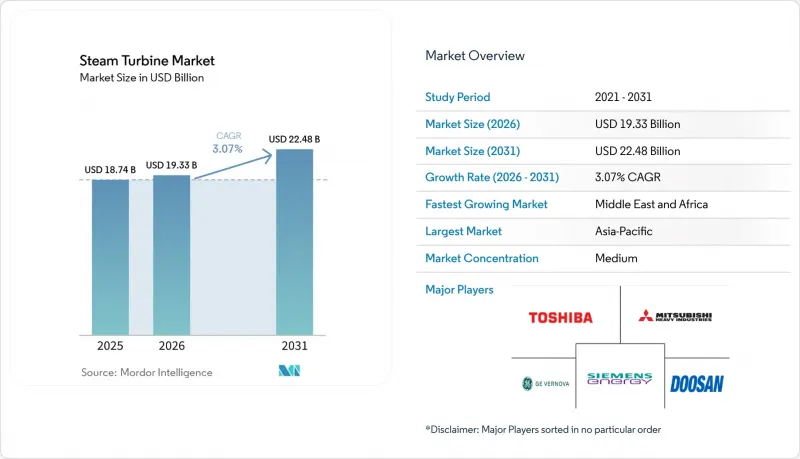
This report is Segmented by Capacity (Below 300 MW, 300 To 600 MW, and Above 600 MW), Plant Fuel (Coal, Natural Gas, Nuclear, and Biomass/Waste-to-Energy), End-User Industry (Power Generation, Oil and Gas, and Industrial and Other), and Geography (North America, Europe, Asia-Pacific, South America, and Middle East and Africa). The Market Sizes and Forecasts are Provided in Terms of Value (USD).
Global Steam Turbine Market Trends and Insights
Surging Demand for Flexible Baseload Capacity in Coal-Retiring Grids
Steam turbines equipped with fast-start and low-turn-down features are being retained as synchronous condensers to supply inertia in grids where wind and solar penetration already exceeds 40%. U.S. utilities that decommissioned older subcritical coal units are now repowering interconnection rights with hydrogen-ready combined-cycle blocks that synchronize within 30 minutes, a requirement spelled out in several Midcontinent ISO capacity auctions. German operators delaying lignite closures until 2030 are ordering single-crystal bladed turbines that can cycle twice daily without creep damage. These installations provide voltage support during evening demand ramps longer than four-hour battery limits, offsetting curtailment penalties levied on renewables. Consequently, steam turbine market participants offering enhanced cycling capability and synthetic inertia packages are commanding 8% to 12% equipment price premiums over legacy designs.
Repowering of Ageing Combined-Cycle Plants with Advanced Class Steam Turbines
Roughly 120 GW of F-class gas plants installed between 2000 and 2010 are reaching design life, driving a repowering cycle that replaces aging steam trains with H- or J-class equipment. A typical 500 MW uprate boosts net efficiency by 2-3 percentage points and extends asset life 20 years at 40%-50% of greenfield capex, yielding paybacks under seven years at USD 4 per MMBtu gas prices. European Union carbon-intensity rules encourage utilities to retrofit rather than build new, preserving existing grid permits and water rights. Vendors supplying modular turbine trains that fit within existing foundations have shortened outage windows from 16 weeks to 10, reducing lost-revenue risk for merchant plants. Hydrogen co-firing tolerance up to 30% by volume is now a bid prerequisite in several U.K. capacity-market tenders, further stimulating repower demand.
Aggressive LCOE Decline of Utility-Scale Solar-Plus-Storage
Four-hour lithium-ion storage paired with PV reached a global weighted-average levelized cost of USD 56 per MWh in 2025, undercutting new combined-cycle gas in sunny markets. As capacity factors rise beyond 30% in deserts and tropics, utilities are canceling steam contracts in favor of renewable portfolios, trimming near-term addressable demand by almost 1 GW yearly. OEMs emphasize ancillary-service revenue and fast black-start capabilities, but long-duration storage prototypes such as flow batteries and compressed air threaten this advantage after 2028. Consequently, project developers now price gas and coal exposure higher, increasing required equity returns by 200-250 basis points, which compresses the steam turbine market opportunity window.
Other drivers and restraints analyzed in the detailed report include:
- Post-Inflation Industrial CAPEX Boom in South-East Asia
- Hydrogen-Ready Turbine Upgrades Unlocking Future Revenue Streams
- Water-Stress Regulations Curbing Once-Through Cooling Permits
For complete list of drivers and restraints, kindly check the Table Of Contents.
Segment Analysis
The 300 to 600 MW class contributed 59.8% of 2025 revenue, underscoring its dominance within combined-cycle and ultra-supercritical coal configurations. At this level, economies of scale match common transformer ratings and regional grid codes, ensuring dispatch priority during peak hours. The steam turbine market size for this class is forecast to rise to USD 13.5 billion by 2031 as utilities in India, Egypt, and Saudi Arabia finalize tenders for gas and nuclear baseload. Efficiency records continue to fall: GE's 9HA.02 notched 62.5% net combined-cycle efficiency in 2025, while Siemens Energy's SGT6-9000HL demonstrated 50% hydrogen capability without derate.
Below-300 MW units will outpace headline growth at 4.8% CAGR, mirroring an industrial pivot toward on-site cogeneration in Southeast Asia and LatAm pulp, textile, and food clusters. Extraction-condensing variants in the 150-250 MW band are gaining popularity, where process steam drives petrochemical margins upward of 300 basis points compared with grid purchases. At the micro-utility end, <100 MW modular trains address mining camps and island micro-grids that prize fast deployment over top-quartile heat rate. Conversely, the >600 MW bracket remains niche, restricted to new supercritical coal in India and select AP1000 reactor projects, facing stiffer ESG headwinds and limited lender appetite.
Geography Analysis
Asia-Pacific retained 47.6% of 2025 revenue as China's ultra-supercritical upgrades and India's coal-plus-nuclear trajectory dominated procurement. Southeast Asia added 15 GW of cogeneration through 2025-2028, reflecting industrial expansion and favorable fuel availability. As a result, the regional steam turbine market continues to generate large frame orders plus an accelerating volume of mid-sized industrial trains.
The Middle East and Africa steam turbine market is poised to grow at 5.3% CAGR, driven by Saudi Arabia's 30 GW gas-fired independent power projects, the United Arab Emirates' full Barakah ramp-up, and Egypt's nuclear and gas blend. Gas availability from Jafurah and other unconventional fields encourages combined-cycle builds that free oil for export. Concurrently, nuclear ambitions across Egypt and Saudi Arabia lock in multi-year turbine demand, elevating the regional contribution from 12% share in 2025 to an expected 15% by 2031.
North America and Europe experience flat-to-modest expansion as coal exits counterbalance repowering and district-heating retrofits. U.S. growth hinges on capacity-market incentives for fast-start synchronous capacity, while European demand centers on hydrogen-ready gas blocks and biomass CHP. South America remains niche, with Brazil's sugar-bagasse CHP and Argentina's Vaca Muerta gas development representing most activity. Together, these dynamics maintain global diversification of revenue streams within the steam turbine market.
- Siemens Energy AG
- GE Vernova Inc.
- Mitsubishi Heavy Industries Ltd.
- Toshiba Energy Systems & Solutions
- Dongfang Turbine Co. Ltd.
- Doosan Enerbility Co., Ltd.
- Bharat Heavy Electricals Ltd.
- Harbin Electric Corp.
- Ansaldo Energia SpA
- Fuji Electric Co., Ltd.
- Kawasaki Heavy Industries Ltd.
- MAN Energy Solutions SE
- Elliott Group
- Triveni Turbines Ltd.
- WEG SA
- Hitachi-Zosen Corp. (Energy Solutions)
- Shanghai Electric Group Co. Ltd.
- Baker Hughes Co.
- Nanjing Turbine & Electric Machinery Group
- Siemens-Gamesa (Steam generator for hybrid plants)
Additional Benefits:
- The market estimate (ME) sheet in Excel format
- 3 months of analyst support
TABLE OF CONTENTS
1 Introduction
- 1.1 Study Assumptions & Market Definition
- 1.2 Scope of the Study
2 Research Methodology
3 Executive Summary
4 Market Landscape
- 4.1 Market Overview
- 4.2 Market Drivers
- 4.2.1 Surging demand for flexible baseload capacity in coal-retiring grids
- 4.2.2 Repowering of ageing combined-cycle plants with advanced class steam turbines
- 4.2.3 Post-inflation industrial CAPEX boom in South-East Asia
- 4.2.4 Hydrogen-ready turbine upgrades unlocking future revenue streams
- 4.2.5 Government-led nuclear new-build programs in emerging markets
- 4.2.6 Decarbonized district-heating schemes using extraction-condensing units
- 4.3 Market Restraints
- 4.3.1 Aggressive LCOE decline of utility-scale solar-plus-storage
- 4.3.2 Water-stress regulations curbing once-through cooling permits
- 4.3.3 Slow EPC execution cycles inflating project IRRs
- 4.3.4 Financing flight from fossil-linked assets post-ESG mandates
- 4.4 Supply-Chain Analysis
- 4.5 Regulatory Landscape
- 4.6 Technological Outlook (Materials, Digital Twins, Super-critical CO2)
- 4.7 Porter's Five Forces
- 4.7.1 Bargaining Power of Suppliers
- 4.7.2 Bargaining Power of Consumers
- 4.7.3 Threat of New Entrants
- 4.7.4 Threat of Substitutes
- 4.7.5 Intensity of Competitive Rivalry
5 Market Size & Growth Forecasts
- 5.1 By Capacity
- 5.1.1 Below 300 MW
- 5.1.2 300 to 600 MW
- 5.1.3 Above 600 MW
- 5.2 By Plant Fuel
- 5.2.1 Coal
- 5.2.2 Natural Gas
- 5.2.3 Nuclear
- 5.2.4 Biomass/Waste-to-Energy
- 5.3 By End-user Industry
- 5.3.1 Power Generation
- 5.3.2 Oil and Gas (Up-/Mid-/Down-stream)
- 5.3.3 Industrial and Other
- 5.4 By Geography
- 5.4.1 North America
- 5.4.1.1 United States
- 5.4.1.2 Canada
- 5.4.1.3 Mexico
- 5.4.2 Europe
- 5.4.2.1 Germany
- 5.4.2.2 United Kingdom
- 5.4.2.3 France
- 5.4.2.4 Italy
- 5.4.2.5 NORDIC Countries
- 5.4.2.6 Russia
- 5.4.2.7 Rest of Europe
- 5.4.3 Asia-Pacific
- 5.4.3.1 China
- 5.4.3.2 India
- 5.4.3.3 Japan
- 5.4.3.4 South Korea
- 5.4.3.5 ASEAN Countries
- 5.4.3.6 Rest of Asia-Pacific
- 5.4.4 South America
- 5.4.4.1 Brazil
- 5.4.4.2 Argentina
- 5.4.4.3 Rest of South America
- 5.4.5 Middle East and Africa
- 5.4.5.1 Saudi Arabia
- 5.4.5.2 United Arab Emirates
- 5.4.5.3 South Africa
- 5.4.5.4 Egypt
- 5.4.5.5 Rest of Middle East and Africa
- 5.4.1 North America
6 Competitive Landscape
- 6.1 Market Concentration
- 6.2 Strategic Moves (M&A, Partnerships, PPAs)
- 6.3 Market Share Analysis (Market Rank/Share for key companies)
- 6.4 Company Profiles (includes Global level Overview, Market level overview, Core Segments, Financials as available, Strategic Information, Products & Services, and Recent Developments)
- 6.4.1 Siemens Energy AG
- 6.4.2 GE Vernova Inc.
- 6.4.3 Mitsubishi Heavy Industries Ltd.
- 6.4.4 Toshiba Energy Systems & Solutions
- 6.4.5 Dongfang Turbine Co. Ltd.
- 6.4.6 Doosan Enerbility Co., Ltd.
- 6.4.7 Bharat Heavy Electricals Ltd.
- 6.4.8 Harbin Electric Corp.
- 6.4.9 Ansaldo Energia SpA
- 6.4.10 Fuji Electric Co., Ltd.
- 6.4.11 Kawasaki Heavy Industries Ltd.
- 6.4.12 MAN Energy Solutions SE
- 6.4.13 Elliott Group
- 6.4.14 Triveni Turbines Ltd.
- 6.4.15 WEG SA
- 6.4.16 Hitachi-Zosen Corp. (Energy Solutions)
- 6.4.17 Shanghai Electric Group Co. Ltd.
- 6.4.18 Baker Hughes Co.
- 6.4.19 Nanjing Turbine & Electric Machinery Group
- 6.4.20 Siemens-Gamesa (Steam generator for hybrid plants)
7 Market Opportunities & Future Outlook
- 7.1 White-space & Unmet-need Assessment

