PUBLISHER: Mordor Intelligence | PRODUCT CODE: 2061589

PUBLISHER: Mordor Intelligence | PRODUCT CODE: 2061589
Portable Communication Systems In Military Applications - Market Share Analysis, Industry Trends & Statistics, Growth Forecasts (2025 - 2030)
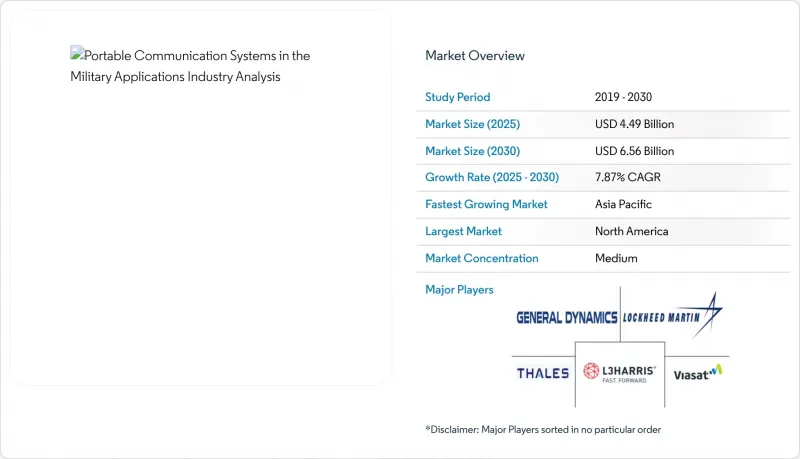
According to Mordor Intelligence, the portable communication systems in the military applications industry analysis size is valued at USD 4.49 billion in 2025 and is projected to reach USD 6.56 billion by 2030, reflecting a 7.87% CAGR over the forecast period. Growth is fueled by defense ministries shifting from single-channel voice sets to software-defined platforms that host multiple waveforms, integrate 5G links, and mesh with Low-Earth-Orbit (LEO) satellites. This report is Segmented by Communication Type (Satellite, and More), and Geography (North America, and More). The Market Forecasts are Provided in Terms of Value (USD).
Insights and Trends of Portable Communication Systems In Military Applications
Expanding Multi-Domain Operations Doctrine
Joint All-Domain Command and Control architectures demand that dismounted radios relay targeting data across land, air, maritime, cyber, and space nodes within seconds, compressing kill-chain timelines from minutes to single-digit seconds. NATO's 2024 concept paper stipulates Link 16, JREAP, and Variable Message Format coexistence inside hand-held form factors, forcing vendors to embed multi-waveform chipsets. Project Convergence exercises in 2024 verified under-five-minute sensor-to-shooter loops, validating procurement of software-defined radios that can dynamically join joint fires networks. Australia, Japan, and other Indo-Pacific allies followed with billion-dollar upgrades aligning with AUKUS or Quad frameworks. These parallel investments lift baseline volumes and unify interface standards, accelerating global adoption of dual-mode radio-satellite designs.
Battlefield Digitisation Programmes in NATO and Quad Nations
Morpheus in the UK, Digitalisierung der Landstreitkrafte in Germany, and India's USD 3.5 billion Tactical Communication System exemplify wholesale transitions from voice-centric sets to soldier-worn IP networks. Contract awards across Europe and Asia-Pacific require over-the-air upgrades, biometric log-ins, and encrypted apps that mirror commercial smartphones. Marine Corps networking kits embed antennas inside plate carriers, freeing operators' hands and shortening reaction time. Poland's 2024 order for AI-driven FONET radios shows how smaller NATO countries leapfrog directly to cognitive technology. Volume commitments secure economies of scale, making advanced features affordable to mid-tier militaries by 2027.
Congested RF Spectrum in Urban Theatres
Combat in Gaza, Mosul, and Mariupol exposed saturation of 2.4 GHz and 5 GHz bands by civilian LTE, Wi-Fi, and IoT devices, eroding military link margin by 40%. The ITU's 2024 World Radiocommunication Conference added only 40 MHz for defense, far short of requests. FCC coexistence rules for 3.1-3.45 GHz imposed USD 800 hardware filters per radio and extended schedules by six months. AI hopping at 1,000 channel/s counters jamming, but raises power draw 25%, shortening battery life. Higher transmit power and dense relay nodes inflate procurement and logistics bills at the battalion level.
Other drivers and restraints analyzed in the detailed report include:
- Surge in Low-Earth-Orbit Defence Satcom Constellations
- AI-Enabled Spectrum Management for Contested EW Environments
- Export-Control Barriers (ITAR, Wassenaar)
For complete list of drivers and restraints, kindly check the Table Of Contents.
List of Companies Covered in this Report:
- L3Harris Technologies Inc.
- General Dynamics Corporation
- Viasat Inc.
- Thales Group
- Lockheed Martin Corporation
- BAE Systems PLC
- Codan Group
- Saab AB
- Raytheon Technologies Corporation
- Elbit Systems Ltd
- Rafael Advanced Defense Systems Ltd
- Sat-Com Communications Systems
Additional Benefits:
- The market estimate (ME) sheet in Excel format
- 3 months of analyst support
TABLE OF CONTENTS
1 INTRODUCTION
- 1.1 Study Assumptions
- 1.2 Scope of the Study
2 RESEARCH METHODOLOGY
3 EXECUTIVE SUMMARY
4 MARKET DYNAMICS
- 4.1 Market Overview
- 4.2 Market Drivers
- 4.3 Market Restraints
- 4.4 Porter's Five Forces Analysis
- 4.4.1 Threat of New Entrants
- 4.4.2 Bargaining Power of Buyers/Consumers
- 4.4.3 Bargaining Power of Suppliers
- 4.4.4 Threat of Substitute Products
- 4.4.5 Intensity of Competitive Rivalry
5 MARKET SEGMENTATION (Market Size by Value - USD billion)
- 5.1 Communication Type
- 5.1.1 Satellite
- 5.1.2 Radio
- 5.2 Geography
- 5.2.1 North America
- 5.2.1.1 United States
- 5.2.1.2 Canada
- 5.2.2 Europe
- 5.2.2.1 United Kingdom
- 5.2.2.2 Germany
- 5.2.2.3 France
- 5.2.2.4 Rest of Europe
- 5.2.3 Asia-Pacific
- 5.2.3.1 China
- 5.2.3.2 India
- 5.2.3.3 South Korea
- 5.2.3.4 Rest of Asia-Pacific
- 5.2.4 Latin America
- 5.2.4.1 Brazil
- 5.2.4.2 Rest of Latin America
- 5.2.5 Middle-East and Africa
- 5.2.5.1 United Arab Emirates
- 5.2.5.2 Saudi Arabia
- 5.2.5.3 Turkey
- 5.2.5.4 Rest of Middle-East and Africa
- 5.2.1 North America
6 COMPETITIVE LANDSCAPE
- 6.1 Vendor Market Share
- 6.2 Company Profiles
- 6.2.1 L3Harris Technologies Inc.
- 6.2.2 General Dynamics Corporation
- 6.2.3 Viasat Inc.
- 6.2.4 Thales Group
- 6.2.5 Lockheed Martin Corporation
- 6.2.6 BAE Systems PLC
- 6.2.7 Codan Group
- 6.2.8 Saab AB
- 6.2.9 Raytheon Technologies Corporation
- 6.2.10 Elbit Systems Ltd
- 6.2.11 Rafael Advanced Defense Systems Ltd
- 6.2.12 Sat-Com Communications Systems
7 MARKET OPPORTUNITIES AND FUTURE TRENDS

