PUBLISHER: Mordor Intelligence | PRODUCT CODE: 2061607

PUBLISHER: Mordor Intelligence | PRODUCT CODE: 2061607
Snus - Market Share Analysis, Industry Trends & Statistics, Growth Forecasts (2026 - 2031)
According to Mordor Intelligence, snus market size in 2026 is estimated at USD 3.35 billion, growing from 2025 value of USD 3.21 billion with 2031 projections showing USD 4.17 billion, growing at 4.43% CAGR over 2026-2031.
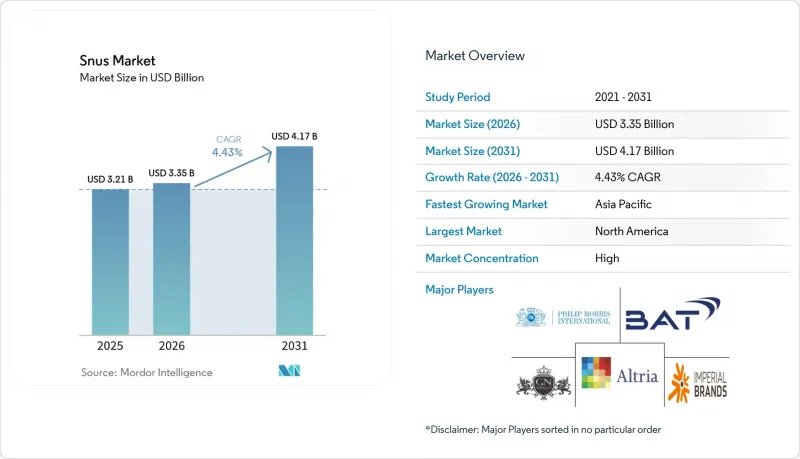
This report is Segmented by Product Type (Loose Snus, Portion Snus), Flavor Category (Tobacco/Original, Mint and Menthol, and More), End User (Men, Women), Distribution Channels (Tobacco Specialty Stores, Supermarkets/Hypermarkets, Convenience Stores, and More), and Geography (North America, Europe, Asia-Pacific, and Rest of the World). The Market Forecasts are Provided in Terms of Value (USD).
Global Snus Market Trends and Insights
Increased demand for smokeless tobacco alternatives
Regulatory momentum toward harm reduction is creating significant market opportunities as health authorities recognize the varying risk profiles of nicotine delivery systems. The increasing prevalence of smoking-related diseases is driving demand for smokeless tobacco alternatives, such as snus. Cigarette smoking continues to be a major public health issue, with over 16 million Americans living with smoking-related diseases in 2024, according to the Centers for Disease Control and Prevention. The FDA's renewal of Modified Risk Tobacco Product (MRTP) orders for 8 General Snus products, effective through November 2032, establishes a regulatory precedent for reduced-risk marketing claims. In December 2024, Sweden's Parliament formally incorporated tobacco harm reduction into its public health policy, illustrating how risk-proportionate taxation and regulation can promote population-level smoking cessation. This regulatory acceptance provides a competitive advantage to companies with established smokeless portfolios and PMTA-ready products, while traditional cigarette manufacturers face declining volumes and increasing margin pressures.
Product innovation and flavor variety
Technological advancements in pouch design and nicotine delivery systems are significantly broadening the category's appeal, reaching beyond its traditional consumer base. In March 2025, Scandinavian Tobacco Group introduced KLAR pouches featuring bioceramic technology, which is designed to enable faster and more efficient nicotine absorption, offering a more satisfying experience for users. Similarly, British American Tobacco has enhanced its VELO Plus product line with hinged lid designs, aimed at improving convenience and overall user experience. In April 2025, XQS UK launched a range of innovative flavors, including Raspberry Blackcurrant, Strawberry Kiwi, and Berrynana Twist, specifically targeting younger adult consumers who are increasingly seeking alternatives to traditional tobacco flavors. Manufacturing advancements are also evident in packaging, with companies adopting fully recyclable materials and incorporating child-resistant designs. These efforts not only ensure compliance with regulatory requirements but also help brands stand out in a competitive market. Furthermore, the innovation cycle within the industry has accelerated, as companies actively utilize consumer feedback loops and rapid prototyping techniques to introduce new product variants on a quarterly basis, rather than adhering to the traditional annual launch schedule.
Stringent regulatory restrictions
Regulatory fragmentation across jurisdictions increases compliance challenges and creates market access barriers, hindering growth potential. The European Union's Tobacco Products Directive limits the sale of tobacco-containing snus to Sweden. However, individual EU member states impose additional restrictions on nicotine pouches, despite their tobacco-free nature. France's proposed ban on nicotine pouches, opposed by Sweden, highlights the fragmented European market and the growing regulatory uncertainty. According to the World Health Organization, in 2024, tobacco causes over 7 million deaths annually, including approximately 1.6 million non-smokers exposed to second-hand smoke. This concerning statistic supports the implementation of strict regulatory measures on snus. The FDA's import alert system, aimed at unauthorized products, demonstrates its impact on disrupting established supply chains, as seen with detention orders against The Snus Factory and Another Snus Factory Stockholm AB. Manufacturers face rising compliance costs as they navigate varied regulatory pathways, age-verification requirements, and marketing restrictions across different jurisdictions.
Other drivers and restraints analyzed in the detailed report include:
- Convenience and discreet nicotine consumption
- Rise of "all-white" cellulose pouches attracting first-time users
- Supply-chain volatility in pharmaceutical-grade nicotine
For complete list of drivers and restraints, kindly check the Table Of Contents.
Segment Analysis
Portion snus holds a dominant 90.82% market share in 2025, driven by consumer preference for its pre-portioned, discreet packaging. This format avoids the mess and social stigma associated with loose varieties. With a projected CAGR of 2.98% from 2026 to 2031, its growth is supported by innovations such as moisture optimization, improved pouch materials, and advanced flavor encapsulation. On the other hand, loose snus, though a smaller segment, appeals to traditional users who prefer customizable portion sizes and authentic Scandinavian consumption methods.
Portion snus benefits from manufacturing efficiencies, utilizing automated packaging systems and strict quality controls. This enables mass production at lower unit costs. British American Tobacco's Pecs facility in Hungary, certified with ISO 22000 food safety standards, highlights how food-industry practices enhance product quality and ensure regulatory compliance. Additionally, the portion format supports flavor and nicotine strength innovations while preserving product integrity during storage and distribution.
Traditional tobacco and original flavors hold a 41.12% market share in 2025, highlighting their strong consumer appeal and widespread regulatory approval. For experienced users, the original flavor represents authenticity, tradition, and quality, reinforcing its leading position. However, mint and menthol variants are experiencing rapid growth, with a 3.37% CAGR projected from 2026 to 2031. Their popularity stems from cooling sensations and breath-freshening qualities, which enhance their social acceptability. At the same time, younger adults are increasingly drawn to fruit and berry flavors as alternatives to traditional tobacco. Specialty flavors, including coffee, citrus, and seasonal options, continue to expand the market's reach.
Flavor development is shifting towards natural extract formulations, driven by health-conscious consumer preferences and potential regulatory restrictions on artificial additives. The FDA's approval of 10 ZYN flavor variants, including non-traditional options like Coffee and Citrus, sets a regulatory precedent for diverse flavor profiles in authorized products. In February 2025, Scandinavian Tobacco Group demonstrated the importance of flavor innovation by rapidly expanding its flavor portfolio in the UK market, introducing Black Cherry and Citrus Cooling variants, which highlight the role of flavor diversity in driving brand differentiation and increasing market share.
Geography Analysis
North America holds a leading 60.73% market share on 2025, driven by regulatory approvals and significant investments from major tobacco companies. The FDA's approval in January 2025 of 20 ZYN products marks a turning point, establishing a regulatory pathway for marketing nicotine pouches in the world's largest tobacco market. Philip Morris International's USD 832 million investment in manufacturing facilities in Kentucky and Colorado strengthens the region's dominance through 2030. Additionally, Canada's regulatory framework, which exempts tobacco-free nicotine pouches (<=4 mg/dose) from prescription requirements, creates new growth opportunities. In Mexico, while strict tobacco control laws present challenges, the courts' 2025 decision to uphold these regulations also opens avenues for reduced-risk products that adhere to stringent advertising restrictions.
Europe's regulatory environment remains fragmented. Sweden leads in harm reduction, while other EU member states enforce more restrictive policies. Sweden's formal adoption of a harm reduction policy in December 2024, including preferential taxation for snus over cigarettes, reinforces its status as a global model for risk-proportionate regulation. Following the June 2025 ban on disposable vapes, the UK has emerged as Europe's third-largest nicotine pouch market, capitalizing on substitution opportunities for oral nicotine products. Germany's complex regulatory framework, where tobacco-containing snus is banned under EU TPD but nicotine pouches face only regional restrictions, highlights the diverse national regulations that create both market opportunities and compliance challenges.
Asia-Pacific is poised for the fastest regional growth, with a 4.86% CAGR from 2026 to 2031, driven by increasing awareness and evolving regulatory frameworks in key markets. Japan's classification of synthetic nicotine pouches outside traditional tobacco regulations provides market access opportunities through pharmaceutical approval pathways. Thailand's regulatory ambiguity regarding personal snus imports, coupled with growing acceptance of tobacco-free alternatives, demonstrates how unclear regulations can foster market development. India's emerging manufacturing capabilities, exemplified by companies like Mohan Food Products with a 20-tonne production capacity for nicotine pouches, signal potential for regional supply chain growth. On the other hand, Singapore's comprehensive ban on nicotine pouches, including restrictions on promotion and importation, illustrates how stringent policies can limit market access despite regional growth trends.
- Philip Morris International
- Altria Group
- British American Tobacco
- Imperial Brands PLC
- GN Tobacco
- Japan Tobacco
- Dholakia Tobacco Pvt Ltd
- Another Snus Factory Stockholm AB
- Empire of Snus
- Harsh International
- Swisher International
- TIGERSNUS ORGANIC SNUS
- Turning Point Brands
- Wilsons and Co Sharrow Ltd
- Kurbits Snus
- Mac Baren
- Habit Factory AB
- Ministry of Snus
- Altria Group
- Imperial Brands
- Thunder Snus AB
- Northerner
- V2 Tobacco
Additional Benefits:
- The market estimate (ME) sheet in Excel format
- 3 months of analyst support
TABLE OF CONTENTS
1 INTRODUCTION
- 1.1 Study Assumptions and Market Definition
- 1.2 Scope of the Study
2 RESEARCH METHODOLOGY
3 EXECUTIVE SUMMARY
4 MARKET LANDSCAPE
- 4.1 Market Overview
- 4.2 Market Drivers
- 4.2.1 Increased demand for smokeless tobacco alternatives
- 4.2.2 Product innovation and flavor variety
- 4.2.3 Convenience and discreet nicotine consumption
- 4.2.4 Rise of all-white cellulose pouches attracting first-time users
- 4.2.5 Expanding awareness and adoption in new geographies
- 4.2.6 Ai-driven nicotine customization and marketing
- 4.3 Market Restraints
- 4.3.1 Stringent regulatory restrictions
- 4.3.2 Health-risk perception and anti-tobacco lobbying
- 4.3.3 Supply-chain volatility in pharmaceutical-grade nicotine
- 4.3.4 Competition from nicotine alternatives
- 4.4 Consumer Behaviour Analysis
- 4.5 Regulatory Landscape
- 4.6 Technological Outlook
- 4.7 Porter's Five Forces
- 4.7.1 Threat of New Entrants
- 4.7.2 Bargaining Power of Buyers
- 4.7.3 Bargaining Power of Suppliers
- 4.7.4 Threat of Substitutes
- 4.7.5 Competitive Rivalry
5 MARKET SIZE AND GROWTH FORECASTS (VALUE AND VOLUME)
- 5.1 By Product Type
- 5.1.1 Loose Snus
- 5.1.2 Portion Snus
- 5.2 By Flavor Category
- 5.2.1 Tobacco/Original
- 5.2.2 Mint and Menthol
- 5.2.3 Fruit and Berry
- 5.2.4 Other Flavors
- 5.3 By End User
- 5.3.1 Men
- 5.3.2 Women
- 5.4 Distribution Channels
- 5.4.1 Tobacco Specialty Stores
- 5.4.2 Supermarkets/Hypermarkets
- 5.4.3 Convenience Stores
- 5.4.4 Online Retail Stores
- 5.4.5 Other Distribution Channels
- 5.5 By Geography
- 5.5.1 North America
- 5.5.1.1 United States
- 5.5.1.2 Canada
- 5.5.1.3 Rest of North America
- 5.5.2 Europe
- 5.5.2.1 Czech Republic
- 5.5.2.2 Denmark
- 5.5.2.3 Norway
- 5.5.2.4 Sweden
- 5.5.2.5 Rest of Europe
- 5.5.3 Asia-Pacific
- 5.5.3.1 India
- 5.5.3.2 Rest of Asia-Pacific
- 5.5.4 Rest of the World
- 5.5.4.1 South Africa
- 5.5.4.2 Algeria
- 5.5.4.3 Other Countries
- 5.5.1 North America
6 COMPETITIVE LANDSCAPE
- 6.1 Market Concentration
- 6.2 Strategic Moves
- 6.3 Market Share Analysis
- 6.4 Company Profiles (includes Global level Overview, Market level overview, Core Segments, Financials as available, Strategic Information, Market Rank/Share for key companies, Products and Services, and Recent Developments)
- 6.4.1 Philip Morris International
- 6.4.2 Altria Group
- 6.4.3 British American Tobacco
- 6.4.4 Imperial Brands PLC
- 6.4.5 GN Tobacco
- 6.4.6 Japan Tobacco
- 6.4.7 Dholakia Tobacco Pvt Ltd
- 6.4.8 Another Snus Factory Stockholm AB
- 6.4.9 Empire of Snus
- 6.4.10 Harsh International
- 6.4.11 Swisher International
- 6.4.12 TIGERSNUS ORGANIC SNUS
- 6.4.13 Turning Point Brands
- 6.4.14 Wilsons and Co Sharrow Ltd
- 6.4.15 Kurbits Snus
- 6.4.16 Mac Baren
- 6.4.17 Habit Factory AB
- 6.4.18 Ministry of Snus
- 6.4.19 Altria Group
- 6.4.20 Imperial Brands
- 6.4.21 Thunder Snus AB
- 6.4.22 Northerner
- 6.4.23 V2 Tobacco
7 MARKET OPPORTUNITIES AND FUTURE OUTLOOK

