PUBLISHER: Mordor Intelligence | PRODUCT CODE: 2061634

PUBLISHER: Mordor Intelligence | PRODUCT CODE: 2061634
Fruit Jellies - Market Share Analysis, Industry Trends & Statistics, Growth Forecasts (2026 - 2031)
According to Mordor Intelligence, the fruit jellies market size is valued at USD 1.42 billion in 2026, growing from the 2025 value of USD 1.23 billion, and is forecast to climb to USD 1.75 billion by 2031, advancing at a 4.23% CAGR during the forecast period.
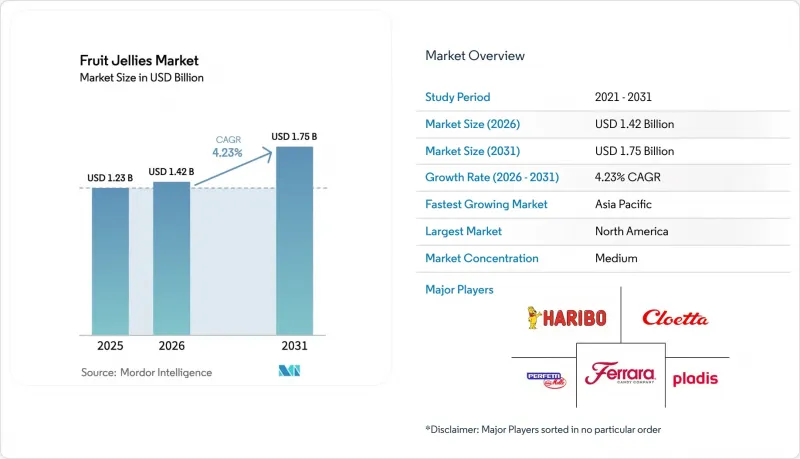
This report is Segmented by Product Type (Traditional Fruit Jellies and Functional/Fortified Jellies), Packaging Type (Pouches and Sachets, Cups and Jars, and More), Distribution Channels (Supermarkets/Hypermarkets, Convenience/Grocery Stores, Specialty Stores, Online Retail, and Other Distribution Channels), and Geography. Market Forecasts are Provided in Terms of Value (USD) and Volume (Tonnes).
Global Fruit Jellies Market Trends and Insights
Increasing Consumer Preference for Natural and Fruit-Flavored Confections
Consumers are increasingly examining ingredient lists, preferring recognizable fruit names over synthetic flavors. According to Mondelez's 2023 State of Snacking survey, 43% of global consumers review ingredient labels before purchasing, and 42% prioritize nutritional benefits in their snacks over indulgence. This trend is driving formulators to adopt pectin-based gels, which offer clean-label credentials and support "made with real fruit" claims. In 2024, United States blueberry production increased by 23%, with 46% of the harvest designated for processing, ensuring a steady supply for natural colorants and flavor concentrates, as reported by the United States Department of Agriculture (USDA). Additionally, the United States Department of Agriculture (USDA) data showed that strawberry frozen-pack volumes reached 343.3 million pounds in 2024, enhancing their availability for jelly applications. Regulatory support is reinforcing this shift; the FDA's 21 CFR Part 101 requires percent-juice declarations when fruit terms appear on labels, encouraging brands to use authentic fruit content instead of artificial essences. As a result, traditional jellies are being reformulated with higher fruit solids, reducing the sensory gap with premium preserves and driving up price points.
Innovation in Flavors, Textures, and Premiumization
Texture layering and exotic flavor pairings are reshaping the premium tier of the candy market. In April 2025, HARIBO enhanced its Starmix line with foam-egg and foam-heart inclusions, merging chewy fruit jelly bases with aerated toppings for a unique mouthfeel. Mars, in 2025-2026, unveiled Skittles Gummies Fuego, fusing spicy-sour profiles with tropical fruit notes, aiming to attract younger consumers in search of novelty. Perfetti Van Melle, in May 2025, launched Mentos Discovery Roll, which combines botanical extracts with fruit jellies, appealing to those who see confections as mood enhancers. These brands are tapping into sugar-reduction platforms like Incredo Sugar, which boosts sweetness perception by 30-50% without altering flavor systems. Premiumization efforts are bolstered by sustainable packaging; a survey by Mondelez found 82% of consumers are willing to pay a premium for products in recyclable or bio-based materials. This blend of sensory innovation and eco-consciousness is broadening market reach, moving beyond conventional candy aisles into specialty retail and gifting sectors.
High Sugar Content and Artificial Additives Raise Health Concerns
Sugar content in traditional fruit jellies-often 50-60% by weight-positions the category in direct conflict with public-health campaigns targeting added sugars. The Food and Drug Administration's updated Nutrition Facts label requires separate disclosure of added sugars, making high-sugar confections more transparent to consumers and vulnerable to taxation. Several European municipalities have proposed sugar levies on confectionery exceeding 10 grams per 100 grams, which would encompass most fruit jellies. Artificial colors, particularly azo dyes like Allura Red and Tartrazine, face consumer backlash despite regulatory approval; brands are reformulating with anthocyanins from berries and carotenoids from carrots, but these natural alternatives cost 2-3 times more and exhibit lower color stability under light and heat. The shift to natural colors and reduced sugar is compressing margins, as reformulation requires pilot-plant trials and sensory validation that can span 12-18 months. Smaller brands lacking research and development budgets are exiting the category or accepting private-label contracts, accelerating market concentration.
Other drivers and restraints analyzed in the detailed report include:
- Rising Health Consciousness Favors Low-Sugar, Vitamin-Enriched Variants
- Demand for Clean-Label, Vegan, and Allergen-Free Products
- Intense Competition from Gummies, Chocolates, and Healthier Snacks
For complete list of drivers and restraints, kindly check the Table Of Contents.
Segment Analysis
Functional jellies are expanding at a 5.12% CAGR, materially faster than the wider fruit jellies market. They capture shoppers looking for vitamin boosts, collagen, or probiotic claims without swallowing pills. Traditional lines still delivered 65.17% of 2025 revenue because they dominate gifting and impulse displays. However, the segment's volume edge masks a profit gap: fortified SKUs retail at 20-30% premiums and enjoy pharmacy placement that insulates them from confectionery discounting. Two of the top five global launches in 2025 combined vitamin C enrichment with reduced-sugar matrices, signaling convergence rather than cannibalization. FDA guidance allowing "good source" claims once a serving hits 10% DV of vitamin C enables brands to upgrade incumbent recipes without full repositioning.
Traditional sub-segments remain strategically important for cash flow and regional nostalgia. HARIBO's foam-egg refresh reinforced how micro-texture tweaks can reignite heritage lines. Percent-juice disclosure rules incentivize higher fruit solids, letting classic SKUs borrow halo effects from functional peers. Over the forecast horizon, functional products are expected to account for 42% of absolute dollar growth in the fruit jellies market, cementing their status as the primary innovation frontier.
Geography Analysis
In 2025, North America contributed 38.28% of the global fruit jellies revenue, driven by established gifting traditions, premium market positioning, and high per-capita confectionery consumption. Cultural factors, such as increased demand during Halloween, Christmas, and Easter, along with structural advantages like organized retail and cold-chain logistics, reinforce the region's leadership. However, supply chain disruptions are impacting cost stability. United States Department of Agriculture data revealed a 74% year-over-year increase in processing orange prices in 2024, alongside a 35% decline in Florida's orange production. This forced formulators to shift to apple, blueberry, or synthetic flavor carriers. In January 2025, apple grower prices rose by 20%. Although peach harvests increased by 22%, heat-related quality issues limited the availability of clingstone peaches for processing. These rising input costs are compressing margins and driving consolidation, as smaller brands struggle to manage procurement challenges. Regulatory oversight is also intensifying; the FDA's Compliance Program 7321.005 now includes fruit jellies, requiring percent-juice declarations and allergen labeling, which increases compliance costs. Despite these obstacles, North America's mature market structure and consumers' willingness to pay premiums for functional and clean-label products maintain its revenue leadership.
Asia-Pacific is projected to grow at an annual rate of 4.58% through 2031, supported by the expansion of organized retail in tier-2 cities, rising disposable incomes, and cultural gifting practices. Japan's omiyage tradition drives consistent demand for regionally branded fruit jellies, often featuring local fruits like yuzu or ume. Similarly, China's Lunar New Year and India's Diwali generate seasonal demand spikes comparable to Western holiday trends. Meiji Holdings and Morinaga capitalize on these occasions by launching limited-edition flavors tied to seasonal harvests, creating urgency among consumers. E-commerce is experiencing significant growth in Southeast Asia, enabling niche brands to bypass traditional distribution channels and connect with consumers through targeted social media campaigns. However, challenges such as high last-mile logistics costs and the need for temperature-controlled shipping in tropical climates persist. To address these issues, brands are developing ambient-stable formulations that can withstand transit temperatures of 30-35°C without compromising texture. In China, domestic players like Guanshengyuan and Hsu Fu Chi (a Nestle subsidiary) benefit from vertical integration in fruit sourcing and expertise in local flavors, creating significant barriers for Western competitors.
Europe combines mature Western markets with emerging opportunities in the East, achieving steady growth through premiumization and sustainability initiatives. Christmas and Easter drive 30-40% volume increases, with fruit jellies marketed as premium boxed assortments alongside chocolates. Germany, the United Kingdom, and France lead consumption, supported by HARIBO's strong market presence and extensive retail penetration. However, regulatory pressures on sugar content and artificial colors are intensifying. Some municipalities are proposing sugar levies on confectioneries with more than 10 grams of sugar per 100 grams. In response, brands are reformulating with natural colorants like anthocyanins from berries and carotenoids from carrots. These alternatives, however, are 2-3 times more expensive and less color-stable than artificial options, as noted in the Journal of Food Science. Eastern Europe and Russia offer growth potential with the expansion of organized retail, but geopolitical tensions and currency fluctuations pose challenges for long-term planning. Meanwhile, South America and the Middle East-Africa, though smaller markets, are growing steadily. Local companies like Arcor in Argentina and others in Brazil are increasing investments in production capacity and distribution, targeting both domestic markets and exports to neighboring regions.
- HARIBO GmbH and Co. KG
- Perfetti Van Melle
- Ferrara Candy Company
- Jelly Belly Candy Company
- Mars, Incorporated (including Wrigley)
- Mondelez International
- The Hershey Company
- Cloetta AB
- Just Born, Inc.
- Impact Confections
- Nestle S.A. (incl. Hsu Fu Chi)
- Albanese Confectionery
- Arcor
- Meiji Holdings
- Morinaga and Co.
- Yupi Indo Jelly Gum
- Guanshengyuan
- Yake Food
- Palmer Candy Company
- Giant Gummy Bears
- Goody Good Stuff
Additional Benefits:
- The market estimate (ME) sheet in Excel format
- 3 months of analyst support
TABLE OF CONTENTS
1 INTRODUCTION
- 1.1 Study Assumptions and Market Definition
- 1.2 Scope of the Study
2 RESEARCH METHODOLOGY
3 EXECUTIVE SUMMARY
4 MARKET LANDSCAPE
- 4.1 Market Overview
- 4.2 Market Drivers
- 4.2.1 Increasing Consumer Preference for Natural and Fruit-Flavored Confections
- 4.2.2 Innovation in Flavors, Textures, and Premiumization
- 4.2.3 Rising Health Consciousness Favors Low-Sugar, Vitamin-Enriched Variants
- 4.2.4 Demand for Clean-Label, Vegan, and Allergen-Free Products
- 4.2.5 Seasonal and Festive Gifting in Regions like Europe and Asia
- 4.2.6 Expansion of Organized Retail and E-Commerce
- 4.3 Market Restraints
- 4.3.1 High Sugar Content and Artificial Additives Raise Health Concerns
- 4.3.2 Intense Competition from Gummies, Chocolates, and Healthier Snacks
- 4.3.3 Stringent Food Safety and Labeling Regulations
- 4.3.4 Volatility in Fruit Prices and Supply Chain Disruptions
- 4.4 Consumer Behaviour Analysis
- 4.5 Regulatory Outlook
- 4.6 Porter's Five Forces
- 4.6.1 Threat of New Entrants
- 4.6.2 Bargaining Power of Buyers/Consumers
- 4.6.3 Bargaining Power of Suppliers
- 4.6.4 Threat of Substitute Products
- 4.6.5 Intensity of Competitive Rivalry
5 MARKET SIZE AND GROWTH FORECASTS (VALUE and Volume)
- 5.1 By Product Type
- 5.1.1 Traditional Fruit Jellies
- 5.1.2 Functional/Fortified Jellies
- 5.2 By Packaging Type
- 5.2.1 Pouches and Sachets
- 5.2.2 Cups and Jars
- 5.2.3 Bottles
- 5.2.4 Cans and Others
- 5.3 By Distribution Channels
- 5.3.1 Supermarkets/Hypermarkets
- 5.3.2 Convenience/Grocery Stores
- 5.3.3 Specialty Stores
- 5.3.4 Online retail Stores
- 5.3.5 Other Distribution Channels
- 5.4 By Geography
- 5.4.1 North America
- 5.4.1.1 United States
- 5.4.1.2 Canada
- 5.4.1.3 Mexico
- 5.4.1.4 Rest of North America
- 5.4.2 Europe
- 5.4.2.1 Germany
- 5.4.2.2 United Kingdom
- 5.4.2.3 France
- 5.4.2.4 Italy
- 5.4.2.5 Spain
- 5.4.2.6 Russia
- 5.4.2.7 Netherlands
- 5.4.2.8 Belgium
- 5.4.2.9 Poland
- 5.4.2.10 Rest of Europe
- 5.4.3 Asia-Pacific
- 5.4.3.1 India
- 5.4.3.2 China
- 5.4.3.3 Japan
- 5.4.3.4 Australia
- 5.4.3.5 South Korea
- 5.4.3.6 Rest of Asia-Pacific
- 5.4.4 South America
- 5.4.4.1 Brazil
- 5.4.4.2 Argentina
- 5.4.4.3 Rest of South America
- 5.4.5 Middle East and Africa
- 5.4.5.1 South Africa
- 5.4.5.2 Saudi Arabia
- 5.4.5.3 Rest of Middle East and Africa
- 5.4.1 North America
6 COMPETITIVE LANDSCAPE
- 6.1 Market Concentration
- 6.2 Strategic Moves
- 6.3 Market Ranking Analysis
- 6.4 Company Profiles (includes Global-level Overview, Market-level Overview, Core Segments, Financials (if available), Strategic Information, Market Rank/Share, Products and Services, Recent Developments)
- 6.4.1 HARIBO GmbH and Co. KG
- 6.4.2 Perfetti Van Melle
- 6.4.3 Ferrara Candy Company
- 6.4.4 Jelly Belly Candy Company
- 6.4.5 Mars, Incorporated (including Wrigley)
- 6.4.6 Mondelez International
- 6.4.7 The Hershey Company
- 6.4.8 Cloetta AB
- 6.4.9 Just Born, Inc.
- 6.4.10 Impact Confections
- 6.4.11 Nestle S.A. (incl. Hsu Fu Chi)
- 6.4.12 Albanese Confectionery
- 6.4.13 Arcor
- 6.4.14 Meiji Holdings
- 6.4.15 Morinaga and Co.
- 6.4.16 Yupi Indo Jelly Gum
- 6.4.17 Guanshengyuan
- 6.4.18 Yake Food
- 6.4.19 Palmer Candy Company
- 6.4.20 Giant Gummy Bears
- 6.4.21 Goody Good Stuff
7 MARKET OPPORTUNITIES AND FUTURE OUTLOOK

