PUBLISHER: Mordor Intelligence | PRODUCT CODE: 2061672

PUBLISHER: Mordor Intelligence | PRODUCT CODE: 2061672
Europe Fighter Aircraft - Market Share Analysis, Industry Trends & Statistics, Growth Forecasts (2026 - 2031)
According to Mordor Intelligence, the europe fighter aircraft market size was valued at USD 14.13 billion in 2025 and estimated to grow from USD 15.04 billion in 2026 to reach USD 20.59 billion by 2031, at a CAGR of 6.46% during the forecast period (2026-2031).
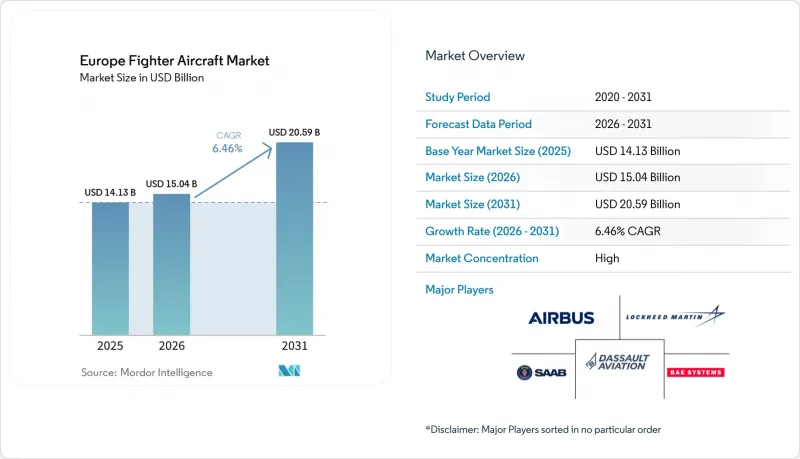
This report is Segmented by Take-Off and Landing (Conventional Take-Off and Landing, and More), Fighter Generation (4th Generation, 4. 5th Generation, and More), Engine Configuration (Single-Engine and Twin-Engine), Mission Role (Air-Superiority, and More), End User (Air Force, and More), and Geography (United Kingdom, France, and More). The Market Forecasts are Provided in Terms of Value (USD).
Europe Fighter Aircraft Market Trends and Insights
Post-Ukraine Surge in European Defense Budgets
The EU's SAFE regulation unlocks EUR 150 billion (USD 175.85 billion) in loan guarantees dedicated to joint capability acquisition, marking the region's most enormous peacetime spending wave since the Cold War. Germany's 5% of GDP pledge alone sends USD-level demand surging for new builds and sustainment across the Europe fighter aircraft market. National "escape-clause" budget mechanisms let Member States exceed fiscal rules by 1.5% of GDP through 2029, widening headroom for back-to-back orders. NATO's 2024 capability review called air-superiority gaps critical, turning fighters into top-priority line items. Near-term disbursements, therefore, push the Europe fighter aircraft market toward a procurement super-cycle that extends at least through 2030.
Accelerated 5th-Generation F-35 Procurements
Germany's 35-aircraft F-35A contract for nuclear-sharing roles anchors a regional commitment exceeding EUR 30 billion (USD 35.16 billion) to 2030. Belgium, Romania, and the Czech Republic follow with fleet conversions, valuing NATO interoperability over developmental risk. While US ITAR constraints raise sovereignty alarms, smaller forces accept dependency to secure near-term, 5th-generation capability envelopes. Resulting volume propels single-engine demand and reinforces a cost-per-flight-hour benchmark that influences future 6th-generation affordability discussions.
Soaring Acquisition and Life-Cycle Costs
F-35A unit prices exceed USD 80 million, while an upgraded Eurofighter approaches USD 120 million when development amortization is included. Sustainment typically accounts for 60-70% of total ownership, locking governments into multi-decade funding streams that squeeze other readiness accounts. The European Defence Agency (EDA) estimates that fragmented national buys add 20-30% to unit costs, yet political preferences for local workshare often trump economies of scale. Consequently, affordability pressures may moderate volumes after the current surge, tempering the long-run growth curve for the European fighter aircraft market.
Other drivers and restraints analyzed in the detailed report include:
- Launch of 6th-Generation Programs FCAS and GCAP
- Ageing Legacy Fleets Approaching End of Life
- Export-Control/ITAR Constraints on Subsystems
For complete list of drivers and restraints, kindly check the Table Of Contents.
Segment Analysis
CTOL aircraft accounted for 62.25% of the European fighter aircraft market in 2025, underpinned by well-established basing infrastructure and NATO STANAG-compliant runways. Fleet operators prize lower acquisition and sustainment costs versus STOVL peers, enabling broader force structure coverage. The European fighter aircraft market anticipates incremental CTOL orders from Germany, Spain, and Poland as life-extension deadlines converge.
VTOL/STOVL jets chart a 7.54% CAGR from a low base. Italy declared F-35B initial operating capability aboard the Cavour in 2024, validating integration pathways yet exposing deck-space and maintenance intensity challenges. The UK's Queen Elizabeth-class carriers field the region's largest STOVL air wing, but readiness rates below 65% spotlight sustainment burdens. Spain's 2025 decision to forgo F-35B acquisitions underscores fiscal and operational trade-offs that could cap long-term penetration. Even so, carrier-based deterrence needs and dispersed-basing concepts keep VTOL demand visibly on the radar of the European fighter aircraft market.
4th- and 4.5th-generation aircraft make up more than 80% of active inventories; 4.5th-gen alone held 43.12% of Europe's fighter aircraft market share in 2025. Eurofighter Typhoon commands the most extensive installed base, and Italy's March 2025 EUR 2.8 billion (USD 3.28 billion) order for up to 24 additional units extends production through 2028.
6th-generation programs exhibit an 8.18% CAGR as FCAS and GCAP progress from concept stage to demonstrator testing. While timelines stretch beyond 2035, down-selects on common propulsion, adaptive engines, and collaborative combat sensors are already shaping supplier ecosystems. For the European fighter aircraft market, this creates a dual-track procurement landscape where 4th-and 5th-generation aircraft bridge capability gaps until 6th-generation units become operational.
List of Companies Covered in this Report:
- Lockheed Martin Corporation
- Airbus SE
- Saab AB
- Dassault Aviation SA
- BAE Systems plc
- United Aircraft Corporation
- The Boeing Company
- Textron Inc.
- United Aircraft Corporation
- Leonardo S.p.A.
Additional Benefits:
- The market estimate (ME) sheet in Excel format
- 3 months of analyst support
TABLE OF CONTENTS
1 INTRODUCTION
- 1.1 Study Assumptions and Market Definition
- 1.2 Scope of the Study
2 RESEARCH METHODOLOGY
3 EXECUTIVE SUMMARY
4 MARKET LANDSCAPE
- 4.1 Market Overview
- 4.2 Market Drivers
- 4.2.1 Post-Ukraine surge in European defense budgets
- 4.2.2 Accelerated 5th-generation (F-35) procurements
- 4.2.3 Launch of 6th-generation programs (FCAS and GCAP)
- 4.2.4 Ageing legacy fleets reaching end of life
- 4.2.5 EU joint-procurement mechanism unlocking scale buys
- 4.2.6 Rise of manned-unmanned teaming requirements
- 4.3 Market Restraints
- 4.3.1 Soaring acquisition and life-cycle costs
- 4.3.2 Export-control/ITAR constraints on subsystems
- 4.3.3 Lengthy development and certification timelines
- 4.3.4 Engine-core production bottlenecks in Europe
- 4.4 Value Chain Analysis
- 4.5 Regulatory Landscape
- 4.6 Technological Outlook
- 4.7 Porter's Five Forces Analysis
- 4.7.1 Threat of New Entrants
- 4.7.2 Bargaining Power of Buyers
- 4.7.3 Bargaining Power of Suppliers
- 4.7.4 Threat of Substitutes
- 4.7.5 Intensity of Competitive Rivalry
5 MARKET SIZE AND GROWTH FORECASTS (VALUE)
- 5.1 By Take-off and Landing
- 5.1.1 Conventional Take-off and Landing (CTOL)
- 5.1.2 Short Take-off and Landing (STOL)
- 5.1.3 Vertical Take-off and Landing (VTOL/STOVL)
- 5.2 By Fighter Generation
- 5.2.1 4th Generation
- 5.2.2 4.5th Generation
- 5.2.3 5th Generation
- 5.2.4 6th Generation/NGAD
- 5.3 By Engine Configuration
- 5.3.1 Single-Engine
- 5.3.2 Twin-Engine
- 5.4 By Mission Role
- 5.4.1 Air-Superiority
- 5.4.2 Multi-Role
- 5.4.3 Close-Air-Support/Strike
- 5.5 By End User
- 5.5.1 Air Force
- 5.5.2 Naval Aviation
- 5.5.3 Marine/Army Aviation
- 5.6 By Geography
- 5.6.1 Germany
- 5.6.2 United Kingdom
- 5.6.3 France
- 5.6.4 Russia
- 5.6.5 Spain
- 5.6.6 Sweden
- 5.6.7 Austria
- 5.6.8 Rest of Europe
6 COMPETITIVE LANDSCAPE
- 6.1 Market Concentration
- 6.2 Strategic Moves
- 6.3 Market Share Analysis
- 6.4 Company Profiles (includes Global level Overview, Market level overview, Core Segments, Financials as available, Strategic Information, Market Rank/Share for key companies, Products and Services, and Recent Developments)
- 6.4.1 Lockheed Martin Corporation
- 6.4.2 Airbus SE
- 6.4.3 Saab AB
- 6.4.4 Dassault Aviation SA
- 6.4.5 BAE Systems plc
- 6.4.6 United Aircraft Corporation
- 6.4.7 The Boeing Company
- 6.4.8 Textron Inc.
- 6.4.9 United Aircraft Corporation
- 6.4.10 Leonardo S.p.A.
7 MARKET OPPORTUNITIES AND FUTURE OUTLOOK
- 7.1 White-space and Unmet-need Assessment

