PUBLISHER: Mordor Intelligence | PRODUCT CODE: 2061695

PUBLISHER: Mordor Intelligence | PRODUCT CODE: 2061695
Reusable Launch Vehicles - Market Share Analysis, Industry Trends & Statistics, Growth Forecasts (2026 - 2031)
According to Mordor Intelligence, the reusable launch vehicles market size was valued at USD 6.15 billion in 2025 and is estimated to grow from USD 6.43 billion in 2026 to USD 9.45 billion by 2031, at a CAGR of 7.99% during the forecast period (2026-2031).
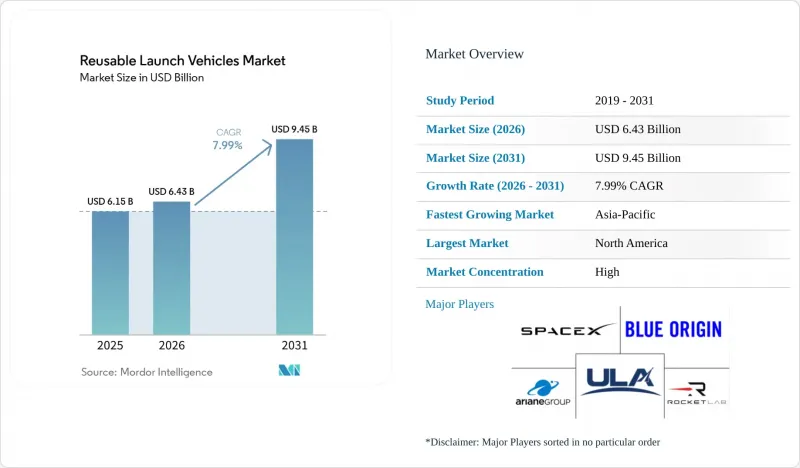
This report is Segmented by Type (Partially Reusable and Fully Reusable), Configuration (Single-Stage-To-Orbit, and More), Payload Class (Small, Medium, and Heavy), End User (Commercial and Defense and Governments), Mission (Satellite Deployment, Human Spaceflight, and More), and Geography (North America, Europe, and More). The Market Forecasts are Provided in Terms of Value (USD).
Global Reusable Launch Vehicles Market Trends and Insights
Cost-per-kg Drop to Less than USD 2,500 Driven by Booster Reuse
Reusable booster fleets are pushing average launch costs below the USD 2,500-per-kilogram threshold that once constrained many commercial missions. Marginal pricing falls as operators pivot to line-style engine production and standardized refurbishment procedures. These economics open new routes such as point-to-point cargo delivery and low-orbit logistics services that compete with premium air freight rates. Lower hardware emissions reinforce adoption by aligning with emerging environmental standards, creating a dual economic and sustainability benefit. The cost tipping point widens addressable demand across broadband, remote sensing, and in-space logistics.
Constellation Boom Demanding High-Cadence Launches
More than 400 commercial constellation projects are in various stages of build-out, yet fewer than one-fifth are actively launching. Each roll-out phase compresses into an 18- to 36-month window, forcing providers to seek vehicles able to fly weekly or even daily. Scheduled flights for national broadband networks and earth-observation arrays already exceed available slots on expendable rockets. Reusable fleets that can complete multiple missions per booster each month provide operators with both cost relief and schedule certainty, locking in launch contracts several years in advance.
Up-Front Capex and Refurbishment Infrastructure
High-volume reuse programs require specialized test bays, non-destructive evaluation labs, and cryogenic propellant handling cells, all of which push initial facility spending into the hundreds of millions of USD. Cash burn peaks years before flight revenue, challenging newcomers' balance sheets. Mature players are mitigating this through vertically integrated engine shops and modular hangars that streamline inspection cycles, yet the barrier remains formidable for regions with fledgling launch markets.
Other drivers and restraints analyzed in the detailed report include:
- Government and DoD Multi-Year Service Contracts
- Emergence of Heavy-Lift Fully Reusable Systems (Greater than 100 tons)
- Safety-Driven Regulatory Delays
For complete list of drivers and restraints, kindly check the Table Of Contents.
Segment Analysis
Partially reusable boosters generated 93.80% of 2025 revenue, confirming that recovering the first stage captures most of a launch vehicle's cost base. Reusability milestones-40 flights per Falcon 9 core, for example, support routine reflights with minor hardware swaps. The reusable launch vehicles market is thus dominated by operators that have optimized booster turnarounds to fewer than two weeks. Fully reusable architectures, however, are registering the highest CAGR of 11.17% as technology demonstrators progress toward returning upper stages intact. Once thermal shielding and propellant management hurdles are solved, end-to-end reuse may bring marginal launch costs close to propellant costs alone.
Second-generation programs funded in 2025 underscore investor appetite: one fully reusable startup secured USD 260 million and booked a 2026 orbital debut. Established players are flight-testing belly-flop re-entry profiles and in-air stage grabs to shave turnaround times. As mass-production lines mature, the reusable launch vehicles market will likely see the cost curve bend further in favor of full reuse over partial schemes.
Two-stage-to-orbit (TSTO) systems held an 88.90% share in 2025 and are growing at the highest CAGR of 8.17% through 2031, reflecting a balance between aerodynamic margins and propulsion flexibility. First-stage return consumes modest payload mass while upper stages remain expendable or are queued for future recovery trials. Companies experimenting with advanced aerospike engines and lightweight composites illustrate the appeal-simple ground operations and a small vehicle count-yet must demonstrate that re-entry loads and propellant reserves do not erode commercial economics.
Expansion of engine thrust-to-weight ratios and the adoption of high-efficiency closed-cycle designs could narrow the performance gap by the end of the decade. If SSTO prototypes validate durable heat-shield tiles and rapid refuel-and-go procedures, the reusable launch vehicles market could witness a second wave of architectural disruption.
Geography Analysis
North America controlled 83.61% of 2025 revenue, anchored by mature launch pads, vertically integrated engine lines, and multi-billion-USD government launch contracts. Operators headquartered in the region accounted for over half of global orbital flights, securing market leadership through demonstrable reflight statistics and rapid pad turnaround capabilities. Export control rules channel allied military missions back to US providers, reinforcing a domestic backlog that sustains factory utilization.
Asia-Pacific will be the fastest-growing geography at a 17.77% CAGR. Chinese commercial firms flight-tested booster landings in 2025, pairing domestic mega-constellation plans with coastal spaceport build-outs. India's Next Generation Launch Vehicle program adopts recover-and-reuse plans, while private startups leverage cost-effective supply chains to build methane engines domestically. Japan, South Korea, and Australia are investing in equatorial launch pads and propellant depots, anticipating regional customer demand for low-inclination orbits.
Europe's uptake of reusability is slower. Sparse institutional launch volumes and reliance on a single heavy-lift program constrain economies of scale needed to justify dedicated refurbishment facilities. New entrants pursuing mini-launchers with fold-out heat shields illustrate technical innovation, yet limited domestic payload pipelines hinder the economics of reuse. Policy efforts, including ESA's reusability campaigns and public-private co-funding of test stands, aim to narrow the gap, but meaningful share gains may slip beyond 2030.
- Space Exploration Technologies Corp.
- ArianeGroup SAS
- United Launch Alliance, LLC
- Indian Space Research Organisation
- Rocket Lab USA, Inc.
- Mitsubishi Heavy Industries, Ltd.
- Blue Origin Enterprises, L.P.
- Hyundai Rotem Company
- Shanghai Academy of Spaceflight Technology
- Korea Aerospace Research Institute
- ispace, inc.
- LandSpace Technology Co., Ltd.
- Stoke Space Technologies, Inc.
- China Aerospace Science and Technology Corporation
- Innovative Rocket Technologies Inc. (iRocket)
Additional Benefits:
- The market estimate (ME) sheet in Excel format
- 3 months of analyst support
TABLE OF CONTENTS
1 INTRODUCTION
- 1.1 Study Assumptions and Market Definition
- 1.2 Scope of the Study
2 RESEARCH METHODOLOGY
3 EXECUTIVE SUMMARY
4 MARKET LANDSCAPE
- 4.1 Market Overview
- 4.2 Market Drivers
- 4.2.1 Cost-per-kg drop to less than USD 2,500 driven by booster reuse
- 4.2.2 Constellation boom demanding high-cadence launches
- 4.2.3 Government and DoD multi-year service contracts
- 4.2.4 Emergence of heavy-lift fully reusable systems (Less than 100 tons)
- 4.2.5 Venture-capital shift to "launch-on-demand" business models
- 4.2.6 Certification of reused boosters for national-security payloads
- 4.3 Market Restraints
- 4.3.1 Up-front capex and refurbishment infrastructure
- 4.3.2 Safety-driven regulatory delays
- 4.3.3 Sparse domestic demand in Europe limits reuse economics
- 4.3.4 Spaceport environmental/community opposition
- 4.4 Value Chain Analysis
- 4.5 Regulatory Landscape
- 4.6 Technological Outlook
- 4.7 Porter's Five Forces Analysis
- 4.7.1 Bargaining Power of Suppliers
- 4.7.2 Bargaining Power of Buyers
- 4.7.3 Threat of New Entrants
- 4.7.4 Threat of Substitutes
- 4.7.5 Intensity of Competitive Rivalry
5 MARKET SIZE AND GROWTH FORECASTS (VALUE)
- 5.1 By Type
- 5.1.1 Partially Reusable
- 5.1.2 Fully Reusable
- 5.2 By Configuration
- 5.2.1 Single-Stage-to-Orbit (SSTO)
- 5.2.2 Two-Stage-to-Orbit (TSTO)
- 5.2.3 Multi-Stage (Booster-only reuse)
- 5.3 By Payload Class
- 5.3.1 Small (Less than 2,000 kg)
- 5.3.2 Medium (2,000 kg to 20,000 kg)
- 5.3.3 Heavy (More than 20,000 kg)
- 5.4 By End User
- 5.4.1 Commercial
- 5.4.2 Defense and Governments
- 5.5 By Mission
- 5.5.1 Satellite Deployment
- 5.5.2 Cargo Resupply and In-Space Logistics
- 5.5.3 Human Spaceflight
- 5.6 By Geography
- 5.6.1 North America
- 5.6.1.1 United States
- 5.6.1.2 Canada
- 5.6.2 Europe
- 5.6.2.1 United Kingdom
- 5.6.2.2 France
- 5.6.2.3 Germany
- 5.6.2.4 Russia
- 5.6.2.5 Rest of Europe
- 5.6.3 Asia-Pacific
- 5.6.3.1 China
- 5.6.3.2 Japan
- 5.6.3.3 India
- 5.6.3.4 Australia
- 5.6.3.5 South Korea
- 5.6.3.6 Rest of Asia-Pacific
- 5.6.4 Rest of the World
- 5.6.4.1 Middle East
- 5.6.4.2 Africa
- 5.6.4.3 South America
- 5.6.1 North America
6 COMPETITIVE LANDSCAPE
- 6.1 Market Concentration
- 6.2 Strategic Moves
- 6.3 Market Share Analysis
- 6.4 Company Profiles (includes Global level Overview, Market level overview, Core Segments, Financials as available, Strategic Information, Market Rank/Share for key companies, Products and Services, and Recent Developments)
- 6.4.1 Space Exploration Technologies Corp.
- 6.4.2 ArianeGroup SAS
- 6.4.3 United Launch Alliance, LLC
- 6.4.4 Indian Space Research Organisation
- 6.4.5 Rocket Lab USA, Inc.
- 6.4.6 Mitsubishi Heavy Industries, Ltd.
- 6.4.7 Blue Origin Enterprises, L.P.
- 6.4.8 Hyundai Rotem Company
- 6.4.9 Shanghai Academy of Spaceflight Technology
- 6.4.10 Korea Aerospace Research Institute
- 6.4.11 ispace, inc.
- 6.4.12 LandSpace Technology Co., Ltd.
- 6.4.13 Stoke Space Technologies, Inc.
- 6.4.14 China Aerospace Science and Technology Corporation
- 6.4.15 Innovative Rocket Technologies Inc. (iRocket)
7 MARKET OPPORTUNITIES AND FUTURE OUTLOOK
- 7.1 White-space and Unmet-Need Assessment

