PUBLISHER: Mordor Intelligence | PRODUCT CODE: 2061722

PUBLISHER: Mordor Intelligence | PRODUCT CODE: 2061722
Railway Wiring Harness - Market Share Analysis, Industry Trends & Statistics, Growth Forecasts (2026 - 2031)
According to Mordor Intelligence, the railway wiring harness market size is expected to grow from USD 2.85 billion in 2025 to USD 3 billion in 2026 and is forecast to reach USD 3.87 billion by 2031 at 5.25% CAGR over 2026-2031.
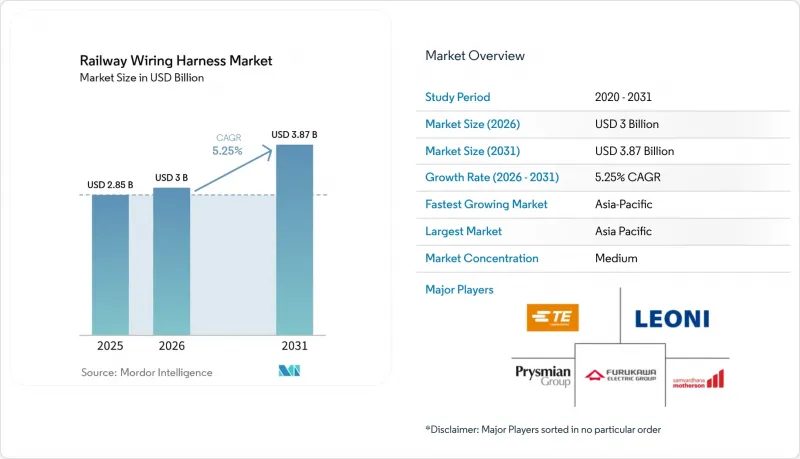
This report is Segmented by Insulation Type (PVC, XLPE, and More), Wire Material (Copper, Optical Fibre, and More), Train Type (High-Speed Rail, Ligh Rail/Tram, Metro/Monorail, and More), Application (HVAC, Engine & Traction, and More) and Geography. The Market Forecasts are Provided in Terms of Value (USD) and Volume (Units).
Global Railway Wiring Harness Market Trends and Insights
Government rail-electrification pipelines
India completed 98.83% electrification of its 69,512 km broad-gauge system by March 2025, cutting annual diesel use by 136 crore liters. Lithuania approved EUR 398 million to bring its network to 39% electrified by 2030 with EU Cohesion Fund support. Denmark's Banedanmark is converting 1,150 km of regional lines, citing 40% lower operating costs once energised. The US Federal Railroad Administration now endorses intermittent electrification paired with dual-mode locomotives, a cost-efficient template for North American corridors. Across projects, demand rises for harnesses certified for 25 kV AC duty and robust electromagnetic compatibility, underpinning steady market volume additions in the Railway Wiring Harness Market.
High-speed rail expansion in Asia-Pacific & Europe
Vietnam's parliament cleared USD 67 billion for a 1,541 km Hanoi-Ho Chi Minh City line that targets six-hour journeys and an 8% GDP lift. Germany ring-fenced EUR 500 billion for rail-first infrastructure, pledging 744 km of new or upgraded track by 2030. US policy momentum includes USD 8.2 billion under the Bipartisan Infrastructure Law, enabling the Las Vegas-Los Angeles corridor. India's Mumbai-Ahmedabad Shinkansen project deploys a dual 25 kV supply for 320 km/h operations. In the Railway Wiring Harness Market,These large-scale schemes elevate demand for precision-engineered harnesses covering traction, signaling, and broadband services inside aerodynamically optimised rolling stock.
Copper price volatility is squeezing OEM margins
Copper's 2025 rally strained budgets, pushing builders to defer cable orders and renegotiate contracts every quarter. The construction sector alone absorbs 20% of US copper, creating spill-over inflation for rail procurement. BHP warns that mine depletion could outpace new supply despite strong price signals. Smaller harness shops lack hedging tools, so the margin compression can reach double digits. High prices encourage theft, forcing operators to deploy additional surveillance and substitute lower-value conductors. These pressures throttle short-run project starts, dampening near-term shipment volumes.
Other drivers and restraints analyzed in the detailed report include:
- Shift to copper-clad aluminium (CCA)
- Demand for driverless & CBTC-equipped metros
- Lengthy homologation cycles for new materials
For complete list of drivers and restraints, kindly check the Table Of Contents.
Segment Analysis
PVC retained market leadership with a 44.72% share in 2025 due to incumbency and cost advantage. The shift to halogen-free flame-retardant compounds accelerates because EU Taxonomy financing now rewards low-smoke materials and EN 45545-2 mandates strict toxicity thresholds. HFFR therefore posts a 7.58% CAGR, the fastest among insulation categories, as European orders convert en masse. XLPE is growing due to superior dielectric strength suited for high-voltage traction, while thermoplastic elastomer is expanding owing to its flexibility in passenger-door harnesses. The other bracket, mainly silicone and fluoropolymer blends, covers niche uses in extreme temperature zones.
Regulatory catalysts continue to favour HFFR despite a 2-4-year homologation lag. EU REACH Annex XVII formaldehyde limits from August 2026 further constrain PVC volumes, nudging operators to accelerate specification updates. Regulation (EU) 2024/1781 on ecodesign adds recyclability metrics, bolstering halogen-free adoption. Suppliers able to certify new formulas promptly will capture premium margins. Therefore, the railway wiring harness market sees a measured but persistent redirection of insulation demand toward sustainable compounds that satisfy both safety and circular-economy objectives.
Copper continues to dominate with 58.15% share, yet pricing headwinds revive interest in CCA. Optical fiber is estimated to deliver a 7.22% CAGR through 2031 as predictive maintenance, passenger Wi-Fi, and real-time video monitoring intensify data traffic needs. Hybrid conductor solutions in the other segment serve specialty functions such as power-over-fiber links in tunnel environments.
Digitalisation strategies drive fiber demand most in Europe, where national operators deploy 5G trackside networks. Sumitomo Electric's EUR 90 million purchase of Sudkabel expands high-voltage fiber-optic offerings that couple with traction cables. Meanwhile, sustained copper volatility incentivises exploration of aluminium-based alternatives, and automotive precedence validates CCA for signal lines. Over the forecast period, the material mix gradually pivots toward combinations that balance conductivity, bandwidth, weight, and cost.
Geography Analysis
Asia-Pacific controls 44.05% of revenue and exhibits a robust 7.45% CAGR through 2031. China aims for 50,000 km of high-speed track, and India funds USD 30 billion of network upgrades, including the Shinkansen-based Mumbai-Ahmedabad corridor. Vietnam approved the USD 67 billion North-South line, while Thailand cooperates with China on the Trans-Asian Railway, each elevating demand for high-specification harnesses. The Asian Development Bank estimates rail investment needs to be 0.4% of regional GDP by 2035, underpinning a sizeable, long-term opportunity.
In Europe, Germany's EUR 500 billion rail plan, Lithuania's electrification, and continent-wide ETCS adoption combine to stimulate replacement and expansion spending. EU Taxonomy and EN 45545-2 regulations propel the uptake of HFFR products, and simultaneous decarbonisation objectives open space for CCA and fiber upgrades. The market nonetheless contends with homologation bottlenecks that can slow the arrival of novel materials.
In North America, the Bipartisan Infrastructure Law channels USD 8.2 billion into high-speed corridors, and SEPTA's USD 724.3 million car order demonstrates traction for domestically produced equipment. Adopting intermittent electrification and dual-mode locomotives can bridge the gap between diesel fleets and full catenary coverage, gradually enlarging the harness demand. South America and Middle East and Africa are smaller today, yet projects in Brazil and Saudi Arabia suggest incremental volume as economic diversification and urbanisation advance.
- TE Connectivity
- Leoni AG
- Furukawa Electric Co.
- Prysmian Group
- Samvardhana Motherson Group
- Hitachi Metals Ltd
- Nexans SA
- LS Cable & System
- Huber+Suhner AG
- Belden Inc.
- Fujikura Ltd
- Molex LLC
- Yazaki Corporation
- Sumitomo Electric Industries
- Aptiv PLC
Additional Benefits:
- The market estimate (ME) sheet in Excel format
- 3 months of analyst support
TABLE OF CONTENTS
1 Introduction
- 1.1 Study Assumptions & Market Definition
- 1.2 Scope of the Study
2 Research Methodology
3 Executive Summary
4 Market Landscape
- 4.1 Market Overview
- 4.2 Market Drivers
- 4.2.1 Government rail-electrification pipelines
- 4.2.2 High-speed rail network expansion in Asia-Pacific & Europe
- 4.2.3 Shift to copper-clad aluminum (CCA) to cut train weight
- 4.2.4 Demand for driverless & CBTC-equipped metros
- 4.2.5 Smart-cabling for predictive maintenance
- 4.2.6 EU Taxonomy rules favouring halogen-free cables
- 4.3 Market Restraints
- 4.3.1 Copper price volatility squeezing OEM margins
- 4.3.2 Lengthy homologation cycles for new materials
- 4.3.3 Skilled-labour shortages in harness assembly
- 4.3.4 EMC/EMI compliance hurdles for 25 kV AC traction
- 4.4 Value/Supply-Chain Analysis
- 4.5 Regulatory Landscape
- 4.6 Technological Outlook
- 4.7 Porter's Five Forces
- 4.7.1 Threat of New Entrants
- 4.7.2 Bargaining Power of Buyers
- 4.7.3 Bargaining Power of Suppliers
- 4.7.4 Threat of Substitutes
- 4.7.5 Competitive Rivalry
5 Market Size & Growth Forecasts (Value (USD) and Volume (Units))
- 5.1 By Insulation Type
- 5.1.1 PVC
- 5.1.2 XLPE
- 5.1.3 Thermoplastic Elastomer (TPE)
- 5.1.4 Halogen-Free Low-Smoke (HFFR)
- 5.1.5 Others
- 5.2 By Wire Material
- 5.2.1 Copper
- 5.2.2 Copper-Clad Aluminium
- 5.2.3 Optical Fibre
- 5.2.4 Others
- 5.3 By Train Type
- 5.3.1 High-Speed Rail
- 5.3.2 Light Rail / Tram
- 5.3.3 Metro / Monorail
- 5.3.4 Locomotive & Freight Cars
- 5.4 By Application
- 5.4.1 HVAC
- 5.4.2 Engine & Traction
- 5.4.3 Lighting
- 5.4.4 Braking System
- 5.4.5 Infotainment & Connectivity
- 5.4.6 Safety & Signalling
- 5.4.7 Others
- 5.5 By Geography
- 5.5.1 North America
- 5.5.1.1 United States
- 5.5.1.2 Canada
- 5.5.1.3 Rest of North America
- 5.5.2 South America
- 5.5.2.1 Brazil
- 5.5.2.2 Argentina
- 5.5.2.3 Rest of South America
- 5.5.3 Europe
- 5.5.3.1 Germany
- 5.5.3.2 United Kingdom
- 5.5.3.3 France
- 5.5.3.4 Russia
- 5.5.3.5 Spain
- 5.5.3.6 Rest of Europe
- 5.5.4 Asia-Pacific
- 5.5.4.1 China
- 5.5.4.2 India
- 5.5.4.3 Japan
- 5.5.4.4 South Korea
- 5.5.4.5 Australia
- 5.5.4.6 Rest of Asia-Pacific
- 5.5.5 Middle East & Africa
- 5.5.5.1 Saudi Arabia
- 5.5.5.2 UAE
- 5.5.5.3 Turkey
- 5.5.5.4 South Africa
- 5.5.5.5 Egypt
- 5.5.5.6 Rest of Middle East & Africa
- 5.5.1 North America
6 Competitive Landscape
- 6.1 Market Concentration
- 6.2 Strategic Moves
- 6.3 Market Share Analysis
- 6.4 Company Profiles (includes Global level Overview, Market level overview, Core Segments, Financials, Strategic Information, Market Rank/Share, Products & Services, Recent Developments)
- 6.4.1 TE Connectivity
- 6.4.2 Leoni AG
- 6.4.3 Furukawa Electric Co.
- 6.4.4 Prysmian Group
- 6.4.5 Samvardhana Motherson Group
- 6.4.6 Hitachi Metals Ltd
- 6.4.7 Nexans SA
- 6.4.8 LS Cable & System
- 6.4.9 Huber+Suhner AG
- 6.4.10 Belden Inc.
- 6.4.11 Fujikura Ltd
- 6.4.12 Molex LLC
- 6.4.13 Yazaki Corporation
- 6.4.14 Sumitomo Electric Industries
- 6.4.15 Aptiv PLC
7 Market Opportunities & Future Outlook
- 7.1 White-space & Unmet-Need Assessment

