PUBLISHER: Mordor Intelligence | PRODUCT CODE: 2061727

PUBLISHER: Mordor Intelligence | PRODUCT CODE: 2061727
Leptospirosis - Market Share Analysis, Industry Trends & Statistics, Growth Forecasts (2026 - 2031)
According to Mordor Intelligence, the leptospirosis market size is expected to grow from USD 617.61 million in 2025 to USD 654.05 million in 2026 and is forecast to reach USD 871.14 million by 2031 at 5.90% CAGR over 2026-2031.
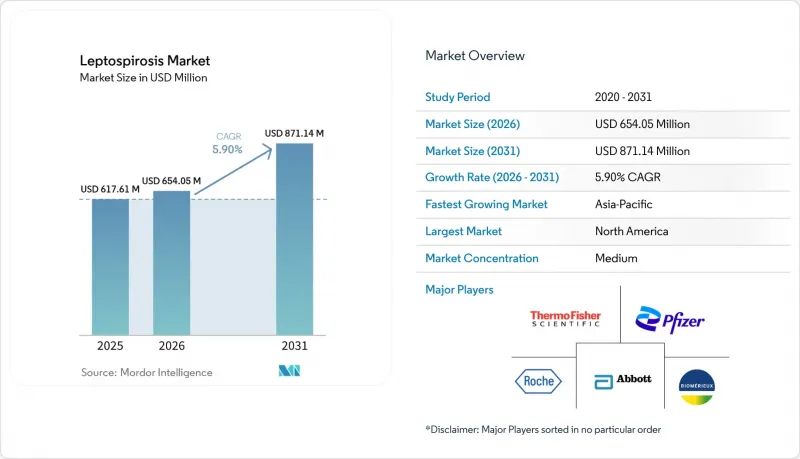
This report is Segmented by Product Type (Diagnostics, Therapeutics), End User (Hospitals & Specialty Clinics, Diagnostic Reference Laboratories, and More), Distribution Channel (Hospital Pharmacies, Retail & Online Pharmacies, and More), and Geography (North America, Europe, Asia-Pacific, Middle East & Africa, South America). The Market Forecasts are Provided in Terms of Value (USD).
Global Leptospirosis Market Trends and Insights
Flooding And Extreme Rainfall Driven By Climate Change
In May 2024, flooding in Brazil's Rio Grande do Sul resulted in 1,314 reported cases and 55 fatalities, increasing the incidence rate to 12.1 per 100,000, significantly higher than the national average of 1.9 per 100,000. Concurrently, surveillance efforts identified 958 lab-confirmed infections, marking a 10.3-fold increase and prompting swift actions for procuring rapid tests and preventive antibiotics. In the Philippines, the first seven months of 2025 recorded 3,037 cases, reflecting a 121% increase from the previous year, attributed to Typhoon Hagupit. This surge led to the transition of LAMP testing to community clinics. New Zealand experienced its highest case load in 20 years following Cyclone Gabrielle, while the Netherlands saw a 4.1-fold rise in local infections in 2024, coinciding with intensified precipitation extremes. Such climatic events are transforming leptospirosis from a seasonal ailment, primarily affecting farm workers, to a pressing year-round public health concern, driving increased investments in diagnostics and treatments within the leptospirosis market.
Reinstating Leptospirosis As A Notifiable Disease
In August 2023, France reinstated mandatory reporting for leptospirosis. By 2024, 886 cases were recorded, with a notable 74% hospitalization rate. This data highlights the disease's burden and aids in setting procurement budget baselines. Following a 2023 decree in Argentina, confirmed cases increased 3.8-fold by epidemiological week 34 of 2025, emphasizing the need for rapid molecular assays. In January 2026, Australia expanded its national case definition to include PCR-positive results, broadening the range of reimbursable tests and boosting diagnostic demand. In the United States, weekly publications under the National Notifiable Diseases Surveillance System ensure hospitals remain vigilant, stabilizing order volumes for multiplex panels. Such regulatory measures are transforming previously latent testing demands into quantifiable, budgeted needs, thereby expanding the leptospirosis market.
Fragmented Reimbursement Pathways Hinder Progress on Neglected Tropical Diseases
Between 2018 and 2023, the World Health Organization reported a 41% decline in official development assistance for neglected tropical diseases, significantly reducing financial resources for new diagnostic developments. In India, Indonesia, and the Philippines, health insurance plans exclude coverage for leptospirosis tests, requiring patients to pay out of pocket amounts ranging from USD 15 to 40, which can represent up to a week's wages in rural areas. In Brazil, reimbursement is provided for outdated microscopic agglutination tests but not for advanced PCR tests. This policy directs laboratories toward slower, traditional technologies, even as the market shifts toward rapid molecular platforms for leptospirosis. These inconsistencies limit economies of scale for advanced assays, delaying price reductions and restraining the growth of the leptospirosis market.
Other drivers and restraints analyzed in the detailed report include:
- Public-Sector Stockpiling Of Doxycycline And Ceftriaxone For Disaster Response
- Tertiary Hospitals Adopting Multiplex Febrile-Illness PCR Panels
- Reliance on Low-Margin Generic Antibiotics Stifles Private R&D Investment
For complete list of drivers and restraints, kindly check the Table Of Contents.
Segment Analysis
Diagnostics, contributing 55% of 2025 revenue, emphasize the transition of laboratory confirmation from an optional service to a clinical requirement. While serological ELISA and MAT kits remain dominant in reference labs, molecular assays now account for nearly one-third of diagnostic sales due to reagent prices dropping below USD 5 per run. The multiplex category is experiencing the fastest growth, with products like bioMerieux's BioFire Global Fever Panel and HiMedia's Acute Fever Panel delivering results in under an hour, enabling physicians to reduce broad-spectrum antibiotic therapy. Although smaller in size, therapeutics are projected to surpass diagnostics with a 6.35% CAGR through 2031. This growth is driven by the expansion of disaster-response stockpiles in Asia-Pacific and South America, ensuring consistent orders for generic manufacturers and strengthening the overall resilience of the leptospirosis market.
Geography Analysis
In 2025, North America accounted for 40.40% of global revenue, supported by mandatory weekly reporting by health authorities and government stockpiles, which established a consistent baseline for test and drug consumption in the regional leptospirosis market. Hospital formularies now predominantly feature multiplex panels, and reimbursement policies have evolved to tie payouts to documented etiology, steering practitioners away from broad-spectrum regimens. The United States operates over 50 state public-health laboratories equipped for same-day Leptospira PCR testing, ensuring sustained demand even in non-flood seasons.
Asia-Pacific is projected to grow at a compound annual growth rate (CAGR) of 6.95% through 2031, driven by the Philippines reporting significant case numbers in the first half of 2025 and India's substantial annual infections, many of which remain undiagnosed. Affordable LAMP tests, priced at approximately USD 3.50, are enabling mass screenings in community clinics, broadening the leptospirosis market's reach beyond urban tertiary centers. Australia's decision in early 2026 to include PCR in its case definition provides a boost from high-income regions, while Indonesia and Malaysia are expected to implement similar policy changes within the next two years.
In South America, demand is episodic, often spiking in response to floods. For example, Brazil's severe flooding in May 2024 led to a significant surge in confirmed cases within two months, prompting emergency purchases of rapid tests and large quantities of doxycycline. Meanwhile, Argentina's notification law highlighted diagnostic gaps, with the majority of 2025 cases concentrated in three provinces, a void that suppliers are now working to address. Europe experiences steadier growth but faces challenges due to varied reimbursement policies across its member nations. In Africa, while the burden of the disease remains largely uncharted, there is potential for significant growth once financial support improves.
- Abbott Laboratories
- Bayer
- BioMerieux Inc.
- Chembio Diagnostics
- Dr. Reddy's Laboratories Inc.
- Genomtec
- GlaxoSmithKline
- Johnson & Johnson
- Lupin
- Meridian Bioscience
- Molbio Diagnostics Ltd.
- Pfizer
- QIAGEN
- Roche
- Novartis
- Sanofi
- Seegene
- Sun Pharmaceuticals Industries
- Thermo Fisher Scientific
- Viatris (Mylan)
Additional Benefits:
- The market estimate (ME) sheet in Excel format
- 3 months of analyst support
TABLE OF CONTENTS
1 Introduction
- 1.1 Study Assumptions & Market Definition
- 1.2 Scope of the Study
2 Research Methodology
3 Executive Summary
4 Market Landscape
- 4.1 Market Overview
- 4.2 Market Drivers
- 4.2.1 Flooding and Extreme Rainfall, Driven by Climate Change, are Increasingly Impacting Tropical and Temperate Regions
- 4.2.2 Reinstating Leptospirosis as a Notifiable Disease in Many Countries is Boosting Diagnostic Demand
- 4.2.3 Public-Sector Entities are Stockpiling Doxycycline and Ceftriaxone for Disaster Response
- 4.2.4 Tertiary Hospitals are Adopting Multiplex Febrile-Illness PCR Panels
- 4.2.5 Adventure Tourism is Driving a Rise in Prophylactic Antibiotic Use
- 4.2.6 Affordable, 45-Minute Nanoparticle-LAMP Lateral-Flow Combo Tests are Enabling Community Screening
- 4.3 Market Restraints
- 4.3.1 Fragmented Product Reimbursement Pathways for Neglected Tropical Diseases
- 4.3.2 Dependence on Generic, Low-Margin Antibiotics Limiting Private R&D Investment
- 4.3.3 Supply-Chain Bottlenecks in Rabbit-Serum Based EMJH / Culture Reagents
- 4.3.4 Possible Efflux-Pump Mediated Reduced Susceptibility in Pomona Serovar Strains
- 4.4 Value / Supply-Chain Analysis
- 4.5 Regulatory Landscape
- 4.6 Technological Outlook
- 4.7 Porter's Five Forces Analysis
- 4.7.1 Threat of New Entrants
- 4.7.2 Bargaining Power of Suppliers
- 4.7.3 Bargaining Power of Buyers
- 4.7.4 Threat of Substitutes
- 4.7.5 Industry Rivalry
5 Market Size & Growth Forecasts (Value, USD)
- 5.1 By Product Type
- 5.1.1 Diagnostics
- 5.1.1.1 Serological Assays (ELISA, MAT-based)
- 5.1.1.2 Molecular Assays (qPCR, LAMP, CRISPR)
- 5.1.1.3 Rapid Immunochromatographic Tests (Lateral Flow, DPP)
- 5.1.1.4 Multiplex Syndromic Panels
- 5.1.2 Therapeutics
- 5.1.2.1 Beta-lactams (IV Penicillin G, Ampicillin)
- 5.1.2.2 Tetracyclines (Doxycycline, Omadacycline)
- 5.1.2.3 Macrolides (Azithromycin)
- 5.1.2.4 Third-Generation Cephalosporins (Ceftriaxone, Cefotaxime)
- 5.1.2.5 Others (Supportive Care Adjuncts)
- 5.1.1 Diagnostics
- 5.2 By End User
- 5.2.1 Hospitals & Specialty Clinics
- 5.2.2 Diagnostic Reference Laboratories
- 5.2.3 Point-of-Care / Primary-Care Settings
- 5.2.4 Public-Health Agencies & NGOs
- 5.3 By Distribution Channel
- 5.3.1 Hospital Pharmacies
- 5.3.2 Retail & Online Pharmacies
- 5.3.3 Government & Emergency Procurement
- 5.4 By Geography
- 5.4.1 North America
- 5.4.1.1 United States
- 5.4.1.2 Canada
- 5.4.1.3 Mexico
- 5.4.2 Europe
- 5.4.2.1 Germany
- 5.4.2.2 United Kingdom
- 5.4.2.3 France
- 5.4.2.4 Italy
- 5.4.2.5 Spain
- 5.4.2.6 Rest of Europe
- 5.4.3 Asia-Pacific
- 5.4.3.1 China
- 5.4.3.2 Japan
- 5.4.3.3 India
- 5.4.3.4 Australia
- 5.4.3.5 South Korea
- 5.4.3.6 Rest of Asia-Pacific
- 5.4.4 Middle East & Africa
- 5.4.4.1 GCC
- 5.4.4.2 South Africa
- 5.4.4.3 Rest of Middle East & Africa
- 5.4.5 South America
- 5.4.5.1 Brazil
- 5.4.5.2 Argentina
- 5.4.5.3 Rest of South America
- 5.4.1 North America
6 Competitive Landscape
- 6.1 Market Concentration
- 6.2 Market Share Analysis
- 6.3 Company Profiles (includes Global level Overview, Market level overview, Core Segments, Financials as available, Strategic Information, Market Rank/Share, Products & Services, Recent Developments)
- 6.3.1 Abbott Inc.
- 6.3.2 Bayer AG
- 6.3.3 BioMerieux Inc.
- 6.3.4 Chembio Diagnostics
- 6.3.5 Dr. Reddy's Laboratories Inc.
- 6.3.6 Genomtec
- 6.3.7 GlaxoSmithKline PLC
- 6.3.8 Johnson & Johnson (Janssen)
- 6.3.9 Lupin Ltd.
- 6.3.10 Meridian Bioscience Inc.
- 6.3.11 Molbio Diagnostics Ltd.
- 6.3.12 Pfizer Inc.
- 6.3.13 Qiagen Inc.
- 6.3.14 F. Hoffmann-La Roche Ltd
- 6.3.15 Novartis AG
- 6.3.16 Sanofi
- 6.3.17 Seegene
- 6.3.18 Sun Pharmaceutical Industries Ltd.
- 6.3.19 Thermo Fisher Scientific Inc.
- 6.3.20 Viatris (Mylan)
7 Market Opportunities & Future Outlook
- 7.1 White-space & Unmet-Need Assessment

