PUBLISHER: Mordor Intelligence | PRODUCT CODE: 2061809

PUBLISHER: Mordor Intelligence | PRODUCT CODE: 2061809
Kimchi - Market Share Analysis, Industry Trends & Statistics, Growth Forecasts (2026 - 2031)
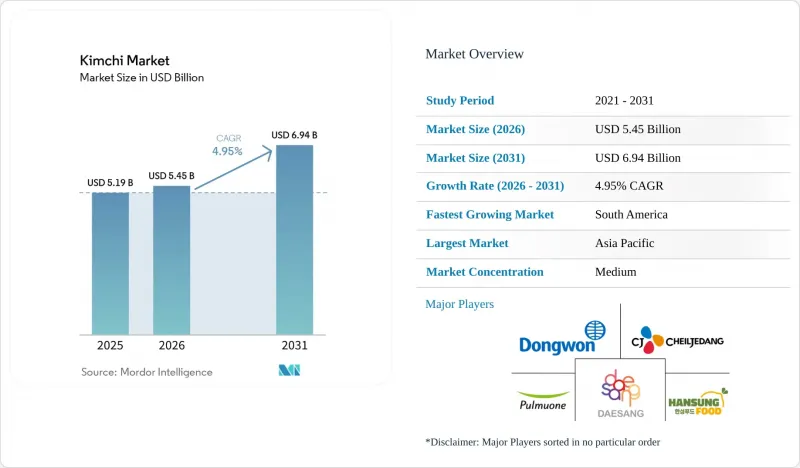
According to Mordor Intelligence, the kimchi market size is expected to grow from USD 5.19 billion in 2025 to USD 5.45 billion in 2026 and is forecast to reach USD 6.94 billion by 2031 at 4.95% CAGR over 2026-2031.
This report is Segmented by Product Type (Baechu Kimchi, Kkakdugi Kimchi, Dongchimi Kimchi, and More), Distribution Channel (Foodservice and Household/Retail), Packaging Format (Plastic Tubs and Buckets, Glass Jars and Bottles, Pouches/Sachets, Cans), and Geography (North America, Europe, Asia-Pacific, South America, Middle East and Africa). The Market Forecasts are Provided in Terms of Value (USD).
Global Kimchi Market Trends and Insights
Rising global popularity of Korean cuisine and cultural influence (Hallyu wave)
The rising global popularity of Korean cuisine, strongly influenced by the expansion of the Hallyu (Korean Wave), has emerged as a significant driver for the kimchi market. The worldwide success of Korean entertainment, including K-pop, K-dramas, and films, has heightened international curiosity and acceptance of traditional Korean foods such as kimchi. This cultural diffusion has translated into increased consumption across regions such as Southeast Asia, the Middle East, Europe, and North America. According to a 2025 government-commissioned survey, over 82.3% of global respondents reported a favorable perception of Korea and its culture, highlighting the extensive reach of Hallyu. Notably, the influence is particularly strong among younger demographics, with nearly 79% of teenagers expressing positive attitudes toward Korean culture. This growing cultural affinity has accelerated the adoption of kimchi in both retail and foodservice sectors worldwide. Furthermore, the association of kimchi with health benefits, authenticity, and premium Asian cuisine has strengthened its global positioning.
Increasing consumer awareness of gut health and probiotics
The growing emphasis on gut health and probiotic consumption is significantly contributing to the expansion of the kimchi market. Consumers are becoming more informed about the role of a healthy gut microbiome in supporting digestion, immunity, and overall well-being, leading to increased demand for naturally fermented foods. Kimchi, which contains beneficial live cultures formed during fermentation, is gaining recognition as an effective and natural probiotic source. This heightened awareness is particularly evident among health-focused consumers seeking functional foods with added nutritional value. In addition, the rising preference for clean-label and minimally processed products has further strengthened kimchi's market appeal. Scientific studies linking gut health to broader health outcomes, including metabolic and immune functions, are also influencing purchasing behavior. Consequently, food companies are increasingly promoting the probiotic benefits of kimchi and introducing diverse product variants to meet evolving consumer demand.
Strong odor and taste profile limiting mainstream consumer acceptance
A significant challenge restricting the wider adoption of kimchi is its strong aroma and bold, pungent flavor, which may be off-putting for consumers who are not accustomed to fermented foods. The distinctive smell, produced during lactic acid fermentation and from ingredients such as garlic and cabbage, can discourage first-time buyers, while the spicy and tangy taste can be polarizing in markets with a preference for milder flavors. This sensory intensity impacts both retail sales and foodservice incorporation, as hesitant consumers may avoid trying or regularly consuming kimchi. Despite increasing awareness of its health benefits and nutritional value, the pronounced odor and taste continue to limit mainstream appeal. To address this, manufacturers are developing milder variants, improved packaging solutions to reduce odor, and flavor-blended options, yet consumer resistance remains a notable restraint on market growth.
Other drivers and restraints analyzed in the detailed report include:
- Expansion of Asian foodservice restaurants and quick-service formats globally
- Surging vegan and plant-based diet adoption
- Short shelf life and storage challenges for fresh kimchi products
For complete list of drivers and restraints, kindly check the Table Of Contents.
Segment Analysis
Baechu kimchi, made primarily from napa cabbage, accounted for the largest share of the kimchi market in 2025, contributing 59.97% of total revenue. Its dominance is driven by its status as the most traditional and widely consumed form of kimchi, particularly in South Korea and across Asia-Pacific. The product's versatility allows it to be consumed as a side dish, ingredient, or standalone meal component, further strengthening its market position. In addition, its well-established production processes and widespread availability across retail and foodservice channels support consistent demand. Consumers also associate baechu kimchi with authentic taste and proven health benefits, including probiotic properties. The segment continues to benefit from product innovations such as ready-to-eat packaging, low-sodium variants, and organic options, reinforcing its leadership in the global market.
Kkakdugi, a cubed radish-based kimchi, is projected to be the fastest-growing segment, expanding at a CAGR of 5.69% through 2031. Its growth is driven by increasing consumer interest in diverse kimchi varieties beyond traditional cabbage-based products. Kkakdugi offers a distinct crunchy texture and slightly sweeter flavor profile, making it appealing to both domestic and international consumers. The rising popularity of Korean cuisine globally has also contributed to greater exposure and adoption of this variant. Additionally, foodservice outlets and restaurants are incorporating kkakdugi into menus, boosting its visibility and consumption. Manufacturers are capitalizing on this trend by introducing packaged and flavored variations tailored to regional tastes.
Geography Analysis
Asia-Pacific dominated the kimchi market, accounting for 55.02% of the global share in 2025, driven primarily by South Korea, where kimchi is a daily dietary staple. The region benefits from deeply rooted cultural consumption, strong domestic production, and widespread availability across retail and foodservice channels. Countries such as China and Japan are also contributing to regional demand, supported by growing interest in fermented foods and cross-cultural culinary adoption. The dominance of Asia-Pacific is further reinforced by increasing exports of Korean food products, particularly through the global expansion of K-food trends. Rising urbanization and busy lifestyles have boosted demand for ready-to-eat and packaged kimchi across major cities. Additionally, health awareness regarding probiotics and gut health has encouraged higher consumption among younger consumers.
South America is emerging as the fastest-growing region in the kimchi market, projected to expand at a CAGR of 5.76% through 2031. This growth is largely driven by increasing awareness of global cuisines and the rising popularity of fermented foods among health-conscious consumers. Countries such as Brazil and Argentina are witnessing growing demand, particularly in urban areas where international food trends are rapidly adopted. The expansion of Asian restaurants and Korean cultural influence, including K-pop and K-dramas, has also contributed to consumer curiosity and trial. Furthermore, the region is experiencing growth in modern retail formats and e-commerce platforms, which are improving product accessibility. Importers and local distributors are introducing packaged kimchi in supermarkets and specialty health stores, catering to niche but expanding consumer segments.
North America and Europe represent steadily growing markets for kimchi, supported by increasing consumer awareness of probiotic-rich foods and the expanding popularity of Korean cuisine. In the United States and Canada, kimchi has transitioned from a niche ethnic product to a mainstream health food, widely available in supermarkets and organic stores. Similarly, European countries such as the UK, Germany, and France are witnessing rising demand, particularly among vegan and health-focused consumers. Meanwhile, the Middle East & Africa region is at a nascent stage but shows gradual growth due to urbanization, rising disposable incomes, and the expansion of international retail chains.
- CJ CheilJedang Corp.
- Daesang Corporation
- Pulmuone Co., Ltd.
- Dongwon F&B Co., Ltd.
- Cosmos Food Co., Inc.
- Sinto Gourmet LLC
- Hansung Food Co., Ltd.
- Tazaki Foods Ltd.
- MILKimchi Inc.
- Real Pickles Inc.
- Lucky Foods LLC
- Mama O's Premium Kimchi LLC
- Choi's Kimchi Co., LLC
- Top Gourmet Foods Inc.
- King's Asian Gourmet Inc.
- Eden Foods Inc.
- Gold Mine Natural Food Co.
- Kehoe's Kitchen Pty Ltd.
- Kimchi Club Pty Ltd.
- Cleveland Kitchen LLC
Additional Benefits:
- The market estimate (ME) sheet in Excel format
- 3 months of analyst support
TABLE OF CONTENTS
1 INTRODUCTION
- 1.1 Study Assumptions and Market Definition
- 1.2 Scope of the Study
2 RESEARCH METHODOLOGY
3 EXECUTIVE SUMMARY
4 MARKET LANDSCAPE
- 4.1 Market Overview
- 4.2 Market Drivers
- 4.2.1 Rising global popularity of Korean cuisine and cultural influence (Hallyu wave)
- 4.2.2 Increasing consumer awareness of gut health and probiotics
- 4.2.3 Growing demand for fermented and functional foods
- 4.2.4 Expansion of Asian foodservice restaurants and quick-service formats globally
- 4.2.5 Surging vegan and plant-based diet adoption
- 4.2.6 Product innovation in flavors, formats, and packaging
- 4.3 Market Restraints
- 4.3.1 Strong odor and taste profile limiting mainstream consumer acceptance
- 4.3.2 Short shelf life and storage challenges for fresh kimchi products
- 4.3.3 Supply chain complexities related to fresh vegetable sourcing
- 4.3.4 Limited awareness in emerging markets outside Asia
- 4.4 Value Chain Analysis
- 4.5 Regulatory Landscape
- 4.6 Technological Outlook
- 4.7 Porter's Five Forces
- 4.7.1 Bargaining Power of Suppliers
- 4.7.2 Bargaining Power of Buyers
- 4.7.3 Threat of New Entrants
- 4.7.4 Threat of Substitutes
- 4.7.5 Competitive Rivalry
5 MARKET SIZE AND GROWTH FORECASTS (VALUE)
- 5.1 By Product Type
- 5.1.1 Baechu (Napa Cabbage) Kimchi
- 5.1.2 Kkakdugi (Radish) Kimchi
- 5.1.3 Dongchimi (Radish Water) Kimchi
- 5.1.4 Nabak Kimchi (Sliced vegetable kimchi)
- 5.1.5 White (Baek) Kimchi
- 5.1.6 Other Product Types
- 5.2 By Packaging Format
- 5.2.1 Plastic Tubs and Buckets
- 5.2.2 Glass Jars and Bottles
- 5.2.3 Pouches/Sachets
- 5.2.4 Cans
- 5.3 By Distribution Channel
- 5.3.1 Foodservice (HoReCa)
- 5.3.2 Household/Retail
- 5.3.2.1 Supermarkets/Hypermarkets
- 5.3.2.2 Convenience Stores
- 5.3.2.3 Specialty Stores
- 5.3.2.4 Online Retail Stores
- 5.3.2.5 Other Distribution Channels
- 5.4 By Geography
- 5.4.1 North America
- 5.4.1.1 United States
- 5.4.1.2 Canada
- 5.4.1.3 Mexico
- 5.4.1.4 Rest of North America
- 5.4.2 Europe
- 5.4.2.1 Germany
- 5.4.2.2 United Kingdom
- 5.4.2.3 Italy
- 5.4.2.4 France
- 5.4.2.5 Spain
- 5.4.2.6 Netherlands
- 5.4.2.7 Poland
- 5.4.2.8 Belgium
- 5.4.2.9 Sweden
- 5.4.2.10 Rest of Europe
- 5.4.3 Asia-Pacific
- 5.4.3.1 China
- 5.4.3.2 India
- 5.4.3.3 Japan
- 5.4.3.4 Australia
- 5.4.3.5 Indonesia
- 5.4.3.6 South Korea
- 5.4.3.7 Thailand
- 5.4.3.8 Singapore
- 5.4.3.9 Rest of Asia-Pacific
- 5.4.4 South America
- 5.4.4.1 Brazil
- 5.4.4.2 Argentina
- 5.4.4.3 Colombia
- 5.4.4.4 Chile
- 5.4.4.5 Peru
- 5.4.4.6 Rest of South America
- 5.4.5 Middle East and Africa
- 5.4.5.1 South Africa
- 5.4.5.2 Saudi Arabia
- 5.4.5.3 United Arab Emirates
- 5.4.5.4 Nigeria
- 5.4.5.5 Egypt
- 5.4.5.6 Morocco
- 5.4.5.7 Turkey
- 5.4.5.8 Rest of Middle East and Africa
- 5.4.1 North America
6 COMPETITIVE LANDSCAPE
- 6.1 Market Concentration
- 6.2 Strategic Moves
- 6.3 Market Share Analysis
- 6.4 Company Profiles (includes Global level Overview, Market level overview, Core Segments, Financials as available, Strategic Information, Market Rank/Share for key companies, Products and Services, and Recent Developments)
- 6.4.1 CJ CheilJedang Corp.
- 6.4.2 Daesang Corporation
- 6.4.3 Pulmuone Co., Ltd.
- 6.4.4 Dongwon F&B Co., Ltd.
- 6.4.5 Cosmos Food Co., Inc.
- 6.4.6 Sinto Gourmet LLC
- 6.4.7 Hansung Food Co., Ltd.
- 6.4.8 Tazaki Foods Ltd.
- 6.4.9 MILKimchi Inc.
- 6.4.10 Real Pickles Inc.
- 6.4.11 Lucky Foods LLC
- 6.4.12 Mama O's Premium Kimchi LLC
- 6.4.13 Choi's Kimchi Co., LLC
- 6.4.14 Top Gourmet Foods Inc.
- 6.4.15 King's Asian Gourmet Inc.
- 6.4.16 Eden Foods Inc.
- 6.4.17 Gold Mine Natural Food Co.
- 6.4.18 Kehoe's Kitchen Pty Ltd.
- 6.4.19 Kimchi Club Pty Ltd.
- 6.4.20 Cleveland Kitchen LLC
7 MARKET OPPORTUNITIES AND FUTURE OUTLOOK

