PUBLISHER: Mordor Intelligence | PRODUCT CODE: 2061858

PUBLISHER: Mordor Intelligence | PRODUCT CODE: 2061858
Yoga Clothing - Market Share Analysis, Industry Trends & Statistics, Growth Forecasts (2026 - 2031)
According to Mordor Intelligence, the yoga clothing market size is expected to grow from USD 28.47 billion in 2025 to USD 30.86 billion in 2026 and is forecast to reach USD 45.87 billion by 2031 at a 8.25% CAGR over 2026-2031.
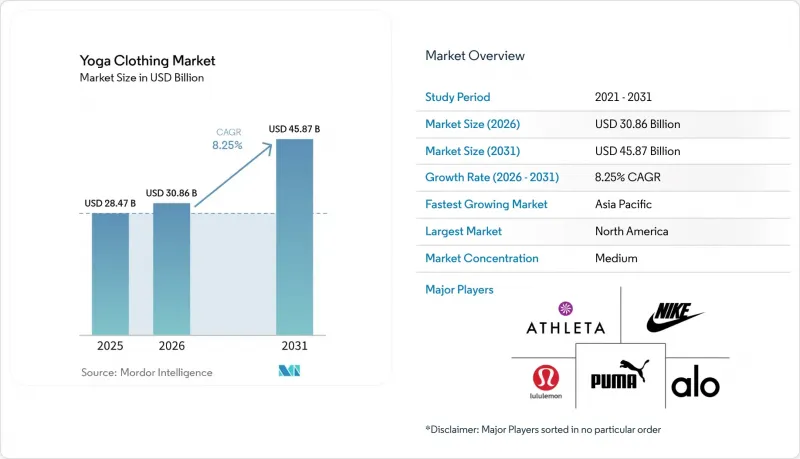
This report is Segmented by Product Type (Tops, Bottoms, One-Piece and Sets, Accessories), End User (Male, Female), Category (Mass, Premium), Distribution Channel (Offline Retail Stores, Online Retail Stores), and Geography (North America, Europe, Asia-Pacific, South America, Middle East and Africa). The Market Forecasts are Provided in Terms of Value (USD).
Global Yoga Clothing Market Trends and Insights
Rising adoption of yoga as holistic wellness practice
The increasing recognition of yoga as a holistic approach to physical fitness, mental well-being, and stress management is a significant driver of the global yoga clothing market. As consumers place greater emphasis on preventive healthcare and mindfulness-based routines, yoga has transitioned from a niche activity to a mainstream wellness practice. This shift has created a steady demand for specialized apparel designed to provide flexibility, comfort, and breathability. The trend is further supported by the rapid growth of yoga infrastructure. For example, according to the National Sporting Goods Association, nearly 7,500 new Pilates and yoga studios were registered in the United States in 2025, reflecting a notable rise in participation levels. Additionally, government-led initiatives are accelerating adoption, particularly in emerging markets. In India, the government has promoted yoga and related practices through programs under Ayushman Bharat. The inclusion of AYUSH Health and Wellness Centres under the National AYUSH Mission involved a total expenditure of INR 3,399.35 crore between FY2019-20 and FY2023-24. These policy-level efforts not only enhance awareness and accessibility of yoga but also sustain participation rates, driving consistent demand for yoga-specific clothing globally.
Expansion of athleisure trend
The global yoga clothing market is experiencing significant growth due to the rapid expansion of the athleisure trend, which has integrated activewear into everyday fashion. Consumers increasingly favor apparel that combines functionality, comfort, and style, enabling yoga clothing to transition from fitness settings to casual, travel, and even semi-formal environments. This trend has driven brands to create versatile products that offer both aesthetic appeal and performance features such as stretchability, breathability, and durability. Additionally, the influence of social media, celebrity endorsements, and evolving workplace dress codes prioritizing comfort has further established athleisure as a mainstream lifestyle choice. Consequently, yoga apparel has expanded beyond its traditional user base, appealing to a wider audience seeking stylish yet comfortable clothing, thereby driving substantial market growth.
Product substitution by general activewear
The global yoga clothing market is constrained by the increasing substitution of yoga-specific apparel with general activewear, which provides similar functionality at often lower price points. Many consumers, particularly those who practice yoga casually or occasionally, prefer multipurpose activewear such as leggings, t-shirts, and sports bras. These items can be used across various fitness activities, reducing the demand for specialized yoga apparel. The widespread availability of affordable and stylish activewear from mass-market brands has further accelerated this trend. These products often feature comparable attributes, such as stretchability, moisture management, and comfort. Moreover, the versatility of general activewear for activities like gym workouts, running, and everyday wear makes it a practical option for budget-conscious consumers. This overlap in functionality and use cases diminishes the unique value proposition of dedicated yoga clothing, thereby limiting its potential for market growth.
Other drivers and restraints analyzed in the detailed report include:
- Growing preference for functional and performance-oriented fabrics
- Innovation in sustainable and eco-friendly materials
- Counterfeit products and brand imitation
For complete list of drivers and restraints, kindly check the Table Of Contents.
Segment Analysis
Bottoms accounted for 47.03% of the market share in 2025, driven by their functionality, comfort, and versatility in both fitness and everyday use. Consumers prioritize features such as high stretchability, squat-proof fabrics, compression support, and moisture-wicking properties, which enhance performance during yoga and other physical activities. High-waisted designs, offering core support and body contouring, have gained significant popularity, particularly among female consumers seeking both comfort and aesthetic appeal. Furthermore, the use of advanced materials that ensure durability, breathability, and shape retention has bolstered product demand. The growing adoption of athleisure has positioned yoga bottoms as suitable for everyday wear, leading to increased repeat purchases and expanding their usage beyond workouts, thereby driving segment growth.
Tops are projected to grow at the fastest rate, with a CAGR of 8.95% through 2031, driven by increasing demand for comfort, breathability, and style in low- to medium-intensity workouts. Consumers are prioritizing lightweight and flexible fabrics that provide unrestricted movement while ensuring adequate support and ventilation. The emphasis on body positivity and personalized style has increased the demand for diverse fits, designs, and layering options, making yoga tops versatile for both exercise and casual wear. Furthermore, advancements in fabric technologies, including anti-odor properties, quick-drying materials, and seamless construction, enhance user experience and product differentiation. Fashion trends, social media, and fitness influencers also contribute to the growing demand, as consumers seek visually appealing and functional tops that meet both performance requirements and lifestyle preferences.
Female consumers accounted for 59.30% of the market share in 2025, driven by higher participation in yoga and wellness activities, along with a strong focus on health, fitness, and self-care routines. Women increasingly prefer apparel that combines performance and style, resulting in high demand for products offering flexibility, moisture management, and body-contouring fits. The growing popularity of athleisure has further extended the use of yoga clothing beyond workouts, making it an integral part of everyday wardrobes. Additionally, frequent product innovations, such as high-waisted leggings, seamless designs, and supportive sports bras, cater to female preferences for comfort and aesthetics. Social media trends, celebrity endorsements, and fitness influencers significantly influence purchasing behavior, while the increasing availability of products on e-commerce platforms enhances accessibility and variety, collectively driving growth in this segment.
The male yoga apparel market is projected to grow at a CAGR of 8.84% through 2031, driven by the increasing adoption of yoga among men for fitness, flexibility training, and stress management. Growing awareness of yoga's physical and mental health benefits has led to higher investments in specialized apparel designed for performance and comfort. Products emphasizing breathability, durability, and freedom of movement, such as stretchable shorts, compression wear, and lightweight tops, are witnessing strong demand. Additionally, the trend toward functional fitness and cross-training has encouraged men to choose versatile yoga clothing suitable for various activities. The rising visibility of male fitness influencers and targeted marketing efforts by brands are also helping to challenge traditional stereotypes, thereby broadening the consumer base and supporting consistent growth in the male yoga apparel segment.
Geography Analysis
In 2025, North America accounted for 32.23% of the market share, driven by a well-established fitness culture and high awareness of holistic wellness practices that emphasize both physical and mental health. The region benefits from a large base of regular yoga practitioners, supported by the widespread availability of studios, fitness centers, and wellness programs, which sustain consistent demand for specialized apparel. The strong presence of prominent activewear brands, including Lululemon Athletica and Nike, fosters innovation in fabric technology, design, and premium product offerings. Furthermore, the popularity of the athleisure trend has positioned yoga clothing as everyday wear, extending its use beyond workouts. High digital penetration, influencer-driven marketing strategies, and a robust e-commerce ecosystem enhance product visibility and accessibility, further driving market growth in the region.
Asia-Pacific is the fastest-growing region, with a CAGR of 9.61% projected through 2031. This growth is driven by increasing health consciousness, rising disposable incomes, and the adoption of fitness-oriented lifestyles among urban populations. The cultural significance of yoga in countries like India, coupled with government initiatives promoting traditional wellness practices, is fostering greater participation. Additionally, countries such as China and Japan are experiencing strong demand due to urbanization and the influence of Western fitness trends. The availability of affordable domestic brands alongside international players has improved access to yoga clothing across various income groups. Moreover, the rapid expansion of online retail platforms and mobile commerce, supported by social media engagement, is significantly contributing to sales growth and consumer awareness in the region.
In Europe, the demand for yoga clothing is driven by growing participation in yoga and fitness activities, coupled with a preference for sustainable and ethically produced apparel. In South America, increasing urbanization and the growth of middle-class populations are promoting active lifestyles, leading to higher demand for versatile and affordable yoga clothing. In the Middle East and Africa, market growth is supported by rising fitness awareness, the expansion of organized retail, and the growing popularity of boutique fitness studios, particularly in urban areas. Across these regions, global fashion trends, the entry of international brands, and improved access through e-commerce platforms are collectively fostering steady market growth.
- Lululemon Athletica Inc.
- Color Image Apparel Inc. (Alo Yoga)
- Athleta (Gap Inc.)
- Nike Inc.
- Adidas AG
- Under Armour Inc.
- Puma SE
- Columbia Sportswear (prAna)
- Wolverine Worldwide (Sweaty Betty)
- Manduka LLC
- Girlfriend Collective
- Onzie
- Beyond Yoga(Levi Strauss & Co.)
- Vuori Inc.
- Outdoor Voices
- Reebok
- SGL Sport
- Decathlon (Domyos)
- Spiritual Gangster
- Modaknits Apparel
Additional Benefits:
- The market estimate (ME) sheet in Excel format
- 3 months of analyst support
TABLE OF CONTENTS
1 INTRODUCTION
- 1.1 Study Assumptions and Market Definition
- 1.2 Scope of the Study
2 RESEARCH METHODOLOGY
3 EXECUTIVE SUMMARY
4 MARKET LANDSCAPE
- 4.1 Market Overview
- 4.2 Market Drivers
- 4.2.1 Rising adoption of yoga as holistic wellness practice
- 4.2.2 Expansion of athleisure trend
- 4.2.3 Growing preference for functional and performance-oriented fabrics
- 4.2.4 Innovation in sustainable and eco-friendly materials
- 4.2.5 Influence of social media and fitness influencers
- 4.2.6 Increasing popularity of home-based fitness and digital yoga platforms
- 4.3 Market Restraints
- 4.3.1 Product substitution by general activewear
- 4.3.2 Counterfeit products and brand imitation
- 4.3.3 Fit and sizing challenges across diverse body types
- 4.3.4 Limited product differentiation across brands
- 4.4 Consumer Behavior Analysis
- 4.5 Regulatory Outlook
- 4.6 Technological Outlook
- 4.7 Porter's Five Forces Analysis
- 4.7.1 Bargaining Power of Suppliers
- 4.7.2 Bargaining Power of Buyers
- 4.7.3 Threat of New Entrants
- 4.7.4 Threat of Substitutes
- 4.7.5 Degree of Competition
5 MARKET SIZE AND GROWTH FORECASTS (VALUE)
- 5.1 By Product Type
- 5.1.1 Tops
- 5.1.2 Bottoms
- 5.1.3 One-piece and Sets
- 5.1.4 Accessories
- 5.2 By End User
- 5.2.1 Male
- 5.2.2 Female
- 5.3 By Category
- 5.3.1 Mass
- 5.3.2 Premium
- 5.4 By Distribution Channel
- 5.4.1 Offline Retail Stores
- 5.4.2 Online Retail Stores
- 5.5 By Geography
- 5.5.1 North America
- 5.5.1.1 United States
- 5.5.1.2 Canada
- 5.5.1.3 Mexico
- 5.5.1.4 Rest of North America
- 5.5.2 Europe
- 5.5.2.1 United Kingdom
- 5.5.2.2 Germany
- 5.5.2.3 France
- 5.5.2.4 Italy
- 5.5.2.5 Spain
- 5.5.2.6 Russia
- 5.5.2.7 Netherlands
- 5.5.2.8 Rest of Europe
- 5.5.3 Asia-Pacific
- 5.5.3.1 China
- 5.5.3.2 Japan
- 5.5.3.3 India
- 5.5.3.4 Australia
- 5.5.3.5 South Korea
- 5.5.3.6 Indonesia
- 5.5.3.7 Rest of Asia-Pacific
- 5.5.4 South America
- 5.5.4.1 Brazil
- 5.5.4.2 Argentina
- 5.5.4.3 Colombia
- 5.5.4.4 Rest of South America
- 5.5.5 Middle East and Africa
- 5.5.5.1 Saudi Arabia
- 5.5.5.2 South Africa
- 5.5.5.3 United Arab Emirates
- 5.5.5.4 Rest of Middle East and Africa
- 5.5.1 North America
6 COMPETITIVE LANDSCAPE
- 6.1 Market Concentration
- 6.2 Strategic Moves
- 6.3 Market Share Analysis
- 6.4 Company Profiles (Includes Global-level Overview, Market-level Overview, Core Segments, Financials, Strategic Info, Market Share, Products, Recent Developments)
- 6.4.1 Lululemon Athletica Inc.
- 6.4.2 Color Image Apparel Inc. (Alo Yoga)
- 6.4.3 Athleta (Gap Inc.)
- 6.4.4 Nike Inc.
- 6.4.5 Adidas AG
- 6.4.6 Under Armour Inc.
- 6.4.7 Puma SE
- 6.4.8 Columbia Sportswear (prAna)
- 6.4.9 Wolverine Worldwide (Sweaty Betty)
- 6.4.10 Manduka LLC
- 6.4.11 Girlfriend Collective
- 6.4.12 Onzie
- 6.4.13 Beyond Yoga(Levi Strauss & Co.)
- 6.4.14 Vuori Inc.
- 6.4.15 Outdoor Voices
- 6.4.16 Reebok
- 6.4.17 SGL Sport
- 6.4.18 Decathlon (Domyos)
- 6.4.19 Spiritual Gangster
- 6.4.20 Modaknits Apparel
7 MARKET OPPORTUNITIES AND FUTURE OUTLOOK

