PUBLISHER: Mordor Intelligence | PRODUCT CODE: 2061876

PUBLISHER: Mordor Intelligence | PRODUCT CODE: 2061876
Beauty Tools - Market Share Analysis, Industry Trends & Statistics, Growth Forecasts (2026 - 2031)
According to Mordor Intelligence, the beauty tools market size is projected to be USD 19.43 billion in 2025, USD 20.84 billion in 2026, and reach USD 29.57 billion by 2031, growing at a CAGR of 7.25% from 2026 to 2031.
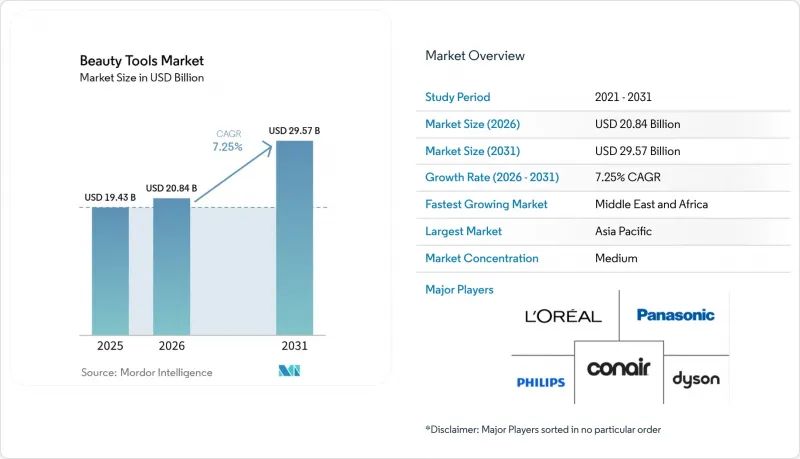
This report is Segmented by Product Type (Hair Tools, Facial Tools, Nail Tools, Makeup Tools), Price Tier (Mass, Premium/Luxury), Mode of Operation (Electric/Battery Operated, Manually Operated), Distribution Channel (Offline Retail Stores, Online Retail Stores), and Geography (North America, Europe, Asia-Pacific, South America, Middle East and Africa). The Market Forecasts are Provided in Terms of Value (USD).
Global Beauty Tools Market Trends and Insights
Technological innovations are driving advancements in beauty tools
In December 2025, Dyson filed a patent for a hair-styling device featuring advanced airflow control and sensor feedback, aiming to enhance styling precision and user experience. Similarly, in June 2025, Philips introduced the BLDC 8000, a brushless DC hair dryer in India, designed to deliver improved durability, energy efficiency, and quieter operation. LED face masks now use 280 to 352 light-emitting diodes across multiple wavelengths, with red light promoting collagen production for anti-aging benefits and blue light targeting acne treatment. Devices like the Dreame Chrona, priced at USD 219.99, and the Keskine, priced at GBP 280 (approximately USD 350), offer clinical-grade phototherapy solutions for home use, making professional skincare more accessible. Microcurrent technology, previously available only in dermatology clinics, is now integrated into portable devices for personal use. For example, Nu Skin's RenuSpa iO, which received FDA clearance in February 2024, is priced at USD 375 and offers advanced skin rejuvenation.
At-home professional treatments are gaining popularity
The beauty tools market is experiencing a shift as consumers increasingly prefer professional-quality treatments at home. This change stems from wellness trends and the desire for convenience. The market shows growing demand for subtle beauty procedures and tools that provide salon-quality results discreetly. For example, 10Beauty's autonomous manicure machine "The 10" received USD 38 million in funding, with its initial 1,000 units purchased by retailers like Nordstrom and Ulta Beauty. The wellness segment influences beauty tool development, as consumers seek products offering both health benefits and aesthetic improvements. Generation Z consumers specifically favor products enhancing natural beauty with multiple benefits, which has influenced product development strategies in the industry.
Counterfeit and poor-quality products remain a concern
The rise in counterfeit beauty tools presents significant challenges to market growth and consumer safety, as counterfeiters use e-commerce platforms to distribute products globally. In 2024, U.S. Customs and Border Protection intercepted 501K counterfeit products valued at USD 8 million. The FDA's Modernization of Cosmetic Regulation Act (MoCRA) now requires cosmetic product registration, strengthening the fight against fraudulent products and addressing tariff loopholes that previously facilitated counterfeit imports. E-commerce platforms are under increasing pressure to implement verification systems, as evidenced by COSRX's warnings about counterfeit versions of their products on Amazon and TikTok Shop. The impact of counterfeiting extends beyond direct revenue losses, as demonstrated by the European Union cosmetics market, which lost approximately 32,000 jobs due to this issue.
Other drivers and restraints analyzed in the detailed report include:
- Growing prevalence of skin and hair concerns
- Social media trends and beauty tutorials strongly influence consumer choices
- Regulatory hurdles and compliance issues persist
For complete list of drivers and restraints, kindly check the Table Of Contents.
Segment Analysis
Facial Tools are projected to grow at a CAGR of 7.54% through 2031, driven by advanced at-home skincare devices. FDA-cleared microcurrent devices, LED masks with 280 to 352 diodes, and derma rollers priced between USD 12 and USD 199 are making clinical-grade skincare accessible. Nu Skin's RenuSpa iO, FDA-cleared in February 2024 and priced at USD 375, focuses on body contouring, while its ageLOC LumiSpa iO offers app-based skin analysis. LED masks from Project E Beauty (EUR 639, ~USD 750) and CURAFACE PRO (EUR 89, ~USD 105) cater to premium and mass markets, democratizing phototherapy previously limited to clinics. Cleansing brushes and steamers support daily skincare, while derma rollers and microneedling devices target anti-aging and serum absorption. Influencer endorsements, like CheekyGlo's TikTok success, are accelerating product adoption.
Hair Tools led the market in 2025, contributing 67.10% of revenue, with Chinese manufacturers shipping 500-650 million units globally. Dyson's Supersonic Travel, launched in 2026, targets frequent travelers with a compact design. Philips introduced the BLDC 8000 dryer in India in June 2025, focusing on energy efficiency and durability. Panasonic's ELMISTA Beautifying Hair Dryer, launched in Japan in 2025, features nanoe moisture technology. SharkNinja's FlexFusion and FlexFusion Straight, launched in October 2024 at USD 349.99 and USD 399.99, combine drying and styling to save space. Hair brushes and combs, though commoditized, are improving with ergonomic designs and sustainable materials. Nail Tools and Makeup Tools, though smaller segments, are innovating. iPolish's app-controlled press-on nails, introduced at CES 2026, use nanopolymers for instant color changes and ship in June 2026. Olive & June's press-on nails cost USD 45, while Yiwu Yusheng's EclipseFlex Pro offers 21-day wear, is 94% plant-based, and biodegrades in 45 days.
From 2024 to 2031, premium and luxury tools are expected to grow at a CAGR of 8.03%, driven by affluent consumers valuing performance, design, and brand heritage. The top 10% of U.S. earners contribute 49.7% of consumer spending, fueling demand for products like Dyson hair dryers (USD 350-500), GHD straighteners (USD 200-300), and multi-wavelength LED masks (USD 400-750). Coty's USD 510 million acquisition of GHD highlights confidence in the premium beauty tools market. Brands like Dyson and L'Oreal are strengthening their positions with patents, such as Dyson's hair-styling apparatus (filed for December 2025) and L'Oreal's aerosol dye attachment, which justify premium pricing. Experiential retail, including personalized consultations and try-before-you-buy options, supports premium positioning, though online channels are challenging this advantage.
In 2025, mass-tier products held 69.32% of revenue, reflecting consumer interest in affordable alternatives. About 77% of consumers have purchased or are willing to buy dupes, and 68% believe dupes match premium quality. The mass beauty segment grew 5% in 2025, reaching USD 72.7 billion, outpacing the 2% growth of prestige products. Chinese brands like Xiaomi, Laifen, CONFU, and Flyco offer hair dryers with advanced features at USD 50-100, delivering 70-80% of premium performance at 30-40% of the price. Private-label and white-label tools sold on Amazon and Walmart gain traction by leveraging platform traffic and reviews. Mass tools benefit from shorter replacement cycles, as consumers replace lower-priced devices more often, maintaining unit sales despite declining average prices. The market is polarizing, with mid-tier brands losing share to both premium and mass segments, forcing repositioning or exits.
Geography Analysis
North America is projected to grow at an 8.15% CAGR through 2031, exceeding the global average of 7.25%. Growth is driven by creator-led commerce, premium product demand among high-income groups, and increased adoption of at-home treatments. TikTok Shop's 94% GMV growth and 87% creator-driven revenue are transforming distribution, enabling brands to bypass retail and cut customer acquisition costs by 45% to 60%. The top 10% of U.S. earners account for 49.7% of spending, supporting demand for premium tools like Dyson's Supersonic (USD 350-500) and Nu Skin's FDA-cleared RenuSpa iO (USD 375). In the first half of 2025, mass beauty revenue grew 4% to USD 34.6 billion, while prestige beauty rose 2% to USD 16.0 billion, highlighting a clear value divide. FDA 510(k) clearance for therapeutic devices raises compliance costs but protects established players by creating entry barriers.
Asia-Pacific contributed 35.65% of 2025 revenue, driven by China's manufacturing strength and domestic consumption. Chinese manufacturers exported 500-650 million home hair-styling appliances in 2025, priced at USD 7-12, undercutting Western brands by 60%-70%. Brands like Xiaomi, Laifen, CONFU, and Flyco leverage efficient production and e-commerce platforms like Tmall, JD.com, and Douyin to reach consumers. In June 2025, Philips launched the BLDC 8000 hair dryer in India, targeting the growing middle class and rising beauty awareness. Japan's aging population boosts demand for anti-aging tools, with Panasonic's ELMISTA Beautifying Hair Dryer featuring nanoe moisture technology tailored to local needs. South Korea's skincare-focused beauty culture drives demand for cleansing brushes, LED masks, and derma rollers. However, counterfeit products remain a challenge, with 90% of US CBP cosmetic seizures originating from China and Hong Kong.
Europe faces high compliance costs under the Medical Device Regulation Annex XVI, which classifies certain beauty devices as medical and requires clinical evidence, technical documentation, and post-market surveillance. Compliance costs can exceed USD 100,000 per SKU, deterring smaller brands and delaying launches. Counterfeiting costs the region EUR 3 billion in lost sales, squeezing margins for genuine brands. Despite these challenges, demand for premium tools remains strong, as seen in Coty's USD 510 million acquisition of GHD, reflecting confidence in the market. South America and the Middle East & Africa, though smaller markets, are seeing early adoption of affordable electric tools and press-on nail systems, bypassing salons. Tariffs and currency issues limit purchasing power, but rising smartphone use is driving e-commerce growth.
- Dyson Ltd.
- Conair Corp.
- Koninklijke Philips N.V.
- Panasonic Corp.
- L'Oreal S.A
- Spectrum Brands Holdings Inc.
- Wahl Clipper Corp.
- Helen of Troy Ltd.
- GHD (Good Hair Day)
- SharkNinja Inc. (Shark Beauty)
- T3 Micro Inc.
- Nu Skin Enterprises Inc.
- Forimi Co. Ltd
- Tescom Co. Ltd.
- Pennelli Faro
- Elchim S.p.A
- Cang Zhou Green Cosmetic Brush Co.,Ltd.
- Xiaomi Inc. (MIJIA)
- CONFU Tech
- Morphe Brushes.
Additional Benefits:
- The market estimate (ME) sheet in Excel format
- 3 months of analyst support
TABLE OF CONTENTS
1 INTRODUCTION
- 1.1 Study Assumptions and Market Definition
- 1.2 Scope of the Study
2 RESEARCH METHODOLOGY
3 EXECUTIVE SUMMARY
4 MARKET LANDSCAPE
- 4.1 Market Overview
- 4.2 Market Drivers
- 4.2.1 Rising consumer beauty consciousness
- 4.2.2 Technological innovations are driving advancements in beauty tools
- 4.2.3 At-home professional treatments are gaining popularity
- 4.2.4 Growing prevalence of skin and hair concerns
- 4.2.5 Social media trends and beauty tutorials strongly influence consumer choices
- 4.2.6 Online platforms provide easy access, reviews, and variety, accelerating tool sales
- 4.3 Market Restraints
- 4.3.1 Counterfeit and poor-quality products remain a concern
- 4.3.2 Advanced beauty tools are often expensive
- 4.3.3 Regulatory hurdles and compliance issues persist
- 4.3.4 Brands face challenges with loyalty and profit margins
- 4.4 Consumer Behaviour Analysis
- 4.5 Regulatory Landscape
- 4.6 Technological Outlook
- 4.7 Porter's Five Forces
- 4.7.1 Bargaining Power of Buyers
- 4.7.2 Bargaining Power of Suppliers
- 4.7.3 Threat of New Entrants
- 4.7.4 Threat of Substitutes
- 4.7.5 Competitive Rivalry
5 MARKET SIZE AND GROWTH FORECASTS (VALUE)
- 5.1 By Product Type
- 5.1.1 Hair Tools
- 5.1.1.1 Hair Dryers
- 5.1.1.2 Hair Straighteners
- 5.1.1.3 Curling Irons
- 5.1.1.4 Hair Brushes and Combs
- 5.1.1.5 Others
- 5.1.2 Facial Tools
- 5.1.2.1 Cleansing Brushes
- 5.1.2.2 Face Massagers
- 5.1.2.3 Derma Rollers
- 5.1.2.4 Facial Steamers
- 5.1.2.5 Others
- 5.1.3 Nail Tools
- 5.1.3.1 Nail Clippers
- 5.1.3.2 Nail Files and Buffers
- 5.1.3.3 Others
- 5.1.4 Makeup Tools
- 5.1.4.1 Makeup Brushes
- 5.1.4.2 Sponges and Blenders
- 5.1.4.3 Others
- 5.1.1 Hair Tools
- 5.2 By Price Tier
- 5.2.1 Mass
- 5.2.2 Premium/Luxury
- 5.3 By Mode of Operation
- 5.3.1 Electric/Battery Operated
- 5.3.2 Manually Operated
- 5.4 By Distribution Channel
- 5.4.1 Offline Retail Stores
- 5.4.2 Online Retail Stores
- 5.5 By Geography
- 5.5.1 North America
- 5.5.1.1 United States
- 5.5.1.2 Canada
- 5.5.1.3 Mexico
- 5.5.1.4 Rest of North America
- 5.5.2 Europe
- 5.5.2.1 Germany
- 5.5.2.2 United Kingdom
- 5.5.2.3 Italy
- 5.5.2.4 France
- 5.5.2.5 Spain
- 5.5.2.6 Netherlands
- 5.5.2.7 Poland
- 5.5.2.8 Belgium
- 5.5.2.9 Sweden
- 5.5.2.10 Rest of Europe
- 5.5.3 Asia-Pacific
- 5.5.3.1 China
- 5.5.3.2 India
- 5.5.3.3 Japan
- 5.5.3.4 Australia
- 5.5.3.5 Indonesia
- 5.5.3.6 South Korea
- 5.5.3.7 Thailand
- 5.5.3.8 Singapore
- 5.5.3.9 Rest of Asia-Pacific
- 5.5.4 South America
- 5.5.4.1 Brazil
- 5.5.4.2 Argentina
- 5.5.4.3 Colombia
- 5.5.4.4 Chile
- 5.5.4.5 Peru
- 5.5.4.6 Rest of South America
- 5.5.5 Middle East and Africa
- 5.5.5.1 South Africa
- 5.5.5.2 Saudi Arabia
- 5.5.5.3 United Arab Emirates
- 5.5.5.4 Nigeria
- 5.5.5.5 Egypt
- 5.5.5.6 Morocco
- 5.5.5.7 Turkey
- 5.5.5.8 Rest of Middle East and Africa
- 5.5.1 North America
6 COMPETITIVE LANDSCAPE
- 6.1 Market Concentration
- 6.2 Strategic Moves
- 6.3 Market Share Analysis
- 6.4 Company Profiles (includes Global level Overview, Market level overview, Core Segments, Financials (if available), Strategic Information, Products, Recent Developments)
- 6.4.1 Dyson Ltd.
- 6.4.2 Conair Corp.
- 6.4.3 Koninklijke Philips N.V.
- 6.4.4 Panasonic Corp.
- 6.4.5 L'Oreal S.A
- 6.4.6 Spectrum Brands Holdings Inc.
- 6.4.7 Wahl Clipper Corp.
- 6.4.8 Helen of Troy Ltd.
- 6.4.9 GHD (Good Hair Day)
- 6.4.10 SharkNinja Inc. (Shark Beauty)
- 6.4.11 T3 Micro Inc.
- 6.4.12 Nu Skin Enterprises Inc.
- 6.4.13 Forimi Co. Ltd
- 6.4.14 Tescom Co. Ltd.
- 6.4.15 Pennelli Faro
- 6.4.16 Elchim S.p.A
- 6.4.17 Cang Zhou Green Cosmetic Brush Co.,Ltd.
- 6.4.18 Xiaomi Inc. (MIJIA)
- 6.4.19 CONFU Tech
- 6.4.20 Morphe Brushes.
7 MARKET OPPORTUNITIES AND FUTURE OUTLOOK

