PUBLISHER: Mordor Intelligence | PRODUCT CODE: 2061885

PUBLISHER: Mordor Intelligence | PRODUCT CODE: 2061885
Beard Care Products - Market Share Analysis, Industry Trends & Statistics, Growth Forecasts (2026 - 2031)
According to Mordor Intelligence, the beard care products market size is expected to grow from USD 1.23 billion in 2025 to USD 1.33 billion in 2026 and is forecast to reach USD 1.94 billion by 2031 at 7.89% CAGR over 2026-2031.
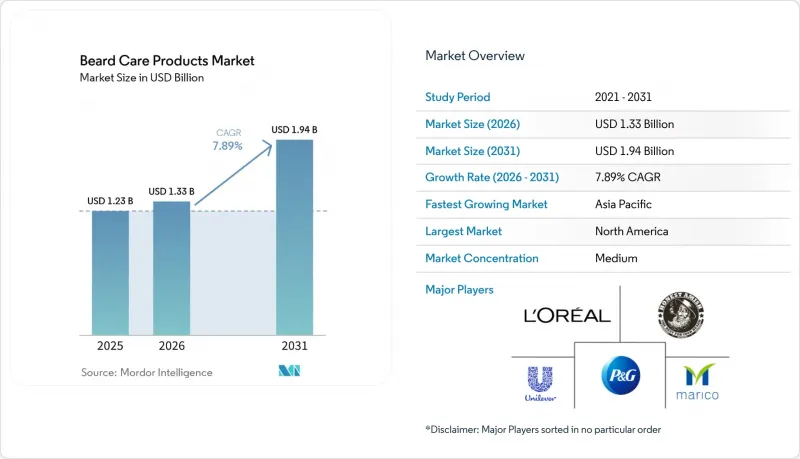
This report is Segmented by Product Type (Beard Oil, Beard Shampoo and Conditioner, Others), Formulation (Natural and Organic, Conventional), Category (Mass, Premium), Distribution Channel (Supermarkets and Hypermarkets, Health and Beauty Stores, Online Retail Stores, Other Distribution Channels), and Geography (North America, Europe, and More). The Market Forecasts are Provided in Terms of Value (USD).
Global Beard Care Products Market Trends and Insights
Millennial men increasingly embrace premium grooming routines
Millennial consumers are reshaping the landscape of beard care, opting for premium grooming products once deemed luxuries by older generations. This shift isn't just about adopting new products; for millennials, grooming has evolved into a wellness practice, seamlessly blending into their broader self-care routines. Social media amplifies this trend, with grooming tutorials and product reviews crafting aspirational content that influences purchasing choices. Platforms like Instagram, YouTube, and TikTok play a significant role in showcasing grooming techniques and product effectiveness, creating a sense of community and engagement among users. By positioning themselves as premium brands, brands not only enjoy higher profit margins but also cultivate customer loyalty, underscoring perceived quality and status. Additionally, the rise of subscription-based models and personalized product offerings further strengthens brand-consumer relationships. However, the longevity of this trend hinges on sustained income growth for millennials and their commitment to grooming habits formed in their younger years.
E-commerce and D2C subscription boxes for beard products are booming
Subscription models are driving the rapid growth of the beard care market, ensuring brands enjoy recurring revenue streams and an enhanced customer lifetime value. These subscription boxes not only help consumers navigate an overwhelming array of product choices but also offer brands a steady revenue stream and insights for personalized marketing. By analyzing customer preferences and purchasing patterns, brands can tailor their offerings to meet specific needs, fostering stronger customer relationships. This approach is especially appealing to younger consumers, who prioritize convenience and are open to regular payments for essentials. Additionally, subscription models provide an opportunity for brands to introduce new products and gather feedback, creating a continuous cycle of innovation and improvement. By adopting direct-to-consumer strategies, brands can sidestep traditional retail margins, channeling those savings into acquiring and retaining customers. Yet, the long-term success of these subscription models hinges on consistently delivering quality and variety to keep customers engaged, all while managing logistics costs that threaten profitability.
Counterfeit and poor-quality products are damaging brand trust
Counterfeit beard care products are undermining consumer trust and creating an uneven playing field for legitimate brands that prioritize quality and safety. These counterfeit items, often laced with harmful ingredients or failing to meet their promises, tarnish the reputation of the entire category. The issue is particularly pronounced in emerging markets, where lax regulatory enforcement and a price-sensitive consumer base lean towards cheaper, often counterfeit, options. In a bid to combat this, the Cosmetic Products Notification Portal (CPNP) has linked up with EU customs IT systems, enabling real-time digital product tracking. This integration allows authorities to quickly verify the authenticity of beard care products and identify counterfeits at border checkpoints. With features like mandatory ingredient disclosures, electronic listings, and inter-agency data sharing, the process of product verification and regulatory oversight has become more efficient. However, safeguarding a brand against counterfeits demands significant investment in anti-counterfeiting strategies, legal actions, and consumer awareness initiatives, often at the expense of product innovation and marketing. Ultimately, the effectiveness of these measures hinges on the dedication of regulatory bodies to enforce them and the commitment of platforms to adopt stringent verification processes for beauty product vendors.
Other drivers and restraints analyzed in the detailed report include:
- Preference for Organic Oils, Butters, and Plant-Based Formulas Appeals to Health-Conscious Users
- Innovations are emerging in multifunctional hybrid beard-skin formulations
- Fluctuations in natural oil supply chains, such as argan and jojoba, are reducing profit margins
For complete list of drivers and restraints, kindly check the Table Of Contents.
Segment Analysis
In 2025, beard oil commands a dominant 35.70% share of the beard care market, highlighting its pivotal role in grooming routines. Its multifunctionality, offering moisturization, styling aid, and fragrance, drives its widespread adoption, especially among newcomers to beard care. This versatility consolidates multiple grooming needs into one product, emphasizing simplicity and efficiency. Its popularity is further enhanced by its accessibility and seamless integration into daily routines, particularly for novices wary of intricate regimens. Despite a more segmented market, beard oil's broad appeal and perceived necessity solidify its cornerstone status. Consequently, it not only anchors most grooming routines but also serves as an introductory product, guiding consumers toward more specialized beard care solutions over time.
While beard shampoo and conditioner haven't yet claimed the largest market segment, they're on a rapid ascent with a projected CAGR of 8.94% through 2031. This surge signals a shift toward more discerning and health-focused grooming habits. Consumers are increasingly aware that regular hair shampoo can deplete facial hair of its natural oils, resulting in dryness, irritation, and potential long-term damage. As this awareness amplifies, so does the demand for products tailored to the unique needs of facial hair and its underlying skin. This trend dovetails with the growing adoption of multi-step grooming routines, akin to skincare regimens, underscoring a holistic approach to personal care. The 2024 Beauty Trend Report highlights this shift, noting consumers' heightened awareness of the interplay between skin and hair health. Brands that introduce well-formulated beard shampoos and conditioners, especially when integrated into a comprehensive grooming solution lineup, are poised to capitalize on this burgeoning segment.
In 2025, conventional synthetic formulations command a dominant 55.82% share of the beard care market. Their affordability, consistent performance, and widespread availability make them the go-to choice. These products resonate particularly with consumers in budget-conscious regions, where daily grooming routines prioritize reliability over botanical purity. Synthetic formulations consistently deliver predictable results in cleansing, conditioning, and styling, reinforcing their mainstream appeal. Their longer shelf life and ease of mass production bolster their retail dominance. While they might not boast the marketing allure of natural alternatives, consumers prioritize function and price over ingredient origin. Even with a rising interest in cleaner labels, the performance and accessibility of synthetics ensure their relevance, especially for those seeking practical grooming solutions.
Natural and organic beard care products are on the rise, projected to grow at an 8.96% CAGR from 2026 to 2031. This surge is fueled by heightened consumer awareness regarding ingredient safety and environmental concerns. Shoppers, now more ingredient-conscious, are not just looking for cleaner beard oils but are extending this scrutiny to shampoos, conditioners, and styling products. This shift has led brands to delve into biodegradable surfactants and plant-based preservatives. Moreover, transparent sourcing and eco-friendly narratives strike a chord with this audience. However, brands face challenges with supply chain volatility, necessitating strategies like multi-origin sourcing and investments in regenerative agriculture. Another emerging trend is hybrid formulations, which meld natural emollients with lab-developed actives, striking a balance between efficacy and a clean-label image. As skepticism towards marketing claims grows, third-party certifications and batch-level traceability are becoming vital for brands to uphold credibility and sidestep greenwashing pitfalls.
Geography Analysis
In 2025, North America commanded a significant 35.78% share of the market, driven by its deep-rooted grooming culture and a consumer base eager to splurge on premium offerings. With market penetration nearing saturation, brands are shifting focus to niche innovations, delving into areas such as personalized scent blending and eco-conscious refill formats. Meanwhile, the FDA's rollout of the Modernization of Cosmetics Regulation Act mandates facility registrations, product listings, and adverse event reporting, adding layers of operational complexity. However, these regulations also pave the way for burgeoning brands in the United States and beyond.
Asia-Pacific, charting a robust 9.78% CAGR, stands as the primary engine driving global expansion. Urban millennials in both China and India are increasingly mirroring Western-style icons, and the surge in e-commerce is effectively bridging previous distribution gaps. Given the region's climatic diversity, research and development efforts are becoming localized: lightweight serums are gaining traction in the humid climates of Southeast Asia, while richer balms are preferred for the colder, drier winters of Northern China. Furthermore, cross-border platforms and live-commerce streams are significantly reducing the time from exposure to purchase, benefiting brands adept at the nuances of local social-commerce practices.
Europe's market is characterized by a steady, values-driven demand. The continent's green-deal policies emphasize sustainable ingredients and recyclable packaging. This push is steering formulators towards adopting bio-based solvents and mono-material components. Meanwhile, South America and the Middle East, and Africa, though still in their infancy, present enticing opportunities for pioneering brands. However, success hinges on their ability to navigate diverse facial-hair norms and regional climatic demands. Additionally, infrastructure enhancements and regional trade agreements are poised to influence the speed of market adoption.
- L'Oreal S.A
- Unilever PLC
- Procter & Gamble (Co. - King C. Gillette)
- Marico Ltd (Beardo)
- Honest Amish
- The Beard Struggle
- Ranger Grooming Company
- Zeus Beard LLC
- Dollar Shave Club Inc.
- Ustraa (Happily Unmarried)
- Bombay Shaving Company
- Seven Potions Ltd
- Reuzel USA, Inc.
- Scotch Porter
- Murdock London
- Edgewell Personal Care (Bulldog Skincare)
- Cremo Company
- Viking Revolution
- Bossman Brands Inc
- Jack Black LLC
Additional Benefits:
- The market estimate (ME) sheet in Excel format
- 3 months of analyst support
TABLE OF CONTENTS
1 INTRODUCTION
- 1.1 Study Assumptions and Market Definition
- 1.2 Scope of the Study
2 RESEARCH METHODOLOGY
3 EXECUTIVE SUMMARY
4 MARKET LANDSCAPE
- 4.1 Market Overview
- 4.2 Market Drivers
- 4.2.1 Millennial men increasingly embrace premium grooming routines
- 4.2.2 E-commerce and D2C subscription boxes for beard products are booming
- 4.2.3 Preference for organic oils, butters, and plant-based formulas appeals to health-conscious users
- 4.2.4 Innovations are emerging in multifunctional hybrid beard-skin formulations
- 4.2.5 Micro-brands proliferate on TikTok and Instagram, driven by influencers
- 4.2.6 Barber collaborations and grooming challenges foster brand advocacy
- 4.3 Market Restraints
- 4.3.1 Counterfeit and poor-quality products are damaging brand trust
- 4.3.2 Fluctuations in natural oil supply chains, such as argan and jojoba, are reducing profit margins
- 4.3.3 Regulators are tightening scrutiny on beard-growth claims and masculinity-focused marketing
- 4.3.4 The market is overcrowded with small private-label brands, driving intense price competition
- 4.4 Consumer Behaviour Analysis
- 4.5 Regulatory Landscape
- 4.6 Technological Outlook
- 4.7 Porter's Five Forces
- 4.7.1 Bargaining Power of Suppliers
- 4.7.2 Bargaining Power of Buyers
- 4.7.3 Threat of New Entrants
- 4.7.4 Threat of Substitutes
- 4.7.5 Competitive Rivalry
5 MARKET SIZE AND GROWTH FORECASTS (VALUE)
- 5.1 By Product Type
- 5.1.1 Beard Oil
- 5.1.2 Beard Shampoo and Conditioner
- 5.1.3 Others
- 5.2 By Formulation
- 5.2.1 Natural and Organic
- 5.2.2 Conventional
- 5.3 By Category
- 5.3.1 Mass
- 5.3.2 Premium
- 5.4 By Distribution Channel
- 5.4.1 Supermarkets and Hypermarkets
- 5.4.2 Health and Beauty Stores
- 5.4.3 Online Retail Stores
- 5.4.4 Other Distibution Channels
- 5.5 By Geography
- 5.5.1 North America
- 5.5.1.1 United States
- 5.5.1.2 Canada
- 5.5.1.3 Mexico
- 5.5.1.4 Rest of North America
- 5.5.2 Europe
- 5.5.2.1 Germany
- 5.5.2.2 United Kingdom
- 5.5.2.3 Italy
- 5.5.2.4 France
- 5.5.2.5 Spain
- 5.5.2.6 Netherlands
- 5.5.2.7 Poland
- 5.5.2.8 Belgium
- 5.5.2.9 Sweden
- 5.5.2.10 Rest of Europe
- 5.5.3 Asia-Pacific
- 5.5.3.1 China
- 5.5.3.2 India
- 5.5.3.3 Japan
- 5.5.3.4 Australia
- 5.5.3.5 Indonesia
- 5.5.3.6 South Korea
- 5.5.3.7 Thailand
- 5.5.3.8 Singapore
- 5.5.3.9 Rest of Asia-Pacific
- 5.5.4 South America
- 5.5.4.1 Brazil
- 5.5.4.2 Argentina
- 5.5.4.3 Colombia
- 5.5.4.4 Chile
- 5.5.4.5 Peru
- 5.5.4.6 Rest of South America
- 5.5.5 Middle East and Africa
- 5.5.5.1 South Africa
- 5.5.5.2 Saudi Arabia
- 5.5.5.3 United Arab Emirates
- 5.5.5.4 Nigeria
- 5.5.5.5 Egypt
- 5.5.5.6 Morocco
- 5.5.5.7 Turkey
- 5.5.5.8 Rest of Middle East and Africa
- 5.5.1 North America
6 COMPETITIVE LANDSCAPE
- 6.1 Market Concentration
- 6.2 Strategic Moves
- 6.3 Market Share Analysis
- 6.4 Company Profiles (includes Global level Overview, Market level overview, Core Segments, Financials (if available), Strategic Information, Market Rank/Share, Products, Recent Developments)
- 6.4.1 L'Oreal S.A
- 6.4.2 Unilever PLC
- 6.4.3 Procter & Gamble (Co. - King C. Gillette)
- 6.4.4 Marico Ltd (Beardo)
- 6.4.5 Honest Amish
- 6.4.6 The Beard Struggle
- 6.4.7 Ranger Grooming Company
- 6.4.8 Zeus Beard LLC
- 6.4.9 Dollar Shave Club Inc.
- 6.4.10 Ustraa (Happily Unmarried)
- 6.4.11 Bombay Shaving Company
- 6.4.12 Seven Potions Ltd
- 6.4.13 Reuzel USA, Inc.
- 6.4.14 Scotch Porter
- 6.4.15 Murdock London
- 6.4.16 Edgewell Personal Care (Bulldog Skincare)
- 6.4.17 Cremo Company
- 6.4.18 Viking Revolution
- 6.4.19 Bossman Brands Inc
- 6.4.20 Jack Black LLC
7 MARKET OPPORTUNITIES AND FUTURE OUTLOOK

