PUBLISHER: Mordor Intelligence | PRODUCT CODE: 2061911

PUBLISHER: Mordor Intelligence | PRODUCT CODE: 2061911
Fortified Edible Oils - Market Share Analysis, Industry Trends & Statistics, Growth Forecasts (2026 - 2031)
According to Mordor Intelligence, the fortified edible oil market size was valued at USD 13.42 billion in 2025 and estimated to grow from USD 14.01 billion in 2026 to reach USD 17.44 billion by 2031, at a CAGR of 4.49% during the forecast period (2026-2031).
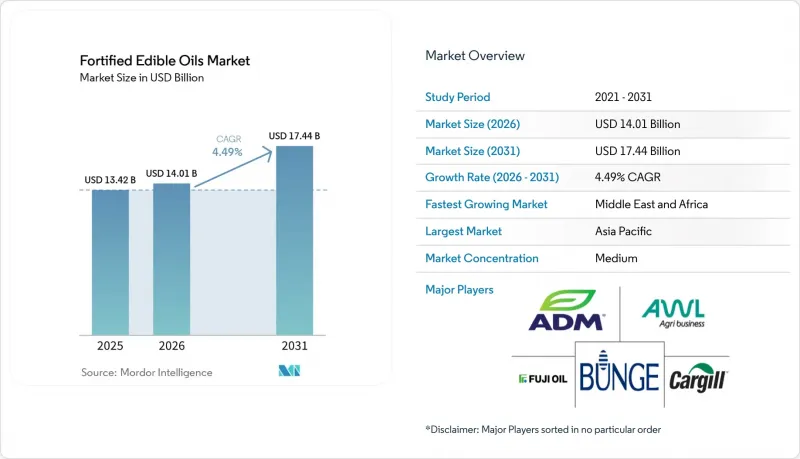
This report is Segmented by Oil Type (Palm Oil, Soybean Oil, Sunflower Oil, and More), Packaging Type (PET/HDPE Bottles, Flexible Pouches, and Others), Distribution Channel (Supermarkets/Hypermarkets, Convenience Stores, and More), and Geography (North America, Europe, Asia-Pacific, South America, Middle East, and Africa). The Market Forecasts are Provided in Terms of Value (USD) and Volume (Liters).
Global Fortified Edible Oils Market Trends and Insights
Increasing health consciousness and demand for nutrient-rich diets
Preventive nutrition is reshaping household purchasing decisions as consumers link micronutrient intake to immunity, cognitive development, and reduced chronic-disease risk. Ethiopia's April 2025 mandatory fortification guidelines for edible oils and flour emerged from evidence that 66% of women of reproductive age in the country are deficient in one or more micronutrients, a statistic that galvanized policymakers to mandate industrial fortification rather than rely on supplementation campaigns with low adherence, according to the Federal Democratic Republic of Ethiopia Ministry of Health. India's Tata Trusts fortification program demonstrated that adding vitamins A and D to edible oil costs approximately USD 0.0018 per kilogram, a negligible increment that processors can absorb without triggering consumer resistance, yet delivers measurable reductions in night blindness and rickets prevalence in intervention districts. This cost-effectiveness is prompting governments to view fortification as a high-return public-health investment, particularly where staple oil consumption is universal, and brand loyalty is low enough that mandates do not distort competition. ADM's January 15, 2026, USD 26 million investment in its Erlanger, Kentucky, facility to expand reformulation capabilities reflects corporate recognition that 80% of US consumers favor product reformulation over supplementation, and 45% specifically seek reduced saturated fats, creating a dual opportunity to fortify while improving lipid profiles.
Stronger adoption of Vitamin A, D, E, and K enrichment
Fat-soluble vitamin fortification is accelerating because edible oils provide an ideal lipid matrix for absorption, bypassing the bioavailability challenges that plague water-soluble fortificants in flour or rice. China's GB/T 21123-2025 national standard for vitamin A fortified edible oils, which replaced the 2007 version and applies to soybean, rapeseed, peanut, and corn oils, mandates opaque packaging in containers up to 100 liters and prescribes high-performance liquid chromatography testing per GB 5009.82, signaling a shift from voluntary guidelines to enforceable quality benchmarks, according to the Standardization Administration of China. A draft regulation issued in September 2025 further proposes vitamin A levels of 4,000 to 8,000 micrograms per kilogram and vitamin D levels of 50 to 100 micrograms per kilogram for vegetable oils, aligning China's fortification intensity with WHO recommendations and potentially unlocking a market where per-capita oil consumption exceeds 20 kilograms annually, according to the China National Center for Food Safety Risk Assessment.
Complex labeling and regulatory variation across markets
Divergent fortification standards and labeling requirements across jurisdictions impose compliance costs that disproportionately burden mid-sized exporters and regional players. Argentina's Joint Resolution 38/2025 modified fortified food requirements to mandate that fat-soluble vitamins provide 20% to 50% of the daily reference value per portion, while water-soluble vitamins must deliver 20% to 100%, a specificity that requires reformulation for products previously compliant under older thresholds. The European Union's Regulation 1925/2006 harmonizes permitted vitamins and their chemical forms across member states, yet individual countries retain discretion over maximum fortification levels: Germany's Federal Institute for Risk Assessment proposed a vitamin D ceiling of 7.5 micrograms per 100 grams for edible oils in 2024, while Sweden and Belgium mandate margarine and fat-spread fortification but leave liquid oils voluntary, creating a patchwork that complicates pan-European distribution. China's September 2025 draft regulation proposing vitamin A levels of 4,000 to 8,000 micrograms per kilogram and vitamin D levels of 50 to 100 micrograms per kilogram for vegetable oils introduces a new compliance hurdle for multinational processors that must reconcile Chinese thresholds with WHO recommendations and domestic standards in their home markets, according to the China National Center for Food Safety Risk Assessment.
Other drivers and restraints analyzed in the detailed report include:
- Shift towards plant-based and sustainable oils
- Mandatory fortification regulations and subsidies
- Raw-material price volatility in base oils
For complete list of drivers and restraints, kindly check the Table Of Contents.
Segment Analysis
Palm oil commanded 40.87% market share in 2025, a position rooted in its cultivation scale across Indonesia and Malaysia, its stable lipid matrix for fat-soluble vitamin retention, and its cost advantage over alternatives in South and Southeast Asian markets where per-capita consumption exceeds 15 kilograms annually. Canola and rapeseed oil, popular in Canada and Northern Europe for their favorable omega-3 to omega-6 ratios, are gaining traction as processors reformulate for heart-health claims, with Cargill's April 21, 2026 opening of a 1 million metric tonne canola facility in Regina, Saskatchewan signaling confidence in long-term demand for premium, health-positioned oils. Mustard oil, concentrated in North India and Bangladesh, occupies a niche where cold-pressed formats and pungent flavor profiles command brand loyalty, yet fortification adoption lags due to small-scale, artisanal production that lacks the blending infrastructure for consistent premix incorporation. Adani Wilmar's May 2024 launch of Fortune Pehli Dhaar fortified mustard oil targets this segment, leveraging the company's 121 million household reach in India and its Haryana integrated plant capacity exceeding 627,000 metric tonnes to scale fortification in a traditionally unfortified category.
Sunflower oil is forecast to grow at 6.28% CAGR from 2026 to 2031, driven by consumer preference for lighter taste profiles in Eastern Europe and South America, and by cultivation expansion in Ukraine, Russia, and Argentina, despite Black Sea supply disruptions that pushed prices upward in early 2026. Soybean oil, the second-largest segment, benefits from integrated crushing and refining infrastructure in the United States, Brazil, and Argentina, yet faces headwinds from biofuel mandates that divert feedstock away from food applications, tightening supply and raising input costs for fortification programs. Other oils, coconut, groundnut, sesame, collectively account for the residual share, serving regional cuisines and specialty applications where fortification is either technically challenging due to high saturated fat content or economically unviable due to low volumes. China's GB/T 21123-2025 standard, which applies to soybean, rapeseed, peanut, and corn oils but excludes palm and coconut, reflects regulatory prioritization of oils with broad consumption bases and established refining infrastructure, a pattern likely to repeat as other governments draft fortification mandates, according to the Standardization Administration of China.
Geography Analysis
Asia-Pacific accounted for 54.78% of global fortified edible oil revenue in 2025, supported by large-scale government initiatives and rising health awareness. Key programs include India's FSSAI +F logo scheme, Indonesia's SNI 7709 palm oil fortification mandate, and increasing demand from China's expanding middle class for preventive health products. In India, per capita edible oil consumption of approximately 19 kg annually, combined with a population exceeding 1.4 billion, creates substantial market scale, where even incremental penetration of fortified oils translates into tens of millions of households, supporting investments in dedicated refining capacity and regional distribution infrastructure, according to the USDA FAS. Indonesia's Minyakita program distributed more than 2 million liters of subsidized fortified palm oil per month in 2025, achieving significant reach among lower-income consumers, while the reduction in bulk packaging from 42% to 6.5% between 2020 and 2025 reflects rapid market formalization, as reported by BPOM Indonesia. In China, although per capita consumption of fortified oils remains relatively limited, demand is increasing alongside urbanization and income growth; however, regulatory approval timelines of 12-18 months continue to constrain market entry for new products. In developed markets such as Japan and South Korea, high consumer awareness of micronutrient benefits is balanced by a preference for minimally processed oils, creating niche opportunities for fortified variants positioned around bioavailability and stability. Meanwhile, Thailand's King Rice Oil Group invested 1.5 billion baht (USD 43 million) in November 2024 to expand production capacity, targeting revenue of 10 billion baht (USD 286 million) by 2030, reflecting expectations of growing demand for functional oils such as oryzanol-enriched rice bran oil. Australia and New Zealand remain relatively small markets with voluntary fortification frameworks, although their stringent food safety standards provide an environment for validating premium fortified oil products prior to broader regional expansion.
The Middle East and Africa region is expected to record the fastest growth, with a projected CAGR of 5.75% through 2031, driven by the expansion of mandatory fortification programs and national nutrition strategies. Countries including Saudi Arabia, the UAE, Egypt, and Ethiopia are integrating fortified edible oils into public health initiatives such as school feeding and maternal nutrition programs. Saudi Arabia's February 2026 draft standards for vitamin A and D fortification, if implemented, will require reformulation across the edible oil market, effectively making fortification a baseline requirement rather than a point of differentiation, according to the Saudi Food and Drug Authority. Ethiopia's April 2025 mandatory fortification guidelines, aligned with WHO standards and supported by compliance monitoring through random sampling, signal a broader regional shift toward compulsory frameworks, as noted by the Ethiopian Public Health Institute. Large-population markets such as Nigeria and Egypt present significant volume opportunities; however, fragmented retail structures, informal distribution channels, and foreign exchange limitations pose challenges to pricing and supply chain efficiency. In contrast, South Africa's more developed retail sector, led by major chains such as Shoprite, Pick n Pay, and Woolworths, provides a relatively structured entry point, although competition remains intense and price sensitivity high. The Gulf Cooperation Council countries benefit from high per capita income levels and government-led health initiatives but remain dependent on imports, increasing exposure to global price volatility. Markets such as Morocco and Turkey, influenced by both European and regional regulatory frameworks, present opportunities for companies capable of navigating dual compliance requirements.
North America and Europe together represented a significant share of global fortified edible oil revenue in 2025, characterized by voluntary fortification regimes, strict labeling standards, and clear segmentation between mass-market and premium products. In Canada, regulatory updates in 2025 increased vitamin D fortification levels in margarine to 26 µg per 100 g and introduced mandatory front-of-pack labeling effective January 1, 2026, supporting demand for products positioned on transparency and health benefits, according to Health Canada. In the United States, while awareness of vitamin D deficiency remains high, particularly in northern regions, the market faces strong competition from dietary supplements, which offer higher dosages and targeted delivery formats. Europe operates under Regulation (EC) No 1925/2006, which permits fortification but allows individual member states to impose additional restrictions, resulting in a fragmented regulatory environment. For example, Finland and Sweden mandate fortification in certain categories, whereas Germany, France, and the United Kingdom maintain voluntary approaches. The Netherlands enforces stricter controls through its Commodities Act Decree, limiting vitamin additions and setting intake thresholds, complicating cross-border distribution strategies. In both North America and Europe, premium segments such as cold-pressed and organic oils command price premiums of 20-30%, appealing to consumers who prioritize natural product attributes over fortification, thereby requiring fortified oil producers to emphasize measurable health benefits and nutrient bioavailability. In South America, markets led by Brazil, Argentina, and Chile are gradually shifting toward more structured fortification policies; Argentina's July 2025 regulatory amendment streamlined approval processes for fortified foods without mandating adoption, while Brazil's large population and public nutrition programs create opportunities for fortified oil distribution, albeit within a context of economic volatility and currency fluctuations.
- AWL Agri Business Ltd.
- Cargill Inc. fortification.fssai
- Archer-Daniels-Midland (ADM)
- Bunge Ltd.
- Ruchi Soya Industries Limited
- Mother Dairy Fruit and Vegetable Pvt. Ltd.
- Emami Agrotech Ltd.
- Liberty Oil Mills Ltd.
- Borges Agricultural & Industrial Edible Oils S.A.U.
- Lam Soon Group
- Cargill Inc.
- BASF SE
- AAK AB
- King Rice Oil Group
- Adani Wilmar
- Kriti Nutrients
- Sime Darby Berhad
- Gulab Oils & Foods Pvt Ltd.
- Liberty Oil Mills
- Fuji Oil Holdings Inc
Additional Benefits:
- The market estimate (ME) sheet in Excel format
- 3 months of analyst support
TABLE OF CONTENTS
1 INTRODUCTION
- 1.1 Study Assumptions and Market Definition
- 1.2 Scope of the Study
2 RESEARCH METHODOLOGY
3 EXECUTIVE SUMMARY
4 MARKET DYNAMICS
- 4.1 Market Overview
- 4.2 Market Drivers
- 4.2.1 Increasing health consciousness and demand for nutrient-rich diets
- 4.2.2 Stronger adoption of vitamin A, D, E, and K enrichment
- 4.2.3 Shift towards plant-based and sustainable oils
- 4.2.4 Improved fortification technologies that protect nutrient stability
- 4.2.5 Product reformulation in response to preventive-health and family-nutrition positioning
- 4.2.6 Mandatory fortification regulations and subsidies
- 4.3 Market Restraints
- 4.3.1 Higher shelf price versus conventional unfortified edible oil.
- 4.3.2 Complex labeling and regulatory variation across markets
- 4.3.3 Competition from naturally positioned oils
- 4.3.4 Raw-material price volatility in base oils
- 4.4 Consumer Behavior Analysis
- 4.5 Regulatory Landscape
- 4.6 Technological Outlook
- 4.7 Porter's Five Forces
- 4.7.1 Threat of New Entrants
- 4.7.2 Bargaining Power of Buyers/Consumers
- 4.7.3 Bargaining Power of Suppliers
- 4.7.4 Threat of Substitute Products
- 4.7.5 Intensity of Competitive Rivalry
5 MARKET SIZE AND GROWTH FORECASTS (VALUE AND VOLUME)
- 5.1 By Oil Type
- 5.1.1 Palm Oil
- 5.1.2 Soybean Oil
- 5.1.3 Sunflower Oil
- 5.1.4 Canola/Rapeseed Oil
- 5.1.5 Mustard Oil
- 5.1.6 Others
- 5.2 By Packaging Type
- 5.2.1 PET/HDPE Bottles
- 5.2.2 Flexible Pouches and Sachets
- 5.2.3 Tinplate/Metal Containers
- 5.2.4 Others
- 5.3 By Distribution Channel
- 5.3.1 Supermarkets/Hypermarkets
- 5.3.2 Convenience Stores
- 5.3.3 Online Retail Stores
- 5.3.4 Others
- 5.4 By Geography
- 5.4.1 North America
- 5.4.1.1 United States
- 5.4.1.2 Canada
- 5.4.1.3 Mexico
- 5.4.1.4 Rest of North America
- 5.4.2 Europe
- 5.4.2.1 Germany
- 5.4.2.2 United Kingdom
- 5.4.2.3 Italy
- 5.4.2.4 France
- 5.4.2.5 Spain
- 5.4.2.6 Netherlands
- 5.4.2.7 Poland
- 5.4.2.8 Belgium
- 5.4.2.9 Sweden
- 5.4.2.10 Rest of Europe
- 5.4.3 Asia-Pacific
- 5.4.3.1 China
- 5.4.3.2 India
- 5.4.3.3 Japan
- 5.4.3.4 Australia
- 5.4.3.5 Indonesia
- 5.4.3.6 South Korea
- 5.4.3.7 Thailand
- 5.4.3.8 Singapore
- 5.4.3.9 Rest of Asia-Pacific
- 5.4.4 South America
- 5.4.4.1 Brazil
- 5.4.4.2 Argentina
- 5.4.4.3 Colombia
- 5.4.4.4 Chile
- 5.4.4.5 Peru
- 5.4.4.6 Rest of South America
- 5.4.5 Middle East and Africa
- 5.4.5.1 South Africa
- 5.4.5.2 Saudi Arabia
- 5.4.5.3 United Arab Emirates
- 5.4.5.4 Nigeria
- 5.4.5.5 Egypt
- 5.4.5.6 Morocco
- 5.4.5.7 Turkey
- 5.4.5.8 Rest of Middle East and Africa
- 5.4.1 North America
6 COMPETITIVE LANDSCAPE
- 6.1 Market Concentration
- 6.2 Strategic Moves
- 6.3 Market Ranking Analysis
- 6.4 Company Profiles (includes Global level Overview, Market level overview, Core Segments, Financials, Strategic Information, Market Rank/Share, Products and Services, Recent Developments)
- 6.4.1 AWL Agri Business Ltd.
- 6.4.2 Cargill Inc. fortification.fssai
- 6.4.3 Archer-Daniels-Midland (ADM)
- 6.4.4 Bunge Ltd.
- 6.4.5 Ruchi Soya Industries Limited
- 6.4.6 Mother Dairy Fruit and Vegetable Pvt. Ltd.
- 6.4.7 Emami Agrotech Ltd.
- 6.4.8 Liberty Oil Mills Ltd.
- 6.4.9 Borges Agricultural & Industrial Edible Oils S.A.U.
- 6.4.10 Lam Soon Group
- 6.4.11 Cargill Inc.
- 6.4.12 BASF SE
- 6.4.13 AAK AB
- 6.4.14 King Rice Oil Group
- 6.4.15 Adani Wilmar
- 6.4.16 Kriti Nutrients
- 6.4.17 Sime Darby Berhad
- 6.4.18 Gulab Oils & Foods Pvt Ltd.
- 6.4.19 Liberty Oil Mills
- 6.4.20 Fuji Oil Holdings Inc
7 MARKET OPPORTUNITIES AND FUTURE TRENDS

