PUBLISHER: Mordor Intelligence | PRODUCT CODE: 2061915

PUBLISHER: Mordor Intelligence | PRODUCT CODE: 2061915
Plasma Cutting Machine - Market Share Analysis, Industry Trends & Statistics, Growth Forecasts (2026 - 2031)
According to Mordor Intelligence, the plasma cutting machine market size is projected to be USD 1.81 billion in 2025, USD 1.89 billion in 2026, and reach USD 2.32 billion by 2031, growing at a CAGR of 4.23% from 2026 to 2031.
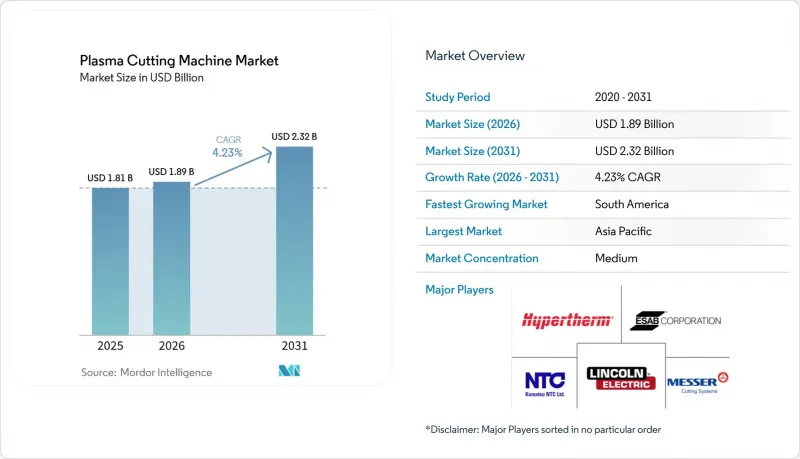
This report is Segmented by Technology Type (Conventional, Advanced HD), by Automation Level (Manual/Handheld, Automated & CNC, Hybrid), by Power Capacity (<=120 Amp, 121-300 Amp, Above 300 Amp), by End-User Industry (Automotive & Transportation, Construction, and More), and by Geography (North America, South America, Europe, and More). The Market Forecasts are Provided in Terms of Value (USD Billion).
Global Plasma Cutting Machine Market Trends and Insights
Rising Adoption of Automation and Industry 4.0 Integration
National programs and public-private partnerships are lowering barriers to digital adoption in fabrication, which accelerates the shift toward CNC and sensor-rich plasma systems in production settings. Manufacturing USA reported engagement with more than 150,700 learners and workers and supported 920 applied R&D projects, reinforcing a pipeline of digital skills and demonstrators that shorten the path from pilot to scale. NIST's Smart Manufacturing Systems Design and Analysis initiative is building reference architecture and assurance methods for cyber-physical systems, which helps integrators improve interoperability across controllers, robots, and cutting platforms. Equipment vendors are aligning with open interfaces and standardized data models to satisfy fabricators' requirements for ERP and MES connectivity; a trend reflected in supplier communications and technology showcases. The NSF's FY2026 request allocates dedicated funding for advanced manufacturing, including AI-enabled digital twins that can assist with real-time process control and quality documentation during cutting operations. Parallel to these initiatives, U.S. manufacturers reported rapid AI adoption in operations in 2025 and expect further integration by 2027, signaling rising demand for CNC plasma systems that embed analytics and closed-loop monitoring.
Increasing Demand for High-Definition (HD) Plasma Technology
Demand for HD plasma is supported by applications that require tight angularity and weld-ready edges on thicker materials, where lasers face constraints in speed, edge quality, or duty cycle. HD platforms maintain productivity advantages on coated and oxidized stock because plasma tolerates surface conditions that would otherwise require time-consuming preparation steps with lasers. In thick-plate fabrication, HD plasma's ability to sustain throughput and manage heat-affected zones supports downstream workflow efficiency in heavy equipment, shipbuilding, and structural steel. Fabricators also favor systems that integrate cleanly with CNC controllers and plant IT, since Ethernet-based interfaces and standards-driven data exchange simplify integration into connected shops. As buyers compare thick-plate productivity, coated-material tolerance, and certification workflows, HD plasma remains a practical choice for many high-mix, mid-to-thick metal operations.
Intense Competition from Fiber Laser Cutting Technology
Fiber lasers have expanded quickly in thin-to-mid thickness bands due to speed and efficiency, which reshapes purchase choices for fabricators focused on sheet and thin plate. Industry comparisons point to higher wall-plug efficiency and much faster thin-gauge speeds for fiber lasers, along with broader adoption across cutting workflows since 2016. Suppliers are scaling fiber power levels beyond 20 kW with advanced beam quality, which supports cleaner cutting and higher velocities on thicker materials in automated systems. Technical reviews note that plasma retains advantages on mild steel above certain thickness thresholds and on coated or rusty stock, while very high laser powers can face duty cycle and heat distortion concerns in production. Diversified machine builders continue to invest in fiber portfolios for welding and cutting, including EV battery joining applications, which strengthens the case for lasers in adjacent workflows that once defaulted to plasma.
Other drivers and restraints analyzed in the detailed report include:
- Expanding Automotive and Aerospace Manufacturing Demand
- Cost-Effectiveness and Superior Speed for Medium-to-Thick Metal Processing
- Shortage of Skilled Operators and Training Requirements
For complete list of drivers and restraints, kindly check the Table Of Contents.
Segment Analysis
Conventional plasma cutting machines commanded 56.71% share in 2025, supported by entrenched installed bases in general fabrication, construction service centers, and maintenance operations, and lower capital budgets guide choices. Advanced high-definition platforms are gaining popularity as users pursue tighter tolerances and more consistent bevel quality on thicker sections, with the fastest cohort forecast at a 6.41% CAGR through 2031. As OEM quality thresholds rise, many fabricators are repositioning to HD plasma for structural components and EV battery enclosures where stable edge quality, reduced secondary finishing, and robust thick-plate throughput matter. Conventional platforms will continue to ship in high volumes, but share erosion is likely as buyers weigh productivity gains, consumable life, and weld-readiness benefits in HD systems. This shift is more pronounced in markets where shipbuilding and aerospace cutting requirements tighten, since these use cases depend on reliable results in thicker materials and coated stock, areas where plasma sustains process advantages.
Across industrial use cases, modernization strategies often favor upgrading tables and controls rather than full machine replacement, which sustains demand for retrofit kits and advanced consumables. A 2026 modernization project at Grosschadl Stahl illustrates how fabricators refresh legacy assets with improved torches, motion systems, and software while preserving existing footprints. In naval and commercial shipyards, policy support for maritime capacity expansion and modernization tilts investment toward high-amperage plasma that can cut thick naval steels and corrosion-resistant alloys at industrial throughput. Given these needs, HD systems will continue to capture incremental value where multi-process integration, repeatable bevels, and certifiable edge quality matter most, while conventional units retain volume in cost-conscious and field-repair contexts. Conventional systems held 56.71% of the plasma cutting machines market share in 2025, and the gap between installed-base volume and value capture will widen as HD adoption steps up in heavier applications. The plasma cutting machines market continues to segment along cut-quality thresholds and upgrade pathways that let users time modernization to production demands and budgets.
Geography Analysis
Asia-Pacific held 28.71% of the plasma cutting machines market share in 2025, led by China's EV manufacturing base and steady investment in automotive and industrial fabrication. South America is the fastest-growing region at a 5.42% CAGR through 2031 on the back of automotive expansions and a rising installed base for thermal cutting, aided by corporate investments that broaden automation and equipment portfolios in the Americas. China's EV sales strength and broader APAC supplier networks continue to support demand for flexible plasma capacity in both mid and high thickness ranges. In North America, maritime policy proposals and yard recapitalization need to favor investments in heavy-duty systems that can process thick naval steel and aluminum, which supports suppliers serving large fabrication programs. The plasma cutting machines market size in South America is projected to expand at a 5.42% CAGR through 2031 as cost-effective platforms gain traction among first-time automation buyers.
Europe shows a dual-speed profile. Western centers emphasize HD plasma technology and tight tolerances for automotive and aerospace supply chains, while Central and Eastern Europe emphasize cost-effectiveness and installed-base upgrades in structural and general fabrication. The EU's industrial maritime strategy strengthens modernization and digitization initiatives in yards across member states, which supports more automated plasma bevel cutting and integrated cells where thick steel remains a core workload. As Western Europe pursues higher precision and traceability, Eastern Europe balances upgrades with budget constraints, keeping conventional plasma relevant alongside gradual HD adoption. The plasma cutting machines market in Europe will therefore continue to reflect distinct buyer priorities, from certification-driven HD in the west to lifecycle-focused retrofits in the east.
The Middle East and Africa remain mixed, with offshore and energy projects in the Gulf countries sustaining high-amperage demand, while sub-Saharan markets favor portable units due to grid and infrastructure variability. In South Asia, India's advanced manufacturing roadmap prioritizes robotics and digital twins, which support incremental adoption of mid-to-high amperage CNC plasma within MSME clusters and shared-use facilities. In North America, public programs continue to back R&D and workforce development across thousands of organizations, which reduces risk for SMEs pursuing automation and real-time quality systems on cutting-edge platforms. These regional patterns reinforce that the plasma cutting machines market grows fastest where policy support, industry training, and supply-chain requirements intersect to justify automation and upgrade cycles.
- Hypertherm
- ESAB Corporation
- Lincoln Electric
- Komatsu NTC
- Messer Cutting Systems
- TRUMPF
- Koike Aronson
- Hornet Cutting Systems
- Jinan Style CNC
- Huayuan Electric
- GCE Holding
- Shanghai Friendess Electronic (StarFire CNC)
- Technocrats Plasma Systems
- ProArc Welding & Cutting
- FastCut CNC
- Thermadyne Holdings (Victor Technologies)
- Vanad 2000 a.s.
- Arcbro CNC
- Wuhan Huagong Laser Engineering
- Boss Tables
Additional Benefits:
- The market estimate (ME) sheet in Excel format
- 3 months of analyst support
TABLE OF CONTENTS
1 Introduction
- 1.1 Study Assumptions & Market Definition
- 1.2 Scope of the Study
2 Research Methodology
3 Executive Summary
4 Market Landscape
- 4.1 Market Overview
- 4.2 Market Drivers
- 4.2.1 Rising Adoption of Automation and Industry 4.0 Integration
- 4.2.2 Increasing Demand for High-Definition (HD) Plasma Technology
- 4.2.3 Expanding Automotive and Aerospace Manufacturing Demand
- 4.2.4 Cost-Effectiveness and Superior Speed for Medium-to-Thick Metal Processing
- 4.2.5 Rapid Infrastructure Development and Construction Growth
- 4.2.6 Growth of Shipbuilding, Marine, and Offshore Industries
- 4.3 Market Restraints
- 4.3.1 Intense Competition from Fiber Laser Cutting Technology
- 4.3.2 High Initial Investment and Total Cost of Ownership
- 4.3.3 Shortage of Skilled Operators and Training Requirements
- 4.3.4 Precision and Cut Quality Limitations for High-Tolerance Applications
- 4.4 Value / Supply-Chain Analysis
- 4.5 Regulatory Landscape
- 4.6 Technological Outlook
- 4.7 Industry Attractiveness - Porter's Five Forces
- 4.7.1 Bargaining Power of Suppliers
- 4.7.2 Bargaining Power of Buyers
- 4.7.3 Threat of New Entrants
- 4.7.4 Threat of Substitutes
- 4.7.5 Industry Rivalry
- 4.8 Industry Transformation Through Digital Integration
5 Market Size & Growth Forecasts(Value, In USD Billion)
- 5.1 By Technology Type
- 5.1.1 Conventional Plasma Cutting Machines
- 5.1.2 Advanced (HD) Plasma Cutting Machines
- 5.2 By Automation Level
- 5.2.1 Manual / Handheld Plasma Cutting Machines
- 5.2.2 Automated & CNC Plasma Cutting Machines
- 5.2.3 Hybrid Plasma Cutting Machines
- 5.3 By Power Capacity
- 5.3.1 <=120 Amp
- 5.3.2 121-300 Amp
- 5.3.3 Above 300 Amp
- 5.4 By End-User Industry
- 5.4.1 Automotive & Transportation
- 5.4.2 Industrial Machinery & Heavy Equipment
- 5.4.3 Shipbuilding & Offshore
- 5.4.4 Construction & Infrastructure
- 5.4.5 Aerospace & Defense
- 5.4.6 Others (general metal fabrication, energy & power, etc.)
- 5.5 By Geography
- 5.5.1 North America
- 5.5.1.1 United States
- 5.5.1.2 Canada
- 5.5.1.3 Mexico
- 5.5.2 South America
- 5.5.2.1 Brazil
- 5.5.2.2 Argentina
- 5.5.2.3 Peru
- 5.5.2.4 Rest of South America
- 5.5.3 Europe
- 5.5.3.1 United Kingdom
- 5.5.3.2 Germany
- 5.5.3.3 France
- 5.5.3.4 Italy
- 5.5.3.5 Spain
- 5.5.3.6 BENELUX (Belgium, Netherlands, and Luxembourg)
- 5.5.3.7 NORDICS (Denmark, Finland, Iceland, Norway, and Sweden)
- 5.5.3.8 Rest of Europe
- 5.5.4 Asia-Pacific
- 5.5.4.1 China
- 5.5.4.2 India
- 5.5.4.3 Japan
- 5.5.4.4 Australia
- 5.5.4.5 South Korea
- 5.5.4.6 ASEAN (Indonesia, Thailand, Philippines, Malaysia, Vietnam)
- 5.5.4.7 Rest of Asia-Pacific
- 5.5.5 Middle East and Africa
- 5.5.5.1 Saudi Arabia
- 5.5.5.2 United Arab Emirates
- 5.5.5.3 Qatar
- 5.5.5.4 Kuwait
- 5.5.5.5 Turkey
- 5.5.5.6 Egypt
- 5.5.5.7 South Africa
- 5.5.5.8 Nigeria
- 5.5.5.9 Rest of Middle East and Africa
- 5.5.1 North America
6 Competitive Landscape
- 6.1 Market Concentration
- 6.2 Strategic Moves
- 6.3 Market Share Analysis
- 6.4 Company Profiles {(includes Global level Overview, Market level overview, Core Segments, Financials as available, Strategic Information, Products & Services, and Recent Developments)}
- 6.4.1 Hypertherm
- 6.4.2 ESAB Corporation
- 6.4.3 Lincoln Electric
- 6.4.4 Komatsu NTC
- 6.4.5 Messer Cutting Systems
- 6.4.6 TRUMPF
- 6.4.7 Koike Aronson
- 6.4.8 Hornet Cutting Systems
- 6.4.9 Jinan Style CNC
- 6.4.10 Huayuan Electric
- 6.4.11 GCE Holding
- 6.4.12 Shanghai Friendess Electronic (StarFire CNC)
- 6.4.13 Technocrats Plasma Systems
- 6.4.14 ProArc Welding & Cutting
- 6.4.15 FastCut CNC
- 6.4.16 Thermadyne Holdings (Victor Technologies)
- 6.4.17 Vanad 2000 a.s.
- 6.4.18 Arcbro CNC
- 6.4.19 Wuhan Huagong Laser Engineering
- 6.4.20 Boss Tables
7 Market Opportunities & Future Outlook
- 7.1 White-Space & Unmet-Need Assessment

