
PUBLISHER: Mordor Intelligence | PRODUCT CODE: 2061934

PUBLISHER: Mordor Intelligence | PRODUCT CODE: 2061934
Bottled Water Processing Equipment - Market Share Analysis, Industry Trends & Statistics, Growth Forecasts (2026 - 2031)
According to Mordor Intelligence, the bottled water processing equipment market size is projected to be USD 7.48 billion in 2025, USD 8.16 billion in 2026, and reach USD 12.47 billion by 2031, growing at a CAGR of 8.85% from 2026 to 2031.
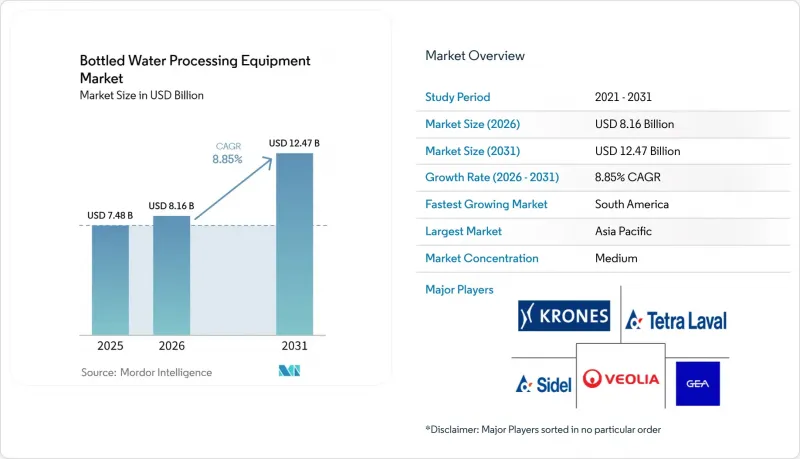
This report is Segmented by Equipment Type (Filters and Membrane Systems, Bottle Washers and Rinsers, Blow Molders, and More), Water Type (Still Water, Sparkling Water, Functional/Fortified Water, Flavored Water), Plant Capacity (30, 000 BPH), and Geography. Market Forecasts are Provided in Terms of Value (USD) and Volume (Units).
Global Bottled Water Processing Equipment Market Trends and Insights
Rising consumer shift toward still and functional bottled water
In 2025, still water's 57.45% market share highlights a significant trend: while plain hydration competes on price and convenience, premium functional variants infused with vitamins, electrolytes, or botanicals appeal to wellness-conscious consumers. Forecasted to grow at a 9.17% CAGR through 2031, the Functional/Fortified Water segment is expanding faster than the overall market. This growth stems from brands differentiating themselves in a commoditized category, enabling them to capture margins that offset rising PET costs. Achieving this differentiation requires inline homogenizers and ultra-high-temperature flash pasteurizers to stabilize heat-sensitive nutrients without compromising flavor. Alfa Laval's EnSaLine platform, introduced in 2025, features real-time viscosity and pH sensors, reducing batch rejection rates from 8% to below 2% during pilot trials by ensuring uniform electrolyte dispersion. While sparkling and flavored waters hold smaller market shares, they add complexity with the need for CO2 injection modules and flavor-dosing skids. For bottlers targeting premium segments, the requirement is clear: invest in flexible filling heads. These systems, capable of efficiently switching between still, sparkling, and fortified formats without extended changeovers, are integral to Sidel and Krones' latest Combi systems. With increasing concerns over water contamination, consumers are turning to bottled water. In 2024, UNICEF reported that over 50% of the global population lacked access to safely managed drinking water.
Stringent potable-water regulations mandating advanced filtration
In April 2024, the EPA issued a final rule on PFAS, establishing maximum contaminant levels of 4 parts per trillion for PFOA and PFOS. This regulation requires municipal suppliers and bottlers to implement either granular activated carbon or reverse osmosis systems. Public water systems have until 2029 to comply, but bottlers face immediate brand risks if third-party tests identify exceedances, as happened with several regional labels in 2025. While reverse osmosis effectively removes PFAS, it also eliminates beneficial minerals, necessitating additional remineralization stages that increase both the system's footprint and energy consumption. In 2025, DuPont introduced its IntegraTec XTP 100 IG ultrafiltration modules, which provide a 30% higher flux compared to earlier models. This innovation reduces the required membrane area and housing size without affecting throughput. At the same time, the European Union is drafting comparable PFAS regulations under a revision of the Drinking Water Directive. Member states are expected to adopt these rules by 2027, potentially aligning the replacement cycle for filtration assets across North America and Europe. This regulatory environment poses a challenge for smaller bottlers in Tier-2 markets: they must choose between investing in multi-barrier systems or exiting the market, which would consolidate their volume into larger players with the financial capacity to absorb the capital costs.
High capex for multi-barrier systems
A turnkey line that includes ultrafiltration, reverse osmosis, ozonation, UV sterilization, blow molding, aseptic filling, and secondary packaging can cost over USD 15 million for a 30,000 BPH facility. This significant investment strains the balance sheets of regional bottlers in South America and Southeast Asia. Rising interest rates through 2024-2025 have tightened financing terms, extending payback periods from 5 to 7 years and discouraging speculative capacity expansions. Premium brands continue to invest in advanced lines, while Tier-2 bottlers often choose refurbished or modular systems that trade off automation and energy efficiency. This dynamic has created a two-tier market, where value players rely on aging assets to compete on price. The high capital requirements also favor contract manufacturers, who distribute equipment costs across multiple brands. This approach is gaining traction in India and Brazil, where local entrepreneurs lack the scale to support dedicated lines. In the beverage industry, leasing and equipment-as-a-service models remain underdeveloped compared to pharmaceuticals. However, companies like Krones and Sidel have piloted output-based pricing in select markets, charging per bottle produced instead of requiring upfront capital. This model aligns incentives but depends on reliable remote monitoring to validate throughput.
Other drivers and restraints analyzed in the detailed report include:
- Replacement cycle of membrane modules in Asia's mega plants
- Shift to aseptic blow-fill-cap lines in emerging markets
- PFAS and micro-plastic compliance uncertainty
For complete list of drivers and restraints, kindly check the Table Of Contents.
Segment Analysis
In 2025, filters and membrane systems represented 32.03% of total revenues, emphasizing their critical role in removing suspended solids, microbes, and emerging contaminants. The market for bottled water processing equipment, specifically these units, reached USD 2.39 billion in 2025. North America and Europe led the market, with replacement contracts typically occurring every 24-36 months. DuPont's IntegraTec XTP 100 IG delivers a 30% increase in flux, reducing the number of modules required and lowering energy consumption, which directly cuts costs for bottlers. Filling and capping machines remain central to production lines, supported by flow-meter systems that provide +-0.2% volume accuracy for still, sparkling, and fortified water formats.
Blow molders are expected to experience the highest growth, with a projected CAGR of 9.23%. This growth is driven by on-site bottle production, which complies with recycled-content regulations and reduces transport emissions. The market share for blow molding in bottled water processing equipment is anticipated to grow from 18% in 2025 to over 22% by 2031, as high-volume plants increasingly adopt integrated blow-fill-cap combinations. Sidel's EvoBLOW Laser technology enables a 15% reduction in bottle weight while exclusively processing 100% recycled PET (rPET), resulting in material savings of 12-18 grams per bottle. Meanwhile, smaller bottlers face a strategic decision: invest in high-capex blow molders or pay a 10-15% premium on preforms, a challenge that could accelerate industry consolidation.
Geography Analysis
In 2025, Asia-Pacific contributed 37.58% of global equipment revenue, primarily driven by large-scale projects in China and India, as well as the routine replacement of membranes necessitated by brackish-water fouling cycles. A notable example is Nongfu Spring's new USD 700 million facility, which demonstrates the integration of advanced controls and consumables designed to maximize OEM lifetime value. Additionally, Southeast Asia expanded its capacity by over 15,000 BPH in 2025 by upgrading production lines that were over a decade old. These upgrades included the implementation of energy-efficient drives and sophisticated sensor systems. Meanwhile, Japan and South Korea have focused on achieving recycled-content targets by deploying specialized systems tailored for 250 ml and 330 ml bottles, which cater specifically to the needs of single-person households. The region's urbanization trends, combined with ongoing concerns about municipal water quality in developing markets, have significantly increased bottled water consumption. For instance, the World Bank reported that in 2024, 64% of the population in East Asia and the Pacific lived in urban areas, highlighting the growing demand for reliable water sources.
South America is projected to be the fastest-growing region, with a robust CAGR of 9.35% anticipated through 2031. Significant investments, such as Coca-Cola Andina's USD 500 million expenditure and Coca-Cola Femsa's BRL 380 million Crystal plant, underscore the region's shift toward advanced production technologies. These aseptic blow-fill-cap lines address cold-chain challenges while ensuring compliance with recycled-content regulations. However, currency fluctuations have complicated the costs of importing resin and machinery, prompting bottlers to increasingly rely on locally sourced rPET and modular equipment. This shift allows for greater scalability and adaptability to meet fluctuating demand.
North America and Europe, as mature markets, experience demand primarily driven by replacement needs, regulatory compliance, and sustainability initiatives. The EPA's PFAS rule has accelerated retrofits of granular activated carbon and reverse osmosis (RO) trains, with retrofit activity expected to peak between 2027 and 2028. Furthermore, legislative measures such as California's SB 54 and the EU directive are driving the adoption of integrated blow-molders and investments in optical sorting technologies. In the Middle East and Africa, the selective installation of aseptic systems is helping to bypass the need for refrigerated logistics. However, despite clear concerns over access to potable water, political instability and currency risks have hindered market penetration in countries like Nigeria and Egypt.
- Sidel
- Krones AG
- GEA Group
- Tetra Laval
- KHS GmbH
- Veolia
- Alfa Laval
- Pall Corporation
- Pentair
- Norland International
- Steelhead Inc.
- EcoPura
- SEPPA
- Aquatech International
- Dow Water and Process
- DuPont Water Solutions
- Lenntech
- Culligan
- Xylem
- 3M Purification
- Ecolab
Additional Benefits:
- The market estimate (ME) sheet in Excel format
- 3 months of analyst support
TABLE OF CONTENTS
1 INTRODUCTION
- 1.1 Study Assumptions and Market Definition
- 1.2 Scope of the Study
2 RESEARCH METHODOLOGY
3 EXECUTIVE SUMMARY
4 MARKET LANDSCAPE
- 4.1 Market Overview
- 4.2 Market Drivers
- 4.2.1 Rising consumer shift toward still and functional bottled water
- 4.2.2 Stringent potable-water regulations mandating advanced filtration
- 4.2.3 Replacement cycle of membrane modules in Asia's mega plants
- 4.2.4 Shift to aseptic blow-fill-cap lines in emerging markets
- 4.2.5 IoT-enabled predictive maintenance lowering OPEX
- 4.2.6 On-site recycled PET mandates boosting in-line bottle makers
- 4.3 Market Restraints
- 4.3.1 High capex for multi-barrier systems
- 4.3.2 PFAS and micro-plastic compliance uncertainty
- 4.3.3 Skilled-operator shortage in Tier-2 bottlers
- 4.3.4 Volatile PET resin prices pressuring margins
- 4.4 Regulatory Landscape
- 4.5 Technological Outlook
- 4.6 Porter's Five Forces
- 4.6.1 Threat of New Entrants
- 4.6.2 Bargaining Power of Buyers
- 4.6.3 Bargaining Power of Suppliers
- 4.6.4 Threat of Substitutes
- 4.6.5 Intensity of Competitive Rivalry
5 MARKET SIZE AND GROWTH FORECASTS (VALUE AND VOLUME)
- 5.1 By Equipment Type
- 5.1.1 Filters and Membrane Systems
- 5.1.2 Bottle Washers and Rinsers
- 5.1.3 Blow Molders
- 5.1.4 Filling and Capping Machines
- 5.1.5 Labelers and Shrink Wrappers
- 5.1.6 Others
- 5.2 By Water Type
- 5.2.1 Still Water
- 5.2.2 Sparkling Water
- 5.2.3 Functional/Fortified Water
- 5.2.4 Flavored Water
- 5.3 By Plant Capacity
- 5.3.1 <10,000 BPH
- 5.3.2 10,000-30,000 BPH
- 5.3.3 >30,000 BPH
- 5.4 By Geography
- 5.4.1 North America
- 5.4.1.1 United States
- 5.4.1.2 Canada
- 5.4.1.3 Mexico
- 5.4.1.4 Rest of North America
- 5.4.2 South America
- 5.4.2.1 Brazil
- 5.4.2.2 Argentina
- 5.4.2.3 Colombia
- 5.4.2.4 Chile
- 5.4.2.5 Rest of South America
- 5.4.3 Europe
- 5.4.3.1 United Kingdom
- 5.4.3.2 Germany
- 5.4.3.3 France
- 5.4.3.4 Italy
- 5.4.3.5 Spain
- 5.4.3.6 Russia
- 5.4.3.7 Sweden
- 5.4.3.8 Belgium
- 5.4.3.9 Poland
- 5.4.3.10 Netherlands
- 5.4.3.11 Rest of Europe
- 5.4.4 Asia-Pacific
- 5.4.4.1 China
- 5.4.4.2 Japan
- 5.4.4.3 India
- 5.4.4.4 Thailand
- 5.4.4.5 Singapore
- 5.4.4.6 Indonesia
- 5.4.4.7 South Korea
- 5.4.4.8 Australia
- 5.4.4.9 New Zealand
- 5.4.4.10 Rest of Asia-Pacific
- 5.4.5 Middle East and Africa
- 5.4.5.1 United Arab Emirates
- 5.4.5.2 South Africa
- 5.4.5.3 Saudi Arabia
- 5.4.5.4 Nigeria
- 5.4.5.5 Egypt
- 5.4.5.6 Morocco
- 5.4.5.7 Turkey
- 5.4.5.8 Rest of Middle East and Africa
- 5.4.1 North America
6 COMPETITIVE LANDSCAPE
- 6.1 Market Concentration
- 6.2 Strategic Moves
- 6.3 Market Share Analysis
- 6.4 Company Profiles (includes Global level Overview, Market level overview, Core Segments, Financials as available, Strategic Information, Market Rank/Share for key companies, Products and Services, and Recent Developments)
- 6.4.1 Sidel
- 6.4.2 Krones AG
- 6.4.3 GEA Group
- 6.4.4 Tetra Laval
- 6.4.5 KHS GmbH
- 6.4.6 Veolia
- 6.4.7 Alfa Laval
- 6.4.8 Pall Corporation
- 6.4.9 Pentair
- 6.4.10 Norland International
- 6.4.11 Steelhead Inc.
- 6.4.12 EcoPura
- 6.4.13 SEPPA
- 6.4.14 Aquatech International
- 6.4.15 Dow Water and Process
- 6.4.16 DuPont Water Solutions
- 6.4.17 Lenntech
- 6.4.18 Culligan
- 6.4.19 Xylem
- 6.4.20 3M Purification
- 6.4.21 Ecolab
7 MARKET OPPORTUNITIES AND FUTURE OUTLOOK

